


Why Every Business Sale Broker is Your New Best Friend
What a Business Brokerage Firm Actually Does (And Why It Matters)
A business brokerage firm is a professional intermediary that helps business owners sell their companies — handling everything from valuation and marketing to negotiations and closing.
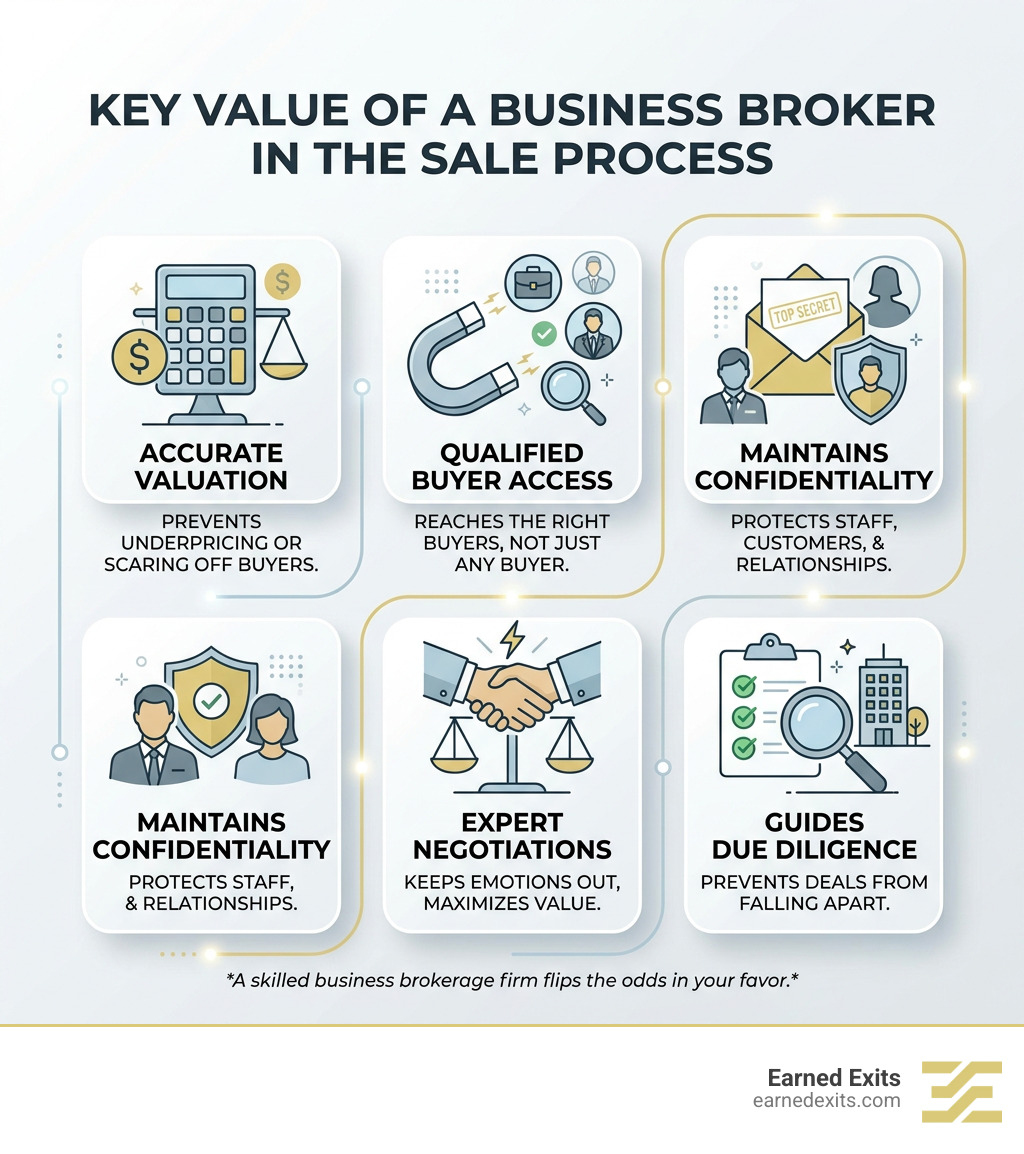
Here’s a quick breakdown of what they do and why owners hire them:
| What a Business Broker Does | Why It Matters |
|---|---|
| Values your business accurately | Prevents underpricing or scaring off buyers |
| Markets to qualified buyers | Reaches people you’d never find on your own |
| Maintains confidentiality | Protects staff, customers, and vendor relationships |
| Manages negotiations | Keeps emotions out of high-stakes conversations |
| Guides due diligence | Prevents deals from falling apart at the finish line |
Selling a business is one of the biggest financial decisions of your life. Yet most owners only do it once.
That’s a problem.
Buyers, on the other hand, often do this repeatedly. They know the process. They know what to ask for. And they know how to use your inexperience against you.
Here’s a sobering reality: fewer than 20% of private businesses listed for sale actually close. The reasons are almost always the same — poor preparation, wrong pricing, weak marketing, or inexperienced representation.
A skilled business brokerage firm flips those odds in your favor.
Whether you’re selling a Main Street shop or a $50M company, the right broker brings structure, expertise, and a network of real buyers to the table. The result? More money, fewer surprises, and a process that doesn’t consume your life.
What Defines a Top-Tier Business Brokerage Firm?

When you start looking for a partner to handle your exit, you’ll quickly realize that not every business brokerage firm is created equal. Some are “one-man bands” working out of a home office, while others are massive global networks. So, how do you tell the difference between a mediocre broker and a top-tier firm?
In our experience, it comes down to four major pillars: Experience, Reviews, Polish, and Expertise.
- Experience: This isn’t just about how many years they’ve been in business, but how many closings they’ve successfully managed. Industry veterans have seen every possible deal-killer—from last-minute financing collapses to “cold feet” from buyers—and they know how to navigate them. Some elite firms in the US have managed over $15 billion in business listings since their inception. That kind of volume builds a “muscle memory” for deals that newcomers simply don’t have.
- Reviews: Real-world feedback is the best indicator of future performance. We look for firms that have a history of satisfied clients who praise their communication and transparency. If a broker is hard to reach before you sign a contract, imagine how hard they’ll be to find when the due diligence gets tough.
- Polish: This might sound superficial, but in the digital age, “polish” matters. A firm with a streamlined, professional website and high-quality marketing materials is more likely to present your business in a way that attracts high-value buyers. If their own brand looks dated, your business listing probably will, too.
- Expertise: Does the firm understand your specific industry? Selling a SaaS company is fundamentally different from selling a construction firm or a medical practice. Top-tier firms often have specialized departments or “subject matter experts” who understand the specific valuation multiples and buyer types for your niche.
To truly understand the impact of professional help, you can read more about how a master the sale: how a business broker elevates your exit strategy to see why DIY sales often fall short.
Identifying Industry Leaders
Identifying the true leaders in the business brokerage firm space requires looking past the marketing fluff. We look for a few specific “gold standards”:
- A Proven Track Record: While the industry average for successful sales is less than 33%, the best firms often boast closing ratios significantly higher—sometimes even exceeding 90% for businesses that meet their specific criteria.
- Global and National Reach: A local broker might know the guy down the street, but a top-tier firm has a proprietary network that spans the country (and often the globe). This is crucial because the best buyer for your business in Arizona might actually be a private equity group in New York or a strategic buyer in Florida.
- Professional Designations: Look for brokers who hold credentials like the Certified Business Intermediary (CBI) or Mergers & Acquisitions Master Intermediary (M&AMI). These aren’t just alphabet soup; they require rigorous training and adherence to ethical standards.
- Specialized Niches: Some of the most successful firms focus exclusively on digital companies, while others thrive in “Main Street” businesses or the middle market (companies with $5M to $100M in revenue).
Business Brokers vs. M&A Firms: Which Partner Do You Need?
One of the most common points of confusion for business owners is the difference between a standard business broker and a sell-side M&A (Mergers and Acquisitions) firm. While they both help you sell, they operate in different worlds.
Think of it like real estate: a business broker is like a high-end residential agent, while an M&A firm is like a commercial developer handling a skyscraper deal.
| Feature | Business Brokerage Firm | Sell-Side M&A Firm |
|---|---|---|
| Target Business Size | Small to mid-sized ($100k – $5M) | Middle-market ($5M – $100M+) |
| Marketing Strategy | Public listings, local networks | Targeted outreach, private auctions |
| Buyer Types | Individual entrepreneurs, “lifestyle” buyers | Private equity, strategic corporations |
| Resources | Local market data, standard valuations | Investment bankers, deep financial modeling |
| Fee Structure | Often success-based (commission) | Retainers plus larger success fees |
If you are looking for more complex corporate transitions, you might want to explore mergers and acquisitions advisory services to see if your company fits that profile.
Advantages of Specialized Brokers
Choosing a specialized business brokerage firm can be the difference between a “sold” sign and a “withdrawn” listing.
- Small Business Specialists: If your business earns less than $1M in profit, you need a broker who understands “Main Street.” They are experts at helping individual buyers secure SBA loans and explaining the “lifestyle” benefits of your business.
- Middle-Market Experts: For businesses with $1M to $10M in owner’s profit, the buyer pool shifts to professional investors. These brokers use sophisticated financial analysis to justify higher multiples.
- Digital and Tech Brokers: Selling an e-commerce brand or a SaaS company requires a different set of metrics (like churn rate and customer acquisition cost). Specialized digital brokers have sold billions of dollars worth of online businesses and know exactly where the “digital-native” buyers hang out.
- Local Expertise: Even in a global economy, local knowledge matters for brick-and-mortar businesses. A broker who understands the specific economic trends in states like Texas, California, or Florida can better articulate the “future potential” of your location to a buyer.
Why 2025 is the “Goldilocks” Year for Your Exit
If you’ve been sitting on the fence about selling, 2025 is shaping up to be what economists call a “Goldilocks” year—not too hot, not too cold, but just right.
Why is this happening now? A few years ago, we saw the highest inflation and interest rates in over four decades. This made it incredibly difficult for buyers to get bank loans, and many sellers pulled their businesses off the market.
However, as we move through 2024 and into 2025, the landscape is shifting:
- Interest Rates are Stabilizing: As rates begin to moderate, the “cost of capital” for buyers goes down. This means they can afford to pay a higher price for your business because their monthly loan payments are lower.
- The “Silver Tsunami”: Thousands of Baby Boomer business owners are reaching retirement age simultaneously. This is creating a massive but orderly market.
- Economic Growth: With inflation coming under control, buyers are feeling more optimistic about the future. They aren’t just looking for a “job”—they are looking for profitable growth.
If you are contemplating an exit, now is the time to sell my business while the economic window is wide open.
How Professional Intermediaries Maximize Your Sale Price
A common mistake owners make is thinking they can just “list it and they will come.” In reality, a business brokerage firm uses a very specific set of tools to drive up your valuation.
The Core Services of a Business Brokerage Firm
The foundation of any good sale is a rock-solid valuation. You can’t just pick a number out of a hat. Top firms utilize:
- Business Valuation: Professional appraisers use proven methods that often adhere to USPAP (Uniform Standards of Professional Appraisal Practice) standards. This ensures the valuation is defendable when the buyer’s bank or accountant looks at it.
- SDE (Seller’s Discretionary Earnings): This is a critical metric for small to mid-sized businesses. A broker knows how to “add back” expenses like your personal health insurance, one-off repairs, or non-essential travel to show the true earning power of the business.
- M&A Advisory: Beyond just finding a buyer, a firm acts as a consultant, helping you clean up your books and operations before you go to market.
- Sale Facilitation: They handle the “paperwork mountain,” from the initial Letter of Intent (LOI) to the final purchase agreement.
If you are in the Western US, you can Find Certified Business Brokers in California or utilize national business valuation services to get an accurate starting point.
Navigating the Sales Process with a Business Brokerage Firm
The process used by professional intermediaries is designed to create competition. When multiple buyers are interested, you get a higher price and better terms.
- Exit Planning: This should ideally start 1-2 years before the sale. It involves making the business “transferable”—ensuring it can run without you.
- Proprietary Networks: Top firms don’t just put a listing on a public website. They have “black books” of private equity groups, high-net-worth individuals, and strategic buyers who have already told the broker, “I’m looking for a HVAC company in Georgia with $2M in revenue.”
- Targeted Outreach and Auctions: For larger deals, a business brokerage firm might run a “controlled auction,” inviting a select group of qualified buyers to submit bids by a certain date.
- Closing Ratios: While the industry average for sales is low, a professional process can lead to a 90%+ success rate.
Before you jump in, make sure you know the business broker definition and track record of who you’re hiring, and prepare your list of 10 questions to ask a business broker to ensure they are the right fit for your goals.
Frequently Asked Questions
How do brokers protect my company’s confidentiality?
This is the #1 concern for most owners. If your employees, customers, or competitors find out you’re selling, it can damage the business before the deal is even done. A professional business brokerage firm protects you by:
- Using NDAs: Every potential buyer must sign a legally binding Non-Disclosure Agreement before seeing any sensitive info.
- Blind Profiles: They market your business using a “teaser” that describes the industry and financial highlights without revealing the name or exact location.
- Secure Data Rooms: Financial documents are kept in encrypted digital vaults where access is monitored and restricted.
Why do only 20% of businesses usually sell?
It’s a shocking statistic, but it’s true. The failures usually fall into three buckets:
- Pricing Greed: The owner insists on a “legacy price” that the numbers simply don’t support.
- Poor Financials: If a buyer (or their bank) can’t verify your income through clean tax returns and P&Ls, they will walk away every time.
- Inexperienced Representation: Many businesses are listed by “generalist” agents who don’t know how to package a company or vet buyers properly.
How should I prepare my company for a 2025 sale?
Preparation is the key to being in that successful 20% group.
- Clean Up the Books: Stop running personal expenses through the business. You want your tax returns to show as much profit as possible.
- Build Management Depth: If the business dies the day you leave, it’s not a business—it’s a job. Buyers want to see a team that can handle daily operations.
- Operational Efficiency: Document your processes. A “manual” for how the business runs makes a buyer feel much more secure.
Conclusion
At Earned Exits, we believe that selling your business shouldn’t be a source of stress—it should be a celebration of your hard work. Our mission is to provide a seamless, organized process that keeps you in the loop every step of the way.
We pride ourselves on excellent communication and thorough support. Whether it’s our deep-dive CFO and due diligence support or our suite of client tools designed for maximum efficiency, we make sure you have everything you need to cross the finish line. We operate across the United States, from Alabama to Washington, ensuring that whether you are in a major hub like Dallas or a smaller market in Kansas, you have world-class representation.
If you’re ready to see what your hard work is truly worth, explore our business brokerage services today. Let’s make your exit the success story it deserves to be.
