


What Does It Really Take to Sell a Business in the Lone Star State?
A Clear Path to Selling Your Texas Business
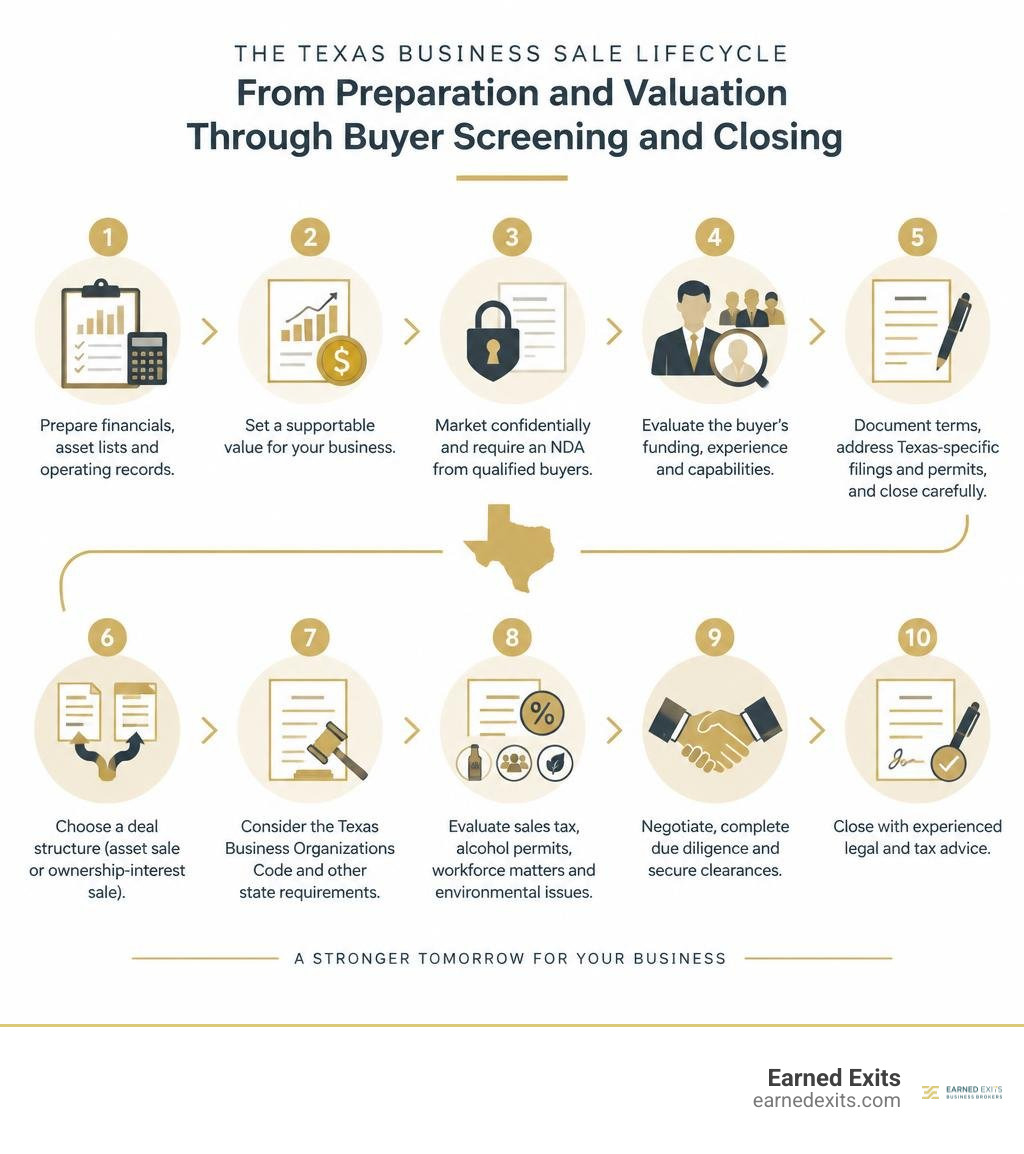
To learn how to sell a business in Texas, start by getting your financial records in order, estimating a realistic value, protecting sensitive information, and screening buyers before sharing detailed business data. Then choose a deal structure, negotiate a letter of intent and purchase agreement, complete due diligence, secure needed tax and regulatory clearances, and close with experienced legal and tax advice.
The process can feel overwhelming the first time. But it becomes far more manageable when you handle it in the right order:
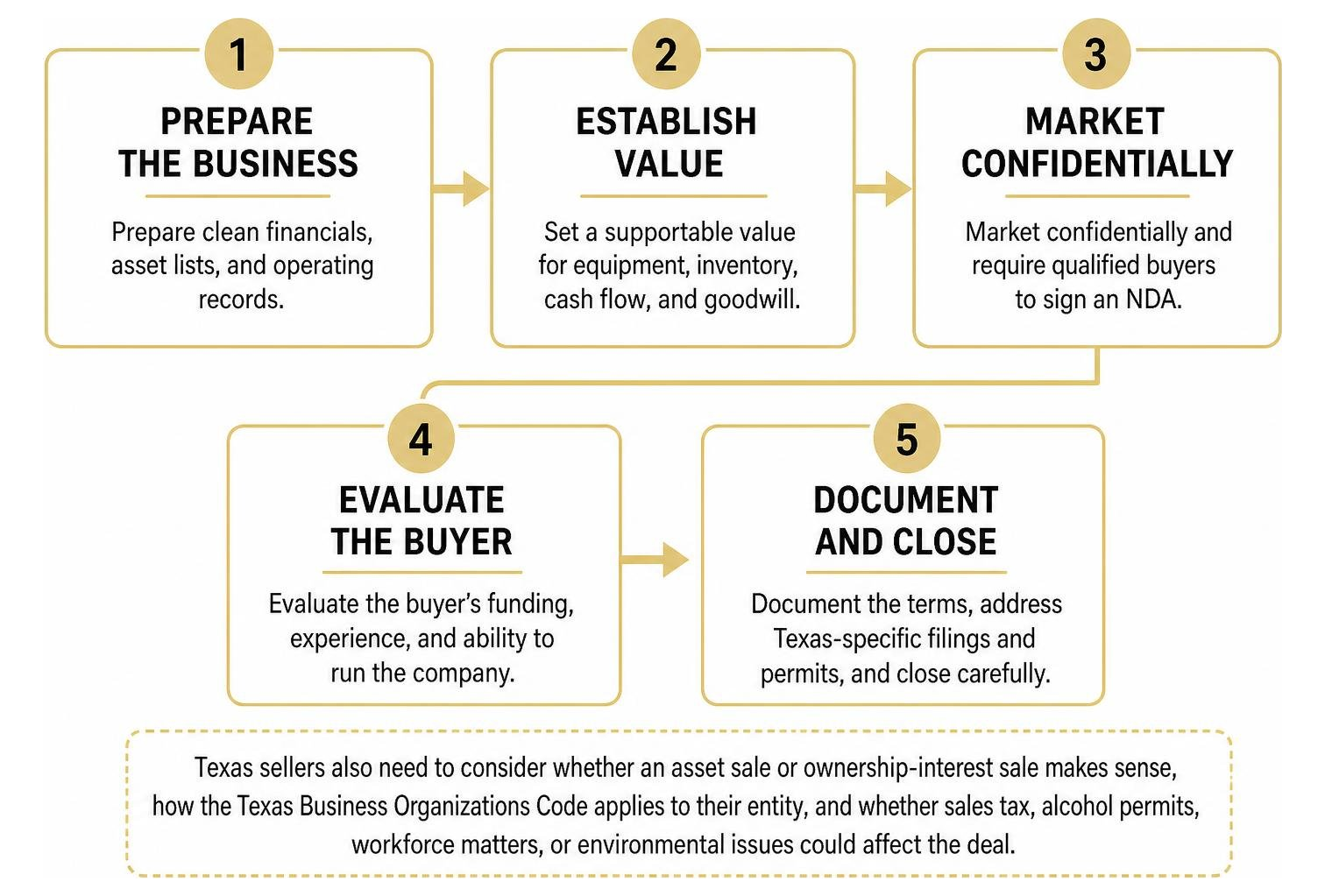
- Prepare clean financials, asset lists, and operating records.
- Set a supportable value for equipment, inventory, cash flow, and goodwill.
- Market confidentially and require qualified buyers to sign an NDA.
- Evaluate the buyer’s funding, experience, and ability to run the company.
- Document the terms, address Texas-specific filings and permits, and close carefully.
Texas sellers also need to consider whether an asset sale or ownership-interest sale makes sense, how the Texas Business Organizations Code applies to their entity, and whether sales tax, alcohol permits, workforce matters, or environmental issues could affect the deal.
I am Britt Clas, a business broker and partner at Earned Exits, where I help owners navigate how to sell a business in Texas and other markets through valuation, buyer outreach, negotiations, diligence, and transition planning. My work centers on helping founders pursue not only a strong price, but also a buyer and deal structure that fit their employees, customers, and legacy.
Complete Step-by-Step Guide: How to Sell a Business in Texas
Selling a company in the Lone Star State involves more than shaking hands over barbecue and signing a bill of sale. Between dynamic metropolitan hubs like Austin, Dallas, and Houston, and industrial powerhouses across West Texas, the state offers an incredible buyer market. However, realizing top value requires a systematic process that aligns financial hygiene, statutory compliance, and rigorous deal execution.
Executing a smooth transaction requires disciplined pre-sale preparation, aggressive buyer qualification, accurate asset valuation, and tight management of legal liabilities. Following proven steps for a smooth exit prevents deal fatigue and ensures you walk away from the closing table with your net proceeds fully intact.
Pre-Sale Preparation and Managing Unsolicited Offers
The strongest exits begin twelve to twenty-four months before going to market. Pre-sale preparation starts with an honest financial audit. Most closely held businesses operate to minimize income taxes, utilizing owner perks, family payroll, and non-operational write-offs. To present a clear picture to buyers and lenders, we reconstruct your historical income statements through a rigorous schedule of discretionary earnings add-backs (Seller’s Discretionary Earnings or adjusted EBITDA).
Unsolicited acquisition inquiries require careful handling. When a competitor, private equity group, or individual buyer reaches out out of the blue, it is tempting to jump into casual talks. Doing so without preparation puts you at a severe disadvantage. Unsolicited buyers rarely offer maximum market value because they face no competitive pressure.
When fielding an unsolicited inquiry:
- Avoid sharing unredacted financial reports or operational metrics.
- Politely direct the party to your advisory team or request a formal, non-binding expression of interest alongside proof of funds.
- Conduct an independent market analysis before entering proprietary discussions to establish your baseline enterprise value.
- Partner with financial specialists; utilizing experienced CFO support to maximize business valuation ensures your normalized earnings and growth projections withstand intense scrutiny.
Protecting Confidentiality and Sourcing Qualified Buyers
Confidentiality leaks can damage customer relationships, spook key employees, and give competitors an unfair edge. A structured sales campaign keeps your identity hidden while presenting compelling operational highlights through a blind profile or Confidential Information Memorandum (CIM).

Before releasing any identifying information, every prospective acquirer must execute a tailored non-disclosure agreement (such as a standard Texas Form 9:30 Confidentiality Agreement).
Crucial safeguards to protect your enterprise include:
- Protecting Customer and Vendor Lists: Never disclose exact customer names, pricing matrices, or critical vendor agreements during initial meetings. Mask customer identities using descriptors (e.g., “Client A: 14% of annual revenue”) until late-stage due diligence.
- Tiered Information Access: Stage disclosures across sequential phases. Provide high-level operational summaries first, moving into detailed operational records only after executing a formal Letter of Intent (LOI).
- Vetting Buyer Financials: Sourcing the right acquirer means filtering out “tire-kickers.” Demand verifiable proof of funds, lending pre-qualification letters, and a thorough review of the buyer’s operational background before granting access to your digital data room.
- Targeted Outreach: Partnering with an advisor or hiring an experienced business broker enables you to run a confidential, competitive auction among pre-vetted strategic and financial buyers across Texas and nationwide, preserving operational secrecy while driving up final sale multiples.
Valuing Assets, Goodwill, and Financials for an Exit
Accurately pricing a business requires decoupling emotional attachment from market realities. Buyers acquire future cash flows and the tangible assets required to generate those earnings. Arriving at an accurate valuation requires a detailed breakdown of tangible assets, operating working capital, and enterprise goodwill.
Valuation Fundamentals: How to Sell a Business in Texas for Maximum Value
In Texas, small to mid-market deals are typically priced off multiples of Seller’s Discretionary Earnings (SDE) for owner-operator businesses or adjusted EBITDA for mid-sized enterprises. However, the headline multiple is only part of the equation:
- Equipment and Tangible Asset Appraisals: Heavy machinery, vehicle fleets, and specialized technology must be inventoried and appraised based on Orderly Liquidation Value (OLV) or Fair Market Value (FMV). In asset-heavy sectors, getting an accurate asset valuation is essential for both price justification and the buyer’s collateral underwriting.
- Inventory Accounting: Inventory should be valued at the lower of cost or net realizable value, excluding obsolete, slow-moving, or damaged stock.
- Enterprise vs. Personal Goodwill: Allocating value to enterprise goodwill (the brand, operational systems, recurring customer contracts, and assembled workforce) rather than personal goodwill (the owner’s personal relationships) is critical. If the business cannot operate profitably without you in the building, buyers will discount the multiple.
To position your company effectively, apply a proven, comprehensive valuation methodology that aligns your balance sheet with current industry multiples, ensuring you succeed in selling your Texas company for top dollar.
Managing Buyer Due Diligence and Quality of Earnings
Due diligence is the buyer’s opportunity to confirm that the financial, legal, and operational narrative presented in marketing materials matches reality. Unprepared sellers often stumble here, leading to price renegotiations (retrades) or deal failure.
To run an organized due diligence process:
- Historical Financial Reconciliation: Provide three to five years of federal tax returns, audited or reviewed balance sheets, profit-and-loss statements, and cash-flow statements that reconcile cleanly to bank deposits.
- Customer Concentration Audits: Buyers assess the risk of customer concentration. If any single customer accounts for more than 15% to 20% of your total revenue, prepare retention strategies, long-term contracts, and diversification data to mitigate perceived buyer risk.
- Facility and Physical Inspections: Ensure commercial real estate leases have adequate renewal terms remaining and that physical facilities pass structural, electrical, and zoning code checks.
- Proactive Diligence Preparation: Preparing a comprehensive sell-side package by mastering the due diligence process before going to market minimizes surprises and significantly accelerates your closing timeline.
Navigating Texas Regulatory Compliance and Legal Documentation
Texas offers a pro-business environment, but corporate transactions remain governed by strict legal frameworks and regulatory requirements. Overlooking state filings or contract warranties can lead to post-closing liabilities.
Essential Legal Framework: How to Sell a Business in Texas Under the BOC
The Texas Business Organizations Code (BOC) governs domestic business entities, including corporations, LLCs, and partnerships. Effective January 1, 2006, the BOC consolidated eleven prior entity-specific statutes (such as the Texas Business Corporation Act and the Texas Revised Limited Partnership Act). While all Texas entities formed after January 1, 2006, automatically fall under the BOC, businesses formed prior to that date were required to transition their governing documents to BOC standards by January 1, 2010.
A standard Texas transaction utilizes standardized legal forms and contracts, including:
- Form 9:10 (Client Intake / Transaction Scoping): Identifies entity ownership structures, identifies potential shareholder conflicts, and confirms corporate authority to sell.
- Form 9:20 (Letter of Intent – LOI): Establishes the deal structure, purchase price, working capital targets, exclusivity periods, and financing contingencies.
- Form 9:40 (Access and Indemnity Agreement): Protects the seller when the buyer accesses the physical facility, equipment, and sensitive corporate records during diligence.
- Form 9:120 (Texas Transaction Due Diligence Checklist): A comprehensive checklist covering organizational records, UCC lien searches, minute books, capitalization tables, and regulatory permits.
For detailed analysis on standard legal documentation across jurisdictions, sellers can consult foundational legal overviews on buying and selling a small business as well as broad state guides regarding the primary legal aspects of buying and selling a business.
State Permits, Environmental Audits, and Tax Clearances
Closing a deal in Texas requires interacting with several state-level regulatory agencies:
- Texas Alcoholic Beverage Commission (TABC): TABC permits do not transfer automatically. A buyer must submit an original application for an alcohol license, which can take 60 to 90 days. Transaction contracts must account for this timeline using management agreements or closing escrows.
- Texas Workforce Commission (TWC): Under the Texas Unemployment Compensation Act, an acquirer who purchases an existing business or its assets may acquire the seller’s experience rating. Sellers must obtain an official TWC Status Report to settle outstanding unemployment tax balances and transfer account status properly.
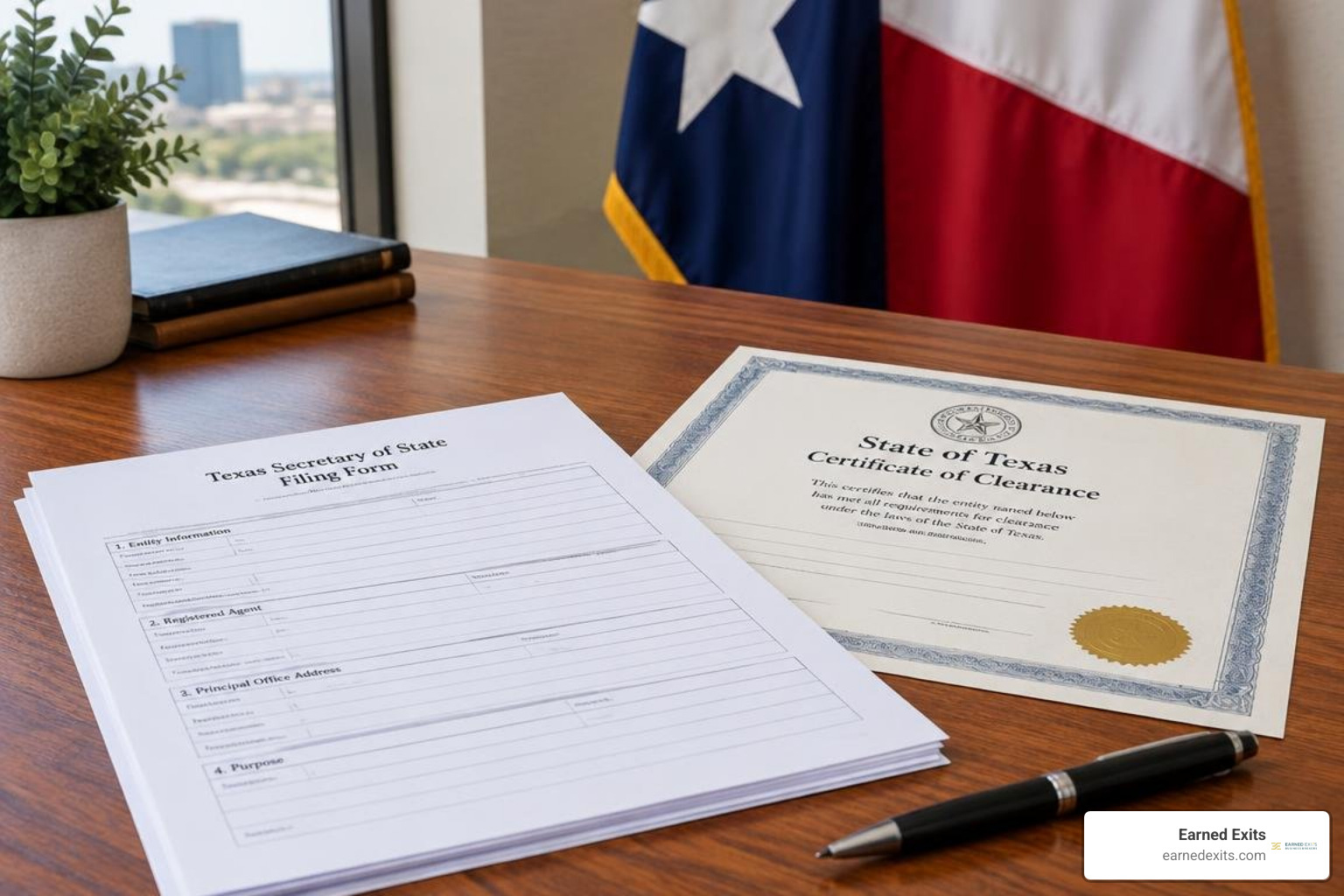
- Texas Comptroller Sales Tax Clearance: Texas Tax Code § 111.020 imposes strict successor liability on business purchasers. If a seller owes delinquent sales and use tax, the buyer must withhold a sufficient portion of the purchase price to cover the liability until the seller produces a Certificate of No Tax Due from the Texas Comptroller of Public Accounts.
- Environmental Liabilities: In industrial, commercial, automotive, and manufacturing sectors, buyers often require a Phase I Environmental Site Assessment (ESA). Sellers must navigate indemnity clauses and representations regarding environmental condition warranties (e.g., Texas Commission on Environmental Quality regulations).
Structuring the Deal: Asset Sales, Stock Transfers, and Seller Financing
Choosing how to structure your transaction is as important as the purchase price itself. The structure determines tax liabilities, contract assignability, and long-term legal exposure.
| Deal Element | Asset Sale | Stock / Equity Sale |
|---|---|---|
| What is Transferred | Specified assets, equipment, inventory, and goodwill | Entire legal entity, including all assets and liabilities |
| Buyer Preference | High: Allows asset basis step-up (depreciation write-offs) and avoids unknown liabilities | Low: Inherits historical operational, tax, and legal liabilities |
| Seller Tax Impact | Potential depreciation recapture (taxed at ordinary income rates) plus capital gains | Generally qualifies for lower long-term capital gains tax treatment |
| Contract Assignability | Requires individual assignments of customer, vendor, and lease agreements | Contracts generally remain intact within the legal entity |
| Entity Governance | Approvals guided by the BOC based on asset disposition thresholds | Governed by shareholder/operating agreements and BOC equity transfer rules |
Understanding entity-specific considerations under Texas law is vital:
- Sole Proprietorships: Since there is no distinct corporate entity, the transaction is treated purely as an individual asset-by-asset sale. Each asset classification (equipment, inventory, non-compete agreements, enterprise goodwill) must be reported separately on IRS Form 8594.
- Partnerships: General and limited partnerships must comply with the partnership agreement regarding dissolution, capital account reconciliations, and partner consent before liquidating or transferring partnership assets.
- Professional Practices: Medical, dental, legal, CPA, and veterinary practices in Texas face strict regulatory ownership constraints (e.g., the Corporate Practice of Medicine doctrine). Acquirers must possess the required Texas professional licensure or utilize structured Management Services Organization (MSO) frameworks.
- Corporations and LLCs: S-corporations and C-corporations require formal board resolutions and shareholder approval according to their bylaws and the Texas Business Organizations Code.
Every transaction requires a well-drafted purchase agreement; reviewing business sale contract essentials helps protect your interests throughout the closing process.
Seller Financing and Assessing Buyer Solvency
In today’s M&A landscape, all-cash deals are rare in the lower-to-middle market. Buyers and Small Business Administration (SBA) lenders frequently ask sellers to carry a promissory note (typically 10% to 30% of the enterprise value) to bridge valuation gaps and demonstrate confidence in the business’s future performance.
Carrying a note turns you into a lender, making buyer solvency assessment vital:
- Credit and Net Worth Verification: Obtain a comprehensive personal financial statement (PFS), pull personal and corporate credit reports, and review liquidity reserves.
- Managerial Experience: A buyer with deep capital but zero industry experience represents a default risk. Vet their operational background, leadership track record, and specific plan to run the business.
- Security Instruments and Personal Guarantees: Never issue an unsecured promissory note. Secure the loan with a UCC-1 financing statement granting a lien over the business assets, require a personal guarantee backed by the buyer (and spouse, where applicable), and retain stock pledge agreements.
- Alternative Performance Structures: If you and the buyer disagree on future growth projections, evaluate alternative earnout arrangements. Applying best practices for structuring and negotiating earnouts helps bridge valuation differences while establishing clear, enforceable performance metrics.
Frequently Asked Questions About Selling a Texas Business
How long does the process of selling a business in Texas typically take?
The average business sale in Texas takes six to nine months from initial engagement to closing. Highly organized businesses with clean, reviewed financials, defensible add-backs, and low customer concentration can close in four to six months. Transactions involving complex SBA 7(a) loan packaging, TABC permit transfers, or Phase I environmental reports typically require eight to twelve months.
Do I need a sales tax clearance certificate from the Texas Comptroller before closing?
Yes. Under Texas Tax Code § 111.020, if you sell your business or stock of goods, the purchaser must withhold enough of the purchase money to cover any unpaid sales and use taxes until you provide an official Certificate of No Tax Due issued by the Texas Comptroller. If this certificate is not obtained prior to closing, the buyer becomes personally liable for your unpaid state sales taxes, which frequently leads buyers to demand substantial escrow holdbacks at closing.
How does entity structure impact the sale under the Texas Business Organizations Code?
Your entity type dictates the required approval thresholds, transfer mechanisms, and dissolution procedures. Under the BOC:
- An LLC sale requires compliance with the company agreement regarding the transfer of membership units and assignment of management rights.
- A corporation requires formal board adoption and shareholder voting thresholds (typically a two-thirds majority for fundamental business transactions, unless altered by the Certificate of Formation).
- Pre-2006 entities that failed to transition their filings to the BOC must resolve organizational documentation to avoid title, authority, and closing delays.
Conclusion
Selling a business in Texas represents the culmination of years of hard work, financial investment, and personal sacrifice. Achieving an exceptional outcome requires deliberate preparation: organizing normalized financial records, implementing confidentiality protections, setting an accurate enterprise valuation, and navigating Texas-specific regulatory frameworks under the Texas Business Organizations Code.
At Earned Exits, we guide founders through every step of this process. From initial valuation and digital data room management to aggressive buyer vetting, deal structuring, and final closing, our team provides the CFO-level support and hands-on guidance necessary to secure the transaction you deserve.
When you are ready to explore your options, reach out to our team for professional sell-side advisory services to maximize your enterprise value and achieve a smooth exit.
