


Ultimate Guide to Sales Process Stages
Why Understanding the Stages in the Selling Process Can Make or Break Your Deal
Understanding the stages in the selling process is the difference between a deal that closes smoothly and one that stalls, falls apart, or leaves money on the table.
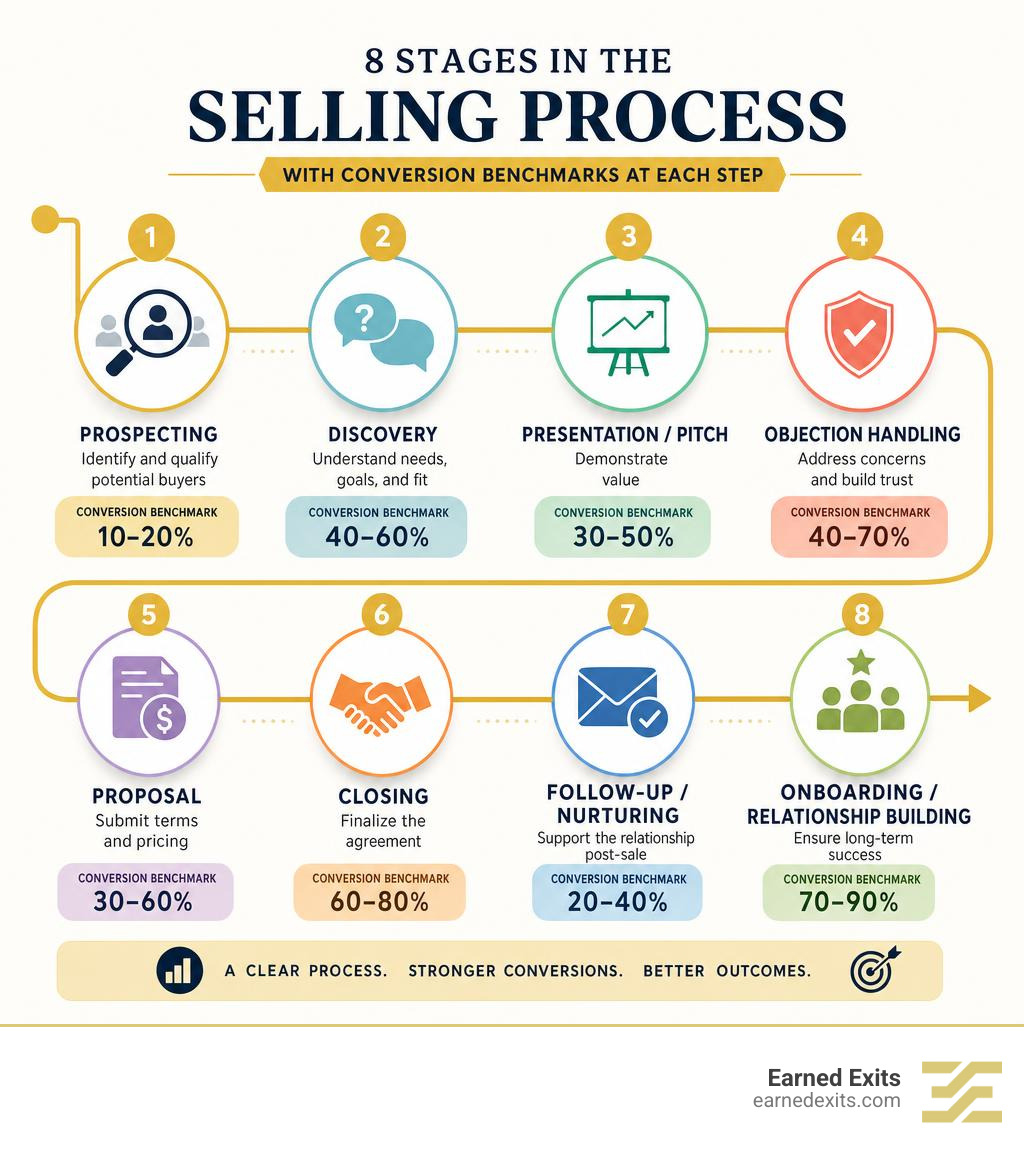
Here’s a quick look at the core stages most modern sales frameworks follow:
- Prospecting – Identify and qualify potential buyers
- Discovery – Understand needs, goals, and fit
- Presentation/Pitch – Demonstrate value
- Objection Handling – Address concerns and build trust
- Proposal – Submit terms and pricing
- Closing – Finalize the agreement
- Follow-Up / Nurturing – Support the relationship post-sale
- Onboarding / Relationship Building – Ensure long-term success
Most frameworks include 7 to 8 stages. The exact number depends on your industry, deal complexity, and how much weight you put on post-sale activities.
Whether you’re selling a SaaS product or a privately held business, the same core truth applies: a clear, repeatable process leads to better outcomes. Without one, deals get disorganized, buyers lose confidence, and opportunities slip away.
The numbers back this up. Top-performing sales organizations are 588% more likely to follow a defined methodology than low performers. And responding to a lead within one minute can increase conversion rates by up to 391%. Process isn’t just structure — it’s a competitive advantage.
For first-time sellers especially, knowing what comes next removes the anxiety of the unknown. It gives you a map when the terrain feels unfamiliar.
I’m Britt Clas, a Business Broker and Partner at Earned Exits, where I’ve guided entrepreneurs through every one of the stages in the selling process — from initial valuation and buyer outreach to negotiation, due diligence, and closing. In the sections below, I’ll walk you through each stage in plain language so you know exactly what to expect and how to prepare.
What is the Selling Process?
To build a high-performing sales engine, we must first understand what the selling process actually is—and what it isn’t. It is incredibly common for business owners and sales reps alike to use terms like “sales process,” “sales methodology,” and “sales cycle” interchangeably. However, conflating these concepts is like confusing a road trip’s route with the car you drive and the speed limit on the highway.
A sales process is a structured, repeatable series of sequential steps that a sales team follows to turn a cold prospect into a paying customer. It is the tactical map that details the exact “what” of a deal’s progression.
By contrast, a sales methodology is the philosophical framework or the “how” behind those steps. For example, while your sales process might dictate that you must conduct a discovery call (the “what”), your chosen methodology—such as Challenger Selling, Consultative Selling, or MEDDIC—dictates how your reps ask questions and position value during that call.
Finally, the sales cycle represents the time-based journey of a deal. It measures the duration it takes for a prospect to move from the first meaningful touchpoint to a closed-won status.
To help visualize these crucial differences and build true pipeline predictability, we have broken down these definitions below:
| Feature | Sales Process | Sales Methodology | Sales Cycle |
|---|---|---|---|
| Definition | The structured, step-by-step formula representing your pipeline stages. | The tactical approach or communication philosophy used to execute each step. | The time-bound journey from first contact to a signed contract. |
| Focus | What steps to take to move a deal forward. | How to interact, ask questions, and handle objections. | How long a deal takes to progress through the pipeline. |
| Example | Prospecting $\rightarrow$ Discovery $\rightarrow$ Pitch $\rightarrow$ Close. | SPIN Selling, MEDDIC, Consultative Selling. | An average B2B sales cycle of 75 days. |
| Primary Goal | Consistency, repeatability, and identifying funnel bottlenecks. | Improving rep skills, communication quality, and win rates. | Measuring pipeline velocity and forecasting revenue. |
Having a standardized, repeatable process is what turns guesswork into predictable revenue. When everyone on our team follows the same blueprint, we can quickly identify where deals are stalling. If we notice that our opportunities are dropping off heavily between the pitch and the proposal, we do not have to guess what is broken; we can laser-focus our coaching on improving our presentation and qualification stages.
To dive deeper into how time-based deal progression operates, you can learn more about the 7 critical stages of a sales cycle.
The Core Stages in the Selling Process
When we look at how businesses successfully transact, the most effective frameworks rely on a structured, 8-stage sales framework. This systematic approach ensures that every deal moves forward with clear intent, preventing reps from rushing to close before they have built consensus or established value.
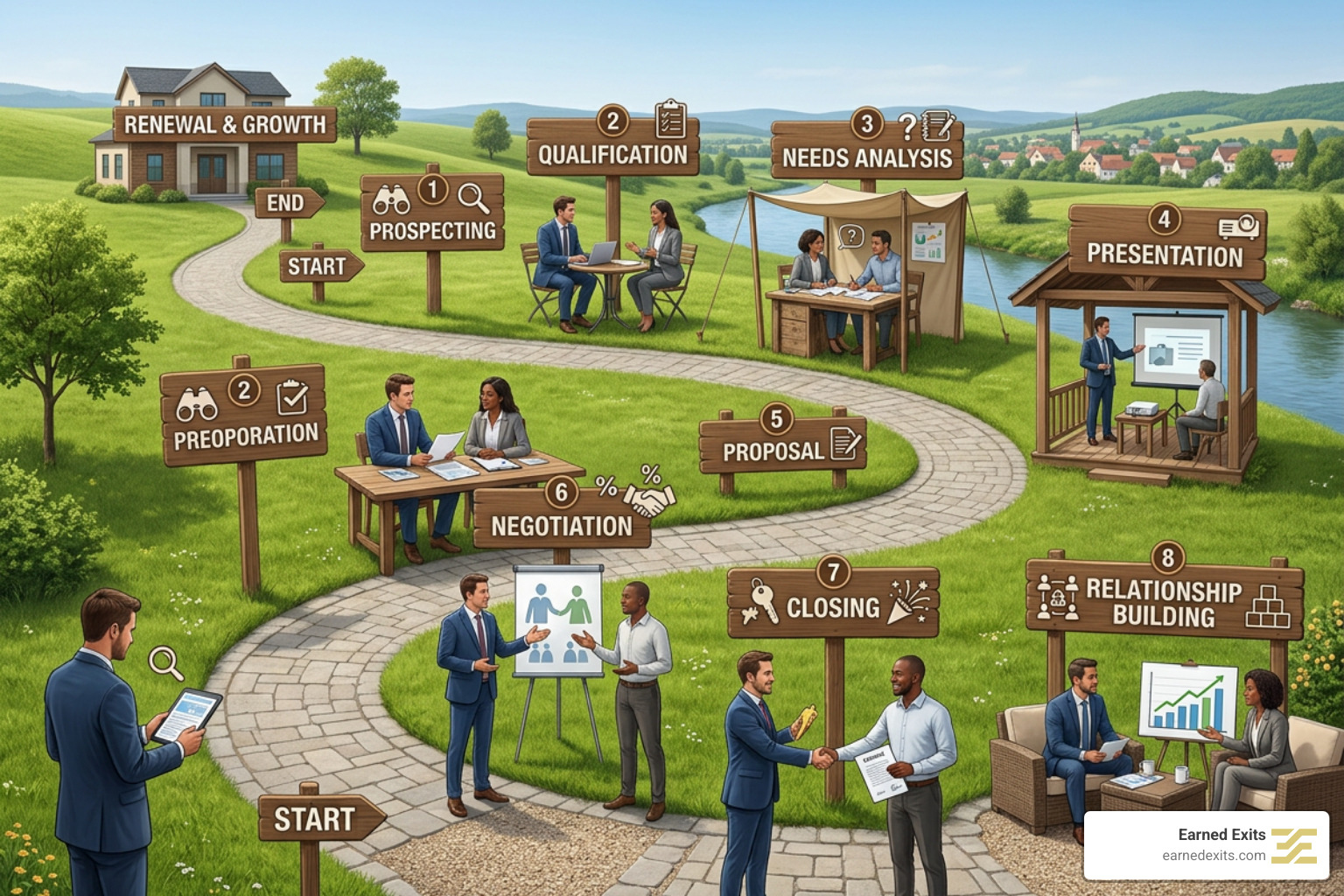
In any high-performing system, each stage has one job, and one job only. To keep the pipeline moving smoothly, we must establish strict exit criteria for every phase. Exit criteria are the specific, verifiable actions that must occur before a deal can be moved to the next step. For example, a deal should never move from “Discovery” to “Pitch” until the prospect has explicitly confirmed their budget, timeline, and primary pain points.
By enforcing these boundaries, we protect our team’s most valuable asset: their time. We prevent reps from building custom proposals for unqualified leads who do not have the authority or budget to buy. This discipline directly impacts pipeline velocity—the metric that measures how fast deals move through our funnel and how much revenue we can expect to generate in a given timeframe.
Standardizing these stages is highly effective across all industries. While the specific activities may change, the underlying psychology remains identical whether you are selling enterprise software, looking at the steps for selling a house in California, or preparing to list a commercial property. To understand how these foundational steps apply to professional careers and general business transactions, you can read the complete guide to the 7-step selling process.
Let’s explore the core stages of this process in detail, starting from the very beginning.
Prospecting and Qualifying: The First Stages in the Selling Process
Prospecting is often cited as the most challenging part of the entire sales journey. In fact, 42% of salespeople state that finding the right prospects is the single hardest part of their job.
The goal of this stage is to identify potential buyers who match our Ideal Customer Profile (ICP). Rather than casting an incredibly wide net and hoping for the best, high-performing teams focus on relevance and precision.
To execute this stage successfully, we must combine outbound lead generation—such as cold calling (which carries an average success rate of 2.3%) and cold emailing (which averages a 5.8% reply rate)—with modern sales force automation (SFA) software. SFA and CRM tools allow us to build highly targeted databases, track outreach attempts, and automatically qualify leads based on intent data and firmographic fit.
If you are preparing to sell a business rather than a traditional product, this initial stage is all about internal preparation and identifying the right type of buyer. Before reaching out to anyone, you need to make sure your internal house is in order. We highly recommend reviewing this comprehensive checklist for preparing your business for sale to ensure your financials, operations, and documentation are ready for scrutiny.
For those operating under specific regional regulations, such as business owners in Alabama, it is also wise to understand the legal and logistical steps required by checking resources like the essential steps to take when selling a business.
Discovery and Preparation
Once a lead is qualified, we enter the Discovery and Preparation stage. This is where we conduct thorough pre-approach research. We analyze the prospect’s industry, company size, growth trajectory, and pain points before we ever hop on a phone call.
By leveraging detailed buyer personas and CRM data, we can craft highly personalized, relevant conversations. During the discovery call itself, our goal is not to sell; it is to listen. We ask open-ended qualifying questions to uncover the prospect’s true operational challenges, decision-making committee, and budget constraints.
When we apply this to the M&A and business brokerage world, preparation looks like creating a compelling narrative for your business while protecting your sensitive data. You cannot just put your company’s name on a public billboard. Instead, you must learn how to market your business effectively while maintaining complete discretion.
To do this successfully, we rely on two critical components:
- The CIM: We package your business’s financials, operations, and growth opportunities into a comprehensive prospectus. You can learn how to build one in The Insider’s Guide to the CIM (Confidential Info Memo).
- Confidentiality Protocols: To prevent competitors, employees, and customers from finding out about a potential sale prematurely, we enforce strict non-disclosure agreements. Discover how we protect your brand in The Art of Confidentiality: Protecting Your Business During the Sale Process.
The Pitch and Handling Objections
Once we have fully diagnosed the prospect’s challenges, we are ready to present our solution. This is the pitch or product demonstration.
A great pitch is never a generic slide deck. It must be directly tailored to the specific pain points uncovered during the discovery phase. We must clearly articulate our unique value proposition, showing the prospect exactly how their life or business will improve after purchasing our solution.
However, even the most perfect pitches will face resistance. Objection handling is a natural and healthy part of the selling process. When a prospect raises a concern about price, implementation, or features, they are actually showing engagement.
To handle these effectively, sales teams should use structured objection playbooks and practice active listening. Rather than immediately defending the product, we validate the prospect’s concern, ask clarifying questions, and present evidence—such as case studies or data—to ease their mind.
If you are selling a business, this stage is incredibly dynamic. It involves presenting your company’s historical performance and future potential to sophisticated buyers. To master this high-stakes environment, check out our guide on mastering the sales pitch.
Additionally, navigating these conversations often requires a delicate balance of negotiation skills. You can learn how to manage these interactions by reading about mastering the Negotiate Business Sale Broker Dance.
Closing and Nurturing: Final Stages in the Selling Process
The closing stage is where all of our hard work pays off. In traditional sales, this involves sending a formal proposal, tracking proposal engagement metrics (such as how long the prospect spends reviewing the pricing page), and entering final contract negotiations.
Once the contract is signed, the sales process does not stop. We must seamlessly hand the new customer over to our customer success or onboarding team. This ensures a fantastic initial experience, which directly impacts customer lifetime value (CLV) and opens the door for future upsells and referrals.
When selling an entire business, the closing and post-closing stages are highly complex, requiring meticulous legal and operational coordination.
To navigate this successfully, you must master several steps:
- Evaluating Offers: You must know how to separate serious buyers from tire-kickers. Learn more by reading Sealing the Deal: A Guide to Evaluating Offers When Selling Your Business.
- Drafting the Contract: The legal transfer of an entity requires watertight documentation. Explore our resources on The Essential Business Sale Contract Template and Legal Guide.
- Post-Sale Handover: A messy transition can lead to legal disputes or earn-out failures. We help ensure everything goes smoothly by teaching you the best practices for ensuring a smooth transition post-sale.
Mapping the Sales Process to the Buyer’s Journey
A common mistake many organizations make is designing a sales process that only serves the seller’s internal reporting needs. If your process forces a prospect to watch a product demo before they even understand if your software solves their problem, you are creating massive friction.
To maximize conversions, we must map our sales process directly to the buyer’s journey.
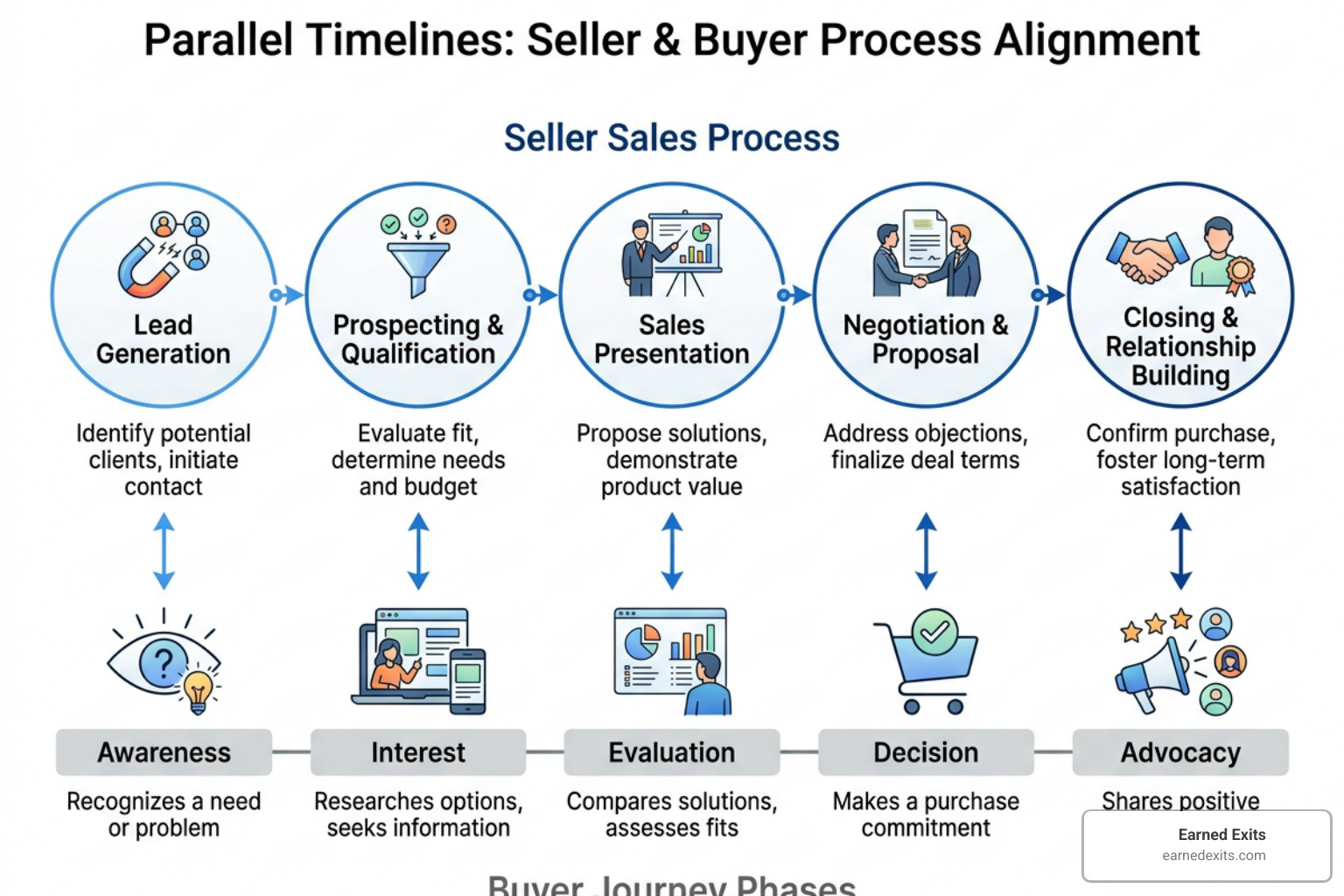
The buyer’s journey is the cognitive path a prospect takes, moving from completely unaware of a problem to actively choosing a vendor. By aligning our internal sales stages with their external buying steps, we can deliver the exact right information at the exact right time.
For example, during the buyer’s “Awareness” phase, our sales team should focus purely on educational content and prospecting. During their “Consideration” phase, we should provide deep-dive discovery and tailored demos. During their “Decision” phase, we support them with case studies, security documentation, and transparent proposal terms.
Understanding this dual perspective is essential for keeping deals moving. To see a detailed comparison of how these stages align, you can explore the 6 stages of the sales process from buyer and seller perspectives.
Frequently Asked Questions about Sales Stages
What is the difference between a sales process and a sales methodology?
The sales process is the “what”—the specific, sequential stages a deal moves through from first contact to a closed contract (e.g., Prospecting $\rightarrow$ Discovery $\rightarrow$ Proposal $\rightarrow$ Close).
The sales methodology is the “how”—the tactical execution framework and communication style your reps use to move a deal from one stage to the next. Common methodologies include consultative selling, SPIN selling, and MEDDIC.
How do B2B and B2C sales processes differ?
B2B and B2C sales operate under entirely different dynamics:
- Buying Cycle Length: B2C purchases are often emotional and immediate. B2B purchases are highly rational, with an average B2B buying cycle lasting 10.1 months and standard B2B sales cycles taking around 75 days.
- Stakeholder Count: B2C deals usually involve a single decision-maker. The average B2B purchase decision involves 6 to 10 stakeholders forming a buying committee.
- Transaction Value: B2B deals carry significantly higher contract values, requiring rigorous ROI proof and CFO reviews.
- Conversion Benchmarks: Because of this complexity, B2B websites average a 1.8% conversion rate, compared to 2.1% to 2.5% for B2C sites.
Why do some frameworks have 7 stages while others have 8?
The variation usually comes down to how a company handles post-sale activities. A traditional 7-stage framework often ends at the “Close.”
However, modern customer-centric organizations use an 8-stage framework that includes post-sale onboarding and relationship building. This recognizes that retaining and expanding existing accounts is far more cost-effective than constantly acquiring new ones.
Conclusion
Mastering the stages in the selling process is the foundation of any successful commercial endeavor. Whether you are scaling a sales team to close enterprise contracts or preparing to exit the business you spent decades building, having a structured, repeatable roadmap eliminates chaos and drives predictable success.
At Earned Exits, we specialize in helping business owners navigate their ultimate sale. Operating across key locations like Florida, California, Arizona, and Connecticut, we provide a seamless, highly organized brokerage experience. From thorough CFO and due diligence support to advanced client tools that maximize efficiency, we ensure your transaction is handled with absolute professionalism and clear communication.
If you are thinking about selling your business, don’t leave your exit to chance. Let us help you navigate the process with confidence. Take the first step today and plan your exit with our 10-step selling process guide.
