


The Ultimate Guide to Structuring and Negotiating Earnouts
When the Price Isn’t the Price: What Sellers Need to Know About Earn-Out Negotiations
Earn outs negotiation tips matter more than most first-time sellers realize — because in many deals, a portion of your payout isn’t guaranteed at closing. It depends on what happens after you hand over the keys.
Here are the most important earn-out negotiation tips for sellers at a glance:
- Get as much cash upfront as possible — minimize the amount at risk in the earn-out
- Use revenue as your metric, not net income or EBITDA (harder for buyers to manipulate)
- Keep the earn-out period short — 12 to 24 months is the sweet spot
- Define metrics precisely — vague language leads to disputes and litigation
- Negotiate operational control — you can’t hit targets you have no influence over
- Include audit rights — verify the numbers independently
- Secure the payment — use escrow accounts or acceleration clauses
- Build in dispute resolution — agree on arbitration or an independent expert upfront
- Watch out for buyer covenants — make sure they can’t deliberately sabotage your targets
- Get professional legal and accounting advice — earn-out disputes are common and costly
Earn-outs have become a standard part of the M&A landscape. In 2024, they appeared in 22% of all M&A deals (outside the life sciences sector). They exist for one core reason: buyers and sellers often can’t agree on what a business is worth today.
Buyers see risk. Sellers see potential. An earn-out splits the difference — the buyer pays a base price now, and more later if the business performs.
That sounds fair. But the reality is messier.
Earn-outs are one of the most common sources of post-sale disputes in M&A. The language gets negotiated late in the deal process, when both sides are optimistic and eager to close. That optimism leads to vague terms. Vague terms lead to disagreements. And disagreements can lead to years of litigation.
For a first-time seller, this is unfamiliar territory. You built something valuable, and now part of your payout depends on decisions made by someone else, tracked by metrics you didn’t define, over a period you may have little control over.
This guide walks you through everything you need to know — clearly, practically, and without the jargon.
Understanding Earn-Outs and the Valuation Gap
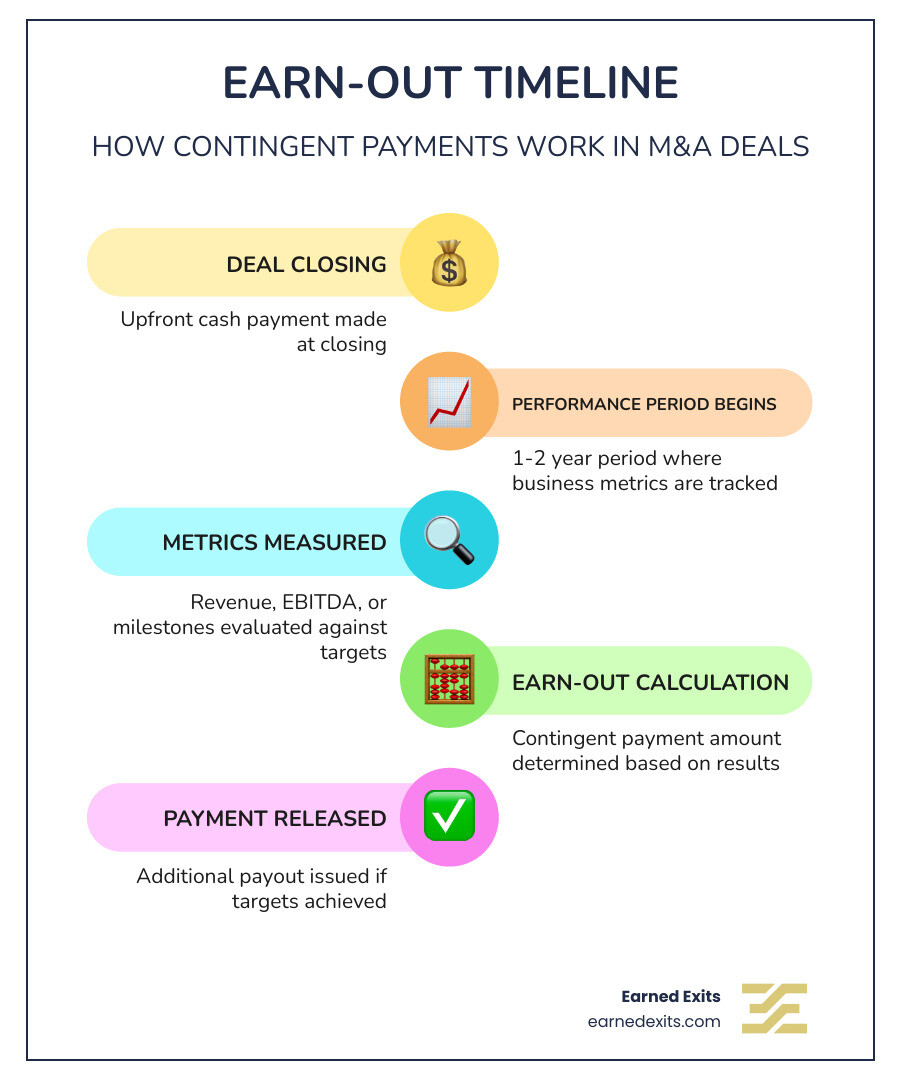
At its heart, an earn-out is a “wait and see” agreement. According to Investopedia, it is a contractual provision where the seller of a business obtains additional future compensation if the business achieves certain financial goals.
Why is this so common now? Look at the numbers. From 2016 to 2021, the average M&A transaction multiple was a healthy 11.9x. However, between 2022 and 2024, that multiple dropped to 9.8x. When the market cools, buyers get nervous. They worry that the high performance you’re showing today might not last once you walk out the door.

We often see earn-outs used to bridge this “valuation gap.” You believe your company is worth $10 million because of a new product launch. The buyer thinks it’s worth $8 million because the product is unproven. An earn-out allows the deal to move forward at $8 million today, with the remaining $2 million paid later if that product actually hits its sales targets.
This mechanism de-risks the acquisition for the buyer while providing you with the upside you deserve. However, as we discuss in our guide on Sealing the Deal: A Guide to Evaluating Offers, a bird in the hand is usually worth two in the bush. An earn-out is essentially “contingent consideration”—it’s a promise, not a guarantee.
Choosing the Right Performance Metrics for Your Deal
The metric you choose will determine whether you ever see that extra cash. In 2024, 62% of earn-outs relied on revenue as the primary metric, while only 22% used earnings or EBITDA.
Revenue vs. EBITDA
We generally advise sellers to push for revenue-based targets. Why? Because revenue is much harder for a buyer to “hide” or manipulate through accounting tricks. EBITDA (Earnings Before Interest, Taxes, Depreciation, and Amortization) can be easily suppressed if the buyer decides to hire ten new expensive executives or move their corporate headquarters’ rent onto your business unit’s books.
Non-Financial and Milestone Metrics
Sometimes, money isn’t the only way to measure success. In industries like pharmaceuticals or tech, milestones are king. For example, a payout might be triggered by U.S. Food and Drug Administration approval of a new drug or the successful launch of a software beta. Other KPIs might include:
- Customer retention rates
- New contract signings
- Successful integration of a specific technology
The Importance of Accounting Consistency
Whatever metric you choose, it must be tied to clear accounting principles. Don’t just say “GAAP” (Generally Accepted Accounting Principles). GAAP allows for a lot of interpretation. You should specify that the earn-out will be calculated using the past practices of the business. This prevents the buyer from changing how they recognize revenue just to avoid paying you. When Avoiding Acquisition Missteps, sophisticated buyers will try to use their own accounting standards—stand your ground here.
Essential Earn Outs Negotiation Tips for Sellers
Negotiating an earn-out is about balancing your desire for a high price with the reality of post-closing risk. Here is how we recommend approaching the table.
First, maximize your upfront cash. The earn-out should be the “cherry on top,” not the meal itself. If you wouldn’t be happy with the deal if the earn-out paid zero, you’re taking on too much risk.
Second, use floors and caps. A “floor” ensures that if you hit a minimum level of performance, you get at least some payment. A “cap” limits the buyer’s total liability, which can actually make them more comfortable offering a higher potential payout.
Third, look at the frequency of payments. Don’t wait three years for one giant check. Negotiate for quarterly or annual milestones. This keeps the buyer honest and puts cash in your pocket sooner. As we explain in our 10 Steps Selling Process, structuring these milestones early can prevent a lot of heartache later.
Using a professional can also change the game. We’ve seen how a business broker elevates your exit strategy by playing the “bad cop” during these tough financial discussions, allowing you to maintain a good relationship with the buyer you’ll be working for post-sale.
Earn outs negotiation tips for operational control
One of the biggest traps for sellers is losing the ability to actually run the business. If your payout is tied to growth, but the buyer freezes your marketing budget or fires your top salesperson, you’re stuck.
You must negotiate for:
- Budget Commitments: The buyer should agree to provide a specific level of funding for your department.
- Resource Allocation: Ensure you have the staff and equipment needed to hit your numbers.
- Veto Rights: You should have a say in major decisions that directly impact your earn-out metrics.
A smooth handover requires clear boundaries on who decides what after the ink is dry.
Earn outs negotiation tips for financial protection
Buyers have many ways to make a profitable business look like it’s losing money on paper. They might allocate a portion of their massive corporate overhead to your small business unit, suddenly “charging” you for HR or legal services you didn’t ask for.
To protect yourself:
- Exclude Extraordinary Items: One-time legal fees or merger integration costs shouldn’t count against your profit targets.
- Audit Rights: You must have the right to review the books and bring in an independent accountant if the numbers look fishy.
- Information Access: You need regular (at least monthly) financial reporting to track your progress.
Maintaining the art of confidentiality is vital during the sale, but once the deal is done, transparency becomes your best friend.
Securing Payments and Mitigating Litigation Risks
The Delaware Chancery Court is full of stories about earn-outs gone wrong. In one famous case, a seller secured over $1 billion in damages because the buyer failed to use “Commercially Reasonable Efforts” (CRE) to promote a product.
However, CRE is a vague term. In 2024, only 10% of earn-outs included a CRE standard, down from 30% in 2023. Buyers are moving away from this because it’s a litigation magnet.
Instead of relying on vague “efforts” clauses, use these tools to secure your money:
- Acceleration Clauses: If the buyer sells the company again or fires you without cause, the entire earn-out should become due immediately.
- Escrow Accounts: Have the buyer put the earn-out money into a third-party account at closing so you know the cash actually exists.
- Parent Guarantees: If you are selling to a small subsidiary, make sure the large parent company guarantees the payment.
- Baseball Arbitration: This is a great dispute resolution tactic. Both sides submit their “final number” to an arbitrator, who must pick one of the two numbers. This encourages both sides to be reasonable rather than staking out extreme positions.
Data from SRS Acquiom shows that 90% of 2024 earn-outs included a covenant stating the buyer would take no action to “directly harm” the earn-out achievement. Make sure that clause is in your contract.
Tax Considerations and Earn-Out Alternatives
How your earn-out is taxed can be just as important as the amount. Generally, if an earn-out is structured as part of the purchase price, it may qualify for capital gains treatment. However, if the IRS decides the payment is actually “disguised compensation” for your continued work, they may tax it as ordinary income—which is much higher.
As we discuss in Crafting a Meaningful Exit, you should explore alternatives if an earn-out feels too risky:
- Seller Notes: A loan you provide to the buyer. It has a fixed interest rate and a set repayment schedule, regardless of business performance.
- Equity Rollovers: You keep a small percentage (e.g., 10-20%) of the company. If the buyer grows the business and sells it later, your “second bite of the apple” could be worth more than any earn-out.
- Reverse Earn-Outs: The buyer pays the full price upfront, but you agree to “give back” a portion if targets aren’t met. This is often better for sellers because you already have the cash.
Frequently Asked Questions about Earn-Outs
What is a typical earn-out period?
The median earn-out length in 2024 was 24 months. While some deals stretch to three or five years, we generally advise against this. The longer the period, the more “noise” enters the equation—market shifts, economic downturns, or changes in the buyer’s management can all derail a long-term earn-out. Only 15% of recent deals stretched beyond three years.
Why do sellers prefer revenue-based metrics?
Sellers prefer revenue because it is the “top line.” It is very difficult for a buyer to manipulate revenue without committing actual fraud. EBITDA and Net Income are “bottom line” metrics that can be reduced by the buyer’s spending decisions, such as increasing R&D or taking on high-interest debt. If you want a simple, clean calculation, stick to revenue.
Can I lose my earn-out if I leave the company?
This depends on your “leaver” provisions. A “Good Leaver” (someone who is fired without cause or leaves due to disability) usually keeps their earn-out. A “Bad Leaver” (someone fired for misconduct or who quits to join a competitor) typically forfeits it. Negotiating these definitions is a critical part of your earn outs negotiation tips checklist.
Conclusion
Earn-outs are a powerful tool for getting a deal across the finish line, but they require a steady hand and an expert eye. They turn a simple sale into a multi-year partnership, and like any partnership, the rules need to be clear from day one.
At Earned Exits, we specialize in helping business owners navigate these complexities. From providing thorough CFO and due diligence support to ensuring your communication with buyers remains professional and productive, our goal is to maximize your value while minimizing your stress.
Don’t leave your final payout to chance. If you’re ready to plan your departure, let us help you Sell My Business with a strategy that protects your hard-earned legacy.
