


The Ultimate Guide to Small Business Valuation Methods
What Are the Best Valuation Methods for Small Business Owners?
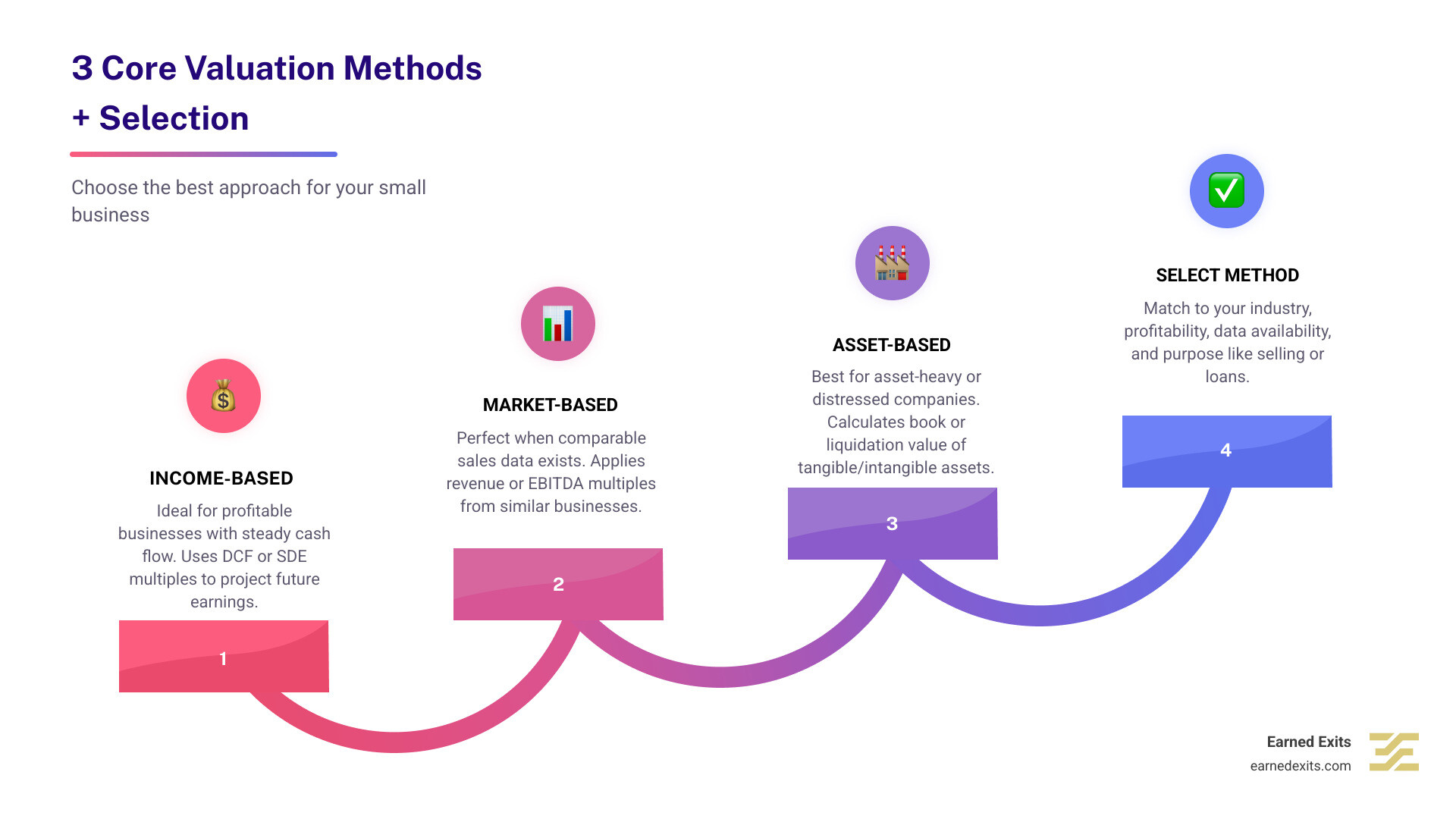
Valuation methods small business owners actually use come down to three core approaches:
| Method | Best For | Example |
|---|---|---|
| Income-Based | Profitable businesses with steady cash flow | DCF, SDE multiples |
| Market-Based | Businesses with comparable sales data | Revenue or EBITDA multiples |
| Asset-Based | Asset-heavy or distressed businesses | Book value, liquidation value |
Quick answer: Most small businesses sell for 2-3x annual revenue, or 2-5x their Seller’s Discretionary Earnings (SDE). The right method depends on your industry, profitability, and why you need the valuation.
You’ve spent years building your business. Now you need to know what it’s actually worth.
Whether you’re planning to sell, applying for a loan, bringing in a partner, or just thinking about retirement — not knowing your number puts you at a serious disadvantage.
Here’s the uncomfortable truth: most small business owners either overestimate or underestimate their company’s value. Emotional attachment inflates it. Unfamiliarity with valuation methods shrinks it.
The good news? Valuation isn’t magic. It follows a clear process, and once you understand how buyers and appraisers think, you can approach the table with confidence.
This guide walks you through every major valuation method — what they are, how they work, and which one fits your situation — so you’re never caught off guard.
Why Business Valuation Matters for Small Business Owners
We often see owners who view valuation as a one-time event—something you do only when a “For Sale” sign goes in the window. In reality, understanding your company’s economic value is a vital part of strategic planning.
Think of a valuation as a comprehensive financial health check. It tells you where you stand in your industry and highlights the levers you can pull to increase your worth before an exit. Beyond selling, there are several critical reasons to keep a current valuation handy:
- Exit Strategy and Retirement Planning: You can’t plan for a beachside retirement if you don’t know if your “nest egg” is worth $500,000 or $5 million.
- Partnership Buyouts: If a partner wants out (or you want to buy them out), an objective valuation prevents “friendship-ending” disputes.
- Loan Applications: Banks often require a formal appraisal to secure financing. A professional valuation can significantly strengthen your application.
- Tax Reporting: The IRS cares deeply about valuation for estate planning and gift taxes.
- Investment Attraction: If you’re looking for “shark” investors, they’ll want to see a defensible number backed by data.
- Divorce Proceedings: Business interests are often the largest asset in a marital estate; a fair valuation ensures an equitable split.
- Growth Tracking: Regularly valuing your business allows you to see if your hard work is actually translating into equity, not just a paycheck.

The 3 Core Valuation Methods for Small Business
When we talk about valuation methods small business experts use, we generally group them into three “buckets.” Each looks at the business through a different lens: what it owns, what others paid for similar shops, and what it will earn in the future.
| Approach | Focus | When to Use |
|---|---|---|
| Asset-Based | Net Cost | Distressed sales or asset-heavy industries (Construction, Manufacturing). |
| Market-Based | Comparison | When there is plenty of recent data on similar business sales. |
| Income-Based | Future ROI | For profitable, “going concern” businesses with consistent cash flow. |
Choosing the right method isn’t just about picking your favorite; it depends on data availability and industry standards. For example, a software company with no physical assets but high recurring revenue would never use an asset-based approach. Conversely, a trucking company with millions in fleet value might find the asset approach most relevant. Often, we use a combination of these to find a valuation range.
Income-Based Valuation Methods for Small Business
The income approach is based on a simple idea: a business is worth the sum of the money it will make for its owner in the future, adjusted for today’s value.
1. Discounted Cash Flow (DCF) DCF is often called the “gold standard,” but it’s also the most complex. It involves forecasting future cash flows for a set period (usually 5 years) and then “discounting” them back to the present day using a discount rate. This rate accounts for the “time value of money” and the risk involved. For established small businesses, discount rates often land between 10% and 12%, while riskier ventures might see 20% or higher.
2. Capitalization of Earnings This is a “shorthand” version of DCF. Instead of projecting year-by-year, it takes a single period of sustainable cash flow and divides it by a capitalization (cap) rate. For many small businesses, cap rates hover around 20-25%.
3. Seller’s Discretionary Earnings (SDE) This is the lifeblood of small business valuation. SDE represents the total financial benefit a single owner-operator gets from the business. To find it, we start with net profit and “add back” things like the owner’s salary, personal health insurance, and one-time expenses (like that one-off SEO project). Demystifying add-backs is crucial because it shows a buyer the true earning power of the company.
Market-Based Valuation Methods for Small Business
The market approach is like appraising a house; you look at what “comparables” (comps) in the neighborhood sold for recently. This is where Business Valuation Services become incredibly helpful, as they have access to private databases of sold businesses.
- Comparable Company Analysis (CCA): We look at public or private companies in the same industry and of a similar size.
- Valuation Multiples: This is the most common “water cooler” talk in business. You might hear, “My buddy sold his HVAC biz for 3x earnings.”
- SDE Multiples: Most small businesses (revenue under $1M) sell for 1.5x to 3x SDE.
- EBITDA Multiples: Larger companies (revenue over $5M) usually sell for 3x to 6x EBITDA (Earnings Before Interest, Taxes, Depreciation, and Amortization).
- Revenue Multiples: Common in industries like SaaS or retail where growth is prioritized over immediate profit. The average American business sells for about 0.6x its annual revenue.
Asset-Based Approaches: Book vs. Liquidation Value
If your business isn’t particularly profitable but owns a lot of “stuff,” the asset-based approach provides a floor for your value. It’s essentially calculating everything your business owns and subtracting what it owes.
- Book Value: This is the value of assets minus liabilities as shown on your balance sheet. Warning: Book value is often inaccurate because it uses “historical cost” (what you paid for a desk 10 years ago) rather than what it’s worth today.
- Adjusted Book Value: This is more realistic. We adjust assets to their Fair Market Value. For instance, if you own real estate that has tripled in value, we “write it up.” If you have old inventory that will never sell, we “write it down.”
- Liquidation Value: The “worst-case scenario.” This is what you’d get if you had to sell everything off in a hurry (usually 30-90 days).
- Inventory Considerations: How you account for inventory matters. Using LIFO (Last-In, First-Out) vs. FIFO (First-In, First-Out) can change your tax burden and your ending asset value during an audit.
Key Factors Influencing Your Business’s Worth
Two businesses can have the exact same revenue but vastly different valuations. Why? Because of the “intangibles.” Here are the 8 factors that impact your company’s worth most significantly:
- Financial Performance: Clean books and consistent 3-year growth are non-negotiable.
- Customer Concentration: If 60% of your revenue comes from one client, your business is “risky.” If that client leaves, the business dies. Buyers hate this.
- Brand Reputation and Goodwill: Do people search for your business by name? A strong brand allows for higher margins and better multiples.
- Intellectual Property (IP): Patents, trademarks, and proprietary processes create a “moat” around your business.
- Market Trends: Are you in a “sunset” industry (like DVD rentals) or a “sunrise” industry (like AI or green energy)?
- Management Depth: If the business can’t run for a week without you, it’s not a business—it’s a job. Businesses with a strong middle-management layer command much higher prices.
- Recurring Revenue: Subscriptions and long-term contracts are worth their weight in gold because they make future income predictable.
- Geographic Location: A retail shop in a booming part of Texas or Florida is naturally worth more than one in a declining rural area.
Preparing for a Professional Business Valuation
If you’re ready to get a Free Valuation, you need to get your house in order first. A professional appraiser is only as good as the data you give them.
What to Gather:
- 3-5 years of Federal Tax Returns.
- Year-to-Date Profit & Loss (P&L) statements and Balance Sheets.
- A list of all equipment, vehicles, and real estate.
- Organizational charts and key employee contracts.
- Lease agreements and major vendor contracts.
Who to Hire: Look for specific credentials to ensure the report is defensible in court or at a bank. The Accredited in Business Valuation (ABV) credential is held by CPAs who specialize in this field. You can also find qualified experts through the American Society of Appraisers (ASA) or the National Association of Certified Valuation Analysts (NACVA) directory.
Frequently Asked Questions about Valuation Methods Small Business
How much does a professional business valuation typically cost?
For a small business, a formal, certified appraisal typically costs between $3,000 and $10,000. The price fluctuates based on the complexity of the business and the depth of the report required. A “calculation of value” (informal) is cheaper, while a “conclusion of value” (formal/legal grade) is more expensive. Organizations like the American Society of Appraisers (ASA) can help you find professionals who fit your budget and needs.
What is the “rule of thumb” for a quick business valuation?
While we don’t recommend relying solely on them, rules of thumb provide a great “sanity check.”
- The 2-3x Rule: Most healthy small businesses sell for 2 to 3 times their annual SDE.
- The Revenue Rule: Many service businesses sell for 0.5x to 1x their annual revenue.
- The EBITDA Rule: For companies making over $5M, a common starting point is 3x to 5x EBITDA.
How do you value a startup with no profits?
Valuing a startup is more “art” than “science.” Since there’s no history, we look at startup valuation techniques like:
- The Berkus Method: Assigning value to the idea, the prototype, the team, and the strategic relationships.
- Cost-to-Duplicate: Calculating how much it would cost to build the tech and team from scratch.
- Future Cash Flows: Using a heavily discounted DCF based on aggressive (but realistic) growth projections.
- Market Size (TAM): If you’re disrupting a $100 billion market, your “potential” value is much higher.
Conclusion
Determining the value of your business is one of the most important financial steps you will ever take. Whether you use an income, market, or asset-based approach, the goal is the same: to get a clear, defensible number that reflects your years of hard work.
At Earned Exits, we specialize in making this process seamless. We provide thorough CFO support, due diligence assistance, and the tools you need to see your business through the eyes of a buyer. We’ve helped owners across the country—from California to Florida—navigate the complexities of the market to ensure they get the exit they’ve earned.
Ready to see what your business is worth in today’s market? Sell My Business with confidence by starting your valuation journey with us today.
