


The Ultimate Guide to Setting Realistic Freight Broker Seller Expectations
Why Freight Brokerage Seller Goals Determine the Value of Your Exit
Setting clear freight brokerage seller goals is the foundation of a successful business sale — and most owners wait too long to define them.
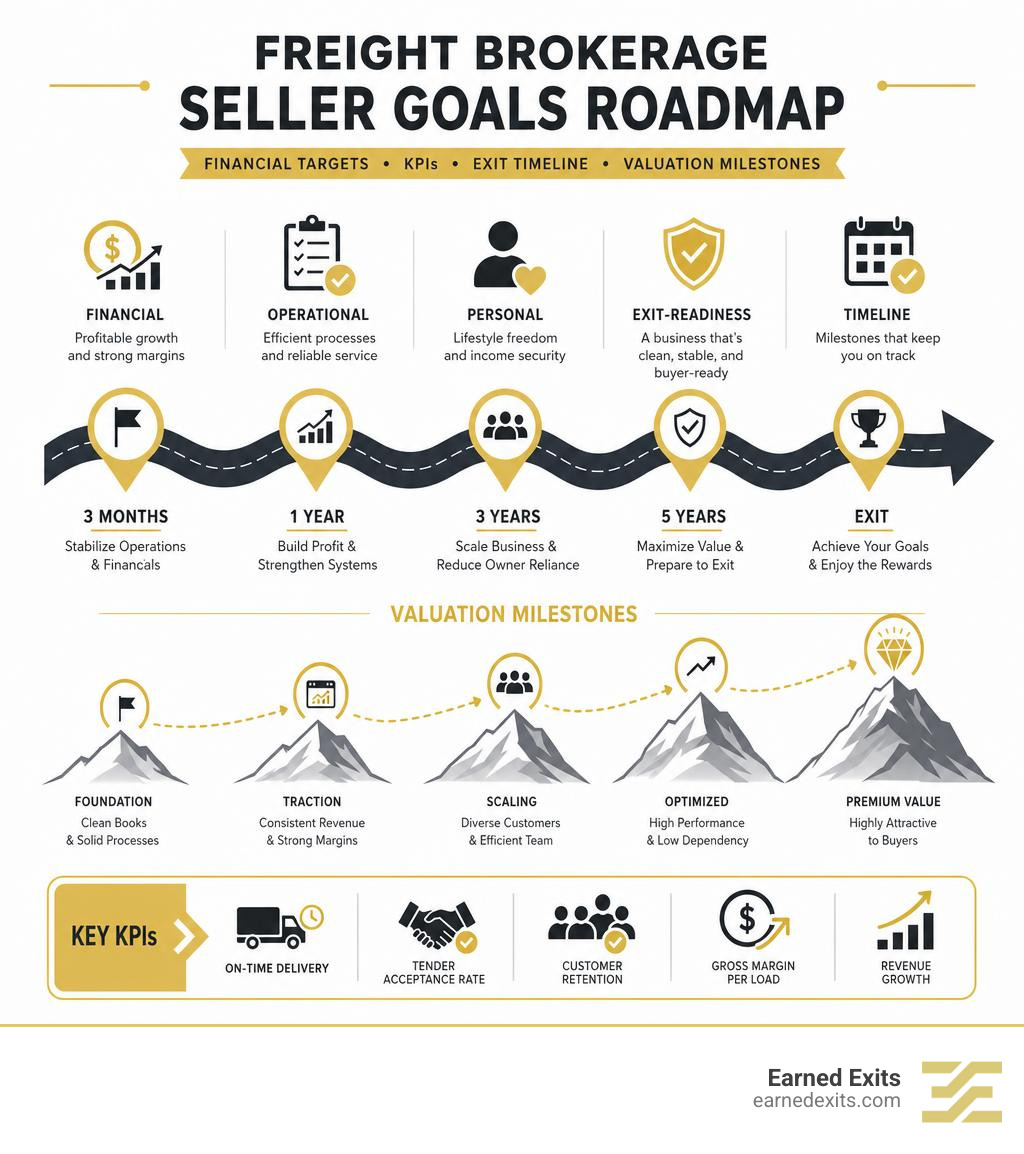
Here are the core freight brokerage seller goals to set before going to market:
| Goal Category | Key Target |
|---|---|
| Financial | Six-figure income, gross margin per load, $40.5M Year 5 revenue |
| Operational | On-time delivery rate, tender acceptance, customer retention |
| Personal | Early retirement, lifestyle freedom, income replacement |
| Exit-Readiness | 3-month cash runway, clean P&L, diversified book of business |
| Timeline | 3-month, 1-year, 3-year, and 5-year milestones defined |
Whether you’re a solo freight agent or running a mid-market brokerage, the gap between what your business is worth and what you could get for it often comes down to one thing: how clearly you defined your goals before the sale.
Freight brokerages that track weekly KPIs and maintain structured financial records are significantly better positioned to attract qualified buyers and close at a strong valuation. Yet many owners only start thinking about this when they’re already ready to walk out the door.
This guide walks you through how to set realistic, measurable goals — from daily sales targets to a clean exit — so you know exactly where you stand and what your business is worth when the time comes.
I’m Britt Clas, a Business Broker and Partner at Earned Exits, where I specialize in guiding entrepreneurs through the full exit process — including helping freight brokerage owners align their freight brokerage seller goals with a deal structure that protects their legacy and maximizes value. My work spans valuation, due diligence, negotiations, and closing for businesses generating $1M to $40M in revenue.
Defining Your Freight Brokerage Seller Goals for Long-Term Value
A freight brokerage can look busy and still be hard to sell.
Lots of calls. Lots of loads. Lots of “we are crushing it” energy. But if the numbers are not organized, the customer base is concentrated, the owner is still the only rainmaker, and margins swing wildly month to month, buyers start sharpening their pencils.
That is why realistic freight brokerage seller goals should connect three things:
- What you want personally
- What the business must prove financially
- What a buyer will need to trust during due diligence
The most useful starting point is still the SMART framework:
| SMART Element | Freight Brokerage Example |
|---|---|
| Specific | Add 8 new recurring shipper accounts in food, retail, or manufacturing |
| Measurable | Reach $75,000 monthly gross margin with 18% net revenue margin |
| Attainable | Increase load count 10% per quarter without lowering service quality |
| Relevant | Build recurring revenue and reduce owner dependency before sale |
| Time-bound | Hit the target within 12 months before beginning exit preparation |
SMART goals work because they force the owner to stop saying, “I want to grow,” and start saying, “I want to grow profitably, in a way a buyer can verify.”
If you are still early in the journey, our guide on starting a freight broker business can help frame what the first stage of the path looks like before exit planning becomes the priority.
Aligning Personal Aspirations with Freight Brokerage Seller Goals
Many freight brokers start with personal goals, not spreadsheet goals.
That is normal. The first dream may be:
- Earn a six-figure income
- Replace a W-2 job
- Stop asking permission to take a Tuesday off
- Build a book of business that creates real wealth
- Retire early
- Fund a second venture
- Create something a child, partner, or team member can continue
Those are valid goals. They just need to be translated into business math.
For example, if your personal goal is $250,000 in annual owner income, you need to know:
- Your average gross margin per load
- Your monthly load volume
- Your operating expenses
- Your commission structure, if you are an agent
- Your customer retention rate
- How much profit must remain in the business for working capital
A 2026 freight agent goal-setting approach emphasizes connecting goals to your personal “why,” then breaking them into daily and weekly controllable actions. That is the right mindset. The article Setting Freight Agent Goals: 2026 Edition also highlights the importance of focusing on actions you can control, such as new conversations, follow-ups, and pipeline development.
Here is the key for sellers: personal freedom is easier to achieve when the business becomes less dependent on you.
If every shipper relationship lives in your phone, your “freedom business” may actually be a job with extra paperwork. Buyers notice that. So do spouses. So does your nervous system.
A stronger goal sounds like this:
“Within 18 months, we will reduce owner-managed customer revenue from 85% to 40%, document all major shipper relationships in the CRM, and train two team members to manage day-to-day account communication.”
That is a personal goal disguised as an enterprise-value goal. Those are our favorite kind.
Structuring Business Milestones to Support Freight Brokerage Seller Goals
Seller goals should change as the brokerage matures. A startup goal is not the same as a sell-side goal for a $10M, $25M, or $40M brokerage.
A helpful planning model from freight broker KPI and multi-year planning resources references aggressive long-term targets such as Year 3 breakeven, a $40.5M Year 5 revenue target, and a 31% IRR goal. Not every brokerage should chase that exact path, but the concept is useful: connect daily KPIs to multi-year value creation.
Here is a practical version:
| Timeline | Realistic Seller Goal | What to Track |
|---|---|---|
| 3 months | Clean up reporting and stabilize sales activity | CRM accuracy, weekly calls, margin per load, cash runway |
| 1 year | Build a repeatable book of business | Recurring shippers, retention, on-time delivery, gross margin |
| 3 years | Reduce owner dependency and improve profitability | Management depth, EBITDA, customer concentration, process documentation |
| 5 years | Prepare for premium buyer interest or strategic exit | Scalable systems, diversified revenue, clean financials, proven growth story |
For a new agent, a realistic first milestone may be $1,000 in monthly gross profit, then $10,000 or more within six months if activity and conversion improve. For an established brokerage, a more relevant goal may be growing monthly gross profit from $75,000 to $150,000 while protecting service quality.
The point is not to copy someone else’s numbers. The point is to build a goal ladder that a buyer can understand.
Core Sales KPIs and Financial Metrics to Track
Freight brokerage is not a generic sales business. Capacity disappears. Rates move. Carriers fail. Shippers change routing guides. A truck-hour that goes unused today cannot be sold tomorrow like a software subscription seat.
That means your KPIs must prove more than revenue. They must prove quality of revenue.
Start with these core metrics:
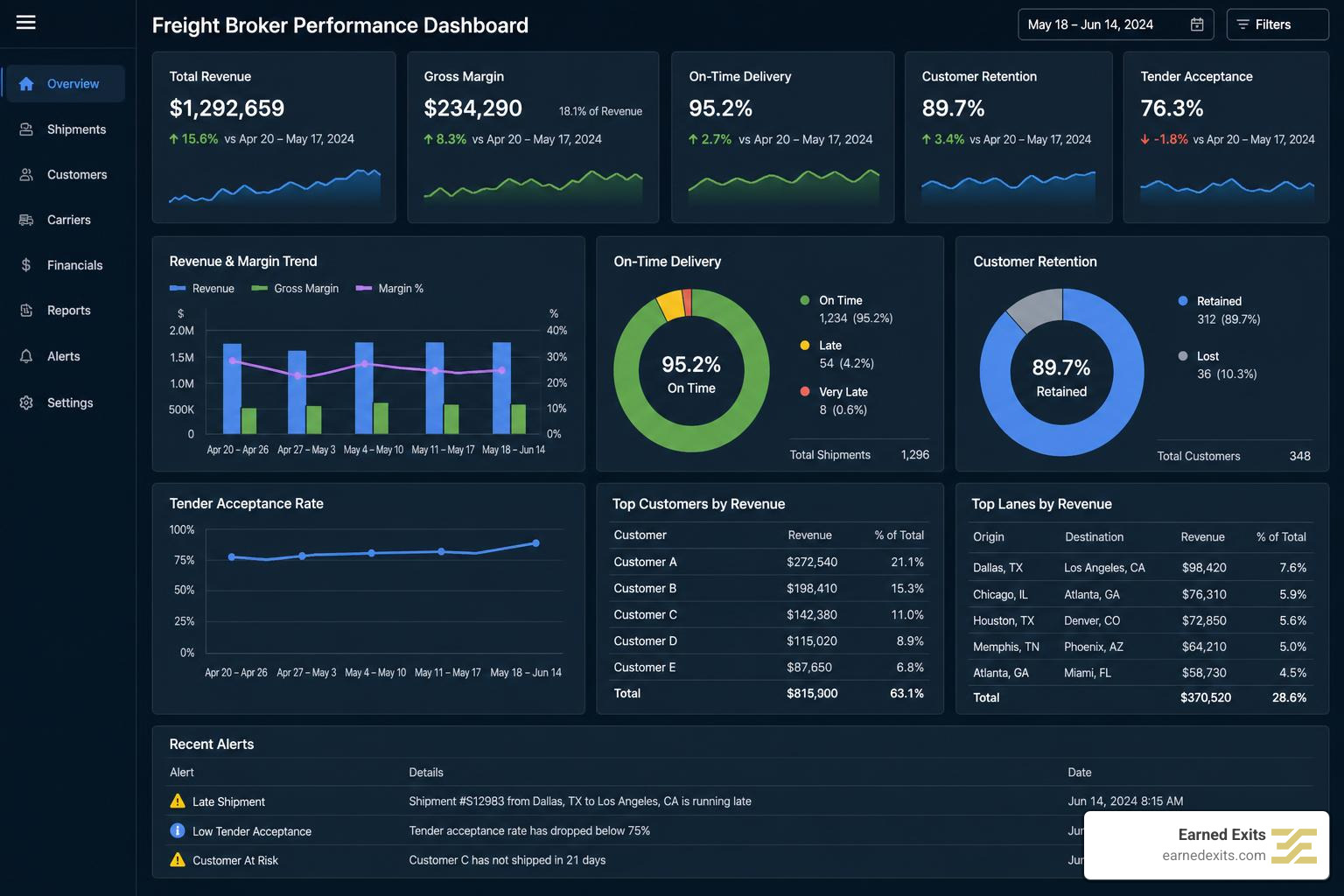
| KPI | Formula or Definition | Why It Matters to Sellers |
|---|---|---|
| Revenue per Load | Total revenue divided by total loads | Shows pricing power and shipment economics |
| Gross Margin per Truckload | Customer revenue minus carrier cost | Shows profitability at the load level |
| Net Revenue per Shipment | Net revenue after pass-through costs | Gives buyers a cleaner view of real earnings |
| On-Time Delivery Rate | On-time deliveries divided by total deliveries | Supports retention and shipper trust |
| Customer Retention Rate | Retained customers divided by starting customers | Proves recurring value |
| Tender Acceptance Rate | Accepted tenders divided by total tenders | Shows capacity reliability |
| Contract vs. Spot Mix | Percentage of freight under contract vs. spot | Shows stability versus volatility |
| Claims Resolution Time | Median time to resolve claims | Impacts retention and reputation |
| Cash Runway | Cash divided by monthly fixed expenses | Shows resilience during claims or downturns |
A strong freight KPI guide such as this logistics and freight sales KPI resource points out that operators should track metrics tied to capacity utilization, lane economics, customer mix, and human capital. That is exactly how buyers think, too.
For freight brokers, the most seller-relevant KPIs are usually:
- Gross margin per load
- Net revenue margin
- Customer retention
- Revenue concentration by customer
- On-time performance
- Tender acceptance
- Contract versus spot mix
- Working capital needs
- Claims frequency and resolution time
For asset-heavy or hybrid businesses, additional metrics matter:
| KPI Area | Non-Asset Brokerage | Asset or Hybrid Freight Business |
|---|---|---|
| Revenue quality | Net revenue per shipment, gross margin per load | Revenue per truck per week, loaded-mile ratio |
| Capacity | Carrier depth, tender acceptance | Driver availability, tractor utilization |
| Margin risk | Spot exposure, carrier rate volatility | Deadhead miles, maintenance, fuel, equipment cost |
| Service | On-time delivery, claims | OTIF, driver turnover, equipment downtime |
| Buyer concern | Customer concentration, owner dependency | Fleet condition, driver retention, operating ratio |
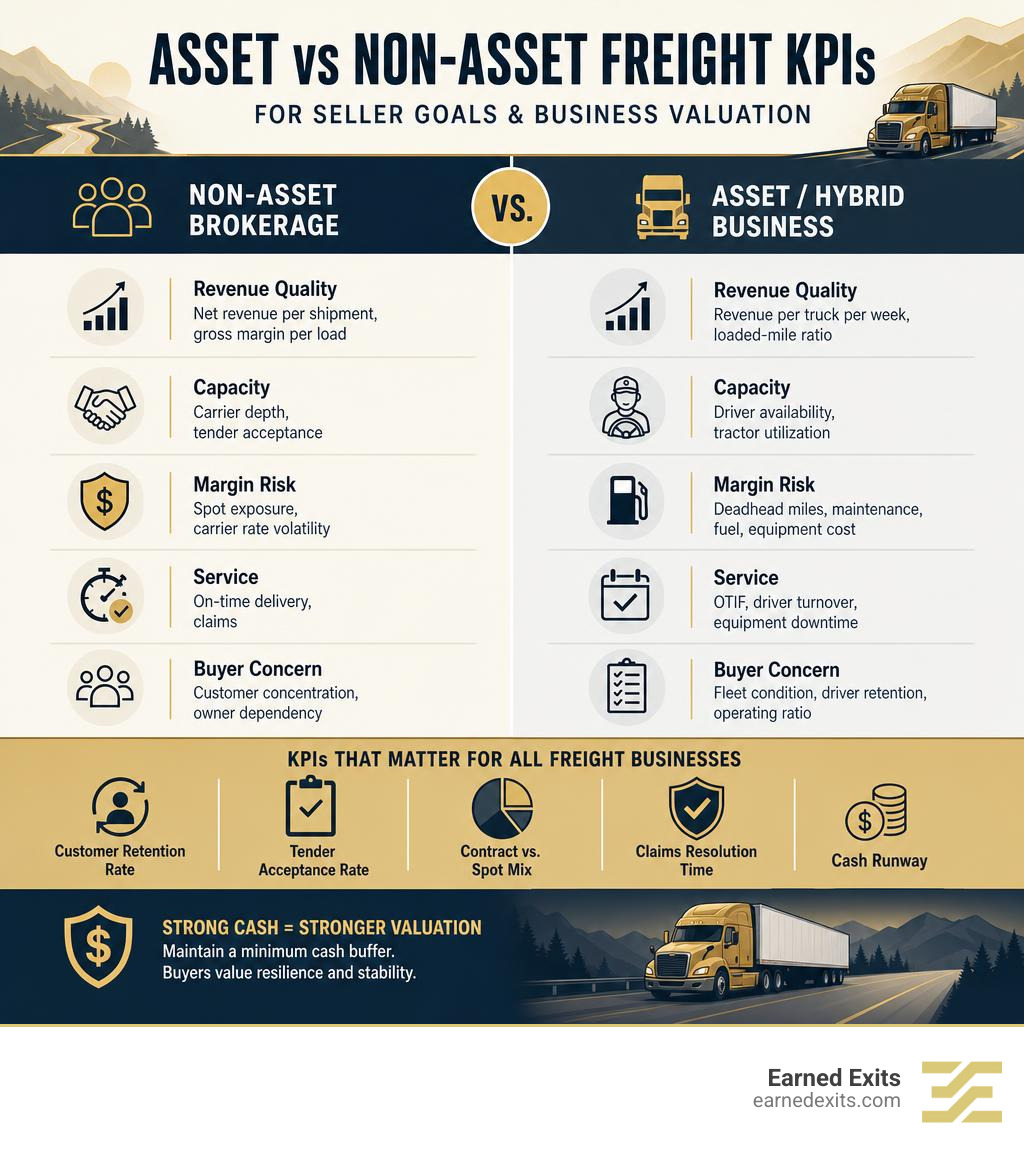
Research-backed freight planning models also emphasize maintaining a minimum cash buffer. One benchmark cited in freight brokerage KPI planning is a $156,000 operating cash floor, roughly equal to several months of fixed expenses in the example. The exact number for your brokerage may be higher or lower, but the principle is universal: buyers like businesses that do not panic when one large claim, slow-paying shipper, or soft freight cycle hits.
We also recommend tracking KPI trends weekly but reviewing strategic meaning monthly. A daily dashboard is useful. Daily emotional overreactions are not. Freight already has enough drama.
Tactical Sales Strategies: Scripts, Cold Calling, and the Red Zone
Sales goals do not become reality because they look nice in a spreadsheet.
They become reality because someone makes the call, sends the follow-up, handles the objection, and asks for the load.
A practical freight sales system should include:
- A defined ideal customer profile
- A prospecting list
- A written call script
- Objection-handling responses
- A follow-up cadence
- A CRM that actually gets used
- A process for moving prospects from “maybe” to “send me a lane”
The freight broker sales playbook for mid-market shippers recommends a simple 3-touch sequence over 10 to 14 days:
- Targeted email on Day 0
- Phone call around Day 3 or 4
- Break-up email around Day 10 to 12
That sequence works because most shipper relationships do not convert after one message. If your sales plan is “send one email and hope,” that is not a sales plan. That is a wish wearing a collared shirt.
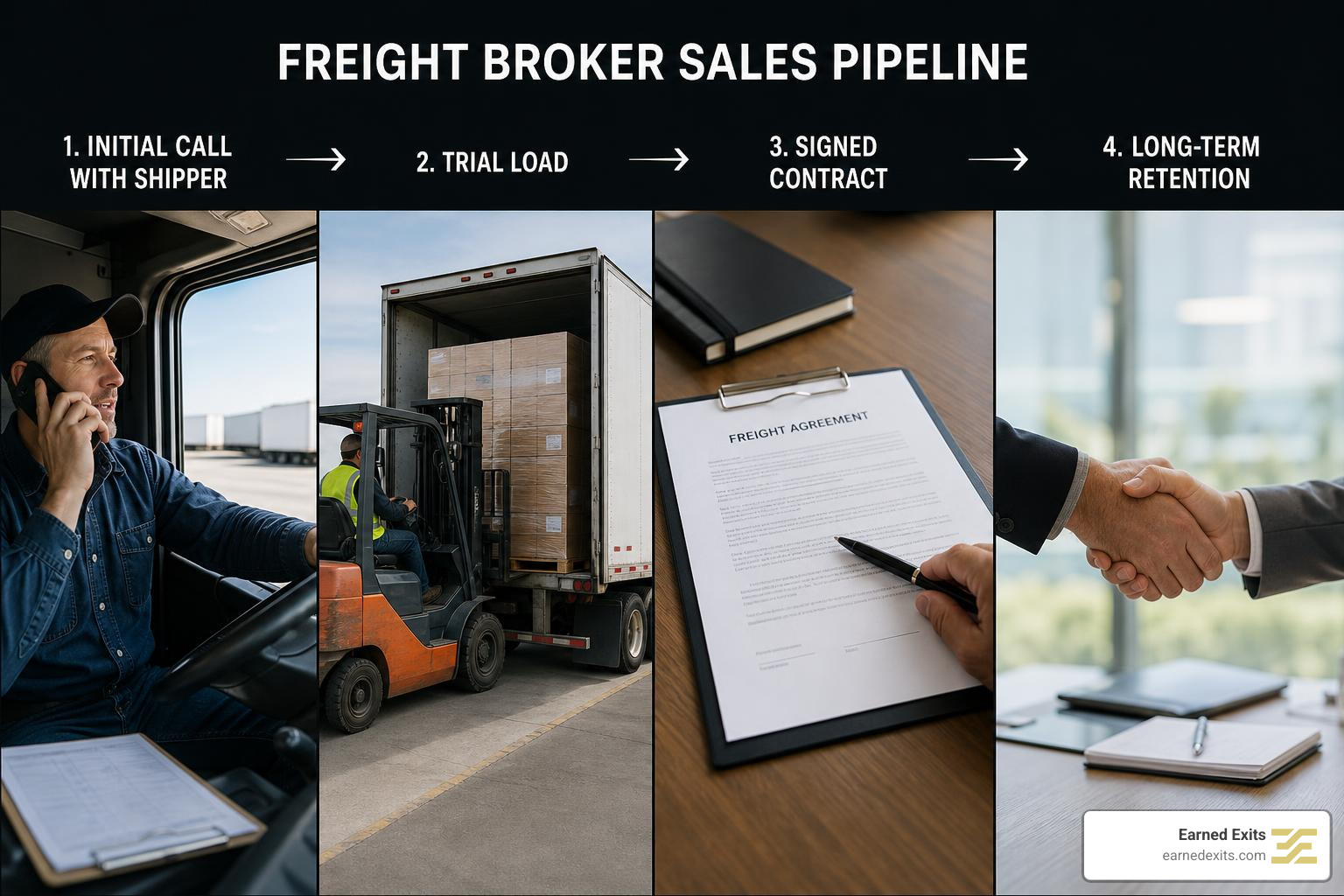
Cold calling still matters in freight because timing matters. A shipper may be “covered” today and desperate tomorrow when a carrier falls off, a lane surges, or peak season causes chaos.
The key is not to sound like every other broker asking, “Do you have any freight I can quote?”
A better discovery approach is:
- “What lanes have caused the most issues this quarter?”
- “Where do you usually need backup capacity?”
- “What happens when your primary carrier rejects a tender?”
- “What would make you consider testing a new broker on one lane?”
- “Are service failures, claims, or communication gaps costing you time right now?”
Good scripts do not make you robotic. They keep you from panicking. Think of them like guardrails. You can still drive like a human.
The “Red Zone” idea in freight sales is also useful. Early-stage prospects may only need weekly or biweekly touches. But once a prospect is sending lanes, asking questions, or saying they may need help soon, follow-up should tighten to every two or three days.
That does not mean “annoy them until they block your number.” It means match your follow-up to their buying cycle.
Common objections and better responses:
| Objection | Weak Response | Stronger Response |
|---|---|---|
| “Your rate is too high.” | “I can try to go lower.” | “I understand. Are you comparing only linehaul, or total cost including service failures, claims, and missed appointments?” |
| “We already have brokers.” | “Okay, call me if you need me.” | “That makes sense. Most of our best customers were covered until they needed backup on problem lanes. Where do you typically need extra support?” |
| “Send me an email.” | “Sure.” | “Absolutely. So I do not send something generic, which lanes or equipment types should I reference?” |
| “Call me next quarter.” | “Okay.” | “Happy to. Before I do, what usually changes next quarter: volume, routing guide, budget, or carrier performance?” |
The seller goal behind all of this is simple: build a sales motion that a buyer believes can continue without the founder personally willing every deal into existence.
Leveraging Inbound Marketing and Technology to Scale
Outbound sales builds pipeline. Inbound marketing builds trust before the first call.
Modern B2B buyers often research heavily before they speak with sales. In freight brokerage, that means shippers may look at your website, Google presence, reviews, LinkedIn activity, lane expertise, and case studies before deciding whether your call is worth returning.
The Freight Brokerage Business Plan: Complete Guide with Financial Templates (2026) emphasizes practical customer acquisition channels such as Google Business Profile, local SEO, referrals, and clear financial planning. Those are not just startup tactics. They also support exit value because they make growth less dependent on one person’s phone hustle.
A scalable freight brokerage should use technology and marketing for:
- CRM tracking
- TMS reporting
- Load-level profitability
- Automated follow-up reminders
- Claims tracking
- Customer segmentation
- Carrier scorecards
- Email campaigns
- Website lead capture
- Google Business Profile optimization
- Content that answers shipper questions
Inbound content can include:
- “How to reduce freight claims on temperature-sensitive loads”
- “When to use contract freight instead of spot freight”
- “How manufacturers can protect capacity during peak season”
- “What to do when tender rejection increases”
- “How to evaluate a freight broker beyond price”
Marketing also improves the quality of your buyer story. A brokerage that can show 35% of leads from local search, 30% from referrals, and a consistent pipeline from content has a stronger growth narrative than one relying only on the founder’s personal relationships.
For exit planning, we like to see:
- Documented lead sources
- Customer acquisition cost estimates
- Conversion rates by channel
- Referral tracking
- Sales cycle length
- Retention by customer segment
- Revenue by industry vertical
That data helps buyers answer the question: “If we acquire this brokerage, can we grow it?”
Preparing Your Freight Brokerage for a High-Value Exit
A high-value exit is built before the buyer appears.
By the time you go to market, the business should already be telling a clean story:
- Revenue is growing
- Margins are understandable
- Customers are diversified
- The team can operate without the owner in every conversation
- Financials reconcile to tax returns and bank statements
- Systems are documented
- Sales activity is trackable
- Carrier and shipper relationships are organized
- Claims and disputes are visible, not hidden in someone’s inbox
At Earned Exits, this is where our process becomes especially valuable. We help owners prepare before the market starts asking hard questions. That includes valuation, positioning, financial review, buyer materials, due diligence support, negotiations, and transition planning.
If you are unsure what your brokerage may be worth, our Business Valuation Services can help you understand value drivers before you commit to a sale process. You can also review our guide on business valuation methods and market multiples to understand how buyers often think about earnings, risk, and growth.
Freight brokerage buyers typically examine:
| Buyer Review Area | What They Want to See |
|---|---|
| Financials | Clean P&L, normalized EBITDA or SDE, accurate add-backs |
| Customers | Low concentration, strong retention, recurring lanes |
| Operations | Documented processes, reliable carrier network, low claims |
| Sales | CRM data, pipeline, repeatable prospecting, diversified lead sources |
| Team | Account management depth, non-owner relationships |
| Legal and compliance | Broker authority, insurance, contracts, claim records |
| Working capital | Cash runway, receivables quality, carrier payment practices |
One of the most overlooked seller goals is claims discipline. Freight brokerages that resolve claims quickly and communicate clearly tend to protect customer relationships better. Some KPI models use a 48-hour median claims resolution benchmark as an indicator of operational responsiveness. Even if your claims are more complex, tracking median resolution time gives buyers confidence that problems are managed, not buried.
Exit-ready goals might include:
- Reduce top customer concentration below 20% to 25% of revenue
- Maintain at least three months of operating runway
- Document all core processes
- Reconcile load-level margin to monthly P&L
- Segment revenue by customer, lane, and contract type
- Build a management layer or account team
- Create a transition plan for the owner after closing
- Prepare buyer-ready financial reports for the past 24 to 36 months
The goal is not perfection. No business is perfect. The goal is explainability.
If something is messy, we want to know before the buyer does. Surprises are fun for birthdays. Not due diligence.
Frequently Asked Questions about Freight Brokerage Sales
What is a realistic profit margin for a scaling freight brokerage?
A realistic margin depends on size, model, customer mix, and operating discipline.
Some freight brokerage business planning resources cite gross margin targets around 42% for highly efficient service models and net profit margins of 15% to 25% by Year 2. In traditional freight brokerage, many operators focus more on net revenue margin, gross margin per load, and EBITDA after overhead.
For sellers, the most important questions are:
- Are margins stable or improving?
- Can margins be explained by customer, lane, and service type?
- Are profits dependent on one or two large shippers?
- Is revenue growing faster than overhead?
- Are claims, fines, and bad debt properly recorded?
- Does the business maintain enough cash runway?
A brokerage with lower revenue but clean margins, strong retention, and less owner dependency may be more attractive than a larger brokerage with thin margins and chaotic reporting.
Healthy seller goals include:
- Track gross margin per load weekly
- Review net revenue margin monthly
- Maintain at least 2 to 3 months of fixed expenses in cash runway
- Reconcile load-level data to the P&L
- Avoid chasing volume that destroys margin
Growth is good. Profitable growth is better. Profitable growth with clean books is what buyers actually pay for.
How do you handle the “your rates are too high” objection?
Do not race to the bottom immediately.
In freight, the lowest rate can become the most expensive option if it leads to missed pickups, rejected tenders, poor communication, fines, claims, or emergency recovery loads.
A strong response reframes the conversation around total cost:
“I understand rate matters. To make sure we are comparing apples to apples, are you looking only at the linehaul rate, or also service reliability, appointment performance, claims risk, and how often backup capacity is needed?”
Then ask a discovery question:
- “Which lanes are most sensitive to service failures?”
- “Where have low-cost options caused issues before?”
- “What happens internally when a shipment misses delivery?”
- “Are you mainly optimizing for price, reliability, or fewer headaches?”
If the shipper only cares about price, they may not be your ideal customer. That is fine. Not every prospect deserves your margin.
Your sales goal should be to win customers who value reliability, communication, and problem-solving, not just the cheapest truck of the day.
When is the right time to transition from spot to contract freight?
The right time to pursue more contract freight is when you have enough lane data, service consistency, and carrier coverage to support commitments without hurting margin.
Spot freight is useful because it creates flexibility and quick revenue. But too much spot exposure can make revenue unpredictable and harder for buyers to value.
Contract freight becomes more attractive when:
- You repeatedly move the same lanes
- You understand seasonal volume patterns
- You have dependable carrier coverage
- Tender acceptance is strong
- Service levels are consistent
- The customer relationship is stable
- Pricing supports margin after capacity shifts
A balanced contract vs. spot mix depends on your brokerage model. Some brokerages intentionally remain spot-heavy, while others build value through recurring contract lanes. From a seller perspective, the strongest story is usually not “we are all contract” or “we are all spot.” It is “we understand our mix, track it, and manage it profitably.”
Contract freight can support valuation because it shows revenue durability. Spot freight can support valuation when it shows agility and strong market relationships. The key is tracking the mix and explaining why it works.
Conclusion
Realistic freight brokerage seller goals do more than help you grow. They help you build a business someone else can confidently buy.
The best goals connect personal aspirations to measurable business value:
- Income goals become gross margin targets
- Lifestyle goals become owner-independence goals
- Sales goals become CRM and pipeline metrics
- Service goals become retention and on-time delivery KPIs
- Exit goals become clean financials, diversified customers, and organized due diligence
At Earned Exits, we help business owners turn that preparation into a clear, efficient sale process. Our work is built around communication, organization, CFO-level support, buyer-ready materials, and tools that make the process easier to manage.
If your next goal is to understand what your freight brokerage could be worth – or what needs to improve before going to market – start with our Sell My Business page.
And if you are still deciding whether to hire representation, read our guide on why finding the right business broker matters.
Your exit does not start when you list the business. It starts when you set the right goals.
