


The Ultimate Guide to Hiring a Professional Business Broker
Why Finding the Right Business Broker Can Make or Break Your Exit
Finding the right business broker is one of the most important decisions you’ll make when selling your company. The wrong choice can cost you months of wasted time, a lower sale price, and a lot of unnecessary stress.
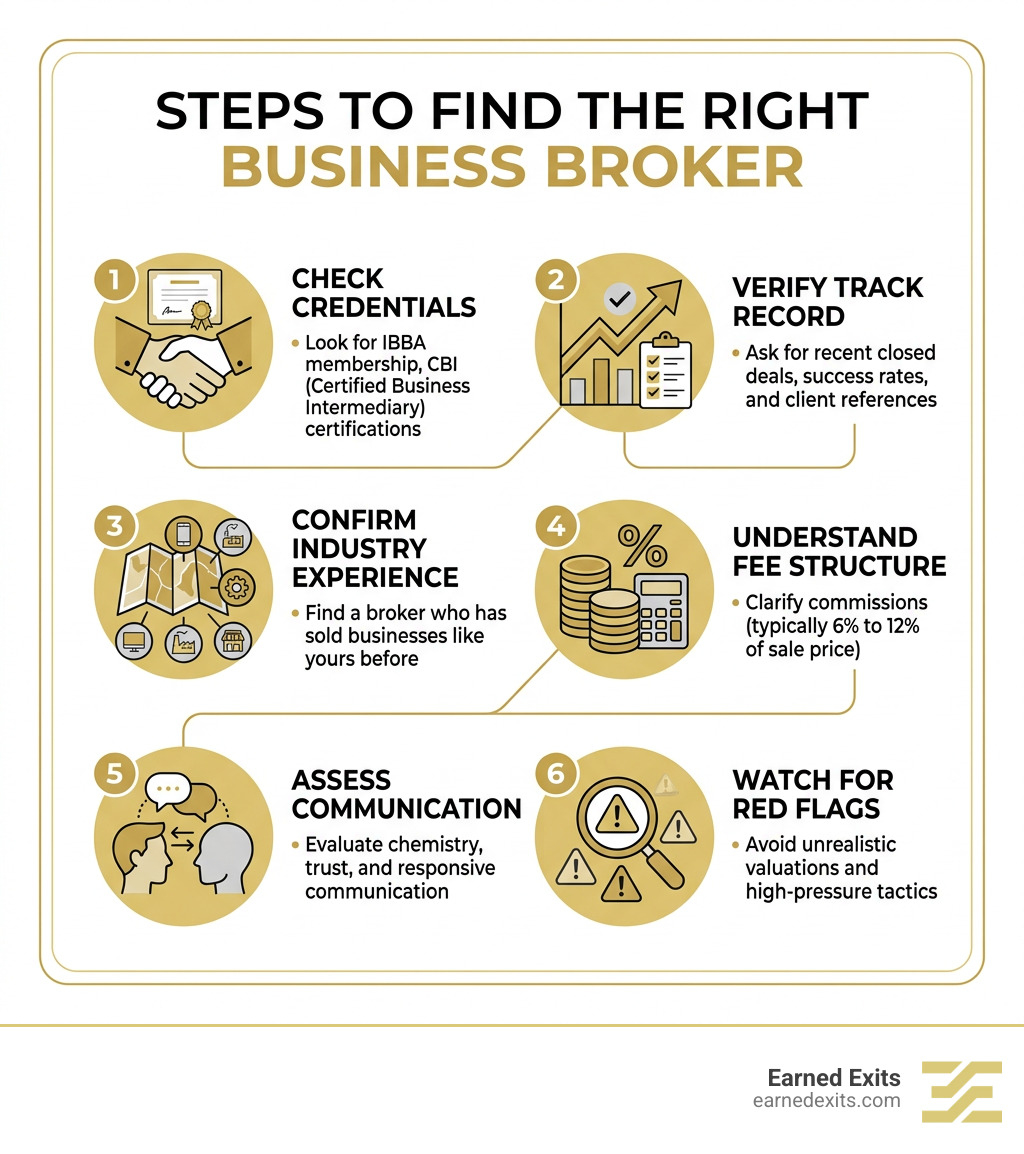
Here’s a quick overview of how to find the right broker:
- Check credentials – Look for IBBA membership and certifications like CBI (Certified Business Intermediary)
- Verify their track record – Ask for recent closed deals, success rates, and client references
- Confirm industry experience – Find a broker who has sold businesses like yours before
- Understand the fee structure – Typical commissions range from 6% to 12% of the sale price
- Assess communication and trust – You’ll work closely for months; chemistry matters
- Watch for red flags – Unrealistic valuations, vague processes, and pressure to sign fast are warning signs
Selling a business is likely the largest financial transaction of your life. Yet most owners go into it without any real preparation. In fact, only 15% of small business owners have a formal exit strategy in place.
That’s a lot of people navigating unfamiliar territory — often for the first time.
A skilled broker guides you through valuation, marketing, buyer vetting, negotiations, and closing. But not every broker delivers on that promise. The difference between a great broker and a mediocre one can mean tens of thousands of dollars — and months of your life.
This guide walks you through everything you need to know to hire the right professional with confidence.
What is a Business Broker and Do You Need One?
At its core, a business broker is a professional intermediary who assists in the purchase and sale of small to mid-sized businesses. Think of them as the “real estate agents” of the corporate world, but with a much more complex toolkit. They don’t just list a property; they package an entire financial history, operational structure, and future potential into a sellable asset.
So, do you actually need one? While it is possible to sell a business on your own, the statistics suggest it’s a massive gamble. According to Goldman Sachs, only 15% of small business owners have a formal exit strategy. Without a guide, many owners find themselves overwhelmed by the sheer volume of paperwork and legal hurdles.
Selling Your Business on Your Own is a risk you don’t want to take because the stakes are incredibly high. Research shows that roughly 60% of small business owners admit to lacking deep accounting knowledge. This is a critical gap because a sale lives and dies by the numbers. A broker provides the financial expertise needed to recast your earnings, ensuring you aren’t leaving money on the table.
Furthermore, a business broker elevates your exit strategy by acting as a buffer. They vet buyers so you don’t waste time with “tire kickers,” and they maintain confidentiality so your employees, customers, and competitors don’t find out about the sale prematurely.
Key Criteria for Finding Right Business Broker

When you begin the process of finding right business broker, you shouldn’t just pick the first name that pops up in a Google search. You are looking for a high-performance partner.
Track Record and Success Rate
The industry average for business sales is surprisingly low—less than 20% of businesses listed for sale actually close. A top-tier broker should significantly outperform this average. Ask potential candidates about their closing ratio and how many deals they’ve successfully completed in the last 12 months. Guiding your success and finding the right business broker is crucial because an experienced broker knows how to keep a deal from falling apart during the grueling due diligence phase.
Credentials and Affiliations
Professionalism in this industry is often signaled by affiliations. The gold standard is the International Business Brokers Association (IBBA). The IBBA trains and certifies brokers, ensuring they adhere to a strict code of ethics and maintain up-to-date knowledge of tax laws and valuation methodologies.
Look specifically for the Certified Business Intermediary (CBI) designation. A CBI has undergone hundreds of hours of training and has proven experience in closing complex transactions. This isn’t just a badge; it’s proof that they understand the nuances of deal structures and legal compliance.
Why industry specialization matters when finding right business broker
A generalist broker might be great at selling a dry cleaner or a local café, but if you own a high-tech firm or a heavy manufacturing plant, you need a specialist. Niche sectors have unique valuation drivers. For example:
- Manufacturing: Requires knowledge of equipment depreciation, supply chain stability, and inventory management. Manufacturing business brokers understand how to value “blue-sky” potential alongside heavy machinery.
- Construction: Involves complex licensing transfers, bonding requirements, and project pipelines. Construction business brokers know how to evaluate the value of recurring contracts versus one-off projects.
- Technology & SaaS: These businesses are valued on recurring revenue (MRR/ARR), churn rates, and intellectual property. SaaS business brokers and Ecommerce business brokers focus on digital assets that a traditional broker might overlook.
The Search Process: How to Identify and Interview Candidates
Finding candidates requires a multi-pronged approach. While online directories are a great starting point, referrals from your “professional circle”—your CPA, attorney, or fellow business owners—are often the most reliable. These professionals have likely seen which brokers actually get deals to the finish line and which ones just collect listing fees.
Once you have a shortlist, the interview phase begins. This is where you move beyond the resume and look for “chemistry.” You will be sharing your most sensitive financial data and speaking with this person weekly (if not daily) for the next six to nine months. If you don’t trust them or find their communication style abrasive, the process will be miserable.
Essential steps for finding right business broker through interviews
When you sit down for an interview, don’t be afraid to grill them. Entrepreneur notes that since this is one of your largest financial transactions, you need an advisor with a proven track record.
Review these 10 questions to ask a business broker to ensure they are a good fit. Key inquiries should include:
- “How did you arrive at the valuation for my business?” (Look for data-backed answers, not “gut feelings.”)
- “What is your marketing strategy to find buyers without alerting my employees?”
- “Can you provide references from sellers in my specific industry?”
- “Who will actually be handling the day-to-day work—you, or a junior associate?”
Understanding Fee Structures and Red Flags
Brokers aren’t free, but a good one pays for themselves by driving up the sale price. Most brokers operate on a commission basis, often called a “success fee.”
Typical Fee Models
- Success Fees: Generally range from 6% to 12% of the total purchase price. Smaller businesses (under $1M) often command higher percentages, while larger M&A deals might scale down to 4-6%.
- Retainers/Upfront Fees: Some brokers charge an initial fee to cover the costs of valuation, professional packaging (the Confidential Information Memorandum), and marketing. This can range from $2,500 to $15,000 depending on the complexity.
- Minimum Fees: Many brokers have a minimum commission (e.g., $25,000) to ensure the deal is worth their time.
| Fee Type | Description | Pros | Cons |
|---|---|---|---|
| Success-Only | Broker only gets paid when the deal closes. | Incentivizes the broker to close at any cost. | Broker may take on too many listings; less individual attention. |
| Retainer + Success | Upfront fee plus a commission at closing. | Broker is committed and covers professional valuation costs. | You lose the retainer if the business doesn’t sell. |
Red Flags to Avoid
Statistics show that the median time a business remains on the market is 200 days. If a broker promises a 30-day sale at a price way above market value, walk away. These are “unrealistic promises” designed to get you to sign an exclusivity agreement.
Other red flags include:
- Poor Communication: If they take three days to return your initial call, they’ll be even slower when a buyer is waiting.
- Lack of Transparency: They should be able to explain their business brokerage services in plain English.
- No NDA Process: If they don’t insist on a Non-Disclosure Agreement before sharing your financials with a “buyer,” they are putting your business at risk.
Frequently Asked Questions about Business Sales
How long does the typical brokerage process take?
The timeline is usually broken into four stages:
- Valuation & Packaging (2-4 weeks): Gathering financials and creating marketing materials.
- Marketing & Buyer Vetting (3-6 months): Finding the right buyer and getting an LOI (Letter of Intent).
- Due Diligence (30-90 days): The buyer “checks the hood” of the business.
- Closing (2-4 weeks): Final legal work and fund transfer. Total time? Expect 6 to 9 months on average.
How do I verify a broker’s professional affiliations?
Don’t just take their word for it. Go to the IBBA website and use their member directory to search for the broker’s name. You can also check with your state’s licensing board, as some states (like Florida or California) require brokers to have a real estate license to sell a business.
Conclusion
Finding the right business broker is the cornerstone of a successful exit. At Earned Exits, we understand that your business isn’t just a collection of assets—it’s your life’s work. We specialize in providing a seamless, organized process that takes the weight off your shoulders.
Our approach is built on excellent communication and thorough due diligence support. We provide our clients with advanced tools and a dedicated team to ensure that the 200-day market average is a hurdle we clear with ease. Whether you are in Alabama, Florida, or Southern California, our reach and expertise are designed to find the buyer who values your legacy as much as you do.
Ready to take the first step toward your next chapter? Learn more about our business brokerage services and let us help you earn the exit you deserve.
