


The Hidden Perks of Hiring a Broker to Sell Your Business
Key Business Broker Selling Advantages Every Owner Should Know
When owners decide to exit, they are often surprised by how complex a corporate transaction can become. One of the primary business broker selling advantages is having dedicated deal architecture and execution expertise on your side. Operating a company requires an entirely different skillset than packaging, marketing, and liquidating one. Trying to manage both simultaneously can put both the business performance and the sale at risk.
Data consistently highlights the value of working with experienced intermediaries:
- Over 90% of successful business sales are facilitated by a business broker or M&A advisor.
- Companies listed with a professional broker sell 50% faster on average than those listed by owners independently.
- Businesses sold through an intermediary typically achieve 20% to 30% higher sale prices than For-Sale-By-Owner (FSBO) transactions.
Attempting to navigate this landscape alone carries hidden costs. For a deeper dive into these pitfalls, see our guide on Selling Your Business on Your Own: A Risk You Don’t Want to Take.
Financial Business Broker Selling Advantages: Higher Valuations and Better Terms
Setting an arbitrary asking price based on a rule of thumb or emotional connection can significantly harm your exit strategy. Price too high, and the business sits on the market until it appears damaged; price too low, and you leave substantial equity on the table.
Brokers analyze Seller’s Discretionary Earnings (SDE) and Adjusted EBITDA to establish true cash flow. They apply realistic industry multiples based on market conditions, company growth, and risk profiles. Furthermore, financial advantages extend far beyond the headline valuation price. A skilled broker focuses heavily on deal structure—optimizing cash at closing, mitigating overly aggressive earnouts, and securing favorable seller financing terms that maximize your net proceeds after taxes and legal expenses. For more on maximizing your return, read Master the Sale: How a Business Broker Elevates Your Exit Strategy.
Operational Business Broker Selling Advantages: Confidentiality and Due Diligence
If employees, customers, or competitors learn that your business is for sale prematurely, customer churn can spike, key talent may leave, and competitors might target your accounts.
Maintaining strict operational privacy is a core benefit of using an intermediary. Confidentiality is successfully maintained in 95% of broker-assisted sales, compared to only 30% of FSBO transactions.
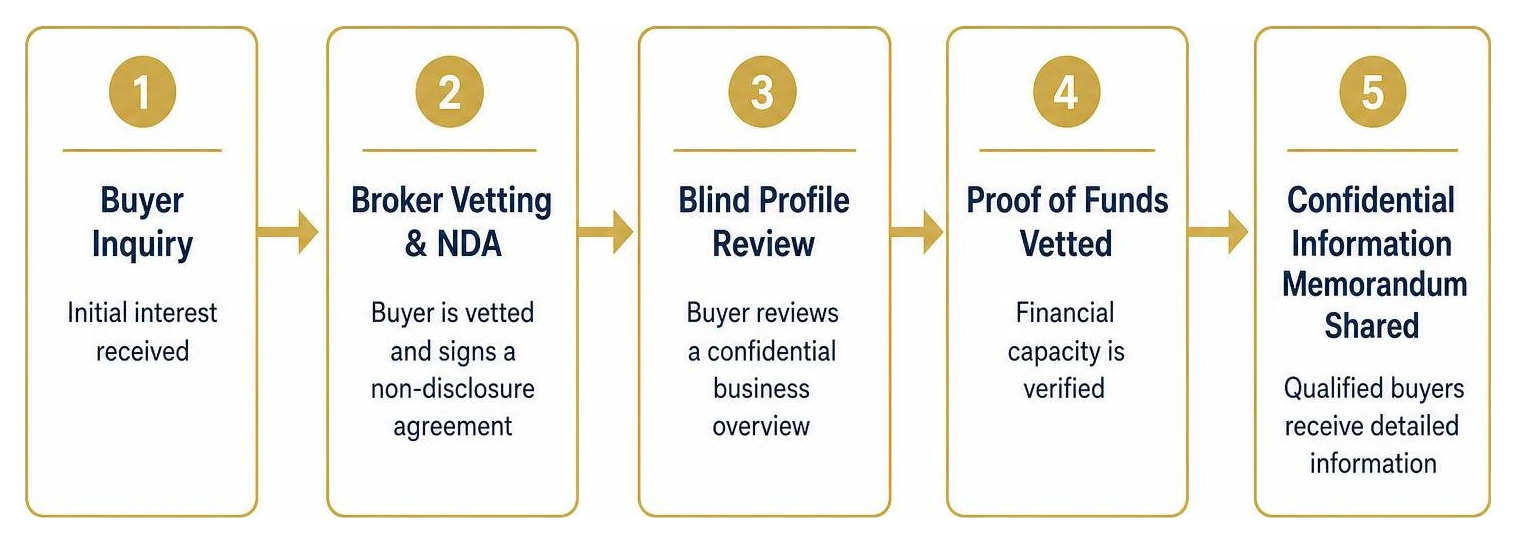
Brokers enforce non-disclosure agreements (NDAs), establish secure virtual data rooms, and gate access to operational details. This protects your business stability and frees you to focus on running daily operations and maintaining revenue during the sale process. Learn more about choosing a partner who prioritizes discretion in Guiding Your Success: Why Finding the Right Business Broker Is Crucial.
How Business Brokers Value, Market, and Qualify Buyers
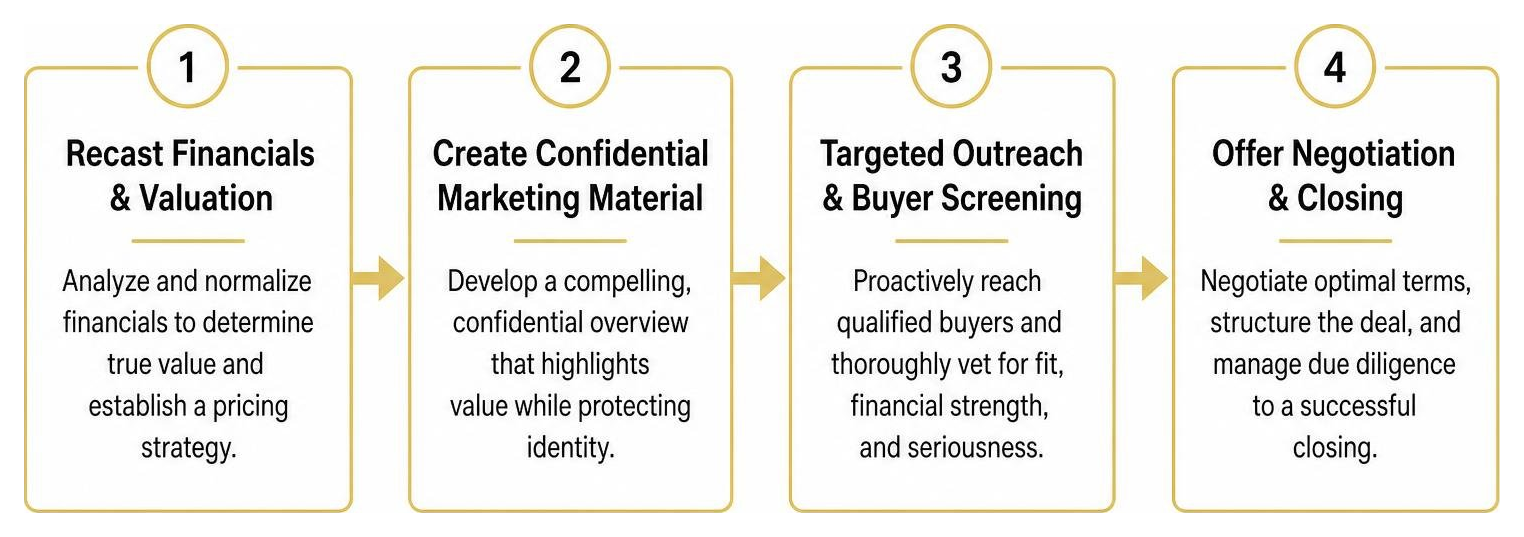
To achieve a successful exit, you need a proactive, systematic approach to finding and evaluating prospective acquirers.
Accurate Business Valuations and Pricing Strategies
Professional valuation balances quantitative financial analysis with qualitative market insights. Brokers adjust income statements to account for non-recurring expenses, owner compensation adjustments, and discretionary perks, revealing the true operational cash flow.
| Valuation Metric | What It Measures | Why It Matters to Buyers |
|---|---|---|
| SDE (Seller’s Discretionary Earnings) | Total financial benefit generated for a single owner-operator. | Standard metric for small businesses ($100k-$1M cash flow). |
| Adjusted EBITDA | Earnings before interest, taxes, depreciation, and amortization adjusted for non-operational items. | Standard metric for middle-market companies ($1M+ cash flow). |
| Industry Multiples | Transaction benchmarks derived from comparable recent regional and national sales. | Ensures your asking price aligns with current capital market realities. |
By backing up valuation calculations with audited adjustments and benchmark data, brokers prevent aggressive buyers from chipping away at your price during negotiations.
Targeted Marketing and Screening Pre-Qualified Buyers
Putting a business on a public listing board without vetting buyers leads to endless tire-kickers and security risks. Brokers build confidential Blind Business Profiles (or “Teasers”) that highlight financial strengths and growth potential without revealing your identity.

Having access to pre-qualified buyer networks reduces the time needed to find a serious buyer by up to 60%. Before sharing detailed financial records, brokers perform strict buyer screening, verifying:
- Liquid capital and proof of funds.
- Industry expertise and acquisition background.
- Realistic timeframes for closing.
- Creditworthiness and lender eligibility (such as SBA financing capability).
Navigating Negotiations, Legalities, and Due Diligence
Once an offer or Letter of Intent (LOI) arrives, the real work begins. Managing negotiations and due diligence requires specialized expertise to keep the deal moving forward without making unnecessary concessions.
Mastering Deal Structure and Deal-Closing Negotiations
A high purchase price means little if the underlying terms put you at financial risk. Negotiations frequently stall over working capital pegs, indemnification caps, escrow holdbacks, and seller financing conditions.
Brokers act as a direct buffer between you and the buyer. This separation preserves emotional leverage and keeps discussions professional. If a buyer makes an aggressive demand, your broker can push back firmly without damaging your long-term working relationship with the acquirer during the post-sale transition. Discover strategies for navigating these discussions in our article on Mastering the Negotiate Business Sale Broker Dance.
Regulatory Compliance and Smooth Transition Management
The due diligence phase is where many unassisted transactions fall apart. Buyers inspect years of tax returns, customer concentration reports, employee agreements, and equipment maintenance logs.
Brokers coordinate this process by:
- Setting up organized Virtual Data Rooms (VDR).
- Coordinating communication between transaction attorneys, CPAs, and lenders.
- Helping address regulatory requirements, license transfers, and municipal compliance.
- Outlining structured training periods and transitional consulting agreements to ensure a smooth handoff.
For a comprehensive walkthrough of these steps, explore Demystifying the Business Broker Selling Process: Step-by-Step to Success.
Evaluating Costs: Broker Fees vs. Return on Investment
A common concern among business owners is the fee structure associated with broker representation. However, reviewing transaction outcomes shows that a broker’s services often pay for themselves by securing higher prices and better terms.
Comparing For-Sale-By-Owner (FSBO) Risks with Broker Fees
Brokers typically work on a success-fee model, earning a commission percentage upon the successful closing of the business. Common models include flat percentage fees (typically 8% to 12% for small businesses) or scaled structures like the Double Lehman formula for larger transactions.
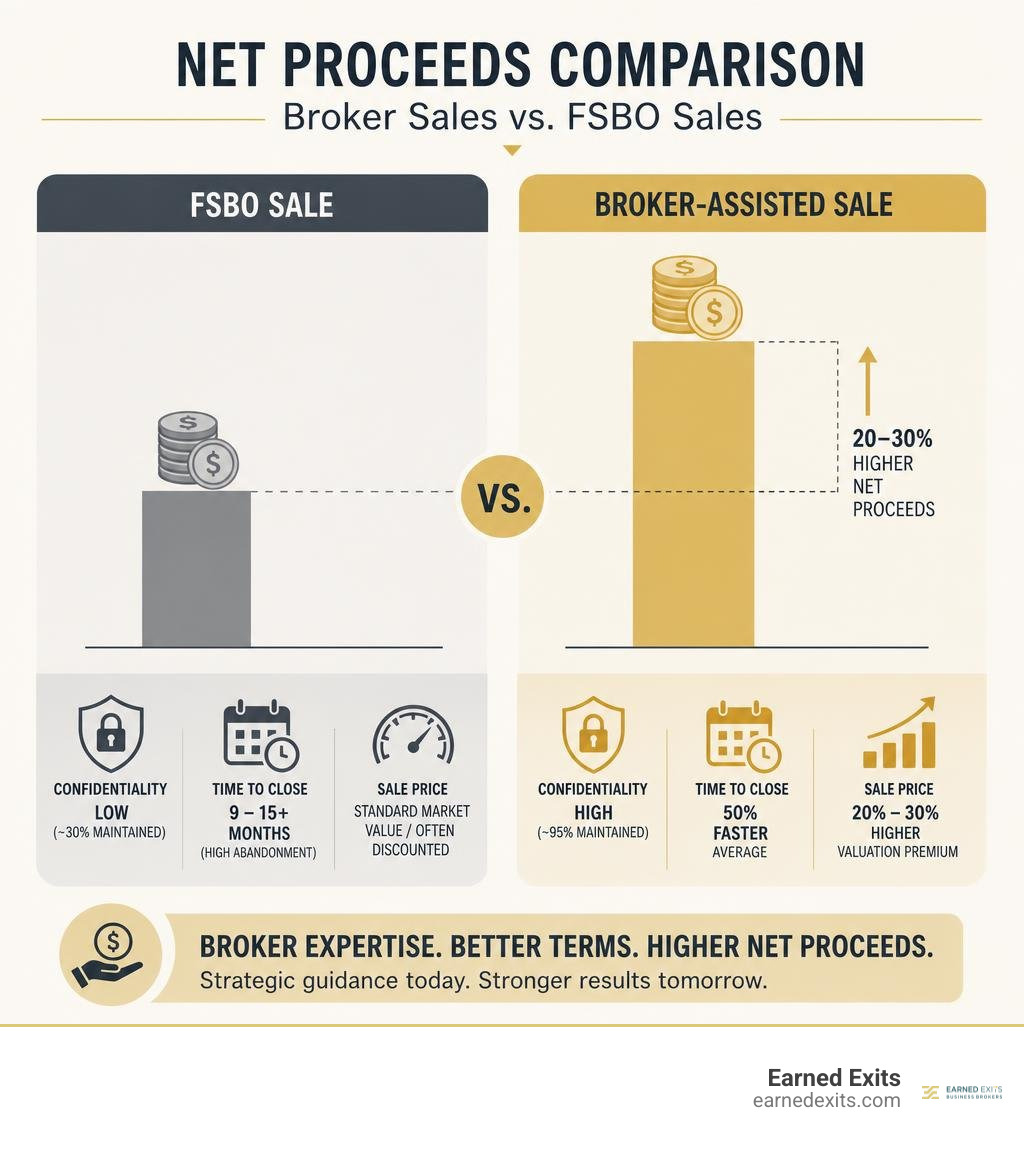
| Transaction Metric | For-Sale-By-Owner (FSBO) | Broker-Assisted Sale |
|---|---|---|
| Average Final Sale Price | Standard Market Value / Often Discounted | 20% to 30% Higher Valuation Premium |
| Confidentiality Rate | Low (~30% maintained) | High (~95% maintained) |
| Average Time to Close | 9 – 15+ Months (High Abandonment) | 50% Faster Average Closing Speed |
| Buyer Vetting Efficiency | Unfiltered / High Time Commitment | Pre-Screened for Capital & Intent |
| Deal Structure Quality | Often Heavily Favors Buyer Terms | Balanced Terms with Risk Protection |
When you factor in the higher purchase price, reduced risk of deal failure, and protected company focus, hiring an expert delivers a clear return on investment.
Frequently Asked Questions About Business Broker Selling Advantages
How much more money can a business broker get for my company?
While every business is unique, statistics show that broker-led transactions yield 20% to 30% more on average than FSBO sales. Brokers achieve this by systematically recasting financials to reveal true cash flow, setting competitive asking prices, and building multi-buyer interest that drives up terms and value.
How do business brokers maintain confidentiality during a sale?
Brokers protect your identity by using anonymous “blind descriptions” for marketing outreach. Prospective buyers must sign an enforceable Non-Disclosure Agreement (NDA) and complete a financial qualification review before receiving your company’s name or proprietary operational data.
What are the standard fee structures for business brokers in 2026?
Most brokers operate on a commission-based success fee due upon closing. Smaller main-street businesses generally carry a commission rate between 8% and 12%. Middle-market businesses often use tiered commission scales, such as the Double Lehman scale (e.g., 10% on the first million, 8% on the second, 6% on the third, and so on).
Conclusion
Selling your company is one of the most significant financial milestones of your career. Trying to handle the sale on your own while running daily operations introduces unnecessary operational risks, privacy concerns, and financial equity loss.
The key business broker selling advantages—accurate valuation, total confidentiality, pre-qualified buyer outreach, and expert negotiation—are designed to maximize your net proceeds and protect your legacy.
At Earned Exits, we deliver a seamless, organized exit experience backed by dedicated financial expertise, robust due diligence guidance, and clear communication every step of the way. When you are ready to explore your options and plan your exit, contact us through our Business Brokerage Services to schedule a confidential consultation.
