


The Complete Plumbing Company Sale Process Guide
What First-Time Sellers Need to Know About the Plumbing Company Sale Process
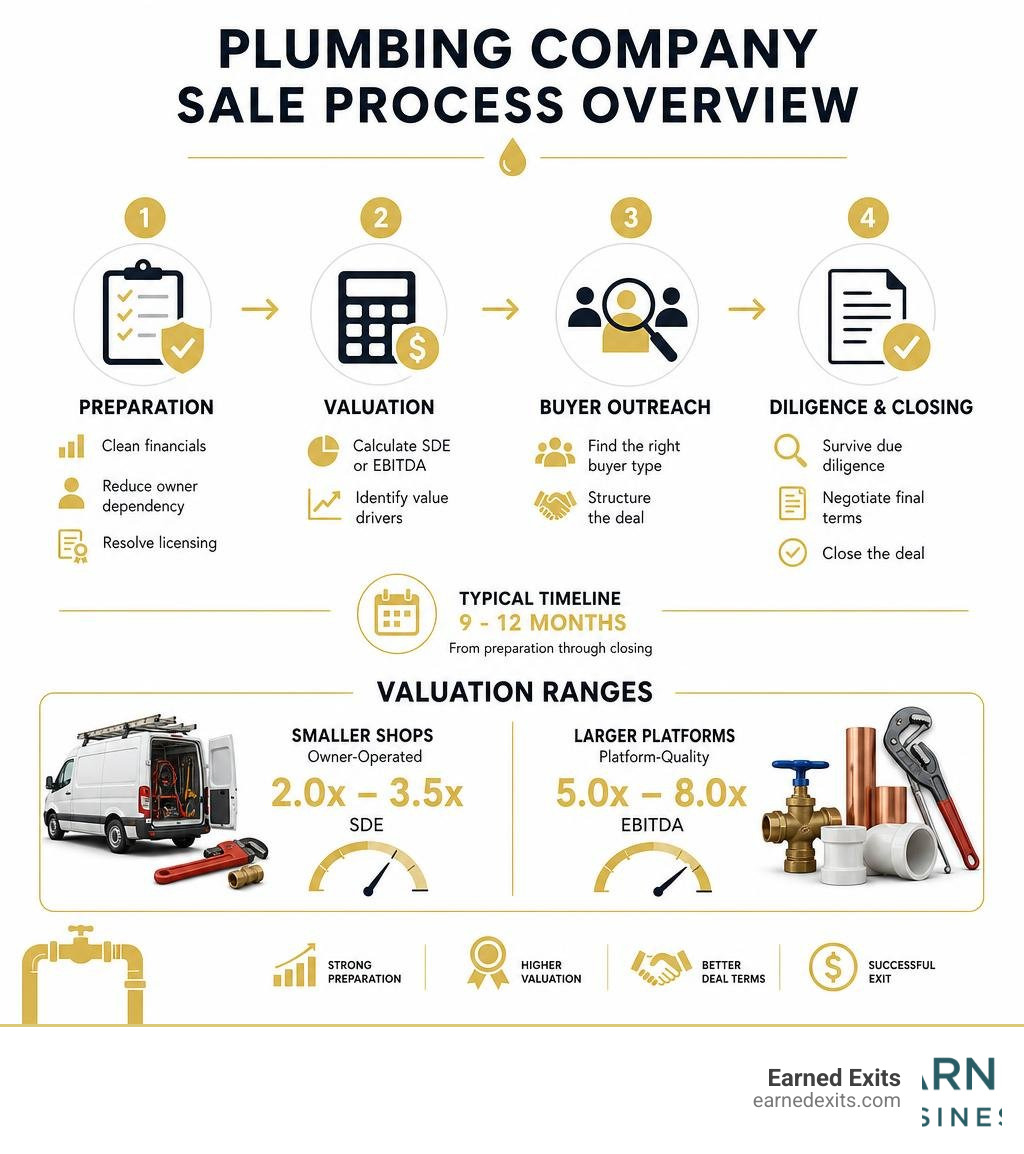
The plumbing company sale process typically unfolds across four key phases:
- Preparation — clean financials, reduce owner dependency, resolve licensing
- Valuation — calculate SDE or EBITDA, identify value drivers
- Buyer outreach — find the right buyer type and structure the deal
- Diligence and closing — survive due diligence, negotiate final terms, close
Most organized sale processes take 9 to 12 months from preparation through closing. Smaller owner-operated shops typically sell for 2.0x to 3.5x SDE, while larger platform-quality companies can command 5.0x to 8.0x EBITDA in a competitive process.
Selling a plumbing business is one of the largest financial events most owners will ever face — yet most go into it without a clear roadmap.
The U.S. plumbing market is valued at $126.4 billion, and buyer demand is strong. Private equity firms are actively rolling up fragmented home service businesses. Individual buyers are using SBA loans to acquire owner-operated shops. Strategic acquirers are paying premium prices for companies with recurring revenue and licensed technician teams.
But strong market demand does not automatically translate into a strong outcome for you.
The gap between what your business could sell for and what it actually sells for often comes down to preparation. Buyers will dig into your financials, your technician roster, your license structure, and your service mix. Weak spots become negotiating leverage — and they use it.
This guide walks you through every phase of the process, in plain language, so you know what to expect and what to do at each step.
I’m Britt Clas, a Business Broker and Partner at Earned Exits, where I’ve guided founders through every stage of the plumbing company sale process — from initial valuation through closing day. With over $2 billion in completed transactions across our team, I’ll share what actually works for sellers navigating this process for the first time.
Glossary for plumbing company sale process:
Phase 1: Preparing Your Plumbing Company for Sale
Preparation is where the battle for transaction value is won or lost. If you wait until you have “buyer interest” to clean up your business, you have already lost valuable leverage. Buyers are looking for reasons to reduce their offer price (known as “re-trading”), and messy operations provide the perfect excuse.
The preparation phase is about translating your plumbing business into “buyer language.” This means moving from cash-basis accounting to accrual-basis accounting, organizing your customer database, and documenting your workflows.

First, let’s look at your financials. You need at least three years of clean, professionally prepared financial statements (profit and loss statements, balance sheets, and tax returns). If you run personal expenses through the business — such as personal vehicles, family travel, or mobile phone plans — these must be cleanly documented on a monthly add-back schedule. These are known as “owner add-backs” and are critical for proving your true operational profitability.
Second, document your Standard Operating Procedures (SOPs). Buyers want to see a systematic business, not a chaotic one. Your SOPs should cover:
- How incoming calls are dispatched
- How technicians quote jobs in the field (flat-rate pricing is highly preferred over time-and-materials)
- How inventory and truck stock are managed
- How customer follow-ups and warranties are handled
If your business relies on modern Field Service Management (FSM) software like ServiceTitan or Housecall Pro, you are already ahead. This software provides the exact operational KPIs (average ticket size, call booking rates, technician conversion rates) that institutional buyers use to underwrite deals.
Eliminating Owner Dependency and Building Technician Depth
The single biggest value killer in a plumbing company sale is “the owner trap.” If your business cannot run for two weeks without you answering the phone, bidding on commercial jobs, or unblocking drains, you do not own a business — you own a job.
Buyers will not pay a premium multiple for a job. They are purchasing a transferable system that can generate profit without your daily presence. To break this dependency, you must build out a middle-management layer. This means hiring or promoting a service manager, a dedicated dispatcher, and an office manager.
Furthermore, you must build technician depth. The industry is facing a severe trade shortage, with hundreds of thousands of plumbers expected to exit the trade over the next few years. In this environment, your licensed technicians are your most valuable asset. Buyers will closely examine your technician roster, looking at:
- License Depth: Do you have multiple Journeyman or Master Plumbers on staff, or does the entire operation rely on apprentice labor?
- Retention Rates: Is your technician turnover below 15%? High turnover signals a cultural or compensation issue.
- Compensation Structure: Are your techs paid hourly, on commission, or a hybrid performance-based model?
To protect your deal value, consider implementing key employee retention agreements or stay-bonuses that pay out 3 to 6 months post-closing. This reassures the buyer that your top revenue-generating technicians won’t walk out the door the day after the sale. If you are just starting to think about how to structure your business for a transition, our Beginners Guide to Selling a Business is an excellent starting point.
Navigating State Licensing and Georgia License Transfer Requirements
Licensing is a critical regulatory hurdle that can completely derail a transaction if handled incorrectly. In many states, including Georgia, plumbing contractor licenses are held by individual Master Plumbers (the “licensed qualifier”), not by the business entity itself.
Under Georgia law (specifically O.C.G.A. Title 43, Chapter 14), if the selling owner is the sole licensed qualifier for the company and exits post-close, the business cannot legally operate unless a replacement qualifier is appointed. Buyers will not close a deal if there is a risk of immediate operational suspension.
During the plumbing company sale process, license transfers are typically handled in one of three ways:
- The Buyer is Already Licensed: If the buyer is a local competitor or a regional strategic player, they already have a qualifying license and can absorb your operations under their existing umbrella.
- Hiring a Non-Owner Qualifier: If you have another Master Plumber on your staff, they can be appointed as the new licensed qualifier for the business. This is the cleanest option and commands a premium valuation because it completely removes licensing risk from the owner’s exit.
- The Seller Consulting Agreement: The exiting owner agrees to stay on as the licensed qualifier under a transition or consulting agreement for a defined period (typically 6 to 12 months) while the buyer recruits or trains a replacement qualifier.
This licensing challenge is not unique to Georgia. In California, the Contractors State License Board (CSLB) gives a business 90 days to replace a qualifying individual, while Florida permits only 60 days. If you are planning an exit in states with active buyer demand, such as Plumbing Businesses For Sale in Arizona or Plumbing Businesses For Sale in Colorado , you must address this licensing transition plan long before going to market.
Phase 2: Valuation and the Plumbing Company Sale Process
How do buyers actually determine what your plumbing business is worth? It is not a finger-in-the-wind guess, nor is it based on a simple percentage of your annual revenue. Plumbing company valuations are built on cash flow, risk profiles, and growth potential.
| Valuation Metric | Small Owner-Operated Shop (<$3M Revenue) | Platform-Quality Plumbing Business ($5M+ Revenue) |
|---|---|---|
| Primary Metric | Seller’s Discretionary Earnings (SDE) | Adjusted EBITDA |
| Typical Multiple | 2.0x to 3.5x SDE | 5.0x to 8.0x EBITDA |
| Target Buyer | Individual Owner-Operator / SBA Buyer | Private Equity / Regional Strategic |
| Key Driver | Asset value, owner transition support | Recurring memberships, middle management |
Your service mix also plays a massive role in valuation. Buyers categorize plumbing revenue into three main buckets:
- Residential Service & Repair: This is the highest-value revenue. It is non-discretionary (when a pipe bursts, people pay immediately), has gross margins of 55% to 65%, and is highly resilient during economic downturns.
- Commercial Contract Work: Steady and predictable, but often comes with lower gross margins (50% to 60%) and longer accounts receivable cycles (30 to 90 days).
- New Construction: This is the lowest-value revenue. It is highly cyclical, dependent on interest rates, has low margins, and features high customer concentration with general contractors. If new construction makes up more than 30% of your revenue, buyers will heavily discount your multiple.
SDE vs. EBITDA in the Plumbing Company Sale Process
Understanding the difference between Seller’s Discretionary Earnings (SDE) and Earnings Before Interest, Taxes, Depreciation, and Amortization (EBITDA) is critical when navigating the plumbing company sale process.
SDE represents the total financial benefit available to a single owner-operator. It is calculated by taking your net net income and adding back your salary, personal vehicle expenses, health insurance, non-cash expenses (depreciation), and one-time business expenses. If your plumbing company generates less than $3 million in revenue, it will almost certainly be valued on a multiple of SDE.
EBITDA, on the other hand, measures the core operating profitability of the business itself, assuming a professional management team is in place. To transition SDE to EBITDA, a buyer must deduct a market-rate salary to replace you with a General Manager.
If your plumbing business generates over $1 million in adjusted EBITDA, you enter the “platform-quality” tier. At this level, institutional buyers and private equity firms will compete for your business, driving multiples into the 5.0x to 8.0x EBITDA range. For a deeper look at these calculations, read The Definitive Guide to Business Valuation.
Key Value Drivers: Recurring Service Revenue and Working Capital
What separates a median-multiple plumbing business from a top-quartile exit? Two words: recurring revenue and working capital.
First, let’s talk about recurring service revenue. In plumbing, this is driven by maintenance agreements (often called “club plans” or “service memberships”). These are programs where homeowners pay a monthly or annual fee in exchange for annual inspections, priority scheduling, and discounts on repairs.
Private equity buyers love service memberships because they represent predictable cash flow and a captive customer base. If you can get your service agreement penetration above 30% of your active customer list, you will see a direct increase of 0.5x to 1.5x on your valuation multiple. It proves to the buyer that you aren’t starting from zero revenue every Monday morning.
Second, consider working capital. In any transaction, the buyer expects to receive a “normal” level of working capital at closing to run the business without immediate cash injections. This includes:
- Accounts Receivable (AR): Clean, un-aged invoices (under 60 days).
- Inventory: Warehouse parts, pipe stock, and specialized equipment (e.g., jetters and camera rigs).
- Truck Stock: The physical parts carried on each service van.
During negotiations, a “working capital peg” is established based on your historical averages. If your actual working capital at close falls below this peg, the purchase price is adjusted downward dollar-for-dollar. Managing your inventory and collections in the months leading up to a sale is vital to preserving your cash proceeds.
Phase 3: Finding the Right Buyer and Structuring the Deal
Once your plumbing company is prepared and valued, the next step is finding the right buyer. A common mistake is accepting the first unsolicited offer that lands in your inbox. Without competitive tension, you have no leverage to negotiate deal structure or price.

Choosing Your Advisor: Broker vs. M&A Advisor vs. Investment Banker
Navigating the market on your own is highly risky. You need a dedicated advisor to protect your confidentiality, prepare your marketing materials (like the Confidential Information Memorandum, or CIM), and run a structured bidding process.
The type of advisor you choose depends heavily on your transaction size:
- Business Broker: Best for smaller plumbing shops with revenues under $3 million. Brokers typically list businesses on public databases (while maintaining confidentiality) and target individual buyers using SBA financing. Broker fees generally range from 8% to 12% of the transaction value.
- M&A Advisor: Ideal for mid-market companies with $3 million to $20 million in revenue. M&A advisors run highly targeted, confidential outreach campaigns to strategic buyers and private equity groups, leveraging proprietary databases to create a competitive bidding environment.
- Investment Banker: Reserved for large, multi-regional plumbing platforms generating over $20 million in revenue. They run highly sophisticated, institutional-grade auctions.
If you are wondering how to select the right partner for your exit, check out The Ultimate Guide to Hiring a Professional Business Broker.
Buyer Types and Deal Structures
The type of buyer you select will dictate both the transition process and how you get paid. The buyer universe for plumbing companies falls into three main categories:
- Private Equity Platforms: These are sponsor-backed home service platforms (e.g., platforms rolling up plumbing, HVAC, and electrical). They are aggressive, highly professional, and pay the highest multiples. However, they expect clean systems, institutional financials, and often require the seller to “roll over” 10% to 20% of their equity into the new combined entity.
- Regional Strategic Buyers: These are larger plumbing or mechanical contractors looking to expand their geographic footprint. For instance, a firm in Seattle might acquire a business to establish a foothold in other parts of the Pacific Northwest, looking at opportunities like Plumbing Businesses For Sale in Alaska . Strategics buy for “tuck-in” synergy — they want your technicians and customer list, and will often consolidate your back-office operations.
- Individual Owner-Operators / Search Funds: These are individuals, often funded by SBA 7(a) loans, looking to buy a business they can actively manage. They typically buy smaller shops, require a longer transition training period, and rely heavily on seller financing.
Regardless of the buyer, the “headline price” is rarely what you actually take home on closing day. Deal structure is where the real risk lies:
- Cash at Close: This is the guaranteed money wired to your account on day one. You should aim for at least 70% to 80% of the purchase price in cash.
- Seller Notes: A loan you extend to the buyer to facilitate the sale, typically paid back over 3 to 5 years with interest.
- Earnouts: Payments contingent on the business hitting specific revenue or EBITDA targets post-sale. Be highly cautious with earnouts — if you no longer control the daily operations, hitting those targets can be incredibly difficult.
Phase 4: Timeline, Diligence Risks, and Special Situations
The final stretch of the plumbing company sale process is where deals are finalized — or where they fall apart. This phase requires stamina, meticulous organization, and professional guidance.
The 9–12 Month Timeline of the Plumbing Company Sale Process
A quality sale process is a marathon, not a sprint. From the day you decide to sell to the day funds are wired, expect a timeline of 9 to 12 months.
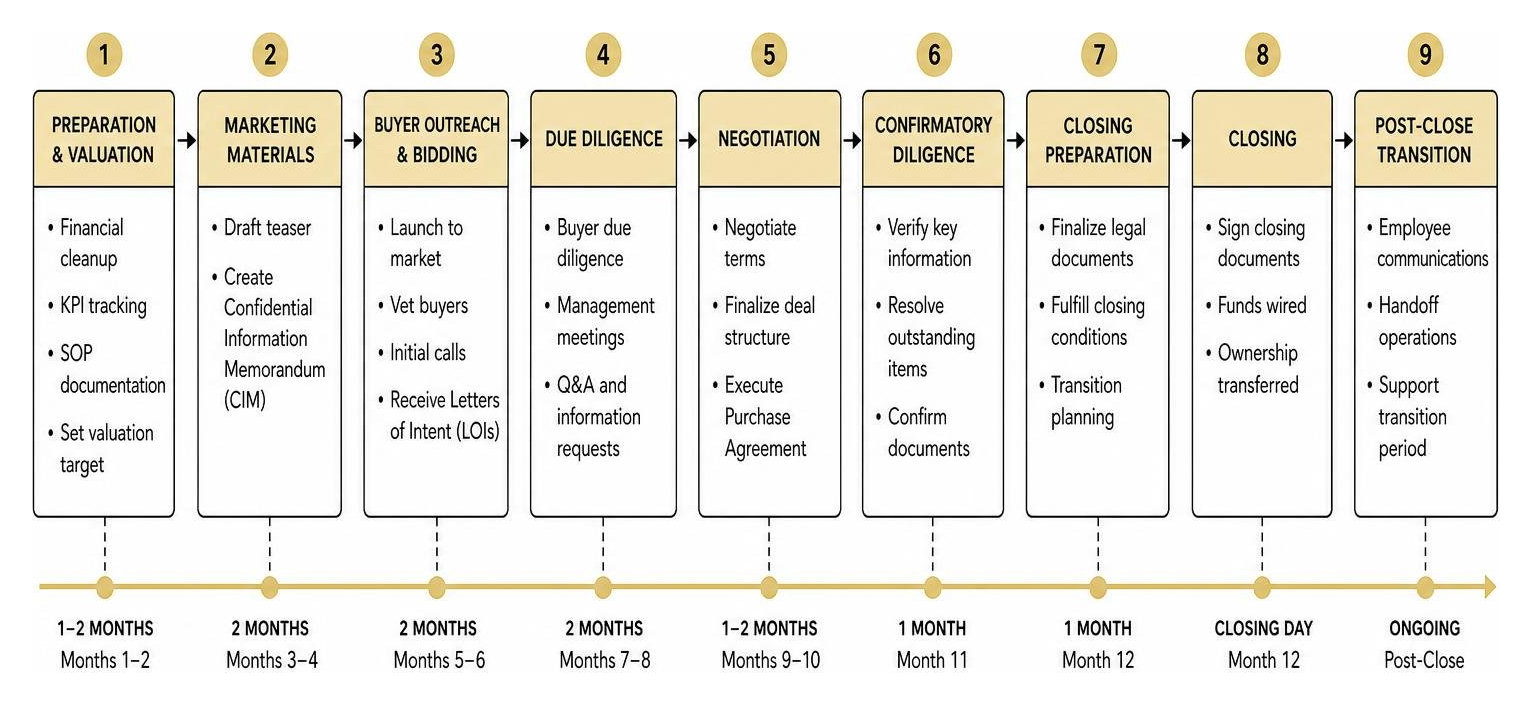
Here is how that timeline breaks down step-by-step:
- Months 1–2: Preparation & Valuation: Financial cleanup, KPI tracking, SOP documentation, and setting a realistic valuation target.
- Months 3–4: Marketing Materials: Drafting the Teaser and the Confidential Information Memorandum (CIM).
- Months 5–6: Buyer Outreach & Bidding: Launching the business to the market, vetting buyers, conducting initial calls, and receiving Letters of Intent (LOIs).
- Months 7–9: Due Diligence: The buyer signs an LOI, securing a 60-to-90-day exclusivity period to audit your books, inspect your fleet, and verify your customer base.
- Months 10–12: Legal Drafting & Closing: Negotiating the Asset Purchase Agreement (APA), resolving license transfers, and closing the transaction.
For a detailed breakdown of each operational step in this timeline, read our guide on the 10 Step Selling Process.
Post-LOI Diligence Risks and Re-Trading Pitfalls
Once a Letter of Intent (LOI) is signed, you enter the exclusivity period. This is the most vulnerable time for a seller. You are locked into negotiating with a single buyer, and if they find discrepancies in your business, they will “re-trade” (lower their offer price).
The most common diligence risks that reduce value post-LOI in plumbing transactions include:
- Callback and Warranty Leakage: Buyers will audit your job history. If your technicians have a high rate of callbacks (returning to fix mistakes on unpaid labor), the buyer will subtract this “leakage” from your normalized earnings.
- Customer Concentration: If a single commercial client or general contractor accounts for more than 15% of your total revenue, the buyer faces a massive risk if that client leaves post-close. This will trigger a valuation discount or a heavy earnout structure.
- W-2 vs. 1099 Misclassification: If you pay your regular service technicians as independent contractors (1099) rather than W-2 employees to avoid payroll taxes, buyers will flag this as a major legal liability.
- Sales Tax Exposure: Many states charge sales tax on service labor. If you have not been collecting and remitting sales tax correctly, the historical liability can wipe out a portion of your sale proceeds.
To protect yourself, make sure your legal counsel uses a robust, battle-tested contract. You can review standard terms in The Essential Business Sale Contract Template and Legal Guide.
How to Sell an Underperforming or Failing Plumbing Business
Not every plumbing business is a highly profitable, platform-ready enterprise. Sometimes, due to health issues, partnership disputes, or severe operational mismanagement, an owner needs to exit an underperforming or failing business.
Can a plumbing business losing money still be sold? Yes.
Buyers (often turnaround specialists or larger local competitors) see value in distressed plumbing companies for their “salvage assets.” These include:
- The Phone Number & Brand: An established phone number that has rung for 20 years represents immediate, organic lead generation.
- The Fleet: Service vans, jetters, and camera equipment can be absorbed into a competitor’s fleet at a discount.
- The Customer List: A database of 1,000+ local homeowners is highly valuable for a competitor looking to build route density.
In a distressed scenario, the average sale price typically ranges from 10% to 40% of its original value or historic earnings multiple. The transaction is almost always structured as an asset sale (where the buyer purchases specific assets and leaves the corporate liabilities and debts with the seller). The key is to act early — it takes 3 to 12 months to sell a failing business, and you must execute the sale while the trucks are still rolling and the phones are still ringing.
Frequently Asked Questions about Selling a Plumbing Business
How long does it take to sell a plumbing company?
An organized, competitive sale process typically takes 9 to 12 months from initial preparation through to closing. Once marketing materials are finalized, receiving initial offers takes about 30 to 45 days, while the subsequent due diligence and legal drafting phases require an additional 60 to 90 days.
What is a realistic valuation multiple for a plumbing business?
Valuation multiples depend heavily on size and operational maturity. Small, owner-operated plumbing companies (under $3 million in revenue) typically trade at 2.0x to 3.5x SDE. Larger, platform-quality operations with strong management teams trade at 5.0x to 8.0x EBITDA in competitive private equity-led transactions.
What happens to my master plumber license after the sale?
Because plumbing contractor licenses are held by individual Master Plumbers rather than the business entity, a clear transition plan is required. The seller can stay on temporarily under a short-term consulting agreement (typically 6 to 12 months), the buyer can utilize their own existing license, or an eligible employee on staff can be promoted to serve as the new licensed qualifier.
Conclusion
The plumbing company sale process is a complex journey, but with the right preparation, it can lead to a life-changing financial exit. The key is to view your business through the eyes of a buyer: focus on cleaning up your financials, reducing owner dependency, building technician depth, and securing recurring service agreements.
At Earned Exits, we specialize in guiding trade founders through this exact process. We provide a seamless, highly organized transaction experience backed by thorough CFO and due diligence support, excellent communication, and customized digital tools designed for maximum efficiency.
If you are ready to explore your options, understand your true market value, or begin planning your exit strategy, we invite you to take the next step. Contact us today to request a confidential consultation and learn how we can help you maximize the value of the business you’ve built.
