


The Complete Guide to Finding a Qualified Business Broker in Florida
What a Business Broker in Florida Does — and Why It Matters for Your Exit
If you’re looking to hire a business broker in Florida, here’s what you need to know upfront:
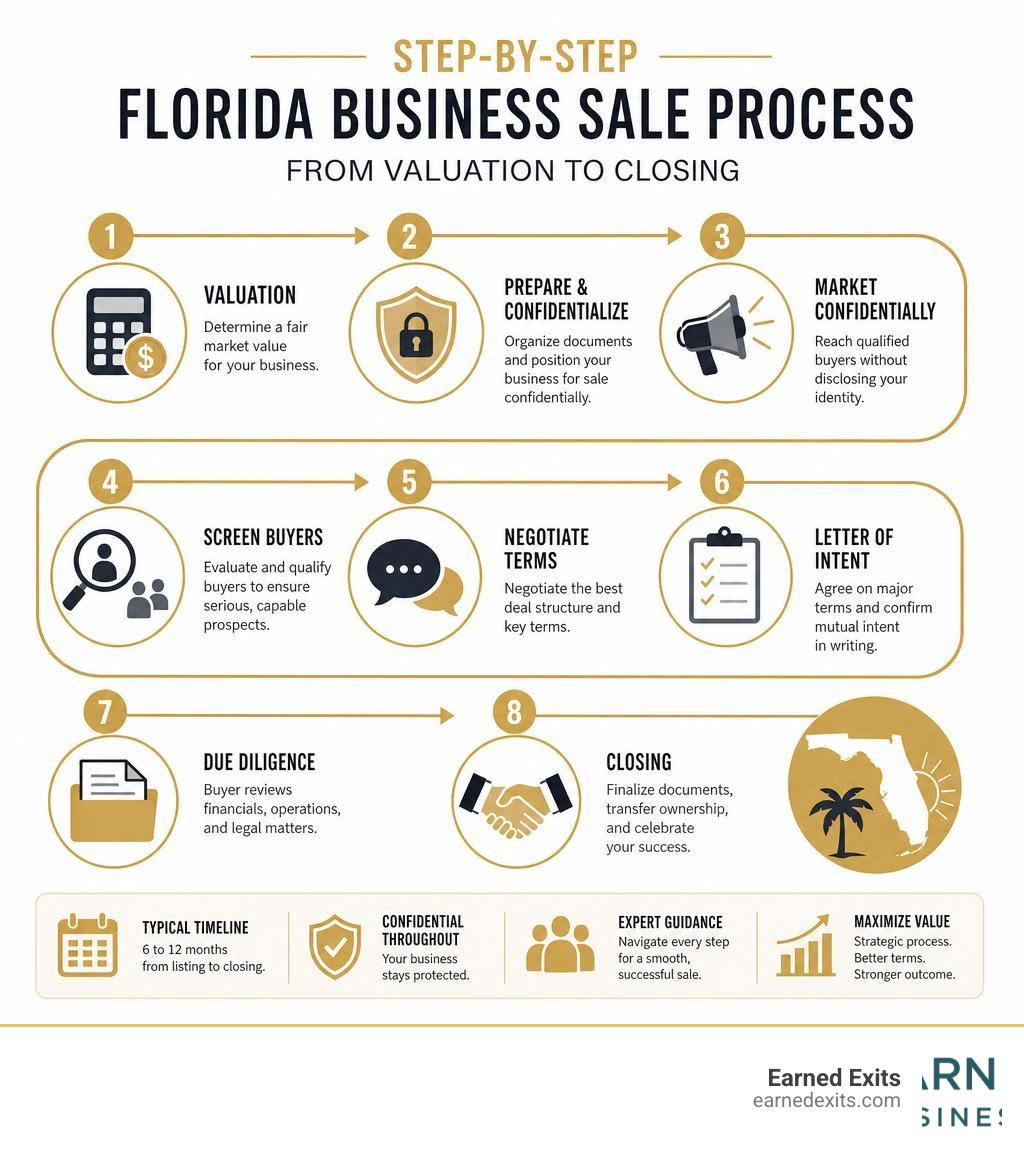
- What they do: A business broker acts as an intermediary between you (the seller) and potential buyers — handling valuation, confidential marketing, buyer screening, negotiation, and closing.
- Why you need one: Selling a business isn’t like selling a house. You can’t put a “for sale” sign in the window without risking your employees, customers, and competitors finding out.
- What to look for: Credentials like the CBI (Certified Business Intermediary) or M&AMI, membership in the Business Brokers of Florida (BBF), and a verifiable track record of closed deals.
- What it costs: Brokers typically work on a success fee (commission), paid by the seller at closing — buyers usually pay nothing directly.
- How long it takes: Most Florida business sales take 6 to 12 months from listing to closing.
Selling a business is one of the biggest financial events of your life — and for most owners, it’s something they’ve never done before. The process involves valuations, confidential marketing, buyer negotiations, and a due diligence phase that can make or break the deal even after you have a signed offer.
Florida’s business market makes this even more complex. The state has one of the most active business brokerage markets in the country, with BBF member brokers closing over $900 million in transactions in 2025 alone. There are 149 listed brokers on the Axial platform, ranging from Main Street specialists to lower-middle-market M&A advisors. Choosing the wrong one — or going it alone — can cost you far more than a broker’s commission.
The difference between a smooth exit and a stalled one often comes down to who’s guiding the process.
I’m Britt Clas, a Business Broker and Partner at Earned Exits Business Brokers, where I’ve helped entrepreneurs navigate the full arc of selling their businesses — from valuation and marketing to negotiation and closing — as part of a team with over $2 billion in completed transactions. My work as a business broker in Florida and beyond has shown me exactly where deals succeed and where they fall apart, and this guide is designed to help you avoid the most common pitfalls.
Why You Need a Business Broker in Florida to Navigate Your Exit
Many business owners wonder, “Can’t I just sell my business myself and save on the commission?”
While it is technically possible, the reality of selling a business without representation is incredibly risky. The primary reason is confidentiality. When you sell a home, you want the entire world to know. When you sell a business, public knowledge of a pending sale can cause key employees to quit, vendors to change payment terms, and competitors to poach your client base.
A professional business broker in Florida acts as a buffer. We market your business using blind listings—describing the opportunity, the financial highlights, and the industry without ever revealing the name or precise location of your company. Before any prospective buyer receives identifying details or sensitive financial documents, they must pass a strict screening process and sign a legally binding Non-Disclosure Agreement (NDA).
Beyond confidentiality, brokers manage the heavy lifting of the transaction. This includes:
- Buyer Vetting: Filtering out “tire-kickers” and ensuring only financially qualified buyers with the necessary liquid capital and experience get access to your records.
- Deal Structuring: Deciding how much of the purchase price will be cash at close, seller financing, or earn-outs.
- Managing Due Diligence: Keeping the buyer’s accountants and attorneys on track without disrupting your day-to-day operations.
To learn more about the tactical advantages of working with an intermediary, check out our deep dive on Florida Business Broker Broker Secrets: Sell Your Company Efficiently.
Key Credentials and the Florida Co-Broking Network
When searching for a broker, you will quickly realize that Florida’s business brokerage market is highly saturated. Because the state requires only a standard real estate license to broker a business, there are many part-time agents who primarily sell residential real estate trying to broker complex business transactions.
To protect your legacy, you need to know how to identify full-time, highly qualified professionals.

Essential Certifications for a Business Broker in Florida
When evaluating potential partners, look for specific, globally recognized industry credentials that demonstrate advanced education and ethical standards:
- Certified Business Intermediary (CBI): Awarded by the International Business Brokers Association (IBBA), this is the gold standard for main-street and lower-middle-market brokers. It requires hundreds of hours of specialized education, passing a rigorous exam, and adhering to a strict code of ethics.
- Merger & Acquisition Master Intermediary (M&AMI): This elite credential is reserved for advisors who specialize in middle-market transactions (typically deals valued between $5M and $50M) and have a proven track record of closing multi-million-dollar transactions.
- Business Brokers of Florida (BBF) Membership: The BBF is the largest state-level business brokerage association in the country. Members must meet strict experience requirements and follow a formal code of ethics.
Working with an accredited professional ensures you aren’t leaving money on the table. For more guidance on vetting your advisor, see The Thorough Guide to Picking a Trusted Business Sale Broker.
How Co-Broking Networks Maximize Exposure
One of the most unique and powerful aspects of the Florida market is its highly organized co-broking system. The Business Brokers of Florida (BBF) operates a proprietary Multiple Listing Service (MLS) specifically for businesses.
In the past 12 months, the BBF network achieved:
- 900+ active member brokers
- 2,200+ active business listings
- 1,140+ successfully sold businesses
- $850M+ in total transaction volume
- Over 12,000 active, registered buyers
When you list your business with a BBF-member business broker in Florida, your listing is instantly shared with hundreds of other brokers across the state. If another broker has a pre-qualified buyer who matches your business profile, they will bring that buyer to the table, and the two brokers will split the commission.
This co-broking model ensures your business gets maximum exposure to local, out-of-state, and even international buyers (who frequently look to Florida for E-2 visa-qualifying business acquisitions). If your broker does not co-broke, they are limiting your business’s exposure to only their internal buyer database.
For a step-by-step breakdown of how to prepare for this market, read A Quick Start Guide to Sell Business Florida.
Valuing Your Florida Business: Methods and Market Segments
Before you take your business to market, you must establish a realistic, defensible valuation. If you overprice the business, it will sit on the market and grow stale. If you underprice it, you leave hard-earned wealth on the table.
Valuation Methodologies Used by a Business Broker in Florida
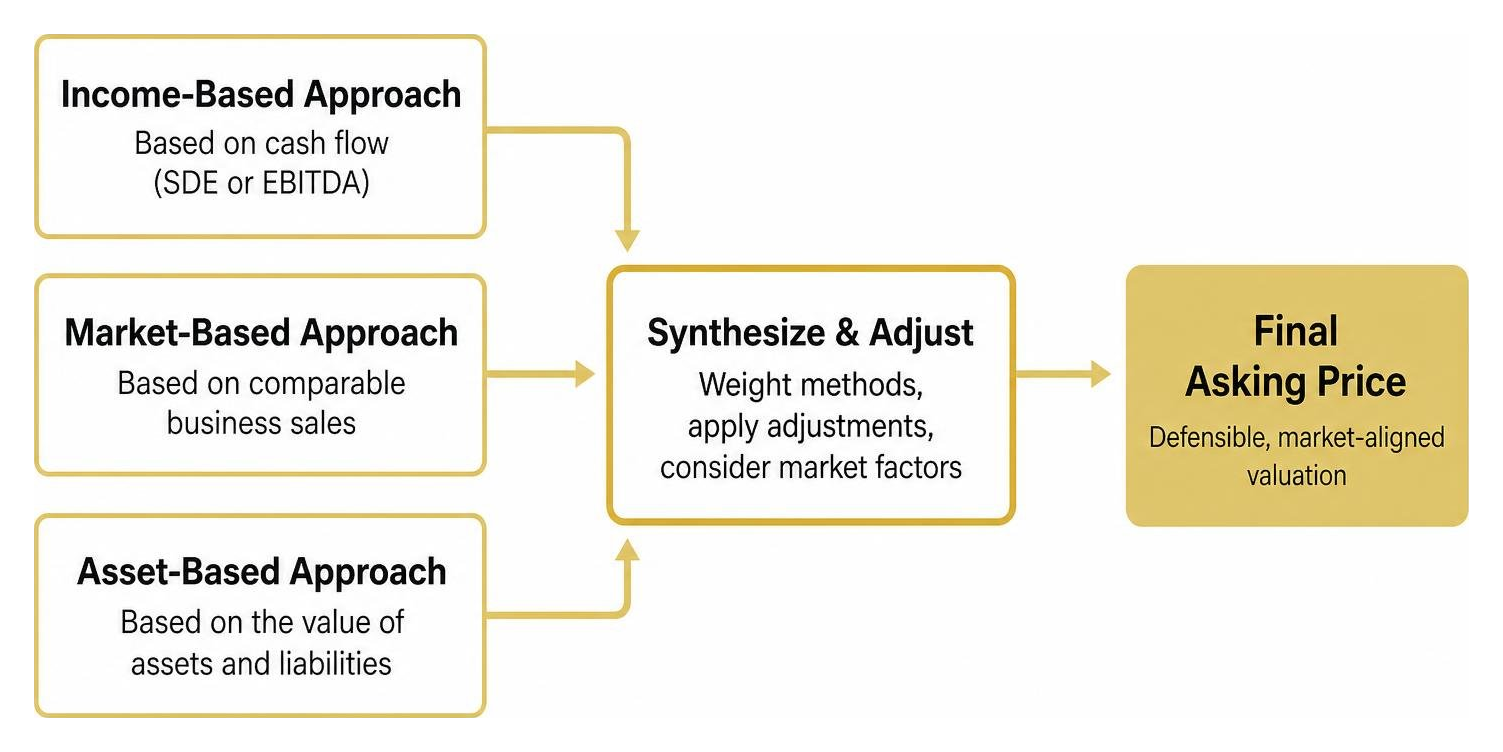
Professional brokers do not rely on “rules of thumb” or generic industry formulas. Instead, they utilize a combination of sophisticated methodologies, often aligned with the Uniform Standards of Professional Appraisal Practice (USPAP):
- Income-Based Approach (Most Common): This method calculates the value of the business based on its historical and projected cash flows. For smaller businesses, brokers calculate Seller’s Discretionary Earnings (SDE). For larger companies, they look at EBITDA (Earnings Before Interest, Taxes, Depreciation, and Amortization).
- Market-Based Approach: This method compares your business to similar companies that have recently sold in Florida. Brokers pull data from closed transaction databases like the BBF MLS and Florida Business Brokers to find realistic local valuation multiples.
- Asset-Based Approach: Primarily used for asset-heavy businesses (like manufacturing or marine transport) or struggling companies, this method calculates the value of all tangible assets (equipment, inventory, real estate) and intangible assets (goodwill, proprietary technology).
Main-Street Businesses vs. Lower-Middle-Market Transactions
The valuation metrics, buyer profiles, and sale structures vary wildly depending on whether your business falls into the “Main Street” category or the “Lower Middle Market.”
| Feature | Main-Street Businesses | Lower-Middle-Market (LMM) |
|---|---|---|
| Annual Earnings | Under $1,000,000 (SDE) | $1,000,000 to $10,000,000+ (EBITDA) |
| Valuation Metric | SDE Multiple (typically 2.0x – 3.5x) | EBITDA Multiple (typically 4.0x – 7.0x+) |
| Primary Buyer | Individual owner-operators, E-2 visa buyers | Private equity, strategic competitors, family offices |
| Financing | SBA 7(a) loans, heavy seller financing | Senior debt, mezzanine debt, equity roll-overs |
| Due Diligence | 30 to 45 days (straightforward financials) | 60 to 90+ days (Quality of Earnings audit) |
Whether you run a local service business on the coast or a multi-location enterprise, understanding where you fit on this spectrum is critical for setting expectations.
Understanding Broker Fees, Timelines, and Track Records
Selling a business is a marathon, not a sprint. Knowing how your broker is compensated, how long the journey will take, and what to look for in their professional history will prevent surprises down the road.

Fee Structures and Commissions
Most business brokers in Florida operate on a success fee model. This means they only get paid when the transaction successfully closes.
- Main-Street Fees: Typically a flat 10% of the total purchase price (including inventory and cash equivalents), with a minimum fee ranging from $15,000 to $25,000.
- Lower-Middle-Market Fees: Larger transactions often use a scaled fee structure, such as the Double Lehman Scale (e.g., 10% on the first million, 8% on the second, 6% on the third, etc.) or a flat percentage between 4% and 6% for larger M&A deals.
The Realistic Sale Timeline
On average, expect the process to take 6 to 12 months from the day you sign the listing agreement to the day funds are wired. The timeline generally unfolds like this:
- Preparation & Valuation (Weeks 1–4): Normalizing your financials, gathering tax returns, and creating the marketing materials.
- Marketing & Buyer Vetting (Months 2–5): Listing the business confidentially, screening buyers, and securing NDAs.
- Offers & Letter of Intent (LOI) (Months 5–7): Reviewing offers and negotiating the basic deal terms.
- Due Diligence & Financing (Months 7–10): The buyer audits your books, inspects assets, and secures SBA or private financing.
- Legal & Closing (Months 10–12): Drafting the definitive asset purchase agreement and closing the deal.
To prepare your questions before interviewing potential brokers, read our guide on 10 Questions to Ask a Business Broker: Choosing the Right Partner for a Meaningful Exit.
Frequently Asked Questions About Florida Business Sales
What are the most common mistakes when choosing a broker in Florida?
The single biggest mistake is hiring a “dual agent” or a residential real estate agent who does business brokerage as a hobby. Business transactions require deep financial literacy, knowledge of tax structures, and an understanding of SBA lending guidelines.
Other common mistakes include:
- Overpricing the business based on emotional value rather than hard financial data.
- Presenting messy financial records that scare away serious buyers during due diligence.
- Failing to maintain strict confidentiality, leading to staff panic and lost customers.
How long does it typically take to sell a Florida business?
As mentioned, the standard timeline is 6 to 12 months. You can speed up this process significantly by having clean, accountant-reviewed financial statements (such as a Quality of Earnings report) ready before you list, and by being open to offering reasonable seller financing (which shows buyers and lenders that you have confidence in the business’s future success).
Who pays the broker commission in a Florida business sale?
In Florida, the seller typically pays the broker commission out of the proceeds of the sale at closing. For buyers, this means you can often leverage the expertise of a professional broker to help you find and acquire a business without paying any direct upfront broker fees.
Conclusion
Finding the right business broker in Florida is the single most critical decision you will make on your path to a successful exit. In a state with an incredibly active market, you need an advisor who doesn’t just list your business on a portal, but actively packages, markets, and defends its value.
At Earned Exits, we pride ourselves on delivering a seamless, organized exit process. We don’t just find buyers; we provide comprehensive CFO and due diligence support to ensure your financials are bulletproof before the buyer’s accountants ever see them. Our advanced client tools and commitment to clear, proactive communication keep your transaction on track from valuation to the final wire transfer.
Ready to find out what your business is worth in today’s market? Let us help you plan your next move. Explore our Earned Exits Business Brokerage Services and schedule your confidential consultation today.
