


The CFO Hero Your Business Sale Needs
Most Business Sales Fail Without the Right Financial Leadership
CFO services for business sale are the structured financial support — from cleanup and valuation to negotiation and closing — that help business owners sell for the highest possible price, on the best possible terms.
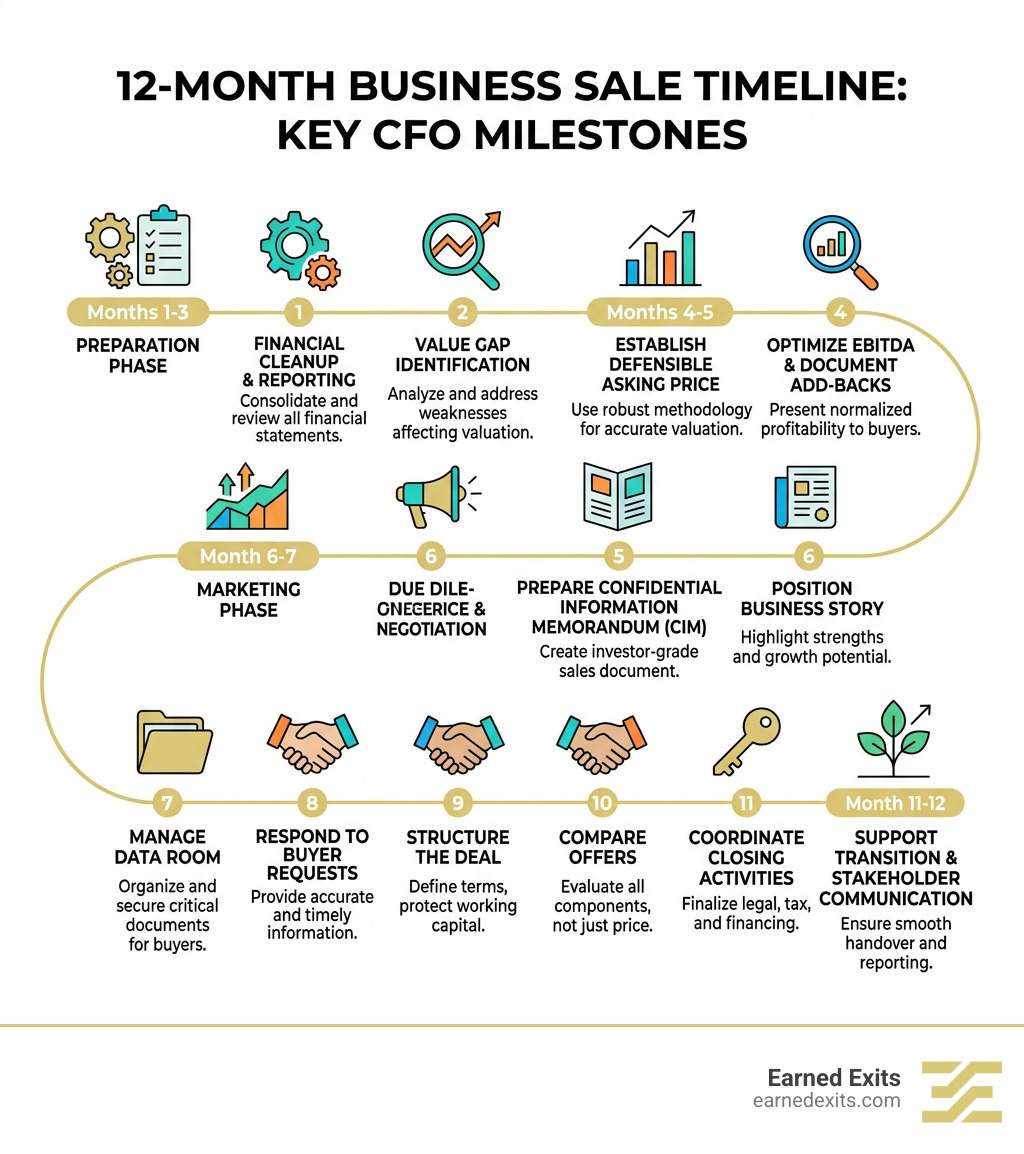
Here’s a quick breakdown of what a CFO does at each stage of your sale:
| Stage | What a CFO Does for You |
|---|---|
| Preparation | Cleans up financials, builds investor-grade reporting, identifies value gaps |
| Valuation | Establishes a defensible asking price, optimizes EBITDA, documents add-backs |
| Marketing | Prepares the Confidential Information Memorandum (CIM), positions your story |
| Due Diligence | Manages the data room, responds to buyer requests, prevents valuation erosion |
| Negotiation | Structures the deal, protects working capital, compares offers beyond just price |
| Closing | Coordinates legal, tax, and financing to get you across the finish line |
| Post-Sale | Supports transition reporting and stakeholder communication |
If you’re selling your business for the first time, the process can feel overwhelming fast. There are buyers, brokers, attorneys, accountants, and term sheets — all moving at once, all with their own agendas.
Most businesses don’t sell — not because they lack value, but because they aren’t prepared.
That’s the hard truth. And it’s exactly where a CFO changes the game.
A CFO isn’t just a number cruncher. In a business sale, they’re the financial architect who makes sure your company looks as valuable as it actually is — and that you don’t leave money on the table when it matters most.
The Strategic Value of CFO Services for Business Sale
When most owners think of a CFO, they imagine a high-priced executive sitting in a corner office. But for small to mid-sized businesses (SMBs) in the $4M–$80M revenue range, a full-time CFO might be overkill. That’s where fractional or outsourced CFO services for business sale come in.
A fractional CFO provides the same high-level strategic leadership as a full-time executive but on a part-time or project basis. This makes expert financial guidance accessible and scalable. You get the “Fortune 500” brainpower without the $300k+ annual salary.
In the context of an exit, this professional acts as your financial architect. They ensure financial transparency, which is the bedrock of buyer trust. If a buyer can’t understand your numbers, they’ll either walk away or “price in” the risk by offering you less money. By utilizing business valuation services, a CFO helps you understand exactly what your business is worth today and what it could be worth with the right tweaks.
Strategic leadership during an exit isn’t just about the past; it’s about the future. A CFO helps develop a strategic exit plan that aligns with your personal goals—whether that’s maximizing cash at close, ensuring employee continuity, or transitioning to family ownership.

How CFO Services for Business Sale Streamline Due Diligence
Due diligence is often the most stressful part of the sale. It’s the “prostate exam” of business—buyers will look into every nook and cranny of your financial history. If you aren’t prepared, this process can drag on for months, leading to “deal fatigue” or, worse, re-trading (where the buyer lowers the price at the last minute because they found a discrepancy).
A CFO manages this by creating a “bulletproof” data room. This is a secure digital repository of every document a buyer might ask for: tax returns, contracts, employee records, and audited financial statements. By using comprehensive due diligence preparation, the CFO anticipates buyer questions before they are even asked. We’ve seen cases where AI-driven analysis was used to organize these data rooms, allowing sales to close in record time—sometimes in as little as 32 days!
Maximizing Net Proceeds with CFO Services for Business Sale
It’s not about what the buyer pays; it’s about what you keep after taxes and fees. A CFO is instrumental in unlocking business valuation methods that favor the seller.
They focus on:
- Tax Optimization: Structuring the deal (asset vs. stock sale) to minimize your tax bill.
- Working Capital Pegs: Negotiating how much cash/inventory stays in the business at close. We’ve seen CFO-led negotiations shift hundreds of thousands of dollars back into the seller’s pocket just by adjusting the working capital calculation.
- Deal Structuring: Evaluating earn-outs, seller notes, and equity rollovers to ensure the terms are as good as the price.
Financial Engineering: Maximizing Valuation and Cash Flow
To a buyer, your business is a machine that produces future cash flow. The more “sharpened” that machine looks, the higher the multiple they will pay. A CFO uses financial engineering to polish that machine.
The most important metric in most sales is EBITDA (Earnings Before Interest, Taxes, Depreciation, and Amortization). However, many SMB owners run personal expenses through the business or have one-time costs that shouldn’t count against their profit. A CFO helps by demystifying add-backs and seller’s discretionary earnings, effectively “adding back” those expenses to show a higher, more accurate profit.
Buyers also look for a “Quality of Earnings” (QofE) report. This is a deep dive that proves your earnings are sustainable and not just a one-time fluke. A CFO helps prepare your books to pass a QofE with flying colors, using realistic valuation metrics to defend your asking price.
Improving Profitability to Attract Premium Buyers
A CFO doesn’t just report the news; they help make it. By performing detailed margin analysis, they can identify which products or customers are actually losing you money. They implement cost controls and improve cash flow management, ensuring that the business is “lean and mean” before it hits the market.
If you want to see where you stand today, you can use a free business valuation tool to get a baseline. From there, a CFO can build a roadmap to increase that value over 12 to 24 months.
Cleaning the Books for Investor-Grade Reporting
“Messy books” are the number one deal killer. If your accounting is done on a “cash basis” for taxes but the buyer wants “GAAP” (Generally Accepted Accounting Principles), you have a problem.
CFO services for business sale include:
- Financial Cleanup: Reconciling old accounts and fixing errors.
- Internal Controls: Proving that the numbers are accurate and that there is no risk of fraud.
- Systems Implementation: Moving from basic spreadsheets to scalable accounting software that provides real-time visibility.
Managing the Sale Process: From Negotiation to Closing
Once the business is ready, the CFO shifts from “architect” to “negotiator.” They work alongside your broker to ensure the financial narrative remains strong.
A key part of this is mergers and acquisitions advisory services. The CFO helps evaluate multiple offers. Sometimes, the highest price isn’t the best deal. An offer of $20M all-cash is often better than an offer of $25M with a $10M earn-out that you might never see. A CFO helps you evaluate deal structures to see the true value of each bid.
Protecting Valuation During Buyer Negotiations
Buyers will try to “chip away” at your price during the closing process. They might say, “We found an issue in your inventory, so we’re dropping our offer by $500k.” A CFO provides narrative control. They anticipate these objections and have the data ready to defend the price.
For example, in a case study of a commercial roofing contractor, proper financial positioning allowed the owner to maintain a high multiple despite market fluctuations. The CFO acts as a buffer, handling the “tough” financial conversations so you can maintain a good relationship with the person who is about to buy your company.
Post-Sale Transition and Stakeholder Communication
The work doesn’t end when the papers are signed. There is a “transition period” where the buyer and seller must work together. The CFO manages:
- Stakeholder Communication: Explaining the transition to employees, banks, and vendors.
- Working Capital Adjustments: Finalizing the “true-up” of cash and debt after the closing date.
- Post-Close Reporting: Ensuring the new owners have the data they need to run the business successfully.
For those looking to stay updated on these complex processes, you can subscribe for M&A insights to receive timely updates on market trends.
CFO-Led Preparation vs. Traditional Business Brokers
There is a massive difference between a traditional business broker and a CFO-led exit partner.
| Feature | Traditional Broker | CFO-Led Exit Partner |
|---|---|---|
| Approach | “List and Wait” | “Prepare and Position” |
| Financials | Uses what you give them | Rebuilds and cleans books first |
| Due Diligence | Facilitator | Active Manager & Defender |
| Valuation | Based on “rules of thumb” | Based on deep financial engineering |
| Targeting | Passive listing | AI-driven buyer identification |
A CFO-led approach focuses on operational control and strategic positioning. Instead of just putting a “For Sale” sign on the lawn, we help you fix the “plumbing and foundation” of the business first so it sells for a premium. If you’re ready to start, our Sell My Business guide and our 10-step selling process provide a clear roadmap.
Avoiding Common Pitfalls in Business Exits
We’ve seen it all. The most common pitfalls include:
- Valuation Erosion: Letting the buyer dictate the value because you don’t have the data to argue back.
- Under-Preparation: Going to market before the books are clean, which leads to failed deals.
- Re-Trading: Allowing the buyer to lower the price during due diligence.
By checking current listings and market readiness, you can see how prepared companies usually look when they successfully attract high-quality buyers.
Frequently Asked Questions
When should a business owner start working with a CFO for exit planning?
Ideally, you should start 12 to 24 months before you want to sell. This gives the CFO time to clean the books, improve margins, and document “add-backs” that increase your EBITDA. However, even if you are 3 months away, a CFO can still add significant value by managing due diligence and protecting you during negotiations.
How do CFO services for business sale improve cash flow?
A CFO looks at your “Cash Conversion Cycle.” They optimize receivables (getting paid faster), manage inventory levels (not tying up cash in the warehouse), and negotiate better terms with suppliers. This “found money” goes straight to your bottom line and increases the business’s value.
What results have clients achieved with CFO-led sales?
Research shows that companies with professional financial leadership achieve much higher multiples. Some notable results include:
- $200M+ in cumulative deal value across various transactions.
- A business selling for $30M within 32 days (doubling the owner’s initial expectation) due to perfect positioning.
- Adding $10M+ in enterprise value to a medical manufacturer simply by improving the quality of their financial reporting.
- Shifting $300k in working capital in the seller’s favor during final negotiations.
Conclusion
Selling your business is likely the most significant financial event of your life. You’ve spent years, maybe decades, building your legacy. Don’t leave the final result to chance.
At Earned Exits, we believe every business owner deserves a “hero” in their corner. By integrating CFO services for business sale into our brokerage model, we provide a seamless, organized process with excellent communication and thorough due diligence support. We use advanced efficiency tools to make the complex simple, ensuring you get the exit you’ve earned.
Ready to see what your business is truly worth? Start your journey with professional business brokerage services today.
