


The Best Advisors for Manufacturing Company Successions
The $6 Trillion Reason Every Manufacturing Owner Needs an Exit Advisor
Hiring the right manufacturing company exit advisor is one of the most important decisions you’ll make as a business owner — and one of the most overlooked.
Here’s a quick overview of what a manufacturing exit advisor does and who the best options are:
| What to Look For | Why It Matters |
|---|---|
| Manufacturing-specific experience | General brokers often miss equipment value, inventory nuances, and regulatory factors |
| Proven M&A transaction history | Closed deals in your revenue range signal real capability |
| Full-process support | Valuation, marketing, buyer qualification, due diligence, and closing under one roof |
| Understanding of buyer types | Strategic buyers, private equity, ESOPs, and MBOs each require a different approach |
| Pre-sale value building | The best advisors help you prepare the business before going to market |
The stakes are enormous. Over the next 15 years, roughly 125,000 family-owned manufacturing businesses will change hands as Baby Boomers retire. This shift is part of the largest generational wealth transfer in history — an estimated $6 trillion across all industries. Yet up to 90% of business exits fail to deliver the results owners expected.
For most manufacturing owners, the business is the retirement plan. The Exit Planning Institute estimates that up to 90% of owners have their personal wealth tied up in their company. That makes getting the exit right not just a business decision — it’s a life decision.
The good news: with the right advisor and enough lead time, a successful exit is absolutely achievable.
I’m Britt Clas, a Business Broker and Partner at Earned Exits, where I’ve guided manufacturing and industrial business owners through the full exit process — from initial valuation to closing — as part of a team with over $2 billion in completed transactions. My work as a manufacturing company exit advisor focuses on helping first-time sellers navigate a complex, high-stakes process with clarity and confidence. Below, I’ve rounded up the most important things to know before you choose your advisory partner.
Related content about manufacturing company exit advisor:
Why You Need a Specialized Manufacturing Company Exit Advisor

Many business owners believe that any general business broker can sell a factory. After all, a business is just revenue and expenses, right?
Not quite. Manufacturing companies are complex, living organisms. Unlike a retail storefront or a digital SaaS platform, a manufacturing facility is tied to massive physical infrastructure, intricate supply chains, specialized labor forces, and strict regulatory standards.
When you decide to transition your business, you aren’t just selling a cash flow stream; you are selling a complex system of production. This is where a generalist broker often falls short, and why partnering with a specialized manufacturing company exit advisor is critical.
Generalist brokers tend to rely heavily on standard financial spreadsheets, applying generic multiples that fail to account for the true value of your operational machinery, proprietary processes, or specialized workforce. A specialized advisor understands the language of the plant floor as well as the boardroom.
Whether you need regional expertise in Alabama, are navigating the unique economic landscapes of the far north with resources like Exit Strategies for Aging Owners – Alaska Business Magazine , or looking to sell a business in Arkansas, choosing a partner with deep industrial roots is non-negotiable.
A dedicated manufacturing business broker knows how to position your company to attract premium buyers. They understand how to translate your operational efficiency, equipment capacity, and quality standards into a narrative that commands a higher multiple. When choosing the right advisory partner for manufacturing successions, you want an advisor who understands how your factory actually makes money.
Navigating Complex Valuations and Equipment Assets
One of the most challenging aspects of exiting a manufacturing business is valuing the physical assets. Machinery appraisal is not a guessing game. A factory floor filled with CNC machines, precision stamping equipment, or custom automation systems represents a massive capital investment.
General brokers often make the mistake of using book value (depreciated asset value on the balance sheet) or ignoring equipment values entirely, assuming they are “baked into” the cash flow multiple. In contrast, specialized advisors look at the orderly liquidation value (OLV) and fair market value in continued use (FMV-CE) of your physical assets.
Furthermore, working capital requirements in manufacturing are notoriously volatile. Raw material inventory, work-in-progress (WIP), and finished goods must be accurately calculated and managed during the transaction. If your inventory management is sloppy, a buyer will use it as a tool to claw back the purchase price during due diligence. To understand how these physical assets interact with your overall valuation, check out The Definitive Guide to Business Valuation.
How a Manufacturing Company Exit Advisor Bridges the Value Gap
The “value gap” is the difference between what a business owner thinks their company is worth and what the market is actually willing to pay. For manufacturers, this gap is often driven by a lack of institutional quality.
Buyers, particularly private equity firms and strategic acquirers, look at a business through the lens of risk and scalability. If your quality systems are undocumented, your machinery is running at maximum capacity with no room for growth, or your financial statements are kept on a cash-basis spreadsheet, buyers will price in that risk by offering a lower EBITDA multiple.
A specialized advisor bridges this gap by engineering a “build-to-sell” transition. They help you clean up your balance sheet, optimize your inventory, and formalize your operational metrics long before you go to market.
A major part of this process involves identifying and presenting normalized earnings. By utilizing Demystifying Add-Backs and Seller’s Discretionary Earnings: Unlocking Business Value, an experienced advisor can legally and strategically add back non-recurring or personal expenses to show the true profit-generating power of your facility, instantly raising your transaction value.
Key Exit Options and Valuation Metrics for Manufacturers

When planning your succession, you aren’t limited to a single path. There are several exit options available, each with its own financial, operational, and legacy implications:
- Strategic Buyer: A competitor, supplier, or customer who buys your business to achieve synergies, acquire your technology, or enter a new geographic market. These buyers usually pay the highest multiples because they can integrate your operations to reduce costs and increase market share.
- Private Equity (PE): Financial buyers looking to acquire a platform company or an “add-on” to an existing portfolio. They typically look for strong management teams and scalable operations.
- Management Buyout (MBO): Selling the business to your existing management team. This is an excellent option for preserving your legacy and rewarding loyal employees, though it often requires the seller to carry a significant portion of the financing.
- Employee Stock Ownership Plan (ESOP): A highly tax-advantaged structure where the company is sold to a trust for the benefit of the employees.
- Family Succession: Passing the torch to the next generation. While emotionally rewarding, it requires careful tax planning and structured leadership training to succeed.
For a deeper dive into choosing the right path for your specific factory, read our comprehensive guide on How to Sell Your Manufacturing Business Without Breaking the Machine.
Strategic Buyers vs. Private Equity Recapitalizations
Understanding the difference between a strategic buyer and a private equity firm is essential. Strategic buyers want to absorb your business. They look for operational synergies—meaning they might consolidate your production into their existing facilities, which can impact your local workforce.
On the flip side, private equity firms often look for a “recapitalization.” In a partial recapitalization, a PE firm might buy 60% to 80% of your business, allowing you to take significant cash off the table while retaining a minority equity stake (often called “rollover equity”). This gives you a “second bite of the apple” when the PE firm eventually grows and sells the consolidated platform down the road.
If preserving your local facility and keeping your leadership team intact is your primary goal, a PE recapitalization or an ESOP may be far more attractive than a full sale to a strategic competitor.
Key Financial and Operational Metrics Driving Multiples
To command a premium valuation, your factory must perform well across several key operational and financial benchmarks. Buyers do not just look at your top-line revenue; they dissect your operational efficiency.
| Metric | Why Buyers Care | Target Benchmark for Premium Multiples |
|---|---|---|
| EBITDA Margin | Measures core operating profitability before financial structuring. | > 15% (depending on the specific manufacturing sub-sector) |
| Capacity Utilization | Shows how much room the factory has to grow without major capital expenditures (CapEx). | 70% – 80% (indicates healthy volume with room for buyer expansion) |
| Customer Concentration | Measures the risk of losing a single major client. | No single customer representing > 15% of total revenue |
| Gross Margin by Product | Proves you know exactly which product lines or custom runs are profitable. | Stable or expanding margins, supported by dynamic pricing |
| Quality Certifications | Lowers the barrier to entry for highly regulated industries (aerospace, medical). | ISO 9001, AS9100, or ISO 13485 active and fully audited |
Preparing Your Factory for Sale: Timeline and Operational Improvements
You cannot prepare a manufacturing plant for sale overnight. A rushed exit almost always results in money left on the table, or worse, a failed transaction.
Ideally, exit planning should begin 3 to 5 years before you want to step away. This timeline gives you enough room to make meaningful operational improvements that directly impact your valuation.
The process begins with a comprehensive facility walk-through and an in-depth operational assessment. This assessment helps identify process bottlenecks, capacity constraints, and supply chain vulnerabilities that a sophisticated buyer’s due diligence team would inevitably exploit to lower their offer. By addressing these issues proactively, you ensure your business is perceived as a low-risk, high-performing asset.
Reducing Owner Dependency and Customer Concentration
The two biggest value killers in mid-market manufacturing are owner dependency and customer concentration.
If you, the owner, are the only person who can quote custom jobs, troubleshoot the main production line, or maintain relationships with your top three clients, your business is not transferrable. If you get hit by a bus tomorrow, the business crumbles. Buyers know this, and they will heavily discount your company—or walk away entirely—if they perceive you are the single point of failure.
To combat this, you must transition your customer relationships to a professional sales team and document your core processes through robust Standard Operating Procedures (SOPs).
Similarly, if 40% of your revenue comes from one customer, a buyer will see a massive risk. If that customer leaves post-sale, the buyer’s investment is ruined. Reducing customer concentration takes time, but it is one of the most effective ways to boost your multiple. For expert assistance in restructuring your business to eliminate these risks, working with specialized Manufacturing Business Brokers can transform your transition.
The Role of a Manufacturing Company Exit Advisor in Pre-Sale Optimization
A great exit advisor doesn’t just list your business; they actively help you optimize it.
During the pre-sale phase, we work with you to integrate your Material Requirements Planning (MRP) or Enterprise Resource Planning (ERP) systems with your financial accounting software. This integration provides real-time inventory visibility and accurate cost-of-goods-sold (COGS) tracking, which is music to a buyer’s ears.
We also help you clean up your financial reporting, moving from simple tax-basis accounting to GAAP-compliant, accrual-based financials. This level of financial clarity speeds up the due diligence process and prevents the dreaded “deal fatigue” that destroys so many transactions.
Frequently Asked Questions About Manufacturing Successions
How far in advance should I start planning my manufacturing exit?
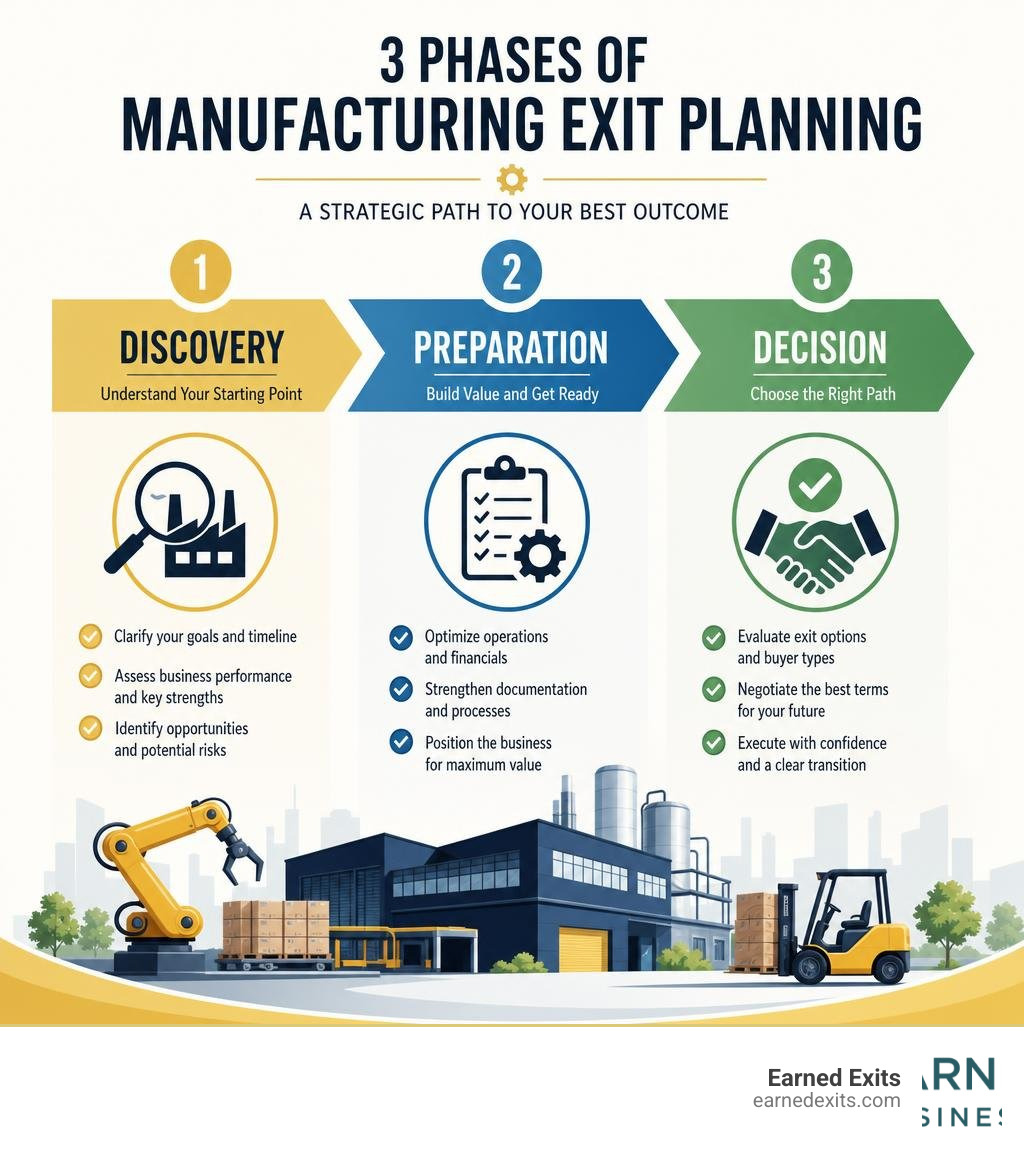
You should start planning 3 to 5 years in advance. This allows you to navigate the three key phases of exit planning smoothly:
- Discovery Phase: Getting an accurate business valuation, understanding your personal financial needs, and identifying operational gaps.
- Preparation Phase: Implementing operational improvements, reducing owner dependency, diversifying your customer base, and documenting SOPs.
- Decision Phase: Determining the ideal buyer type, going to market, and negotiating the structure of the deal.
For more insights on structuring this timeline, working with an experienced advisor can help you map out each phase to maximize value and ensure a seamless transition.
What are the tax and structuring considerations unique to manufacturing exits?
Manufacturing transactions involve unique tax complexities. One of the biggest is the choice between an asset sale and a stock sale.
Buyers almost always prefer asset sales because they can “step up” the tax basis of the physical assets (like machinery and buildings) and depreciate them again, creating a massive tax shield. However, as the seller, an asset sale can trigger significant equipment depreciation recapture taxes, which are taxed at ordinary income rates rather than lower capital gains rates.
An experienced advisor will work alongside your CPA to structure the allocation of the purchase price to minimize your tax burden. They will also help structure any performance-based components, such as earnouts, to protect your financial interests post-closing.
How do current market conditions in 2026 affect manufacturing M&A?
In 2026, the manufacturing M&A landscape is shaped by several macroeconomic forces:
- Interest Rates: While borrowing costs remain higher than the historical lows of the previous decade, there is still an immense amount of “dry powder” (uninvested capital) in private equity, driving competitive bidding for high-quality, institutional-grade manufacturers.
- Reshoring Trends: There is a massive, ongoing push to bring supply chains back to North America. Domestic contract manufacturers, precision machinists, and fabricators are highly sought after by buyers looking to hedge against geopolitical risks.
- Labor Shortages: Factories that have successfully implemented automation (like robotics and advanced CNC systems) to combat skilled labor shortages are commanding premium multiples over those reliant entirely on manual, hard-to-find labor.
Conclusion
Exiting your manufacturing business is the culmination of your life’s work. It is about more than just finding a buyer who will write a check; it is about preserving your legacy, protecting the jobs of the employees who helped you build the company, and securing your financial freedom.
At Earned Exits, we don’t believe in general, one-size-fits-all sales pitches. We combine deep operational intelligence with seasoned M&A expertise to transition founder-led businesses into institutional-quality assets that buyers compete to acquire. Our seamless, organized process provides comprehensive CFO and due diligence support, giving you the tools and communication you need to navigate the sale with complete peace of mind.
If you are ready to explore what your business is worth and how to prepare for a meaningful transition, we are here to help. Contact us today to secure your legacy and take the first step toward a successful exit.
- Get started with a Free Valuation
- Learn more about our Earned Exits Mergers and Acquisitions Advisory Services
- Explore our full suite of Business Brokerage Services
