


The Asset-Based Valuation Formula Explained Simply
What Is the Asset-Based Valuation Formula? (Quick Answer)
The asset-based valuation formula is one of the most straightforward ways to calculate what a business is worth — and if you’re preparing to sell, it’s often the starting point.
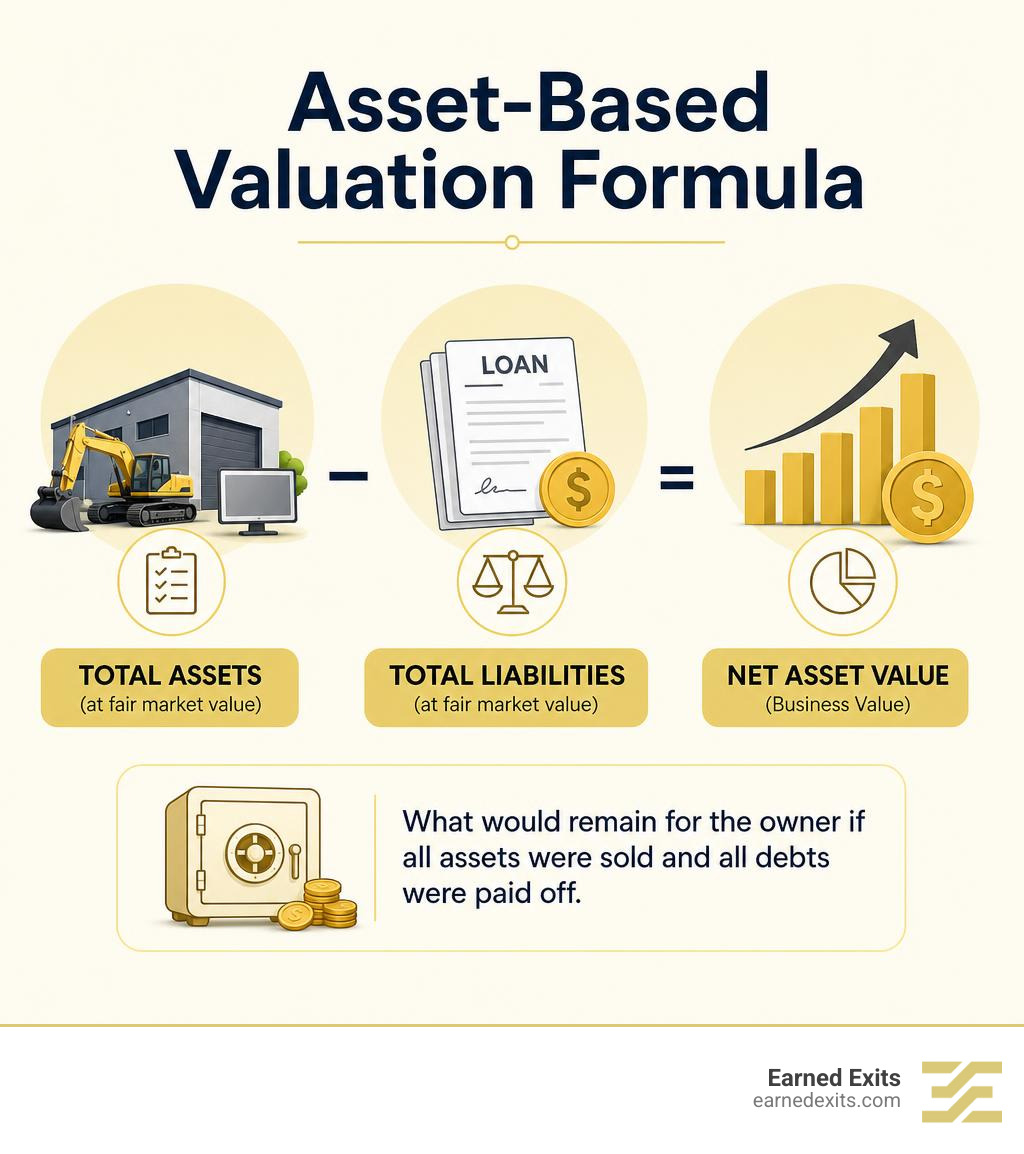
The formula in plain terms:
Business Value = Total Assets (at fair market value) − Total Liabilities (at fair market value)
Here’s a simple example:
| Item | Value |
|---|---|
| Total Assets (fair market value) | $107,000,000 |
| Total Liabilities (fair market value) | $60,000,000 |
| Net Asset Value (Business Value) | $47,000,000 |
The result — often called net asset value or owner’s equity — represents what would remain for the owner if all assets were sold and all debts were paid off.
Most business owners spend years building something valuable without ever running this calculation. Research suggests that 98% of business owners don’t actually know what their company is worth — and if you’re thinking about selling, that’s a costly blind spot.
The asset-based approach cuts through the guesswork. Instead of relying on future earnings projections or what similar businesses sold for, it asks a simpler question: What does this business actually own, and what does it owe?
That simplicity is both its greatest strength and, as we’ll explore, its most important limitation.
I’m Britt Clas, a business broker and partner at Earned Exits, where I’ve guided entrepreneurs through valuations and exits across a wide range of industries — including many asset-heavy businesses where the asset-based valuation formula is the most relevant starting point. Understanding this formula is something I walk sellers through early in our process, because it shapes every conversation that follows.
What the Asset Based Valuation Formula Means
The asset-based valuation method values a business by looking at its net assets. In other words, it starts with the balance sheet, then asks whether the values on that balance sheet reflect economic reality.
That last part matters.
A balance sheet may show a truck at $12,000 because of depreciation, even though it could sell for $40,000. A building may be recorded near its original purchase price, even though the land underneath it has appreciated significantly. On the other hand, inventory may be recorded at cost but only sell for pennies on the dollar if it is obsolete.
That is why a useful asset-based valuation usually relies on fair market value, not just book value.
A helpful overview of this approach is available in this asset valuation overview, and we also cover the method in more depth in our A Complete Asset-Based Valuation Guide.
The formula can be used under two broad assumptions:
- Going concern premise: The business continues operating, so assets are valued based on their use in the business.
- Liquidation premise: The business is shut down and assets are sold, often at orderly liquidation or forced-sale values.
Same formula. Very different results. A machine bolted into a profitable factory may be worth more in use than it is at auction. Business valuation: making accountants and auctioneers argue since forever.
The Basic Asset Based Valuation Formula
The basic formula is:
Net Asset Value = Total Assets − Total Liabilities
This is sometimes called the book value method when it uses the values directly from the company’s financial statements.
Example:
| Item | Amount |
|---|---|
| Cash | $5,000,000 |
| Receivables | $12,000,000 |
| Inventory | $20,000,000 |
| Equipment | $35,000,000 |
| Real estate | $35,000,000 |
| Total Assets | $107,000,000 |
| Bank debt | $45,000,000 |
| Accounts payable and other liabilities | $15,000,000 |
| Total Liabilities | $60,000,000 |
| Net Asset Value | $47,000,000 |
That $47 million is the equity value implied by the assets and liabilities.
However, if the real estate is worth $50 million instead of $35 million, or the inventory is only worth $10 million instead of $20 million, the value changes quickly. That is why the adjusted method is usually more useful than the basic book value method.
Asset Based Valuation Formula for Equity Value
For a more accurate ownership value, use the adjusted net asset formula:
Equity Value = Fair Market Value of Assets − Fair Market Value of Liabilities
If the company has preferred stock, minority interests, or other claims ahead of common owners, those should also be deducted when calculating common equity.
A more detailed version looks like this:
Common Equity Value = Adjusted Assets − Adjusted Liabilities − Preferred Stock − Minority Interests
This distinction matters because business owners often ask, “What is my company worth?” but buyers, lenders, and investors may ask slightly different questions:
- Enterprise value: The value of the whole operating business before debt.
- Equity value: The value left for owners after debt and other claims.
- Common equity value: The value left for common shareholders after senior claims such as preferred stock.
For most small and lower middle-market business owners preparing to sell, the practical question is usually: “After paying off liabilities, what value belongs to me?” That is an equity value question.
Asset Based Valuation Formula for Per-Share Value
For companies with shares, the formula can be taken one step further:
Per-Share Value = Common Equity Value / Shares Outstanding
Example:
| Item | Amount |
|---|---|
| Fair market value of assets | $3,000,000 |
| Debt | ($1,600,000) |
| Preferred stock | ($500,000) |
| Common equity value | $900,000 |
| Shares outstanding | 20,000 |
| Value per share | $45 |
So, if the adjusted asset value is $3 million, debt is $1.6 million, preferred stock is $500,000, and there are 20,000 common shares outstanding, the asset-based value is $45 per share.
That does not automatically mean a buyer will pay $45 per share. It means the asset-based method supports that value based on the company’s net assets.
How to Calculate and Adjust Net Asset Value Step by Step

Calculating net asset value is not just a math exercise. It is a diligence exercise.
At Earned Exits, we often think of this as building a clean, buyer-ready “asset story.” You are not just saying, “Here are the numbers.” You are showing where the numbers came from, why they are supportable, and what a buyer should believe about them.
For more context on how asset-based valuation fits into other approaches, see our business valuation methods guide.
Step 1: List Every Asset the Business Owns
Start with a complete inventory of assets. Do not rely only on the balance sheet, because many valuable assets may be missing or understated.
Common asset categories include:
- Cash and cash equivalents
- Accounts receivable
- Inventory
- Work in progress
- Machinery and equipment
- Vehicles
- Furniture, fixtures, and computers
- Real estate and land
- Leasehold improvements
- Investments and securities
- Intellectual property
- Internally developed software
- Patents, trademarks, and trade names
- Customer lists and contracts
- Favorable leases
- Licenses, permits, and franchise rights
- Deposits and prepaid expenses
For asset-heavy businesses such as manufacturing companies, farms, construction firms, distributors, real estate holding companies, and investment companies, this step can uncover substantial value.
For service businesses, the list may be lighter on tangible assets and heavier on intangible assets. That makes the method harder to apply as a standalone valuation.
Step 2: Revalue Assets From Book Value to Fair Market Value
Next, adjust each asset from book value to fair market value.
Book value is an accounting number. It is generally based on historical cost minus depreciation or amortization.
Fair market value is what a willing buyer and willing seller would likely agree to in an open market, assuming both understand the facts and neither is forced to transact.
Common valuation methods include:
- Market comparables: Recent sales of similar assets.
- Replacement cost: What it would cost to replace the asset with a similar one.
- Depreciated replacement cost: Replacement cost adjusted for age, condition, and obsolescence.
- Appraised value: Independent appraisal for real estate, equipment, or specialized assets.
- Orderly liquidation value: Expected value if assets are sold within a reasonable timeframe.
- Forced liquidation value: Expected value in a quick or distressed sale.
A classic example: a warehouse purchased 20 years ago may have a low book value after depreciation. But if the local real estate market has appreciated, the fair market value could be much higher. The opposite can happen with equipment: a machine may appear valuable on paper but be worth less if it is outdated, damaged, or difficult to resell.
Inventory also needs careful review. Slow-moving, obsolete, seasonal, damaged, or custom inventory may need a haircut. Sometimes a very large haircut. Inventory can look great on a balance sheet and very sad in a warehouse corner.
Step 3: Identify and Adjust All Liabilities
Now list and adjust liabilities. Again, do not stop at the balance sheet.
Common liabilities include:
- Bank loans
- Lines of credit
- Equipment loans
- Accounts payable
- Accrued payroll
- Payroll taxes
- Income taxes owed
- Sales tax obligations
- Lease obligations
- Deferred revenue
- Customer deposits
- Warranty obligations
- Legal claims
- Environmental cleanup costs
- Unfunded pension or benefit obligations
- Related-party balances
- Contingent liabilities
- Off-balance sheet obligations
Deferred revenue is a common item buyers care about. If customers have prepaid for work the buyer must perform later, that obligation affects value.
Related-party balances also deserve attention. Loans to or from owners, family members, related entities, or affiliates may need to be normalized before a buyer can understand the true value of the business.
Step 4: Apply the Adjusted Net Asset Method
Once assets and liabilities are adjusted, apply the adjusted net asset method:
Adjusted Net Asset Value = Adjusted Assets − Adjusted Liabilities
Example:
| Item | Book Value | Fair Market Adjustment | Adjusted Value |
|---|---|---|---|
| Cash | $300,000 | $0 | $300,000 |
| Receivables | $700,000 | ($100,000) | $600,000 |
| Inventory | $1,000,000 | ($250,000) | $750,000 |
| Equipment | $1,200,000 | $500,000 | $1,700,000 |
| Real estate | $2,000,000 | $1,500,000 | $3,500,000 |
| Intangibles | $0 | $400,000 | $400,000 |
| Adjusted Assets | $7,250,000 | ||
| Debt and liabilities | $3,000,000 | $300,000 | $3,300,000 |
| Adjusted Net Asset Value | $3,950,000 |
The adjusted method improves on the basic asset-based approach because it updates old accounting numbers into current economic values.
Technical valuation resources, including asset-based valuation models, often emphasize the same idea: the formula is simple, but the challenge is estimating fair value accurately.
Common Adjustments That Change the Final Value
The biggest value changes usually come from items that are missing, stale, or misunderstood.
Common adjustments include:
- Over-depreciated equipment that is worth more than book value
- Real estate recorded below current market value
- Inventory that is obsolete or overvalued
- Receivables unlikely to be collected
- Internally developed software not recorded as an asset
- Patents, trademarks, or trade names
- Customer lists and recurring contracts
- Favorable lease terms
- Pending litigation
- Environmental or regulatory exposure
- Tax liabilities
- Warranty claims
- Owner-related assets or liabilities
- Personal expenses run through the business
- Related-party loans
The job is not to make the number bigger. The job is to make the number supportable. Buyers can smell “creative valuation” from a mile away, and it smells a lot like stale inventory.
When to Use Asset-Based Valuation Instead of Income or Market Methods
Asset-based valuation is one of the three major business valuation approaches. The other two are income-based valuation and market-based valuation.
| Method | What It Focuses On | Best Used When | Common Tools | Main Limitation |
|---|---|---|---|---|
| Asset-based | What the business owns minus what it owes | Assets drive value or liquidation is possible | Adjusted net asset method, liquidation value | May ignore earnings and goodwill |
| Income-based | Future cash flow and earnings power | The business has stable, predictable profits | DCF, capitalization of earnings, EBITDA or SDE analysis | Depends heavily on forecasts and assumptions |
| Market-based | What similar businesses sell for | Good comparable transaction data exists | EBITDA multiples, revenue multiples, precedent sales | Market data may be thin or misleading |
For a broader overview, see our Definitive Guide to Business Valuation.
Best-Fit Businesses and Scenarios
Asset-based valuation is most useful when the business has meaningful tangible assets or when earnings do not tell the full story.
Best-fit examples include:
- Manufacturing companies
- Farms and agricultural operations
- Construction companies with heavy equipment
- Trucking and logistics businesses
- Real estate holding companies
- Investment companies
- Asset-holding entities
- Distressed businesses
- Businesses with low or inconsistent earnings
- Companies being liquidated
- Bankruptcy or restructuring situations
- Divorce or estate matters
- M&A due diligence
- Businesses with little goodwill beyond asset value
The method is especially helpful for asset-heavy companies with tight margins. A farm, for example, may not generate enormous annual profits, but the underlying land may have appreciated significantly. An income approach may understate value if it focuses only on low rental or operating income.
How Asset-Based Valuation Differs From Income-Based Valuation
Income-based valuation asks: “What future cash flow can this business produce?”
Asset-based valuation asks: “What are the net assets worth today?”
Income methods commonly use:
- Discounted cash flow analysis
- Capitalization of earnings
- Normalized EBITDA
- Seller’s discretionary earnings
- Growth assumptions
- Discount rates or capitalization rates
This approach is often better for profitable businesses where buyers are acquiring future earnings, not just equipment or property.
For small business sales, seller’s discretionary earnings and add-backs are especially important. Add-backs adjust earnings for certain owner-related, nonrecurring, or discretionary expenses. We explain that in our guide to SDE and add-backs.
In short:
- Asset-based valuation is balance-sheet driven.
- Income-based valuation is earnings driven.
If a business has strong earnings and loyal customers, an asset-only approach may undervalue it. If a business has weak earnings but valuable real estate, an income-only approach may undervalue it.
How Asset-Based Valuation Differs From Market-Based Valuation
Market-based valuation asks: “What are similar businesses selling for?”
It uses:
- Comparable company data
- Precedent transactions
- Industry multiples
- EBITDA multiples
- Revenue multiples
- Rules of thumb
- Market sentiment
- Control premiums
- Transaction databases
Market methods are powerful when good comparable data exists. But for private companies, especially niche or asset-heavy businesses, clean market data can be limited.
Academic valuation materials often stress that multiples reflect market expectations, risk, growth, and cash flow assumptions all at once. If you want to go deep into the mechanics of market multiples, these academic valuation notes are a useful resource.
In plain English: market multiples are helpful, but they are not magic. A “5x EBITDA” multiple means little if the comparable companies are not truly comparable.
Why Asset-Based Valuation Often Serves as a Floor Value
Asset-based valuation often acts as a floor value because it estimates what the business is worth based on its salable assets, even if earnings are weak.
This is especially useful when:
- The business is distressed
- Earnings are temporarily depressed
- The owner is considering liquidation
- Buyers are questioning future cash flow
- The company owns valuable land, equipment, or investments
- You need a reasonableness check against income or market values
The floor value concept is tied to the buyer’s substitution principle: a rational buyer generally will not pay far more for a business than it would cost to recreate or acquire equivalent assets, unless the business also provides earnings, goodwill, customer relationships, or strategic value.
If an income-based valuation says the company is worth $2 million, but the adjusted net assets are worth $4 million, we need to investigate. Maybe earnings are understated. Maybe assets are not being used efficiently. Or maybe the business is worth more broken apart than operated as-is.
That is not always a happy answer, but it is a useful one.
Advantages, Limitations, and Hard-to-Value Items

The asset-based valuation method is clear, useful, and often defensible. It is also incomplete when used in the wrong situation.
That is why we rarely look at it in isolation when preparing a business for sale. We want to understand assets, earnings, market demand, buyer behavior, and diligence risk together.
Advantages of the Asset-Based Valuation Method
The main advantages include:
Simple formula
Assets minus liabilities is easy to understand. Owners, buyers, lenders, attorneys, and accountants can all follow the logic.
Tangible support
The value is tied to identifiable assets, which can often be appraised, inspected, photographed, counted, or verified.
Useful for distressed companies
If earnings are low, negative, or inconsistent, asset-based valuation may provide a more realistic measure of value than income methods.
Strong for asset-heavy businesses
Manufacturing, construction, agriculture, real estate, and investment entities often benefit from this approach.
Helpful in liquidation planning
If the business may shut down, the asset method helps estimate what could be recovered from asset sales after liabilities.
Supports buyer due diligence
A clean asset schedule helps buyers understand what they are acquiring and what adjustments may be needed.
Useful for purchase price allocation
In a business sale, buyers often care about how purchase price is allocated among equipment, inventory, real estate, goodwill, and other assets.
Can establish a negotiating floor
It gives owners a grounded view of minimum value before discussing earnings multiples or strategic premiums.
Limitations of the Asset-Based Valuation Method
The limitations are just as important.
It may ignore future earnings
A profitable business is usually worth more than the resale value of its assets.
It can miss goodwill
Customer loyalty, reputation, brand strength, trained employees, systems, and recurring revenue may not appear on the balance sheet.
It is weak for many service businesses
A consulting firm, agency, medical practice, or software company may have limited tangible assets but meaningful earnings power.
It can be backward-looking
Balance sheets show what has been acquired and recorded, not necessarily what the business can become.
Fair market value can be hard to prove
Specialized equipment, niche inventory, and unique property may require professional appraisals.
Public reporting may not show fair values
Many companies report assets at historical cost or depreciated values, not current market values.
It can be expensive to do well
Equipment appraisers, real estate appraisers, IP specialists, and tax advisors may be needed.
It does not measure earnings quality
A company with strong assets but poor operations may not command a strong going-concern sale price.
The formula is simple. The judgment behind it is not.
Challenges With Intangible Assets and Off-Balance Sheet Items
Intangible assets are where asset-based valuation gets tricky.
Common intangible assets include:
- Brand value
- Customer relationships
- Customer lists
- Patents
- Trademarks
- Trade names
- Proprietary processes
- Internally developed software
- Databases
- Licenses
- Favorable contracts
- Non-compete agreements
- Workforce in place
- Goodwill
- Key-person value
Some intangible assets are recorded only when acquired from another company. Internally developed brand value, customer loyalty, or software may not be fully reflected on the balance sheet.
Off-balance sheet items can also change value materially. These may include:
- Pending lawsuits
- Environmental obligations
- Operating lease commitments
- Personal guarantees
- Unrecorded tax exposure
- Contingent earnouts
- Warranty obligations
- Customer refund obligations
- Favorable or unfavorable long-term contracts
- Key employee retention risks
For example, a business with a 98% customer retention rate may have a valuable customer base even if the balance sheet says nothing about it. On the other hand, a pending legal claim may reduce value even if it has not yet become a recorded liability.
This is why the adjusted net asset method is more useful than a quick book value calculation. It forces the valuation process to look beyond the obvious.
Frequently Asked Questions About the Asset Based Valuation Formula
What Is the Asset Based Valuation Formula in Plain English?
The asset based valuation formula is:
Business Value = Assets − Liabilities
In plain English: add up what the business owns, subtract what it owes, and the remainder is the net value available to owners.
For a more accurate result, use fair market values instead of book values:
Adjusted Net Asset Value = Fair Market Value of Assets − Fair Market Value of Liabilities
Think of it as resetting the balance sheet to today’s real-world values.
Is Book Value the Same as Fair Market Value?
No. Book value and fair market value are different.
Book value is based on accounting records. It often reflects historical cost, depreciation, amortization, and tax accounting.
Fair market value reflects what an asset would likely sell for in the current market.
Examples:
- A fully depreciated truck may still sell for $30,000.
- Land purchased decades ago may be worth many times its book value.
- Inventory recorded at cost may be worth less if it is obsolete.
- Equipment may be worth less than book value if it is outdated or hard to resell.
Book value is a starting point. Fair market value is usually the better measure for valuation.
Should You Use Asset-Based Valuation When Selling a Business?
Yes, but usually as one part of the valuation process.
Asset-based valuation is especially useful when selling:
- Asset-heavy businesses
- Distressed businesses
- Companies with inconsistent earnings
- Businesses with valuable real estate or equipment
- Holding companies
- Businesses where liquidation value matters
- Companies undergoing buyer due diligence
However, if your business has strong earnings, recurring revenue, valuable customer relationships, or meaningful goodwill, an asset-based value may be too low by itself.
When we prepare owners for sale, we often compare:
- Asset-based value
- Income-based value
- Market-based value
- Buyer diligence findings
- Deal structure and financing realities
That combination gives a more complete picture than any single formula. If you are unsure where to start, our guide to stop guessing your business value is a practical next step.
Conclusion
The asset-based valuation formula is simple:
Fair Market Value of Assets − Fair Market Value of Liabilities = Net Asset Value
But a reliable valuation depends on the work behind the formula.
You need a complete asset inventory, accurate liability schedule, fair market adjustments, realistic treatment of intangibles, and clean documentation. For asset-heavy companies, distressed situations, liquidation planning, and M&A due diligence, this method can be one of the most useful ways to understand value.
At Earned Exits, we help business owners turn messy financials and asset lists into a clear, organized, buyer-ready valuation story. Our process includes strong communication, CFO-level diligence support, and practical tools that make the sale process more efficient.
If you are preparing to sell, do not rely on a rough guess or a stale balance sheet. Get the numbers clean before buyers start asking hard questions.
You can learn more or start the process here: Get business valuation support.
