


Texas Business Valuation Methods Every Founder Should Know
How to Estimate Your Business Value in Texas
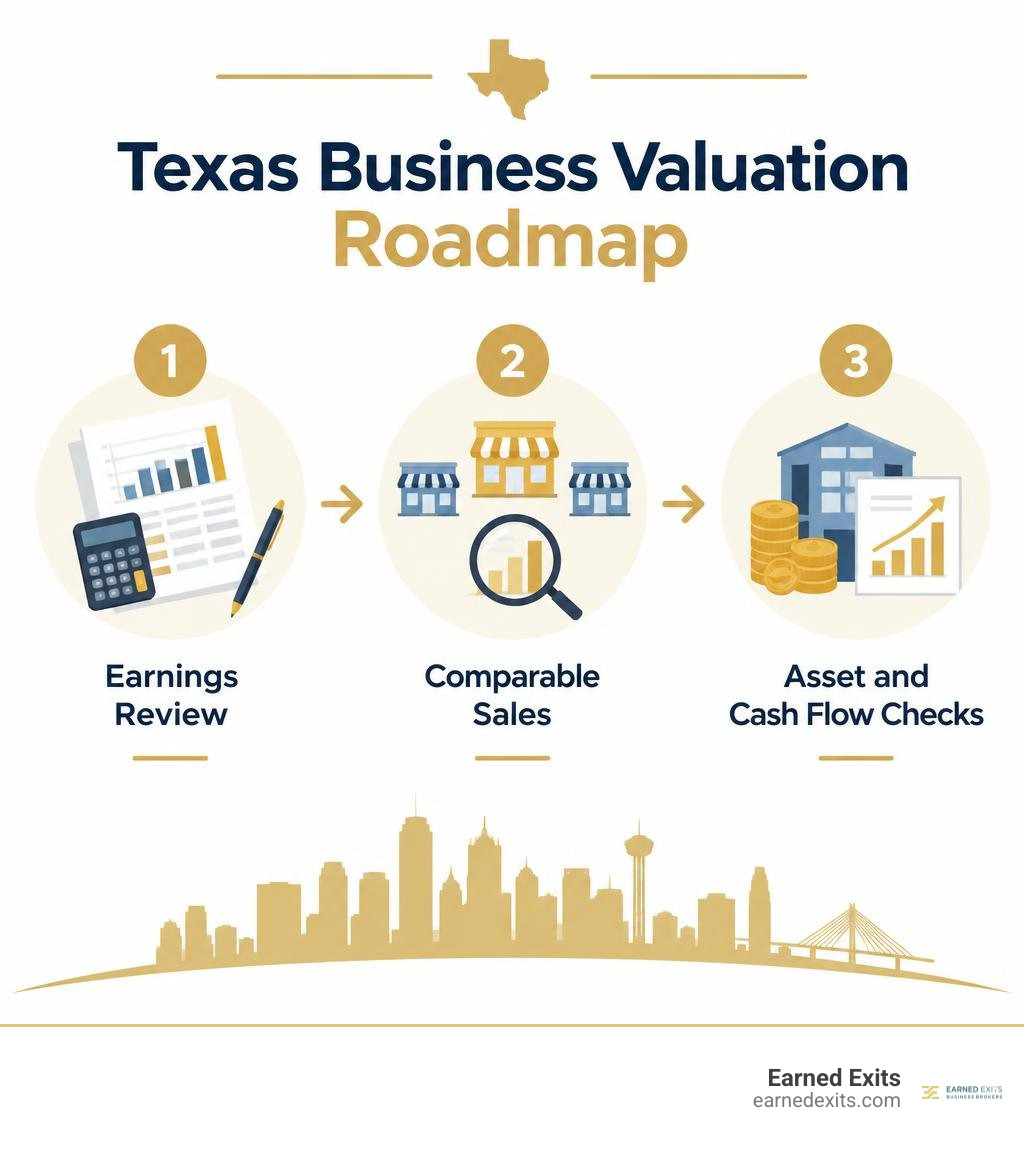
To estimate your company’s worth, start with your recent earnings. Review one-time costs and owner-specific expenses, then compare your company with similar businesses that have sold. An appraiser may also look at future cash flow or the value of your assets. No single method gives every business the right answer; the best fit depends on your industry, records, and reason for valuing the company.
If you are preparing to sell, a clear valuation gives you a starting point for pricing and buyer conversations. It also helps you spot questions buyers may raise during due diligence.
I’m Britt Clas, a business broker and partner at Earned Exits, where I help founders with exit planning, valuation, and the sale process. In this guide to business valuation in Texas, I’ll explain the main methods so you can make sense of your numbers before you go to market.
Related resources:
Core Frameworks for Business Valuation in Texas

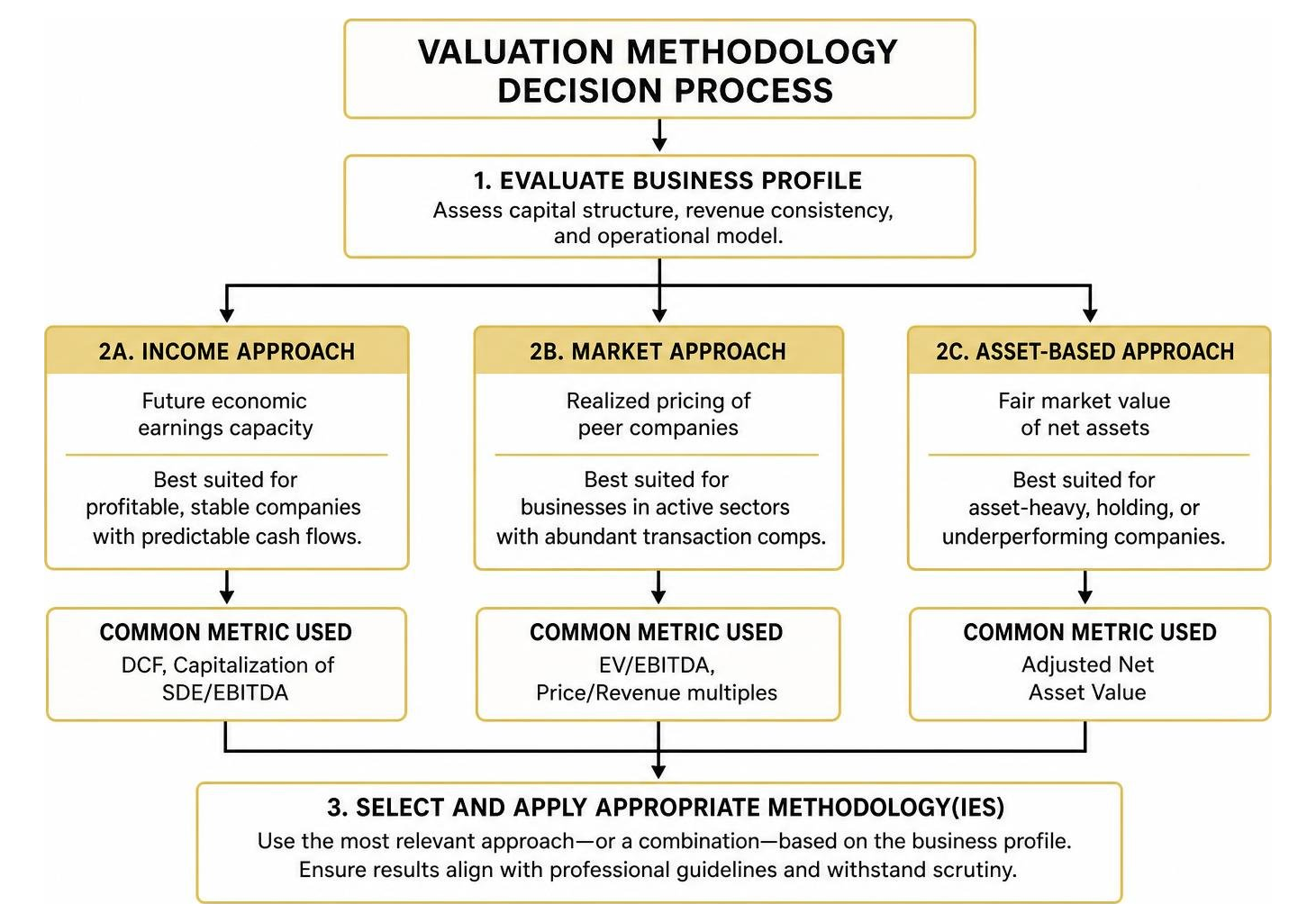
When valuing a business in the Lone Star State, professional appraisers rely on three universally recognized pillars: the Income Approach, the Market Approach, and the Asset-Based Approach. Each framework offers a distinct lens on enterprise worth, and choosing the right combination depends heavily on your capital structure, revenue consistency, and operational model.
As outlined in the definitive guide to business valuation, no appraisal exists in a vacuum. Valuators must adhere to rigorous professional guidelines, such as those established under the Internal Revenue Manual, to ensure the figures withstand regulatory scrutiny, buyer due diligence, or courtroom cross-examination.
| Valuation Approach | Primary Focus | Best Suited For | Common Metric Used |
|---|---|---|---|
| Income Approach | Future economic earnings capacity | Profitable, stable companies with predictable cash flows | DCF, Capitalization of SDE/EBITDA |
| Market Approach | Realized pricing of peer companies | Businesses in active sectors with abundant transaction comps | EV/EBITDA, Price/Revenue multiples |
| Asset-Based Approach | Fair market value of net assets | Asset-heavy, holding, or underperforming companies | Adjusted Net Asset Value |
For capital-intensive operations or holding entities, exploring a comprehensive asset-based valuation guide helps founders understand how tangible machinery, real estate, and liabilities interact to form a baseline floor value.
Discounted Cash Flow and SDE Capitalization
The Income Approach rests on a fundamental financial principle: a company is worth the present value of all its future cash streams. For established middle-market businesses with multi-year forecast reliability, appraisers often deploy the Discounted Cash Flow (DCF) model. This methodology models projected free cash flows over a 5-to-10-year period and discounts them back to the present day using a Weighted Average Cost of Capital (WACC) that accounts for operational and market risk.
For owner-operated small-to-midsize enterprises (SMEs), capitalization of Seller’s Discretionary Earnings (SDE) is frequently the primary standard. SDE recasts historical net income by adding back:
- Owner compensation and discretionary perks
- Non-operating or personal expenses run through the business
- Non-recurring legal or one-time consulting fees
- Depreciation, amortization, and interest
Clean financial hygiene is critical here. Knowing how a skilled CFO maximizes business valuation ensures these add-backs are defendable, documented, and clearly presented to buyers without raising red flags.
Market Multiples and Transaction Comparables
The Market Approach mirrors real estate appraisal logic by examining what buyers actually pay for similar businesses in comparable markets. Appraisers pull from databases of guideline public companies (GPC) and precedent private transactions (M&A databases like DealStats).
Multiples are expressed relative to key operational benchmarks:
- Enterprise Value to EBITDA (common for mid-market and private equity deals)
- Price to SDE (standard for businesses with under $5M in revenue)
- Enterprise Value to Revenue (common in hyper-growth tech and SaaS models)
Context matters significantly across regional micro-economies. What applies in coastal markets may not align directly with local Texas trends, making it vital to understand what it takes to sell a business in Texas when comparing regional pricing trends.
Industry-Specific Valuation Drivers Across the Lone Star State

Texas is not a single, uniform business market. A business in the Permian Basin carries radically different asset profiles, labor costs, and market sensitivities than a digital health startup in Austin or a global logistics firm operating out of the Port of Houston. Appraisers must adjust multiples and risk rates based on local economic conditions, labor trends, and supply chain infrastructure across Houston, Dallas-Fort Worth, Austin, San Antonio, and West Texas.
For founders in the DFW metroplex, reviewing what Dallas business owners need to know provides clear insight into how local corporate migrations and regional buyer pools influence deal terms.
Energy, Heavy Equipment, and Manufacturing Nuances
The industrial footprint of Texas demands specialized valuation capabilities. The American Society of Appraisers (ASA) Houston Chapter plays a significant role in setting professional standards for this space, hosting its annual Energy Valuation Conference to dissect commodity cycles, reserves valuation, and capital expenditure trends.
In oilfield services, manufacturing, and heavy contracting, appraisers face unique challenges:
- Equipment Depreciation: Machinery must often be appraised at Fair Market Value in Continued Use rather than simple book value.
- Capital Expenditure (CapEx) Load: High ongoing reinvestment requirements reduce free cash flow, impacting income-based multiples.
- Client Concentration: Energy services often rely heavily on a small handful of exploration and production operators.
If you run an oilfield or industrial enterprise, evaluating an oilfield service company valuation framework is critical to normalizing volatile commodity-driven revenue swings. Similar asset scrutiny applies when valuing a construction business, where bonded backlogs, WIP (work-in-progress) schedules, and heavy fleet maintenance cycles directly impact the bottom line.
Tech Ecosystems, Healthcare, and Emerging Markets
In tech-heavy hubs like Austin and North Dallas, valuations pivot away from hard assets toward Annual Recurring Revenue (ARR), customer acquisition cost (CAC), lifetime value (LTV), and churn rates. High-growth software and IT service firms command strong multiples if they demonstrate proprietary IP, scalable architecture, and low customer concentration.
Healthcare entities face strict regulatory standards. Appraisers must navigate:
- Stark Law and Anti-Kickback Statute compliance
- Payer mix variations (Medicare, Medicaid, private commercial insurance)
- Provider retention and non-compete enforceability
Acquirers expanding their geographic footprint often look at regional acquisitions to enter these growing sectors. Reviewing strategies to buy an established Houston business can show how institutional buyers assess corporate governance, compliance histories, and human capital when evaluating healthcare and service providers.
Legal, Corporate, and Tax Triggers for Appraisals
Valuations are not just used for exits. Texas businesses routinely require accredited appraisals to resolve legal disputes, facilitate equity ownership transitions, and comply with state and federal tax codes.
Whether structuring partner buy-ins, updating corporate buy-sell agreements, or benchmarking against external markets, having an audit-ready appraisal protects owners from unnecessary tax penalties and contentious litigation. When the time comes to exit entirely, understanding how to sell your Texas company for top dollar requires having your corporate balance sheet aligned with current market expectations.
When to Secure a Formal Business Valuation in Texas
A formal valuation report is essential when an informal estimate won’t satisfy regulatory, legal, or institutional standards. Common triggers include:
- Marital Dissolution: Texas is a community property state. Valuing a marital estate requires separating personal goodwill from commercial enterprise value.
- Shareholder Buyouts & Buy-Sell Agreements: Appraisals establish fair market pricing for departing partners, preventing internal equity disputes.
- Estate and Gift Tax Filings: The IRS scrutinizes discounted transfers of closely held family business stock.
- IRC Section 409A Compliance: Private companies issuing stock options to employees must obtain independent valuations to establish the strike price.
- SBA Lending & Institutional Financing: Lenders require certified third-party valuations for loan underwriting on change-of-ownership deals.
Instead of relying on rule-of-thumb multiples or guesswork, founders should stop guessing what your business is worth and establish clear documentation early in their lifecycle.
Litigation Support, Forensic Accounting, and Economic Damages
When business disputes enter state or federal courts in Texas, business valuation intersects directly with forensic accounting and economic damages modeling. Expert witnesses use valuation methodologies to calculate:
- Lost Profits: Projections of net earnings the business would have realized but for a breach of contract or tortious interference.
- Diminution of Value: Quantifying the permanent reduction in enterprise value caused by an unlawful act.
- Shareholder Oppression & Dissenters’ Rights: Calculating “fair value” for minority owners under Texas corporate statutes.
These professionals must provide deep audit trails, reconstruct incomplete general ledgers, and defend their statistical discount rates under intense cross-examination.
Appraiser Credentials and Intangible Asset Standards
A business valuation is only as credible as the appraiser who signs it. In transaction negotiations, tax disputes, and court proceedings, credentials determine whether an appraisal report is accepted or dismissed.
Owners should look for professionals holding recognized certifications, as detailed in our review of everything about accredited business valuation. When presented to buyers or regulatory bodies, a certified, professional business valuation report provides the defensive rigor necessary to withstand close scrutiny.
Key professional credentials to look for include:
- ASA (Accredited Senior Appraiser): Granted by the American Society of Appraisers, representing deep technical mastery across business and intangible asset valuation.
- CPA/ABV (Accredited in Business Valuation): Awarded by the AICPA to CPAs who specialize in corporate finance, valuation theory, and forensic accounting.
- CVA (Certified Valuation Analyst): Granted by the National Association of Certified Valuators and Analysts (NACVA).
- CFA (Chartered Financial Analyst): A premier designation focused on advanced portfolio management, investment analysis, and complex corporate capitalization.
Valuing Intangibles and IP in Texas Deals
In modern enterprise transactions, intangible assets often represent the vast majority of total value. Appraisers use specialized methodologies to isolate and quantify these off-balance-sheet resources:
- Relief from Royalty Method: Used for patents, proprietary technology, and trademarks by calculating the hypothetical royalties saved by owning the asset outright.
- Multi-Period Excess Earnings Method (MPEEM): Primarily deployed for customer relationships and contracts, isolating the cash flows generated exclusively by that asset.
- Enterprise vs. Personal Goodwill: In Texas, enterprise goodwill (attributable to brand reputation, processes, and corporate location) is transferable in a sale, whereas personal goodwill (tied strictly to the individual founder’s skills and reputation) is not part of the transferable corporate estate.
The Expert Witness Process in Texas Courts
When valuation reports enter litigation, appraisers must satisfy strict legal standards. In Texas courts, expert testimony must meet the Daubert and Robinson standards of reliability and relevance.
During depositions and trial testimony, opposing counsel will scrutinize the appraiser’s peer group selection, discount rates, terminal growth assumptions, and normalization adjustments. Valuators who combine technical certification with court-tested communication skills are essential for defending complex financial conclusions before judges and juries.
Frequently Asked Questions About Business Valuation in Texas
What credentials should I look for in a Texas business appraiser?
Look for appraisers holding credentials from nationally recognized bodies, including the ASA (Accredited Senior Appraiser) from the American Society of Appraisers, the CPA/ABV (Accredited in Business Valuation) from the AICPA, or the CVA (Certified Valuation Analyst) designation. The appraiser must also demonstrate compliance with Uniform Standards of Professional Appraisal Practice (USPAP) and provide evidence of ongoing professional education in regional market dynamics.
How is personal goodwill separated from enterprise goodwill under Texas law?
Under Texas family law and corporate litigation precedent, personal goodwill is tied directly to the founder’s individual reputation, professional license, and personal relationships, while enterprise goodwill belongs to the company’s institutional structure, contracts, brand, and workforce. Appraisers separate the two using multi-attribute allocation models or “with and without” scenarios, determining what portion of revenue would persist if the founder exited immediately without a non-compete agreement.
How long does a formal valuation process take and what documentation is required?
A comprehensive business valuation typically takes 2 to 4 weeks, depending on company complexity and record availability. Documentation required includes:
- Last 3 to 5 years of federal tax returns and profit-and-loss statements
- Current balance sheet and year-to-date interim financials
- Detailed depreciation schedules and asset registers
- Commercial lease agreements and major customer/vendor contracts
- Corporate organization charts and capitalization tables
Conclusion
Understanding the true value of your business is the foundation of any successful transition, growth plan, or legal strategy. Whether you are navigating an upcoming retirement, restructuring ownership, or preparing for a competitive exit in Texas’s dynamic economy, clear numbers eliminate surprises and protect your equity.
At Earned Exits, we combine seasoned business brokerage experience with thorough financial review to guide founders through every phase of the valuation and sale process. If you want to understand your market standing and explore your options, connect with our team for confidential business valuation services tailored to your industry and growth goals.
