


Streamline Your Exit by Auditing Key Legal Liabilities in Advance
Start With a Pre-Sale Legal Audit
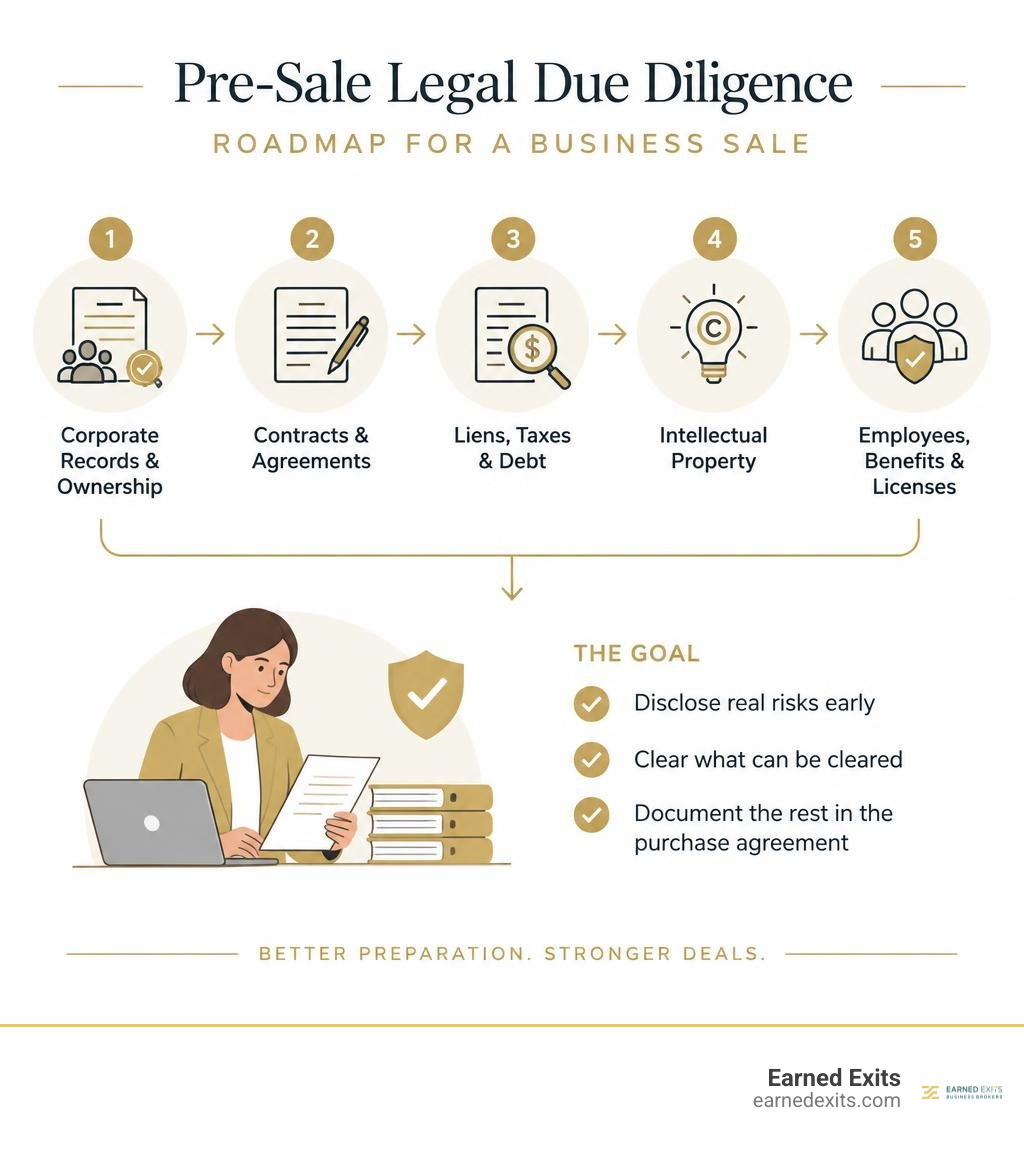
A business sale legal checklist helps you find and fix ownership, contract, lien, tax, employee, and intellectual-property problems before a buyer finds them in due diligence. Start by gathering these records into a secure data room:
- Corporate formation documents, board approvals, stock or membership ledgers, and shareholder agreements.
- Material customer, vendor, loan, lease, software, and insurance contracts, with any change-of-control or assignment limits flagged.
- UCC lien searches, tax records, payoff letters, and releases for every debt or security interest.
- Trademark, domain, patent, copyright, and employee or contractor IP-assignment records.
- Employee agreements, contractor classifications, benefit obligations, and required licenses or permits.
The goal is simple: disclose real risks early, clear what can be cleared, and document the rest accurately in the purchase agreement and disclosure schedules. Missing consents, unassigned IP, outdated corporate records, or old liens can delay closing, lower the price, or give a buyer a reason to renegotiate.
I am Britt Clas, a Business Broker and Partner at Earned Exits, where I help founders prepare, market, negotiate, and close business sales. My work with the business sale legal checklist focuses on helping owners organize the details that protect deal value, employees, and the company’s legacy.
Business sale legal checklist terms explained:
Asset Sale vs. Stock Sale: Legal Structures and Transfer Mechanics
Choosing between an asset sale and a stock sale shapes your liability exposure, tax outcome, and the entire transfer process. Understanding how these mechanics differ helps you evaluate buyer offers and determine how to organize a clean and profitable company exit.
In an asset purchase, the buyer acquires specific, itemized assets and assumes only explicitly named liabilities. Unknown or legacy exposures—such as historical tax errors, past wage-and-hour violations, or unasserted product claims—generally remain behind with the selling entity.
Because title to each individual asset transfers separately, this structure requires distinct conveyancing instruments:
- Individual bills of sale for physical equipment and inventory
- Intellectual property assignments
- Contract novations and third-party lease assignments
- Real estate deeds
For tax reporting, both parties must file IRS Form 8594 (Asset Acquisition Statement) to allocate the aggregate purchase price across seven statutory asset classes under Internal Revenue Code Section 1060. Buyers typically favor asset transactions because they receive a stepped-up tax basis in depreciable assets while leaving historic liabilities behind.
In a stock purchase (or membership interest transfer for an LLC), the buyer purchases the legal equity of the operating company itself. The corporate entity remains entirely intact; only ownership changes. Consequently, all historic liabilities—known, unknown, or contingent—transfer to the buyer by operation of law.
Sellers often prefer stock transactions because proceeds are generally taxed at favorable long-term capital gains rates, and operational continuity is simpler since customer and vendor agreements remain with the same entity.
| Transaction Attribute | Asset Sale | Stock Sale |
|---|---|---|
| Legal Transfer Mechanism | Title transfer of specific assets via Bill of Sale, IP assignments, and contract assignments. | Transfer of stock certificates or LLC units via a Stock Purchase Agreement. |
| Liabilities Transferred | Only specifically assumed liabilities; unknown liabilities stay with seller. | All historic and contingent liabilities remain with the target company. |
| Tax Reporting & Allocation | Requires IRS Form 8594 allocation across statutory asset classes (IRC Section 1060). | Capital gains treatment for selling shareholders; no statutory basis step-up without Section 338(h)(10) election. |
| Third-Party Consents | High: Every material customer, vendor, and lease contract requires assignment or novation. | Moderate: Triggered primarily by specific change-of-control provisions. |
| Entity Clean-Up Post-Close | Seller entity remains active; owner must wind down, liquidate, and formally dissolve. | Seller exits the corporate entity entirely upon closing of the equity transfer. |
Assignability and Change-of-Control Contract Provisions
One of the most frequent sources of closing friction involves third-party consent requirements. In an asset sale, transferring a commercial agreement constitutes an assignment, which almost universally requires prior written consent from the counterparty. In a stock sale, an explicit assignment does not occur, but standard agreements frequently include “change-of-control” clauses that treat an ownership shift exceeding 50% as a prohibited transfer without consent.
When preparing for diligence, review every core commercial agreement using a comprehensive due diligence checklist for corporate acquisitions to identify:
- Commercial real estate leases: Landlords routinely hold approval rights over lease assignments, often requiring tenant financials, net-worth minimums, or personal guarantees from the buyer.
- Key customer contracts: Enterprise master service agreements often allow termination if the business changes ownership.
- Software and technology licenses: Proprietary enterprise platforms (ERPs, proprietary APIs) often require formal transfer fees or re-licensing upon a transaction.
- Supplier agreements: Exclusive vendor distributorships frequently include explicit anti-assignment restrictions.
Regulatory Approvals, Licensing, and Permits Transfer
Operational licenses and municipal permits rarely transfer automatically. Because regulatory bodies operate on distinct statutory timelines, discovering licensing issues late in due diligence can delay a closing by months.
Map out your regulatory footprint early:
- Operating & Environmental Permits: EPA filings, hazardous materials storage, and air quality permits require formal agency review, Phase I site assessments, and administrative re-filings.
- Municipal and State Licenses: Health department clearances, local business permits, and specialized trade registrations (e.g., electrical, plumbing, or contractor licenses) must be renewed or transitioned into the buyer’s entity name.
- Professional Credentials: If the company relies on a qualifying broker, master technician, or licensed professional of record, you must formalize how those responsibilities transition post-closing.
The Master Business Sale Legal Checklist: Pre-Sale Corporate Audit
Buyers scrutinize corporate records to confirm that you actually have the legal authority to sell the business and that no shadow shareholders can emerge later to contest the transaction.

Core Corporate Records on Your Business Sale Legal Checklist
Before entering market negotiations, verify that your minute book and corporate records are complete. When drafting transaction paperwork, referencing the essential business sale contract template and legal guide ensures your corporate structure aligns with legal requirements.
Make sure your corporate records include:
- Articles of Incorporation or Organization: Certified copies from your state of formation, including all historical amendments.
- Bylaws or Operating Agreement: The governing operational rules, clearly showing member voting thresholds, drag-along rights, tag-along rights, and transfer restrictions.
- Board and Shareholder Consents: Documented meeting minutes and formal resolutions authorizing the transaction and naming authorized signers.
- Stock Ledger / Capitalization Table: A complete, unbroken ledger of all issued shares or membership units, stock options, warrants, and cancelled certificates.
- Shareholder Agreements: All existing buy-sell agreements, rights of first refusal, or voting trusts that must be formally waived or terminated prior to close.
Clearing UCC Liens, Tax Encumbrances, and Debt Obligations
A buyer’s lender will not fund a deal if existing creditors hold active security interests against your business assets. All encumbrances must be identified, quantified, and formally cleared before funds change hands.
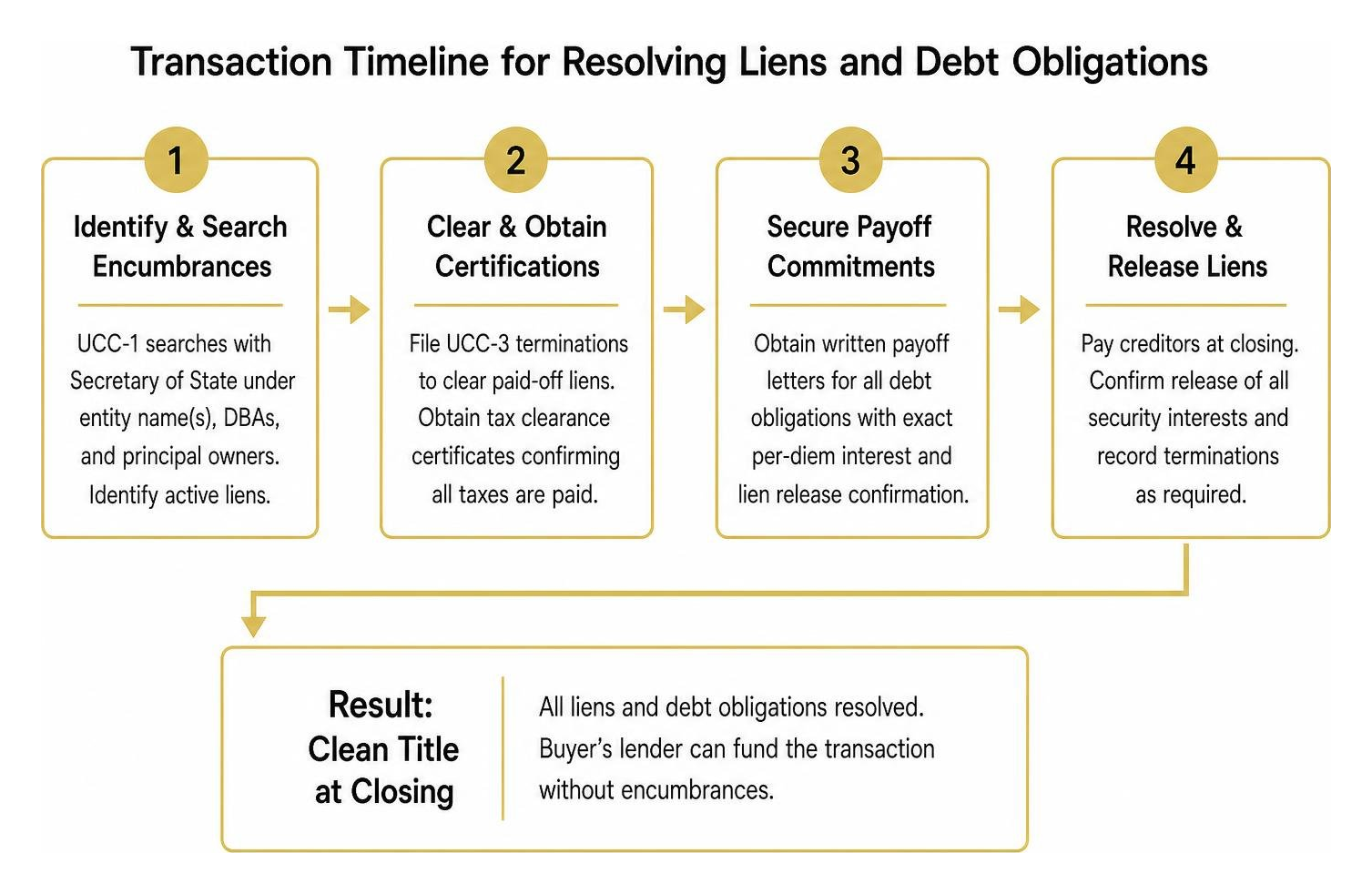
- UCC-1 Financing Statements: Conduct comprehensive searches with the Secretary of State under your legal entity name, historical entity names, DBAs, and principal owners’ names. Outdated UCC-1 filings from paid-off equipment loans or lines of credit must be cleared via formal UCC-3 termination statements.
- Tax Clearance Certificates: Request formal certificates of good standing and tax clearance from state departments of revenue to prove that all sales, use, payroll, and franchise taxes have been paid in full.
- Creditor Payoff Letters: For all active term debt, lines of credit, or promissory notes, secure written payoff letters from lenders specifying the exact per-diem interest and confirming that all security interests will be released upon receipt of closing funds.
- SBA Loan Restrictions: If your company has existing government-backed financing, review our sba loan business sale guidance to address required approvals and avoid unexpected closing delays.
Intellectual Property and Workforce Legal Due Diligence
Intangible assets and workforce relationships often represent the core value of a lower-middle-market business. A single missing signature can jeopardize that value during diligence.

Intellectual Property, Trademarks, and Domain Transfer Procedures
Securing clear chain of title over your intellectual property is critical. When executing an IP audit, reference Nancy Fallon-Houle’s legal due diligence planning checklist to ensure that:
- Registered Trademarks and Patents: All federal and state registrations are current, active, and registered in the business entity’s name rather than in an individual founder’s name.
- Proprietary Source Code and Trade Secrets: Formal assignments are in place for any custom code, formulas, databases, or specialized operational processes.
- Domain Names and Digital Assets: All corporate domains, registrar accounts, web hosts, social media profiles, and cloud assets are registered under corporate administrative accounts rather than personal employee emails.
Employment Agreements, Restrictive Covenants, and Contractor Audits
Workforce compliance is one of the most heavily scrutinized areas in modern M&A. Buyers and their lenders will review your employment practices in detail, an analysis documented in depth when mastering the art of the due diligence report.
Key areas to audit include:
- Invention Assignment Agreements: Confirm that every current and former employee, officer, and independent contractor who participated in creating software, designs, or proprietary processes signed an enforceable “work made for hire” and IP assignment agreement.
- Worker Classification: Auditing Form 1099 independent contractors is essential. Misclassifying workers who should legally be W-2 employees introduces substantial tax and wage-and-hour liability that buyers will require you to indemnify.
- Restrictive Covenants and Noncompetes: Ensure that key executives have signed enforceable non-disclosure and non-solicitation agreements. Noncompete clauses should be structured in compliance with state-specific legal standards regarding duration, geography, and scope.
- Accrued Benefits: Fully calculate and document accrued vacation, paid time off (PTO), unpaid bonuses, and severance obligations so they can be credited or adjusted at closing.
Structuring the Definitive Purchase Agreement to Prevent Re-Trades
The definitive purchase agreement turns negotiated terms into binding legal obligations. When sellers experience price cuts or re-trades during late-stage diligence, vague disclosures or misaligned legal protections are often the cause.
Essential Disclosure Schedules for Your Business Sale Legal Checklist
The disclosure schedules qualify the representations and warranties you make in the purchase agreement. If an issue is disclosed on a schedule, the buyer generally cannot make an indemnification claim for it post-closing. If it is omitted, you can be held personally liable for damages.
When preparing to draft your business purchase agreement without costly closing delays, compile detailed disclosure schedules covering:
- Litigation and Disputes: Any past, pending, or threatened litigation, administrative investigations, or customer settlement demands.
- Customer and Supplier Concentration: Accurate customer concentration schedules reflecting revenue distribution.
- Material Contracts: Complete lists of all contracts exceeding specific financial thresholds or multi-year terms.
- Asset Condition and Inventory Reserves: Documented equipment repairs, obsolete inventory reserves, and write-down histories.
- Environmental and Compliance Matters: Historical environmental reports, remediation records, and safety citations.
Earnouts, Seller Financing, and Post-Closing Liability Mechanisms
Most transactions in the lower middle market involve deferred payments or risk-sharing mechanisms. Protecting your future proceeds requires careful legal structuring:
- Seller Promissory Notes: If providing seller financing, secure a formal promissory note, security agreement, personal guarantee, and a clear intercreditor subordination agreement relative to the buyer’s primary lender.
- Earnout Protections: When deferring valuation to post-closing metrics, review the ultimate guide to structuring and negotiating earnouts to establish clear accounting definitions, audit rights, and operating covenants.
- Indemnification Caps and Baskets: Limit your post-closing liability through a “deductible basket” (the minimum claim threshold before an indemnity obligation begins) and an aggregate “cap” (typically 5% to 15% of enterprise value).
- Escrow Holdbacks: Standard escrows hold 5% to 10% of the purchase price with a third-party escrow agent for 12 to 24 months to satisfy potential warranty claims.
Frequently Asked Questions About Business Sale Legal Requirements
What legal pitfalls cause deals to collapse right before closing?
Deals often falter near closing due to preventable legal issues:
- Unrecorded Liens and Tax Clouds: Surfacing active tax or creditor liens during final lien searches.
- Withheld Landlord Consents: Commercial landlords refusing lease assignments or demanding onerous security deposits.
- Missing Equity Holders: Discovering that a former partner, spouse, or early investor still holds uncancelled equity or claim to shares.
- Worker Misclassification Liabilities: Uncovered liabilities concerning 1099 contractor classifications that trigger payroll tax exposure.
- Material Adverse Change (MAC): Unanticipated drops in monthly financial performance occurring between LOI and the closing date.
What searches must a buyer perform prior to executing a definitive agreement?
Buyers conduct comprehensive public searches to confirm clear title and uncover hidden liabilities. Reviewing the Purchaser legal checklist and search procedures highlights the standard public-record searches:
- Secretary of State UCC-1 financing statement searches across all relevant jurisdictions
- Federal and state tax lien searches
- County-level real property encumbrance and mortgage searches
- Federal, state, and county civil litigation and bankruptcy records
- USPTO trademark, patent, and copyright assignment records
- State good standing and franchise tax clearance verifications
When should an owner assemble legal schedules before going to market?
The most successful transactions begin legal preparation 12 to 24 months prior to going to market. Assembling your minute books, cleaning up cap tables, renewing IP filings, and resolving historical disputes early ensures that when an LOI is signed, due diligence moves forward quickly. Rushing disclosure schedules in the final days of a transaction creates unnecessary friction and increases the risk of post-closing liability.
Conclusion
Closing a business sale successfully requires more than finding the right buyer—it requires thorough legal preparation. By resolving corporate record discrepancies, obtaining required contract consents, clearing encumbrances, and compiling accurate disclosure schedules well in advance, you protect your enterprise value and maintain control throughout the transaction.
At Earned Exits, we help lower-middle-market founders prepare their businesses for clean exits. Our team coordinates the due diligence process and supports you at every step of marketing and closing.
Ready to protect your company’s value and plan your transition? Schedule a confidential consultation to sell your business with Earned Exits today.
