


Stop Guessing What Your Business is Worth
Why You Need a Basic Business Valuation
Many business owners view valuation as a “one-and-done” task performed only at the moment of sale. In reality, understanding your basic business valuation is a vital tool for strategic planning. Think of it as a financial health check-up that provides insights into your company’s vitality and endurance over time.
There are several critical scenarios where a formal valuation becomes indispensable:
- Mergers and Acquisitions (M&A): Whether you are buying a competitor or selling your life’s work, you need a defensible number to anchor negotiations.
- Investment and Fundraising: Venture capitalists and angel investors require a clear valuation to determine how much equity they receive for their capital. For instance, seed-stage startups often face high discount rates (70-90%) because of the inherent risk.
- Tax Compliance: The IRS has specific standards for how businesses should be valued for estate and gift taxes. A key reference here is IRS Revenue Ruling 59-60, which outlines that for closely held corporations, earnings are often the most important factor, though asset value and dividend-paying capacity also matter.
- Shareholder Disputes and Buy-Sell Agreements: If a partner wants out, a pre-defined valuation method prevents legal gridlock.
- Divorce Proceedings: In many states, a business is considered a marital asset that must be equitably distributed based on its fair market value.
- Estate Planning: To protect your heirs and minimize tax burdens, you need an accurate assessment of your business’s worth today.
At Earned Exits, we provide Business Valuation Services to help owners navigate these complex milestones with clarity and data-backed confidence.
Core Methods for Basic Business Valuation
Valuation isn’t a monolith; it’s a toolkit. Most professionals use a combination of three “pillars” to triangulate a fair price. Relying on just one method can lead to a skewed perspective—for example, an asset-based approach might drastically undervalue a software company with massive profits but few physical tools.

Comparison of Valuation Approaches
| Approach | Best For… | Key Logic |
|---|---|---|
| Market Approach | Established industries with many sales | “What are others paying for similar businesses?” |
| Income Approach | Profitable companies with steady growth | “What is the present value of all future profits?” |
| Asset Approach | Asset-heavy or struggling businesses | “What is the net value of everything the company owns?” |
The Market Approach and Multiples
The market approach is often the most intuitive. It looks at “comparables”—similar businesses that have sold recently. The most common tool here is the multiplier. You take a financial metric (like EBITDA or Revenue) and multiply it by an industry-standard number.
- EBITDA Multiples: For companies with less than $20 million in sales, multiples typically fall between 3 and 6.
- Revenue Multiples: Common in high-growth tech. A software firm with $10 million in revenue might be valued at 3x revenue ($30 million), while a service firm might only see 0.5x revenue.
- Seller’s Discretionary Earnings (SDE): This is vital for small to mid-sized businesses. It adds back the owner’s salary and perks to show the true “earnings power” of the business.
For a deeper dive into how these function for your specific size of company, see our guide on Unlocking Business Valuation: Exploring Methods and Market Multiples for Small to Mid-Size Businesses.
The Income Approach: Discounted Cash Flow (DCF)
The Income Approach, specifically the Discounted Cash Flow (DCF) method, is highly favored by investors because it accounts for the “time value of money.” It asks: How much is a dollar earned five years from now worth to me today?
To calculate a DCF, you project the business’s free cash flow for a set period (usually 5-10 years) and then “discount” those future dollars back to the present using a discount rate. This rate accounts for inflation, opportunity cost, and risk. For example, a business expected to earn $2 million annually for five years, discounted at 10%, has a DCF value of approximately $7.6 million.
While DCF is analytically rigorous, it relies heavily on assumptions about the future. For more on the technical side of these models, Investopedia’s breakdown of valuation methods is an excellent resource.
The Asset-Based Approach
This method focuses on the company’s balance sheet. It is often used as a “floor” for valuation—the absolute minimum the business is worth.
- Book Value: Calculated as Total Assets minus Total Liabilities. If a company has $12 million in assets and $5 million in debt, its book value is $7 million.
- Liquidation Value: This is what remains if you had to sell everything off quickly (often at a discount). If those $12 million in assets only fetch $8 million in a fire sale, the liquidation value drops to $3 million after paying the $5 million debt.
The asset approach is best for manufacturing or real estate holding companies but often ignores “goodwill”—the intangible value of your brand, reputation, and customer loyalty.
Key Factors and Value Drivers
Two businesses with identical profits can have vastly different valuations. Why? Because of Value Drivers. These are the “intangibles” that make a buyer feel safe or excited about the future.

- Growth Prospects: A company in a stagnant market is worth less than one in a booming industry.
- Financial Transparency: Can you prove your numbers? Clean, audited, or reviewed financials reduce “risk” for a buyer, which increases your multiple.
- Customer Concentration: If 80% of your revenue comes from one client, your risk is sky-high. Diversified revenue equals a higher valuation.
- Owner Dependence: If the business stops running the day you go on vacation, it isn’t a business—it’s a job. Buyers want a “turnkey” operation.
To understand how to “clean up” your earnings to show the highest possible value, read our article on Demystifying Add-Backs and Seller’s Discretionary Earnings.
Understanding Enterprise Value vs. Equity Value in Basic Business Valuation
It is vital to distinguish between these two terms during a sale:
- Enterprise Value (EV): This is the value of the entire business operation. It’s like the price of a house.
- Equity Value: This is what the owner actually takes home. It is the Enterprise Value minus debt, plus any cash on hand.
Think of the Microsoft example: As of late 2025, Microsoft had a market capitalization (Equity Value) of roughly $3.83 trillion based on its share price and outstanding shares. However, an acquirer would also look at their total debt and cash reserves to find the Enterprise Value.
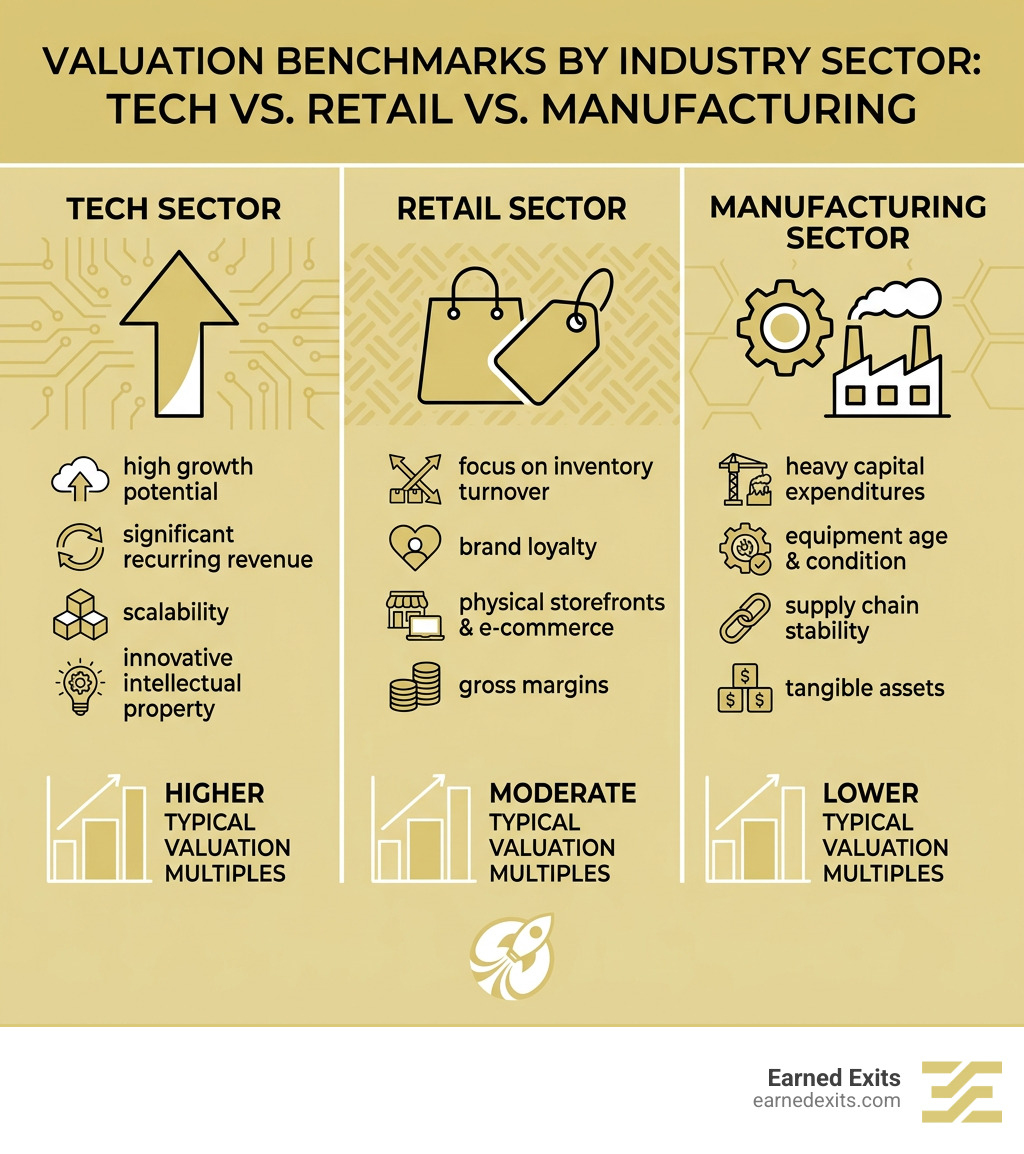
Industry-Specific Factors in Basic Business Valuation
Every industry has its own “rulebook.”
- SaaS (Software as a Service): Valued on Monthly Recurring Revenue (MRR) and churn rates.
- Service Firms: Valued on margins and the strength of the professional team.
- Manufacturing: Heavily influenced by the age and condition of equipment (CAPEX).
Preparing to Maximize Value Before a Sale
You wouldn’t sell a house without painting the walls and fixing the leaky roof. The same applies to your business. We recommend starting this process 12-24 months before a planned exit.
- Financial Normalization: Remove “lifestyle” expenses from the books so a buyer sees the true profit.
- Knowledge Distribution: Document every process. If it’s only in your head, it has no value to a buyer.
- Secure Relationships: Ensure customer contracts and vendor agreements are transferable.
If you’re curious about where you stand today, you can explore our Valuation resources to begin the preparation process.
Frequently Asked Questions about Business Valuation
How do I calculate ROI for a business sale?
ROI can be used to test if your target selling price is realistic for a buyer.
- Formula: (Net Annual Profit / Selling Price) x 100 = ROI%.
- Example: If your business makes $50,000 in profit and you want to sell for $200,000, the buyer gets a 25% ROI.
- Reverse calculation: If a buyer demands a 50% ROI and you make $100,000 profit, your selling price must be $200,000.
What is the difference between book value and liquidation value?
Book value is an accounting figure based on the historical cost of assets minus depreciation. Liquidation value is a “worst-case” scenario—it’s what you’d get if you had to sell all assets in a short window (typically 6-12 months) and pay off all debts. Liquidation value is almost always lower than book value.
Can I use a simple rule of thumb for valuation?
Yes, for a “back of the napkin” estimate. A common rule of thumb is to take the average EBIT of the last three years and multiply it by 4 to 6, then subtract any outstanding debts. However, this is just a starting point; industry trends and your specific growth rate can move that multiple significantly.
Conclusion
Determining a basic business valuation is the first step toward a successful exit. It moves you from “guessing” to “knowing,” allowing you to negotiate from a position of strength. Whether you are in Alabama, California, or any of our other service locations, the principles of value remain the same: minimize risk, maximize transparency, and prove your earnings.
Don’t leave your life’s work to chance or a “gut feeling.” If you’re ready to get a professional, defensible look at what your company is worth, we are here to help.
Learn more about our professional business valuation services here.
