


Smart Strategies to Buy an Established Business in Houston Texas
Evaluating Every Target Business for Sale in Texas Houston Across Key Industries
Successfully acquiring a business for sale in Texas Houston involves targeting resilient, high-demand sectors, verifying historical earnings (typically trading between 2.0x and 3.5x SDE), securing acquisition financing through SBA 7(a) loans or seller carryback notes, and completing state-specific tax clearance and operational due diligence. Houston’s sprawling economy across Harris County provides buyers with an active marketplace. From essential residential services to specialized corporate contracting, the diversity of commercial enterprises allows acquirers to select businesses matching their risk tolerance, technical background, and operational style.
When evaluating potential acquisitions, buyers typically focus on businesses demonstrating verifiable historical cash flows, established customer bases, and documented Standard Operating Procedures (SOPs).
Service and Trade Sectors for an Established Business for Sale in Texas Houston
Commercial and residential service businesses remain cornerstones of the local small business economy. These businesses often feature recurring client relationships, proprietary service territories, and substantial asset bases consisting of vehicles and specialized equipment.
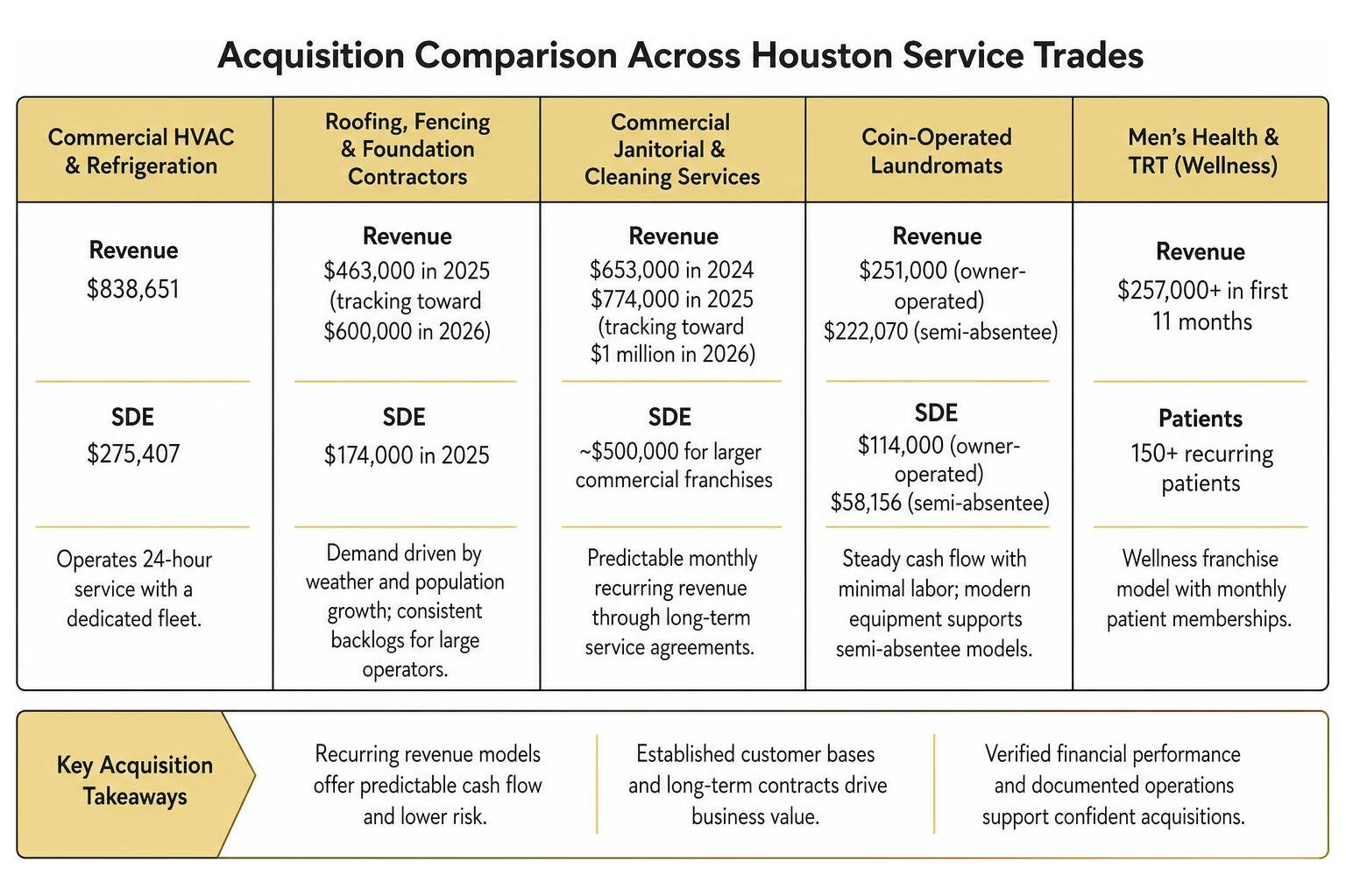
- Commercial HVAC and Refrigeration: These companies serve mission-critical roles for restaurants, grocery outlets, and industrial facilities. For instance, a profitable HVAC and refrigeration business opened over 11 years in Harris County demonstrated $838,651 in gross revenue with $275,407 in Seller’s Discretionary Earnings (SDE), operating a dedicated fleet to provide 24-hour service across the metro area.
- Roofing, Fencing, and Foundation Contractors: Construction and exterior remodeling firms see continuous demand due to regional weather patterns and rapid population expansion. While project-based revenue can fluctuate—such as local roofing operations scaling between $612,000 and several million dollars based on storm cycles—large-scale operators with commercial accounts maintain consistent backlogs. A specialized cement services business in Houston generated approximately $463,000 in revenue and $174,000 SDE in 2025, tracking toward $600,000 in 2026.
- Commercial Janitorial and Cleaning Services: B2B cleaning companies offer highly predictable monthly recurring revenue (MRR) through long-term service agreements. Independent janitorial firms in Houston have expanded from $653,000 in 2024 to $774,000 in 2025, tracking toward $1 million annualized in 2026. Larger commercial cleaning franchises in the region command run-rates near $1.49 million with normalized SDE approaching $500,000.
- Coin-Operated Laundromats: Laundromats provide steady cash flow with minimal labor requirements. A turnkey coin-op laundromat in Houston can generate roughly $251,000 in annual revenue and $114,000 in SDE for an active owner-operator. Semi-absentee operations utilizing modern equipment (such as 2020 Electrolux machines) deliver approximately $222,070 in annualized gross revenue and $58,156 in SDE.
Healthcare and Wellness Acquisitions
Medical and wellness enterprises throughout Greater Houston benefit from proximity to the Texas Medical Center and an expanding population seeking specialized healthcare services.
- Men’s Health and Hormone Replacement Therapy (TRT): The wellness franchise sector provides strong recurring revenue models through monthly patient memberships. A turnkey men’s health & TRT franchise in Northeast Houston generated over $257,000 in gross revenue during its initial 11 months, establishing an active base of 150+ recurring patients.
- Aesthetic MedSpas and Wellness Clinics: Specialized aesthetics practices deliver substantial margins on cash-pay procedures. A MedSpa in Harris County produced gross profits exceeding $600,000 across 2023, 2024, and 2025, delivering $193,041 in SDE. Similarly, body sculpting and wellness clinics in North Houston generate over $518,000 in annual revenue with established digital reputations.
- Independent Medical Practices: Mature private practices present stable acquisition targets. A single-physician internal medicine practice in Houston generates approximately $1,347,000 in gross revenue with an established multi-year history, while dedicated neurology clinics serving roughly 4,000 active patients generate $735,428 in annual gross billings.
Automotive and Retail Enterprises
Automotive maintenance and specialty retail businesses capitalize on Houston’s extensive transportation network and dense neighborhood shopping hubs.
- Automotive and Fleet Repair: As one of the country’s most vehicle-dependent metropolitan areas, Houston sustains high demand for general automotive and commercial fleet repair. A full-service auto & light truck repair business operating for 18 years generates $5.8 million in gross revenue and $720,000 in EBITDA. These operations derive long-term stability from fleet maintenance contracts combined with retail repair bays.
- Lifestyle Retail and Dining Concepts: High-density urban submarkets like The Heights, Montrose, and River Oaks support established lifestyle brands. An 8-year-old retail and café concept located in Houston’s Heights neighborhood generates $1,341,711 in annual revenue and $198,242 in net income, operating with third-party management and documented operational processes.
| Industry Sector | Typical Revenue Range | Average SDE / EBITDA | Representative Multiple Range | Primary Value Driver |
|---|---|---|---|---|
| Commercial HVAC & Trades | $600K – $2.5M | $175K – $500K | 2.5x – 3.5x SDE | Fleet assets, commercial service contracts |
| Commercial Janitorial | $650K – $1.5M | $180K – $500K | 2.25x – 3.0x SDE | Multi-year recurring B2B agreements |
| Medical & MedSpa | $500K – $1.5M | $150K – $400K | 2.5x – 3.75x SDE | Patient retention, cash-pay memberships |
| Auto & Fleet Repair | $1.5M – $6.0M | $250K – $750K | 3.0x – 4.2x EBITDA | Fleet accounts, certified technicians, bays |
| Laundromats (Coin-Op) | $100K – $300K | $45K – $120K | 2.5x – 3.5x SDE | Equipment age, lease terms, self-service |
| Specialty Retail / Café | $500K – $1.5M | $100K – $220K | 2.0x – 2.8x SDE | Prime location, turnkey staff, brand equity |
Assessing Financial Multiples and Valuation Benchmarks in Harris County
Accurately valuing an acquisition target requires normalizing financial statements to uncover true baseline earning power. Buyers use specific earnings benchmarks depending on the size and structure of the company. Reviewing proven small business valuation methods helps buyers calibrate their opening offers against real market data.
SDE and EBITDA Valuation Formulas
Small, owner-operated enterprises are evaluated using Seller’s Discretionary Earnings (SDE), while mid-sized companies with executive leadership teams are evaluated using Earnings Before Interest, Taxes, Depreciation, and Amortization (EBITDA).
In Houston, small enterprises generating under $1 million in revenue typically trade between 2.0x and 3.25x SDE. Companies generating over $1 million in adjusted earnings with management layers trade at 3.5x to 5.0x+ EBITDA. Applying comprehensive frameworks for understanding business valuation standards ensures buyers do not overpay for discretionary owner add-backs that cannot be sustained post-sale.
Factoring Houston Economic Resilience and Population Growth
Houston’s local economic indicators directly influence business transaction values:
- Tax Climate: Texas levies no personal state income tax, allowing owner-operators to retain a higher percentage of net earnings compared to peers in other states.
- Demographic Expansion: Harris County and adjacent suburban counties (Fort Bend, Montgomery) continue to post steady population growth, expanding addressable customer pools for residential services, healthcare, and retail businesses.
- Logistics Infrastructure: Proximity to the Port of Houston, major interstate corridors (I-10, I-45, I-69), and two international airports supports efficient supply chains for distribution, trade, and automotive companies.
Navigating Due Diligence and Transfer Requirements in the Lone Star State
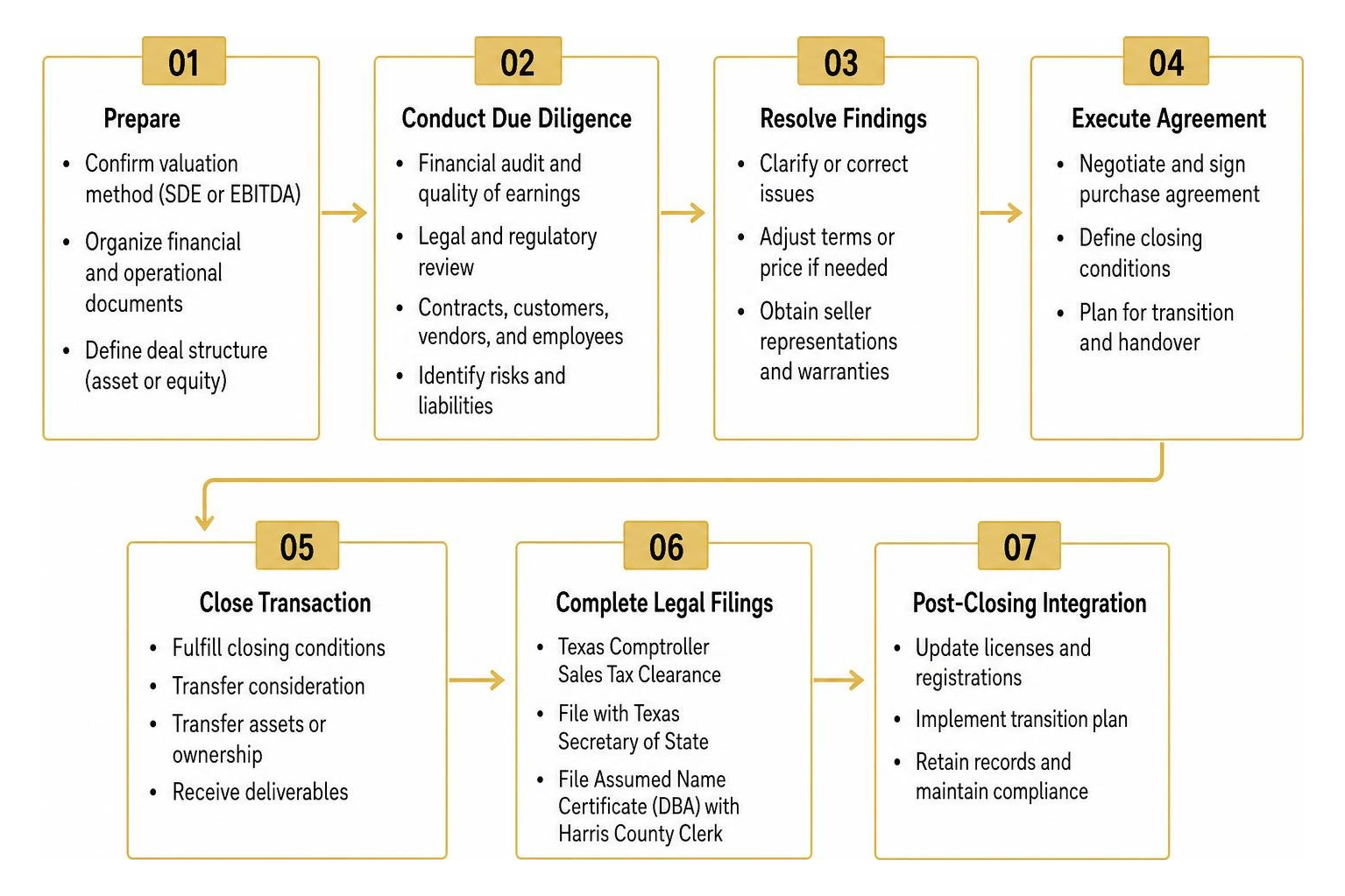
Purchasing a company in Texas involves formal state compliance steps and deep financial auditing. Whether executing an asset purchase or an entity equity acquisition, buyers must satisfy state, county, and municipal requirements. Understanding the nuances of selling a business in the Lone Star State enables purchasers to structure clean purchase agreements that protect against legacy liabilities.
Essential Legal and Regulatory Filings in Texas
- Texas Comptroller Sales Tax Clearance: When acquiring business assets, purchasers must secure a Certificate of Account Status or Certificate of No Tax Due from the Texas Comptroller of Public Accounts to ensure the seller has no outstanding state sales tax liabilities that could attach to the buyer.
- Entity Registrations: New business entities must file Articles of Organization or Incorporation with the Texas Secretary of State.
- Assumed Name Certificates (DBA): File assumed name certificates with the Harris County Clerk’s office if operating under an existing trade name.
- Occupational and Trade Licensing: Trade services (plumbing, electrical, HVAC) must comply with regulations set by the Texas Department of Licensing and Regulation (TDLR), requiring qualified master-license holders on record.
- Corporate Practice of Medicine: Texas strictly enforces corporate practice of medicine doctrines; medical clinics and MedSpas must maintain compliant ownership structures, often involving a licensed physician acting as the medical director or utilizing Management Services Organization (MSO) models.
Due Diligence Audits for a Target Business for Sale in Texas Houston
Due diligence goes beyond reviewing top-line tax figures. A comprehensive audit should address:
- Quality of Earnings (QofE): Reconcile three to five years of federal tax returns against point-of-sale (POS) records, merchant processor statements, and monthly bank records to verify reported revenues and normalized expenses.
- Customer and Account Concentration: Ensure no single client accounts for more than 15% to 20% of total revenue, particularly in B2B janitorial, commercial HVAC, and fleet repair sectors.
- Equipment and Asset Inspections: Conduct third-party physical inspections of all machinery, fleet vehicles, and kitchen or laundry equipment to calculate near-term replacement costs.
- Commercial Lease Terms: Confirm remaining lease duration, option periods, personal guarantee requirements, and landlord assignment clauses. Securing long-term occupancy rights is essential when acquiring high-footprint locations.
Structuring Acquisition Financing and Seller Transition Plans
Securing adequate acquisition capital while retaining sufficient post-closing operating liquidity is vital for a smooth transition. Reviewing the essential steps to buy a business helps buyers prepare institutional lending packages and negotiate balanced seller terms.
Leveraging SBA 7(a) Loans and Seller Notes
Buyers in Houston frequently use a combination of equity, bank debt, and seller financing to complete acquisitions:
- SBA 7(a) Acquisition Loans: The Small Business Administration’s 7(a) program provides up to $5 million in financing for qualified business purchases. SBA loans typically require 10% equity down from the buyer, feature fully amortizing 10-year terms for business acquisitions (or up to 25 years if commercial real estate is included), and require a minimum Debt Service Coverage Ratio (DSCR) of 1.25x.
- Seller Carryback Financing: Sellers often carry a promissory note for 10% to 20% of the purchase price. This bridges valuation gaps, aligns seller incentives with the buyer’s post-closing success, and can satisfy part of the SBA’s equity injection requirements if placed on full standby.
- Earnouts: In transactions where past performance shows recent volatility, structuring a portion of the purchase price as a conditional earnout tied to revenue or gross profit targets protects the buyer from immediate post-sale turnover.
Structuring Onboarding and Knowledge Transfer Terms
A structured handover period minimizes customer attrition and operational disruption:
- Training Period: Include 30 to 90 days of full-time, on-site seller training in the definitive purchase agreement, followed by negotiated phone/email consultation.
- Key Staff Retention: Identify essential personnel—such as lead mechanics, master technicians, or office managers—and implement retention bonuses or updated employment agreements before closing.
- Non-Compete Agreements: Secure standard non-compete covenants restricting the seller from operating a competing business within a defined geographical radius (typically Harris County and adjacent counties) for 3 to 5 years.
Frequently Asked Questions About Houston Business Acquisitions
What is the average multiple for buying a small business in Houston?
Small businesses in Houston with revenues between $250,000 and $2,000,000 typically sell for 2.0x to 3.5x SDE. Lower multiples (2.0x – 2.5x) apply to businesses with heavy owner reliance, shorter lease terms, or aging equipment. Higher multiples (3.0x – 3.75x+) are commanded by companies with recurring membership or contract revenues, semi-absentee management, clean financial records, and proprietary operational systems. Larger mid-market companies ($1M+ in EBITDA) trade on EBITDA multiples ranging from 3.5x to 5.0x+.
Why are Houston business owners choosing to sell their companies?
The primary driver of business sales across Harris County is retirement and succession planning among baby boomer owners. Other common motivations include:
- Serial entrepreneurs divesting mature assets to capitalize new ventures.
- Owners relocating out of state or shifting focus to non-operating investment portfolios.
- Burnout from daily operational demands, especially in high-touch retail or trade businesses.
- A lack of family successors interested in taking over established trade or service operations.
What licenses and legal steps are required to transfer ownership in Texas?
Transferring business ownership in Texas requires:
- Executing a formal Asset Purchase Agreement (APA) or Stock Purchase Agreement (SPA).
- Securing a Certificate of No Tax Due from the Texas Comptroller of Public Accounts.
- Forming and registering the acquiring legal entity with the Texas Secretary of State.
- Securing necessary municipal operating permits from the City of Houston and Harris County.
- Transferring or applying for relevant state-regulated trade licenses through the Texas Department of Licensing and Regulation (TDLR) or specific governing boards.
- Negotiating formal assignment or execution of the commercial facility lease with the property landlord.
Conclusion
Acquiring an established business in Houston offers a direct path to cash flow, an existing client base, and operational scale within one of the nation’s most dynamic regional economies. Success depends on disciplined financial due diligence, proper valuation benchmarking, and structuring fair purchase terms.
At Earned Exits, we provide comprehensive support throughout the transaction lifecycle. From financial analysis and Quality of Earnings assessments to deal structuring and transition planning, our team works closely with buyers and sellers across Harris County and nationwide.
If you are ready to take the next step in your acquisition journey, explore curated acquisition opportunities with professional advisory to find an established business that matches your investment goals.
