


Sell Your Texas Business for Top Dollar in Today’s Market
How to Sell a Texas Business for Top Dollar
To sell your Texas business, start with clean financial records and a market-based valuation. Screen buyers before sharing sensitive details, then compare offers on price, financing, and the chance of closing. Before you sign, have a Texas attorney and tax advisor review the deal structure, taxes, permits, and any property rights included in the sale.
You do not have to sort out every detail at once. A clear plan can help you protect your information, answer buyer questions on time, and avoid surprises during due diligence.
I’m Britt Clas, a business broker and partner at Earned Exits. In this Business Sale Texas guide, I’ll draw on my experience helping owners with valuation, buyer outreach, negotiations, and closing to show you what to do next.

Structuring a Business Sale Texas Transaction: Asset vs. Share Purchases

Choosing how to structure your sale is one of the most significant financial and legal decisions you will make. In Texas, transactions typically take the form of either an asset purchase or an equity transfer (such as a stock purchase or membership interest sale). The chosen structure directly impacts your post-closing legal liabilities, tax exposure, and the complexity of transferring contracts and operational licenses.
To protect both sides, parties should carefully follow established legal procedures for buying and selling a business while taking into account state statutory frameworks.
Asset Sales vs. Stock Transfers
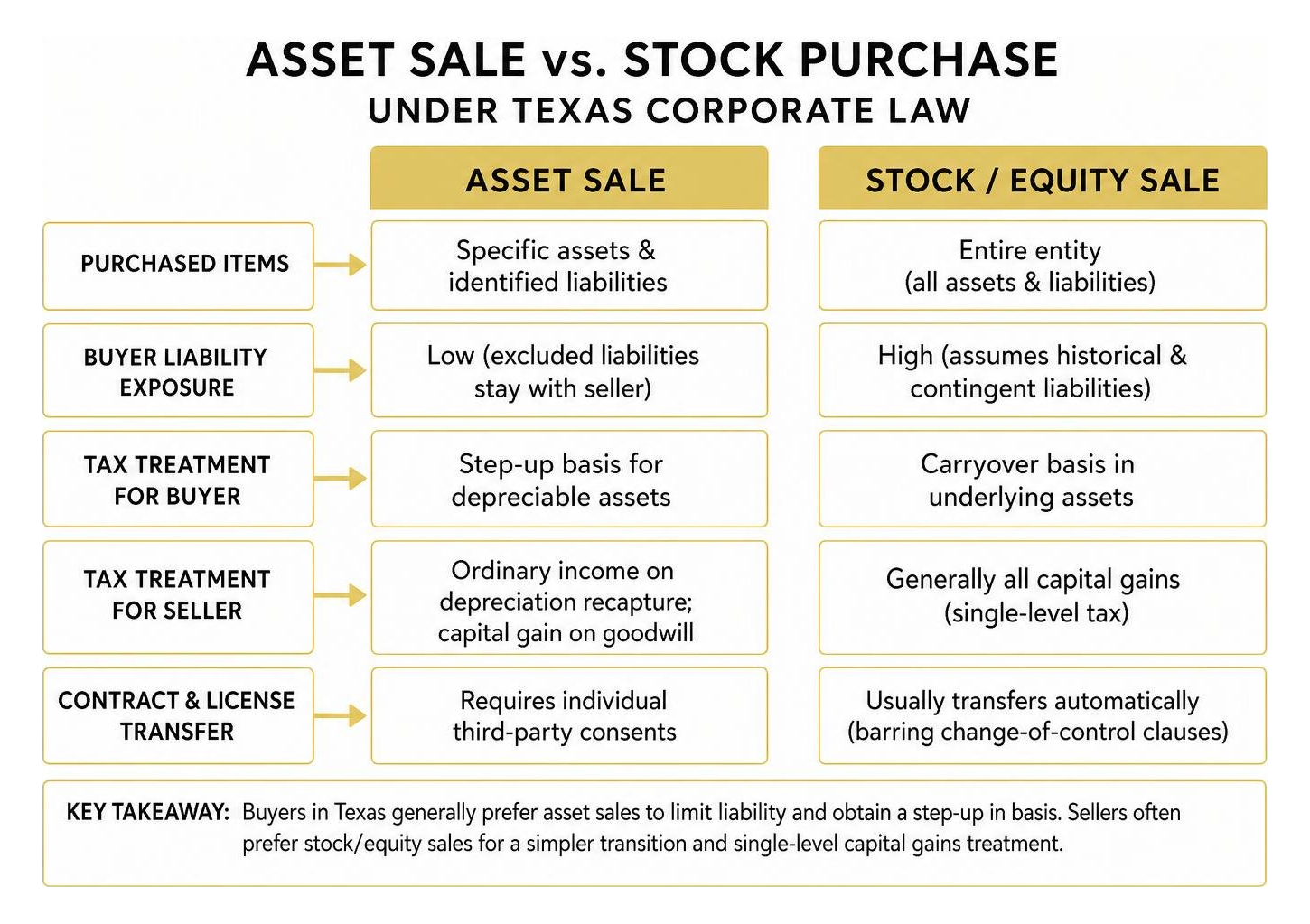
In an asset sale, the buyer acquires specific, identified assets of the company—such as machinery, customer lists, inventory, intellectual property, and goodwill—while leaving specified liabilities behind with the seller entity. Buyers in Texas generally prefer asset deals because they can obtain a “step-up” in the tax basis of the acquired assets for depreciation purposes and minimize exposure to unknown or contingent historical liabilities.
Conversely, sellers often favor a stock or equity sale. In an equity deal, the buyer purchases the shares or membership units of the legal entity itself, transferring ownership of the entire operating business, including its existing contracts, permits, and balance sheet liabilities. For sellers, equity sales usually streamline the transition into a single taxable event taxed predominantly at long-term capital gains rates, avoiding potential double taxation associated with corporate liquidations.
| Transaction Feature | Asset Sale | Stock / Equity Sale |
|---|---|---|
| Purchased Items | Specific assets & identified liabilities | Entire entity (all assets & liabilities) |
| Buyer Liability Exposure | Low (excluded liabilities stay with seller) | High (assumes historical & contingent liabilities) |
| Tax Treatment for Buyer | Step-up basis for depreciable assets | Carryover basis in underlying assets |
| Tax Treatment for Seller | Ordinary income on depreciation recapture; capital gain on goodwill | Generally all capital gains (single-level tax) |
| Contract & License Transfer | Requires individual third-party consents | Usually transfers automatically (barring change-of-control clauses) |
Entity-Specific Rules Under the Texas Business Organizations Code
The legal form of your company dictates the necessary approvals, filings, and statutory procedures required to authorize an exit. Reviewing what does it really take to sell a business in Texas shows that corporate governance plays an essential role across all business types:
- Sole Proprietorships: Because a sole proprietorship is legally indistinguishable from the owner, the transaction must proceed strictly as an asset sale. Contracts, operating names (DBAs), and permits cannot be transferred by equity; they must be assigned or re-registered individually.
- General and Limited Partnerships: Under the Texas Business Organizations Code (BOC), selling partnership interests requires strict adherence to the underlying partnership agreement. Unless otherwise specified, a transfer of a partnership interest grants the buyer rights to profits and distributions, but not necessarily management control without the consent of the remaining partners.
- Professional Practices: Medical, dental, legal, and accounting practices face strict ownership constraints under Texas law. Professional Corporations (PCs) and Professional Limited Liability Companies (PLLCs) can generally only transfer equity to state-licensed professionals within that same discipline.
- Corporations and LLCs: Corporate sales require formal board approval and shareholder consent, governed by the Texas BOC Title 2. If selling substantially all assets outside the ordinary course of business, Texas statute requires specific notice and fundamental business transaction approval thresholds.
Critical Steps and Legal Documents in a Texas Transaction
A successful sale relies on a disciplined, step-by-step documentation workflow that establishes confidentiality, sets commercial terms, and details legal warranties.

Essential Agreements and Due Diligence for a Business Sale Texas
Navigating a business transaction requires a series of interlocking legal instruments designed to manage risk and maintain operational secrecy. Understanding how to sell your Texas company for top dollar means preparing these documents well in advance of going to market:
- Client Intake and Information Memorandum: The initial data-gathering phase where ownership structures, operating agreements, and financial adjustments are compiled into a comprehensive confidential information presentation.
- Non-Disclosure Agreement (NDA): Before disclosing financial statements, vendor agreements, or proprietary methods, prospective buyers must execute an enforceable Texas-governed NDA to prevent competitive misuse of private data.
- Letter of Intent (LOI): The LOI outlines the fundamental deal terms, including purchase price, transaction structure, payment terms, working capital pegs, and an exclusivity (no-shop) period during which the seller cannot negotiate with other parties.
- Definitive Purchase Agreement: Whether drafted as an Asset Purchase Agreement (APA) or a Stock Purchase Agreement (SPA), this is the binding legal contract detailing every asset, liability, representation, and closing condition.
- Financial and Legal Due Diligence: Buyers and their CPAs will thoroughly inspect historical balance sheets, tax returns, payroll records, and customer contracts. Having an independent accounting audit prior to listing prevents valuation renegotiations mid-deal.
Drafting Protective Warranties and Indemnity Provisions
Sellers and buyers balance risk through representations, warranties, and indemnification clauses. As a seller, your goal is to provide accurate representations while limiting ongoing exposure through well-structured disclosure schedules.
- Indemnification Caps and Baskets: Contracts typically establish a “basket” (a threshold of damages that must occur before a claim can be made) and a “cap” (the maximum financial limit of seller liability, often set as a percentage of the purchase price).
- Survival Periods: Warranties regarding day-to-day operations typically survive closing for 12 to 24 months, whereas fundamental representations (such as title to assets, entity authority, and tax compliance) may survive through the applicable statute of limitations.
- Escrows and Holdbacks: Buyers frequently require 5% to 15% of the total purchase price to be held in an escrow account for a defined period to cover potential indemnity claims or post-closing working capital adjustments.
- Access and Indemnity Agreements: Prior to closing, if a buyer requires access to physical premises for inspections, environmental testing, or inventory counts, a standalone access agreement should be executed to protect the seller against property damage or operational disruptions.
Navigating State Taxes and Regulatory Approvals
Taxes and regulatory filings can significantly alter net sale proceeds if not handled accurately during pre-closing structuring.
Managing Texas Comptroller Clearance and Sales Tax Liabilities
Although Texas has no individual personal state income tax, the Texas Comptroller of Public Accounts actively oversees commercial transactions to ensure state tax liabilities are satisfied.
Under Texas Tax Code § 111.020, if an owner sells a business or its stock of goods, the buyer must withhold an amount of the purchase price sufficient to cover any unpaid sales and use taxes owed by the seller, unless the seller provides a Certificate of No Tax Due issued by the Comptroller. If the buyer fails to withhold this amount and the seller owes taxes, the buyer becomes personally liable as a successor for the unpaid taxes, interest, and penalties.
Sellers must also address the Texas Franchise Tax. Final franchise tax returns must be filed up to the date of closing or entity termination to avoid administrative dissolution and statutory tax liens.
Regarding federal taxes, asset sales require the buyer and seller to agree on the allocation of the purchase price across asset classes using IRS Form 8594 (under IRC Section 1060). Allocating higher values to depreciable equipment leads to depreciation recapture taxed at ordinary income rates for the seller, while allocations toward goodwill are taxed at preferential long-term capital gains rates.
Sector Permits and Real Estate Considerations in a Business Sale Texas
Regulated industries require dedicated administrative timelines that can impact the closing schedule:
- Texas Alcoholic Beverage Commission (TABC) Permits: Liquor licenses and retail beverage permits cannot simply be reassigned in an asset sale. Buyers must submit an original application to the TABC, complete county/city certifications, publish public notices, and clear background investigations—a process that often takes 60 to 90 days.
- Texas Workforce Commission (TWC) Status Reports: Buyers must obtain an official statement from the TWC showing that the seller’s state unemployment taxes are fully paid. Under the Texas Labor Code, a successor acquiring an organization, trade, or business may inherit the predecessor’s unemployment compensation liability and tax experience rating.
- Environmental Due Diligence: For industrial facilities, gas stations, manufacturing plants, or oilfield service transactions, Phase I Environmental Site Assessments (ESAs) are critical. Environmental liabilities in Texas can attach to real estate owners regardless of when the contamination occurred.
- Mineral, Water, and Real Property Rights: In Texas, the surface estate and the mineral estate are frequently severed. A commercial real estate purchase does not automatically include subsurface mineral, oil, or gas rights unless explicitly conveyed in the deed. Similarly, commercial groundwater rights and surface water diversion permits regulated by groundwater conservation districts and the Texas Commission on Environmental Quality (TCEQ) require distinct documentation.
Maximizing Value and Managing Buyer Due Diligence
Attracting capable buyers requires balancing operational transparency with data security, ensuring that everyday commercial business operations continue smoothly throughout the marketing period.
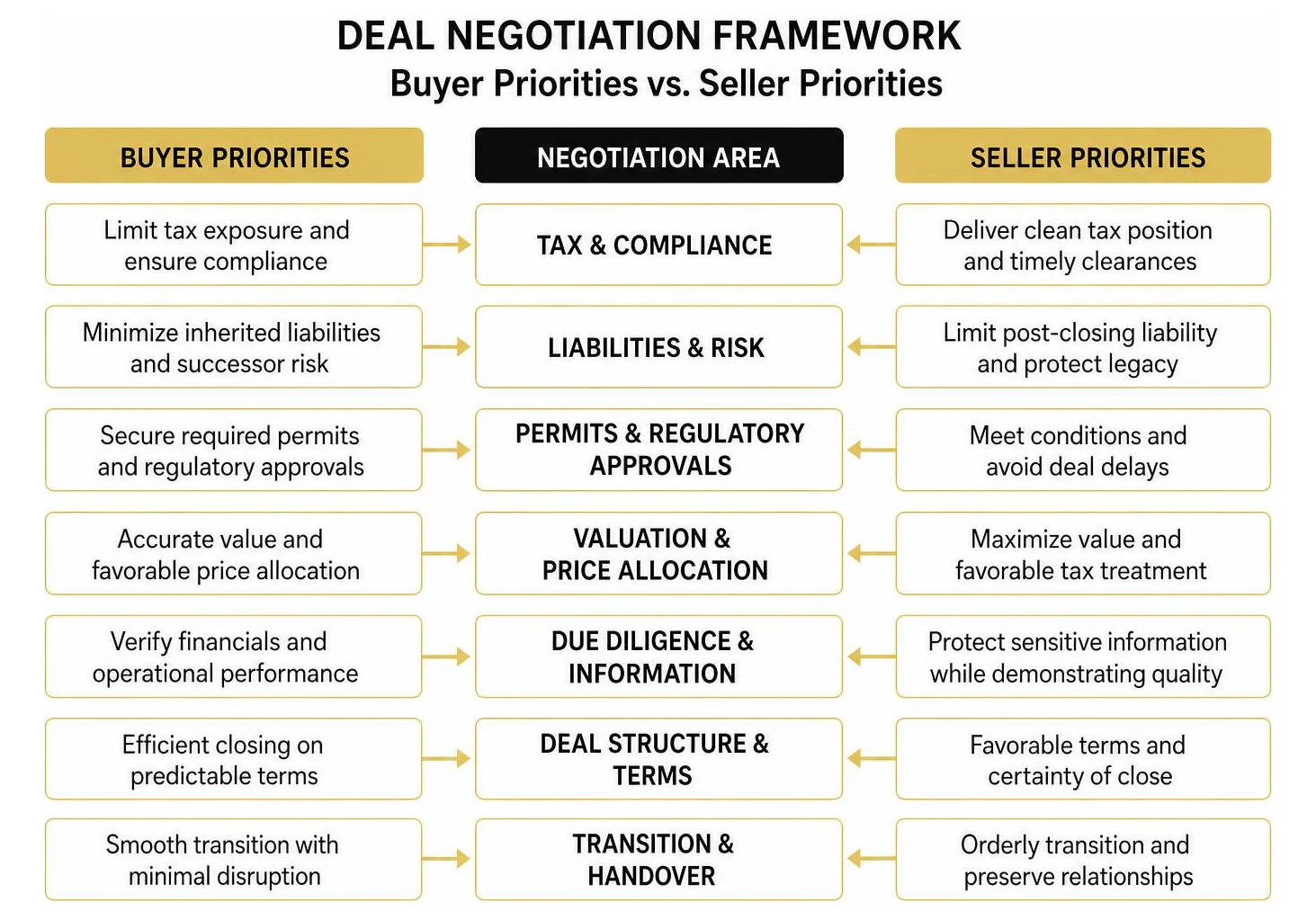
Buyer vs. Seller Priorities in Deal Negotiations
Negotiating the sale of a Texas enterprise involves addressing conflicting motivations between the parties:
When reviewing potential acquirers, understanding the market landscape—such as steps for buying an established business in Houston—helps sellers evaluate whether a buyer has the capital, operational experience, and lending support needed to close.
Structuring Financing and Valuation for Maximum Return
To bridge valuation expectations between buyers and sellers, transactions often incorporate structured deal terms:
- Seller Financing (Promissory Notes): Carrying a seller note for 10% to 30% of the purchase price signals confidence in the business, helps the buyer secure primary bank or SBA 7(a) financing, and provides the seller with recurring interest income.
- Earnouts: In cases where future growth is projected but unproven, a portion of the purchase price can be tied to post-closing revenue or EBITDA targets. Earnout terms must clearly define accounting metrics and operational control to prevent post-sale disputes.
- Equipment and Inventory Appraisals: Setting accurate, defensible values for machinery, rolling stock, and salable inventory avoids last-minute purchase price adjustments during final closing audits.
Frequently Asked Questions about Texas Business Transactions
How does the Texas Business Organizations Code treat companies formed before 2006?
The Texas Business Organizations Code (BOC) was enacted by the Texas Legislature in 2003 and became effective on January 1, 2006. Entities formed before January 1, 2006, were initially allowed to continue operating under their legacy statutes (such as the Texas Business Corporation Act, Texas Limited Liability Company Act, or Texas Revised Partnership Act) during a transition period that concluded on January 1, 2010.
Today, all Texas entities—regardless of formation date—are governed by the BOC. However, pre-2006 entities must verify that their legacy formation documents and internal regulations align with the consolidated provisions of the BOC when executing fundamental business transactions, mergers, or asset sales.
Do I need clearance from the Texas Workforce Commission to sell my company?
Yes. When selling a business with employees, Texas Labor Code provisions impose successor liability for unpaid state unemployment taxes. The buyer should require the seller to obtain an official clearance certificate (Form C-86 or equivalent status letter) from the Texas Workforce Commission (TWC).
This document verifies that all quarterly wage reports have been filed and all unemployment taxes, penalties, and interest are paid in full. Without this clearance, the purchaser can be held directly liable for the predecessor’s outstanding payroll tax debts.
Are mineral and water rights automatically transferred in a Texas commercial sale?
No. Under Texas law, the mineral estate is legally dominant and separate from the surface estate. When commercial real estate is sold as part of a business transaction, all or part of the oil, gas, and mineral rights may have been reserved by prior owners decades earlier.
Unless the purchase agreement and special warranty deed explicitly state that mineral rights owned by the seller are conveyed to the buyer, they may not transfer. The same applies to specific water rights: groundwater rights can be reserved or severed from the land, and surface water rights require formal approval and transfer through the TCEQ.
Conclusion
Exiting a business in Texas requires careful coordination across legal structuring, tax compliance, regulatory clearance, and buyer negotiations. Whether you are navigating the differences between asset and stock sales, clearing liabilities with the Texas Comptroller and TWC, or securing real estate and environmental permissions, having a structured transaction plan protects the value you have built.
Our team at Earned Exits provides complete business brokerage and M&A advisory support, delivering dedicated CFO assistance, thorough due diligence preparation, and structured marketing to help you achieve your exit goals. If you are preparing for a sale or evaluating your company’s market readiness, consult with the Earned Exits business brokerage team to guide your transaction from initial valuation through final closing.
