


SBA Loan Business Sale: How to Untangle the Red Tape
The SBA Loan Business Sale: What You Need to Know Before You Start
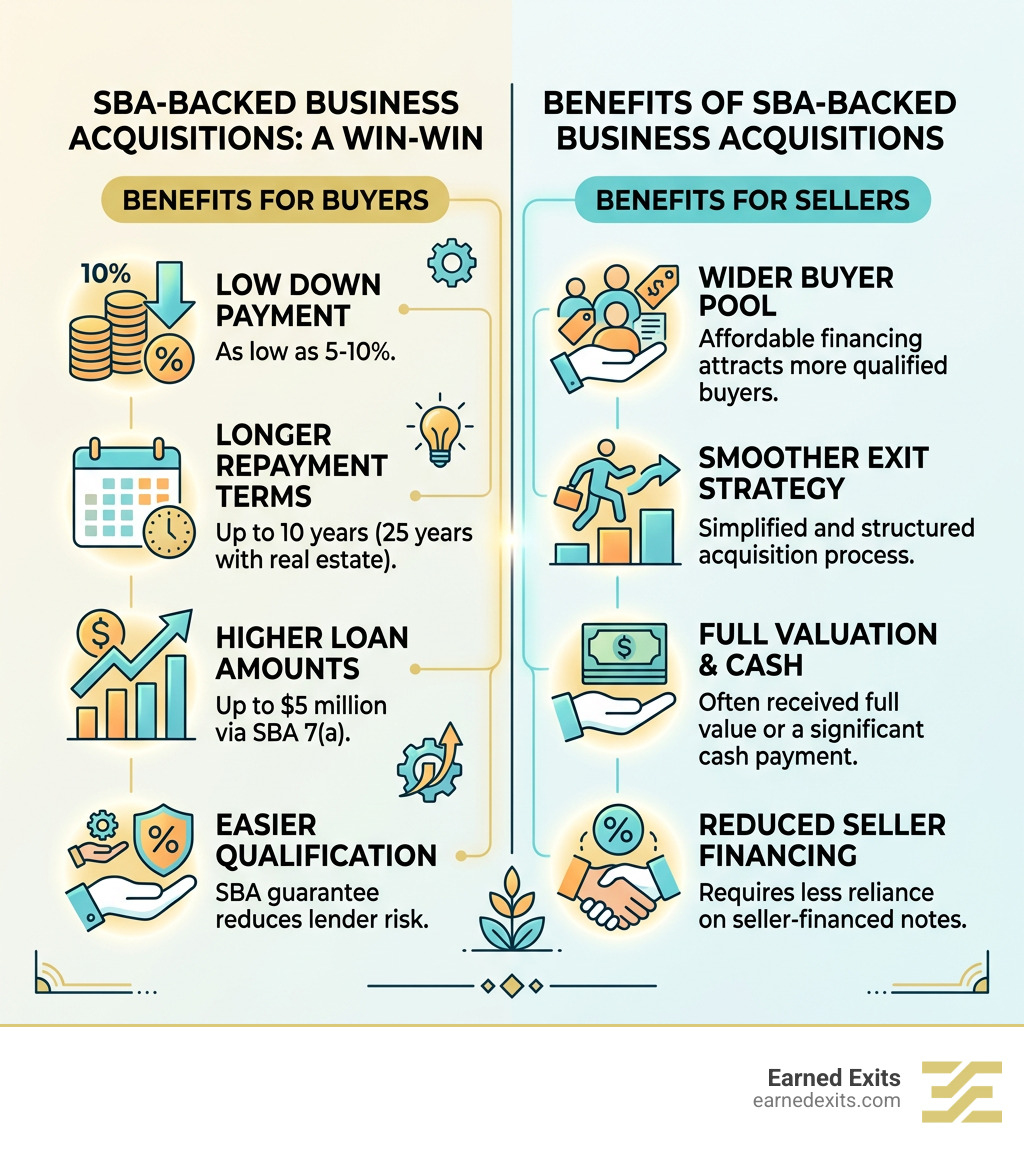
An SBA loan business sale is a transaction where a buyer uses an SBA 7(a) loan — backed by the U.S. Small Business Administration — to finance the purchase of an existing business, typically covering up to 90% of the total deal cost.
Here’s a quick snapshot of how it works:
| Key Factor | Details |
|---|---|
| Max loan amount | $5 million |
| Buyer down payment | As low as 5-10% |
| Repayment term | Up to 10 years (25 years if real estate is included) |
| SBA guarantee | 85% on loans up to $150K; 75% above that |
| Seller financing allowed | Yes — up to 5% can count toward equity requirement |
| Who qualifies | U.S.-based small businesses meeting SBA size standards |
Something big is happening in the American business world right now.
Over the next 10 to 15 years, an estimated 12 million businesses will change hands — a wave so large it’s been called the “silver tsunami.” Baby Boomer owners are retiring, and a new generation of buyers is stepping in.
For many of those buyers, an SBA 7(a) loan is the key to making the deal happen. And for sellers, understanding how SBA financing works can mean the difference between a smooth exit and a deal that falls apart at the finish line.
But SBA loans come with rules. A lot of them. Requirements around down payments, seller notes, collateral, debt coverage ratios, and documentation can feel overwhelming — especially if you’ve never sold a business before.
This guide cuts through the red tape. Whether you’re a seller trying to make your business SBA-financeable, or just want to understand what your buyer is going through, you’ll find clear, practical answers here.
Navigating the SBA Loan Business Sale Process

When we talk about an SBA loan business sale, we are almost always referring to the SBA 7(a) program. This is the SBA’s “flagship” loan. It isn’t a direct loan from the government; instead, the SBA guarantees a portion of the loan (up to 75% or 85%) to reduce the risk for the bank. This encourages lenders to provide capital for acquisitions that might otherwise be considered too “collateral-light” for a conventional loan.
To be eligible, the business must be a for-profit entity operating in the U.S. and meet the SBA’s size standards. For the buyer, the prize is access to up to $5 million in financing with much lower down payments than traditional bank loans.
The timeline for an SBA loan business sale usually follows a specific path:
- Letter of Intent (LOI): The buyer and seller agree on a price and terms.
- Prequalification: The lender reviews the buyer’s credit and the business’s high-level financials.
- Underwriting: This is the “deep dive” where the bank scrutinizes every tax return and bank statement.
- Commitment Letter: The bank formally agrees to fund the deal, pending final SBA approval.
- Closing: Documents are signed, the seller gets paid, and the buyer takes the keys.
Working with Preferred Lending Provider (PLP) lenders is a major advantage. These banks have “delegated authority,” meaning they can approve the loan on behalf of the SBA without waiting for the agency to review the file. This can shave weeks off the process. For more insights on maximizing your chances, check out our guide on Securing Your Dream Business: How to Improve Your Chances of Getting an SBA 7(a) and 504 Loan.
SBA Loan Business Sale Documentation Requirements
The “red tape” is real, and it mostly comes in the form of paper. To get through an SBA loan business sale, the seller must provide a mountain of data. Lenders typically require:
- Tax Returns: The last three years of federal business returns.
- Interim Financials: A year-to-date Profit and Loss (P&L) statement and Balance Sheet (usually no older than 60–90 days).
- Aging Reports: Accounts Receivable (A/R) and Accounts Payable (A/P) reports to see if customers actually pay their bills.
- The “CIM”: A Confidential Information Memorandum, often prepared by a broker, detailing how the business operates.
Buyers aren’t off the hook, either. They must provide personal tax returns, a detailed resume showing industry experience, and a Personal Financial Statement (PFS). In rare cases involving debt restructuring or distressed sales, referencing the IRS Bankruptcy Tax Guide may be necessary to understand tax procedures.
Prequalification and Lender Selection
Not all banks are created equal. Some “big banks” struggle with the nuances of a small business acquisition, while community banks or specialized SBA lenders often move faster.
Lenders will look for a minimum personal FICO score (often 680 or higher). They also calculate the debt-to-earnings ratio. While the SBA officially allows a 1.15x ratio, most quality lenders want to see at least 1.25x—meaning for every $1 of loan payment, the business generates $1.25 in profit to cover it. If you’re looking for more details on the buyer’s side, NerdWallet’s guide on using SBA loans to buy a business is an excellent resource.
Financial Benchmarks: Equity Injection, Collateral, and DSCR
In an SBA loan business sale, the “equity injection” (your down payment) is the foundation of the deal. Historically, the SBA required a 10% equity injection for a change of ownership. However, recent rule changes have made this more flexible.
The Debt Service Coverage Ratio (DSCR) is the most critical metric. Lenders perform a cash flow analysis to ensure the business can pay the new owner a fair salary, pay all business expenses, and still have enough left over to comfortably make the loan payments.
| Financing Component | Standard Requirement |
|---|---|
| Buyer Cash Injection | Minimum 5% (if seller carries 5%) |
| Total Equity Injection | 10% total |
| Lender Financing | Up to 90% |
| Target DSCR | 1.25x to 1.30x |
Personal Guarantees: Anyone owning 20% or more of the buying entity must provide a full unconditional personal guarantee. This means if the business fails, the bank can look to your personal assets to satisfy the debt. If the loan isn’t fully collateralized by business assets, the SBA often requires a lien on the guarantor’s personal real estate if they have 25% or more equity in their home.
Eligible Sources for Down Payments
Where does the 10% come from? It doesn’t all have to be cash in a savings account. Qualifying sources include:
- Cash on hand: Money sitting in your bank account for at least two months.
- Gifted funds: Money from a family member (requires a gift letter).
- HELOC: A Home Equity Line of Credit, provided you have another source of income to pay it back.
- Retirement accounts: Using a ROBS (Roll-overs as Business Start-ups) structure to use 401(k) funds without penalty.
- Seller Financing: A seller note can cover up to half of the 10% requirement (more on that below).
If you are ready to start looking for opportunities, you can explore how to buy a business through our platform.
Structuring the Deal: Seller Financing and Partial Buyouts
The “Silver Tsunami” means millions of owners are looking for an exit, and many are willing to help the buyer across the finish line with seller financing (also called a seller carryback).
In a typical SBA loan business sale, the seller might finance 5% to 15% of the purchase price. This shows the bank that the seller “has skin in the game” and believes the business will succeed under new ownership.
One of the most exciting recent changes to SBA rules involves partial buyouts. Previously, the SBA generally required a 100% change of ownership. Now, the SBA allows for partial changes of ownership, meaning a buyer can buy out a partner or a portion of the business while the original owner stays on. This is huge for internal transitions to employees or family members. According to SCORE, this flexibility is vital as 12 million firms transition over the next decade.
Seller Standby and Subordination
If a seller note is being used to meet the 10% equity requirement, the SBA has a strict rule: the note must be on full standby for the life of the SBA loan. This means the seller cannot receive any principal or interest payments as long as the SBA loan exists (usually 10 years).
However, if the buyer puts down the full 10% themselves, a seller note can be structured with much more flexibility—often allowing for interest-only payments or a short moratorium before full payments begin. This helps mitigate risk for the lender while still providing the seller with an interest-bearing asset.
Preparing Your Business to be SBA-Financeable
If you want to sell your business, you need to make sure a bank will actually lend money against it. A business that looks great on paper but has “messy” books will fail the SBA test every time.
Preparation starts with a business valuation. You need to know what the market says your business is worth, not just what you “feel” it’s worth. We offer a free valuation to help owners get a baseline.
To be SBA-ready, you must:
- Normalize your earnings: Document your “add-backs” (owner’s salary, one-time expenses, personal perks) so the lender can see the true cash flow.
- Clean up the Balance Sheet: Remove old debt or personal assets that shouldn’t be part of the sale.
- Prove Transferability: If the business only runs because you are there 80 hours a week, a bank won’t lend to a buyer. You need a management team or processes in place that a new owner can step into.
Common Pitfalls in an SBA Loan Business Sale
Even the best deals can hit a snag. Some of the most common reasons an SBA loan business sale falls through include:
- Aggressive Add-backs: If you try to claim that your family’s vacation to Hawaii was a “business expense” to inflate your profit, the bank’s underwriter will likely spot it and disqualify it.
- Customer Concentration: If one customer makes up 50% of your revenue, the bank sees a massive risk. If that customer leaves, the buyer can’t pay the loan.
- Weak DSCR: If the business doesn’t make enough money to pay the loan and the buyer a living wage, the deal is dead.
- Misaligned Seller Notes: Sellers who refuse to go on standby when the deal requires it can kill the financing.
- The “Silver Tsunami” Reality: Forbes statistics show that 50% of businesses fail by their fifth year. Buying an established business via an SBA loan is safer than a startup, but only if the financials are rock solid.
Frequently Asked Questions about SBA Business Sales
Can a buyer use an SBA loan to buy out a partner?
Yes! Recent SBA rule updates have made partner buyouts much easier. If a business has multiple owners and one wants to retire or exit, the remaining partner (or an outside buyer) can use an SBA 7(a) loan to purchase those specific shares. In some cases, if the business balance sheet is strong enough, this can even be done with $0 down from the buyer.
How long does the SBA loan process take for a business sale?
While some lenders claim they can close in 30 days, a realistic timeline is 60 to 90 days. This accounts for the time needed to gather documents, complete the third-party valuation, perform the environmental search (if real estate is involved), and navigate the bank’s internal committee. Using a PLP lender is the best way to keep this timeline on the shorter end.
Is collateral required if the business has no hard assets?
SBA loans are “cash-flow based.” This means the bank primarily cares about the business’s ability to pay the loan back from its earnings. If the business has no “hard” assets (like machinery or real estate), the SBA will take a lien on all business assets (goodwill, inventory, etc.). If the loan is still not fully covered, the lender will look to the buyer’s personal real estate as secondary collateral.
Conclusion
Untangling the red tape of an SBA loan business sale doesn’t have to be a nightmare. While the requirements are strict, they exist to ensure that the transition of ownership is successful for both the buyer and the seller.
At Earned Exits, we specialize in making this process seamless. We operate across the United States—from California and Texas to Florida and New York—helping owners navigate the “silver tsunami” with confidence. Our team provides thorough CFO and due diligence support, ensuring your financials are “bank-ready” before you even hit the market.
Whether you need business brokerage services to find the right buyer or just need to understand what your business is worth, we are here to provide the organized, communicative support you need for a successful exit. Let us help you turn your years of hard work into a well-earned exit.
