


Kansas Business Valuation Services and Why ‘I Guess’ Isn’t a Number
Why Every Kansas Business Owner Needs a Professional Business Valuation Report
A professional business valuation report is a formal, documented opinion of what your business is worth — prepared by a credentialed analyst using recognized methods and standards.
Here’s what it covers at a glance:
| What It Is | What It Does |
|---|---|
| A formal written opinion of value | Gives you a defensible, documented number |
| Based on financial data and market evidence | Removes guesswork from pricing and planning |
| Prepared under professional standards (USPAP, AICPA, IRS) | Holds up to scrutiny from buyers, lenders, and courts |
| Uses income, market, and asset approaches | Reflects your business from multiple angles |
| Includes adjustments to normalize earnings | Shows true profitability, not just what’s on paper |
Most business owners pour years of their lives into building something valuable. But when it’s time to sell — or plan for what comes next — many are working with a number they think sounds right.
That’s a problem.
Research shows that business owners typically have more than half of their net worth tied up in their business. Yet most don’t treat it with the same rigor they’d apply to a 401(k) or investment portfolio. The result? Deals fall apart. Buyers push back. Owners leave money on the table — or price themselves out of a sale entirely.
In Kansas, where businesses range from family-owned manufacturers to regional service firms, a well-supported valuation isn’t a luxury. It’s the foundation of a smart exit.
I’m Britt Clas, a Business Broker and Partner at Earned Exits, and I’ve guided entrepreneurs through the full arc of selling their businesses — including helping them understand what a professional business valuation report actually means for their outcome. In this guide, I’ll break down everything you need to know so you can move forward with clarity, not guesswork.
What a Professional Business Valuation Report Really Tells You
A professional business valuation report does more than spit out a number. It explains how that number was reached, what assumptions support it, which valuation methods were used, and what risks or opportunities affect the final conclusion.
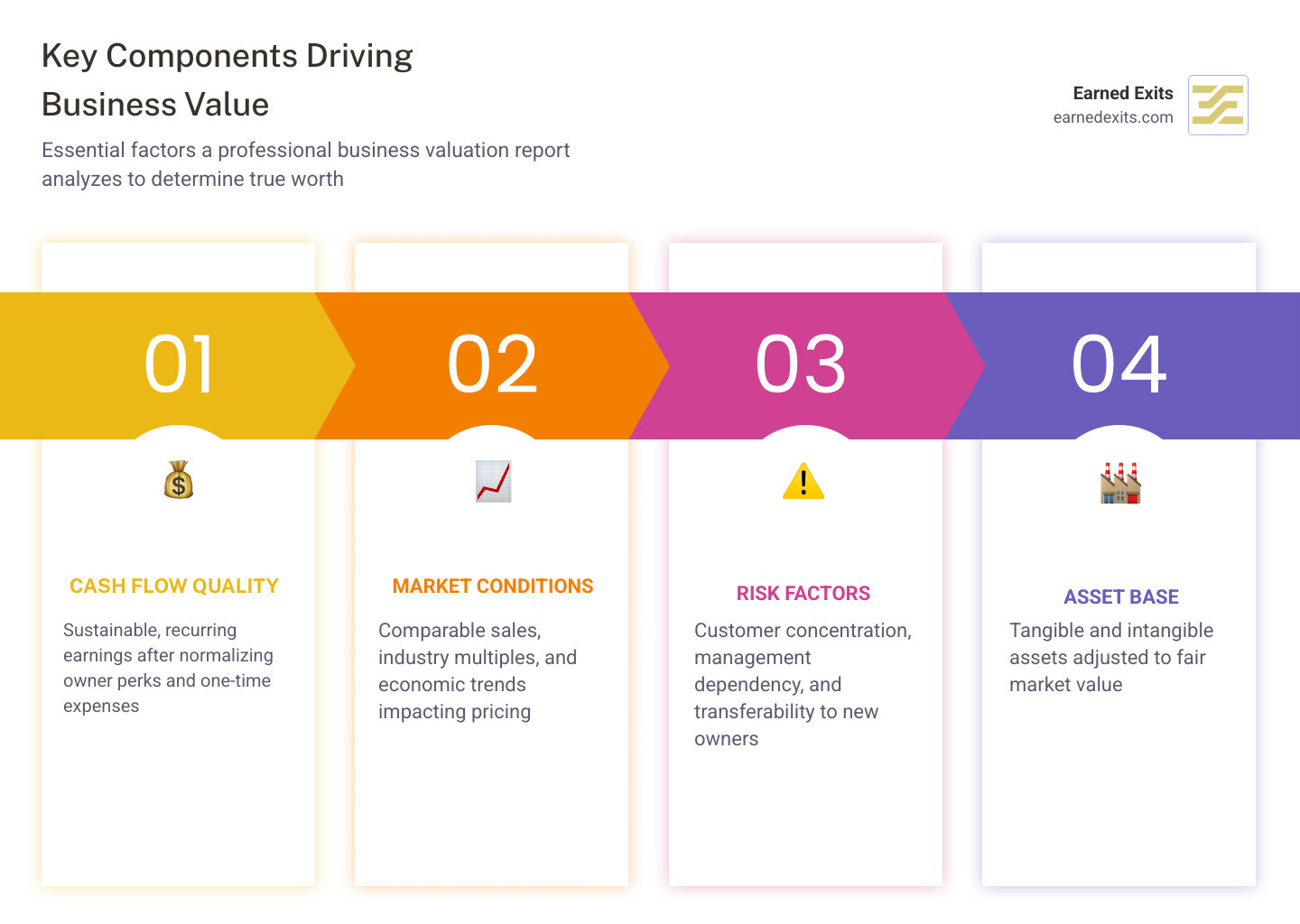
That matters because value is rarely just about revenue. It is about cash flow quality, concentration risk, management depth, asset base, market conditions, growth outlook, and how transferable the business is to a new owner.
A strong report helps with:
- Sale preparation
- Buyer and lender confidence
- Estate and gift planning
- Divorce and shareholder disputes
- ESOP planning
- Tax compliance
- Succession decisions
- Partner buyouts
Why a professional business valuation report matters for Kansas business owners
Kansas business owners often operate in practical, relationship-driven markets. That is a strength, but it can also create pricing blind spots. Owners may rely on local chatter, rough rules of thumb, or what a nearby company allegedly sold for. That is not enough.
Research suggests that, on average, businesses may sell for only about 70% of asking price, while businesses that are properly valued tend to sell closer to 90% of asking price. The lesson is simple: better pricing usually leads to better outcomes.
For Kansas owners, a good valuation can help us:
- Set a realistic asking range
- Support negotiations with evidence
- Spot value gaps before buyers do
- Reduce surprises during due diligence
- Build a cleaner exit plan
Common situations when owners need a professional business valuation report
We see valuation reports used for many reasons, including:
- Buy-sell agreements
- Partner or shareholder buyouts
- SBA lending or other financing
- Succession planning
- Gifting and estate transfers
- Divorce or litigation
- Mergers and acquisitions
- Internal strategic planning
The purpose matters because it affects the scope, standards, and level of detail required.
Why “I guess” leads to pricing mistakes
“I guess it’s worth five million” is not a valuation method. It is a stress response.
Overpricing can scare away qualified buyers. Underpricing can cost you years of built equity. And unsupported pricing usually gets exposed in diligence, where buyers look closely at normalized earnings, customer concentration, margins, payroll, and add-backs.
If you want a reality-based starting point, explore our Business Valuation Services.
Types of Business Valuation Reports and When to Use Each
Not every engagement produces the same kind of report. The right format depends on the intended use, intended users, and level of support needed.
Detailed reports for legal, tax, and high-stakes transactions
A detailed report is the most comprehensive format. It usually includes a full narrative, financial analysis, industry discussion, method selection, assumptions, calculations, and appendices.
This is typically the right fit when the report may face scrutiny from:
- Courts
- The IRS
- Lenders
- Opposing experts
- Attorneys
- Outside investors
Detailed reports are often used for tax matters, disputes, shareholder issues, and major transactions.
Summary reports for internal planning and lower-complexity needs
A summary report is shorter but still professional. It communicates the key facts, analysis, and conclusion of value without every supporting detail found in a fully detailed report.
This can work well for:
- Internal planning
- Preliminary sale readiness
- Management decision-making
- Some lender discussions
- Strategic reviews
Calculation reports, restricted-use work, and when they may not be enough
A calculation report usually involves agreed-upon procedures and a narrower scope. It can be less expensive and faster, but it is also more limited. Intended users may be restricted, and the conclusion may not carry the same weight as a full valuation engagement.
This kind of work may be useful for internal planning, but it is often not enough for litigation, tax filing support, or any situation where third parties will rely heavily on the result.
How the purpose of the valuation changes the scope and depth
The same business can have different report needs depending on why the valuation is being performed. A sale planning report may focus on marketability, transferability, and deal structure. A tax report may require stricter documentation. A dispute report may need deeper support for every assumption.
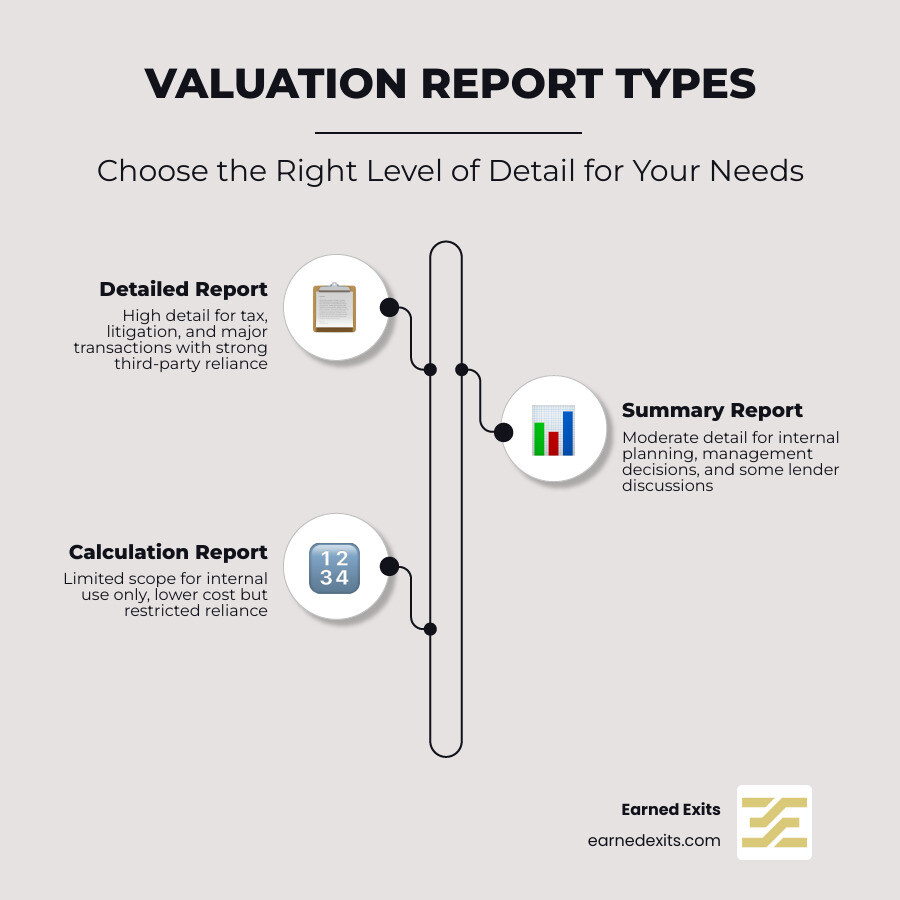
| Report Type | Best Use | Detail Level | Third-Party Reliance |
|---|---|---|---|
| Detailed | Tax, litigation, major transactions | High | High |
| Summary | Planning, internal decisions, some financing | Moderate | Moderate |
| Calculation | Limited internal use | Lower | Limited |
Standards, Assumptions, and Value Foundations in a Professional Business Valuation Report
A report is only as credible as the framework behind it. That means understanding standards of value, premises of value, and professional standards.
Standards of value and premises of value explained simply
Common standards of value include:
- Fair market value: the price at which a hypothetical willing buyer and willing seller would transact, with both informed and under no compulsion
- Fair value: often used in legal or statutory contexts and may vary by jurisdiction or purpose
- Investment value: value to a specific buyer based on that buyer’s unique expectations or synergies
- Intrinsic value: a more analytical estimate of underlying worth, often used internally
Common premises of value include:
- Going concern: the business continues operating
- Orderly liquidation: assets are sold over a reasonable period
- Forced liquidation: assets are sold quickly, often at lower values
Ownership level also matters. A controlling interest may be worth more than a minority interest because control carries decision-making power. In some cases, discounts for lack of control or lack of marketability may apply.
Professional standards that guide report preparation
Professional business valuation work is often guided by:
- USPAP
- AICPA SSVS No. 1
- IRS Revenue Ruling 59-60
These standards help shape ethics, documentation, consistency, reporting structure, and support for conclusions. Revenue Ruling 59-60 remains especially influential in tax-related valuation work because it outlines core factors such as the nature of the business, earning capacity, asset position, and economic outlook.
Limiting conditions, assumptions, and disclaimers you should expect
A professional report should clearly disclose what it relied on and what it did not verify independently. Typical limiting conditions include:
- Reliance on management-provided data
- Assumption that financial records are materially accurate
- Economic conditions as of the valuation date
- Treatment of hypothetical or special assumptions
- Limits on legal or tax advice
- No responsibility for events occurring after the valuation date unless specifically addressed
These are not red flags. They are part of responsible report writing.
The Three Valuation Approaches and the Financial Adjustments Behind Them
There are three main approaches in valuation: asset, income, and market. A credible report considers which approaches are relevant and why.

Asset-based approach: when assets matter most
The asset approach looks at the value of assets minus liabilities. It is especially relevant for:
- Asset-heavy businesses
- Holding companies
- Capital-intensive operations
- Businesses with weak earnings but valuable assets
- Liquidation scenarios
Common methods include adjusted book value and net asset value. We dig deeper into this in A Complete Asset-Based Valuation Guide.
Income approach: cash flow, risk, and future earnings
The income approach estimates value based on the business’s ability to generate future economic benefit. Two common methods are:
- Discounted cash flow, or DCF
- Capitalization of earnings or cash flow
DCF is often used when future performance is expected to change over time. Capitalization methods are more common when earnings are relatively stable.
This approach requires judgment around:
- Forecasts
- Risk
- Discount rates
- Cost of capital
- Terminal value
- Sustainability of margins
Market approach: what comparable companies and deals can reveal
The market approach looks at evidence from actual transactions or market-traded companies. Common methods include:
- Guideline transaction method
- Guideline public company method
- Industry multiple analysis
This approach can be powerful, but comparability matters. Size, geography, margins, concentration, and deal terms can all affect whether a “comp” is actually comparable.
Normalizing financials: the adjustments that change value
One of the most important parts of a valuation is normalizing the financial statements. That means adjusting reported results so they better reflect ongoing, transferable earnings.
Common adjustments include:
- Owner compensation above or below market
- Personal or discretionary expenses run through the business
- Non-recurring legal or repair costs
- One-time revenue spikes
- Related-party rent above or below market
- Non-operating assets or income
- Unusual payroll items
For smaller owner-operated businesses, analysts may focus on SDE. For larger firms, EBITDA or cash flow measures may be more relevant. If you want to understand add-backs better, see Demystifying Add-Backs and Sellers Discretionary Earnings: Unlocking Business Value.
How analysts reconcile multiple methods into one conclusion of value
A final opinion of value is not always a simple average. Analysts weigh methods based on relevance and reliability.
For example:
- Asset methods may matter more for equipment-heavy companies
- Income methods may carry more weight for stable cash-flow businesses
- Market methods may be strongest when good transaction data exists
The final synthesis may also reflect control premiums, marketability discounts, and company-specific risks.
What Documents You Need and What a Strong Report Should Include
The quality of a valuation depends heavily on the quality of the information provided.

Financial data and supporting documents typically required
Most valuation engagements require some mix of the following:
- 3 to 5 years of income statements
- 3 to 5 years of balance sheets
- Cash flow statements
- Federal tax returns
- Interim financials
- General ledger or trial balance
- Accounts receivable aging
- Accounts payable aging
- Debt schedules
- Fixed asset lists
- Payroll summaries
- Lease agreements
- Major customer and vendor concentration data
- Key contracts
- Ownership or cap table information
- Forecasts or budgets
- Organization chart
If these records are incomplete, the report may still be possible, but confidence and defensibility can suffer.
Key sections every credible report should contain
A strong professional business valuation report usually includes:
- Executive summary
- Statement of engagement and purpose
- Standard of value and premise of value
- Company overview
- Industry and economic analysis
- Financial statement analysis
- Normalization adjustments
- Valuation approaches and methods used
- Reconciliation and conclusion of value
- Limiting conditions and assumptions
- Appendices and supporting schedules
What makes a report readable, credible, and persuasive
Good reports are not just technically correct. They are readable.
Best practices include:
- Plain language, not jargon soup
- Clear charts and tables
- Transparent assumptions
- Supportable market evidence
- A logical connection between facts and conclusion
- Enough detail for a third party to follow the reasoning
That is especially important in a sale process. Buyers, lenders, attorneys, and advisors all need to understand the story behind the number.
How technology can streamline valuation without replacing judgment
Automation helps, but it does not replace expertise. Modern tools can speed up:
- Financial data import
- Ratio analysis
- Benchmarking
- Draft report tables
- Error checks
- Workflow management
That creates more time for actual analysis, judgment, and client communication. Industry research also points to continued growth in valuation services, with the global market rising from $7.42 billion in 2024 to $8.05 billion in 2025 and projected to keep growing through 2029. Demand is being driven by M&A activity, compliance needs, and more sophisticated decision-making.
For broader context, see the Business valuation industry outlook and our Definitive Guide to Business Valuation.
Choosing the Right Valuation Professional in Kansas
The person preparing the report matters as much as the template.
Credentials and experience to look for before you hire
Look for relevant credentials and practical experience, such as:
- ASA
- ABV
- CBA
- CPA background
- Formal appraisal training
- Experience with your industry
- Strong report-writing skills
- Transaction support experience
A report can be mathematically neat and still be weak if the appraiser does not understand marketability, buyer behavior, or deal structure.
Questions to ask before ordering a valuation
Before hiring anyone, we suggest asking:
- What is the purpose of the valuation?
- Which standard of value will be used?
- What premise of value applies?
- What type of report will I receive?
- Who is the intended user?
- What documents do you need from me?
- How long will it take?
- What scrutiny should the report be able to withstand?
- What is included in the fee?
- Will you help explain the report after delivery?
Those questions can save a lot of pain later.
When a broker opinion, estimate, or rule of thumb is not enough
Rules of thumb can be useful as rough screening tools. They are not substitutes for a proper report when stakes are high.
A quick estimate may not be enough when you need:
- Financing support
- Tax documentation
- Dispute resolution
- A defensible sale price
- Complex ownership analysis
- Diligence-ready support
That is why we encourage owners to move beyond “my friend sold at 4x EBITDA” logic. Multiples without context are like using someone else’s prescription glasses.
Kansas-specific context that can influence value
Kansas values can be shaped by local and regional factors such as:
- Industry concentration
- Customer geography
- Workforce availability
- Transportation access
- Regional transaction activity
- Dependence on a few key accounts
- The strength of second-line management
For example, a business that serves customers across multiple states may have different risk and marketability characteristics than one dependent on a narrow local base.
Frequently Asked Questions About a Professional Business Valuation Report
How long does a professional business valuation report usually take?
It depends on complexity, data quality, and purpose. Some providers in the market quote turnaround times of roughly 2 to 3 weeks for straightforward engagements, but more complex work can take longer, especially if interviews, revisions, or legal review are involved.
A well-prepared owner can speed things up by organizing financials and answering questions promptly.
How much detail should be in the report for a sale, dispute, or tax filing?
The higher the scrutiny, the more detail you typically need.
- Sale planning: often moderate to high detail, especially if buyers or lenders will review it
- Shareholder dispute or divorce: high detail, with stronger documentation
- Tax filing or estate transfer: high detail and strict adherence to standards
- Internal planning only: a more concise format may be enough
In short, the report should match the risk.
Can a valuation help increase value before I sell?
Yes. In fact, that is one of the most useful reasons to get one early.
A valuation can identify:
- Margin issues
- Customer concentration
- Weak management depth
- Excess owner dependence
- Poor documentation
- Misaligned compensation
- Non-recurring expenses distorting earnings
That gives us a roadmap to improve value before going to market. If you are not ready to sell today, that is fine. A valuation can still help you prepare smarter. Read more in Stop Guessing What Your Business Is Worth.
Conclusion: Get a Defensible Number Before You Buy, Sell, or Plan Your Exit
A professional business valuation report gives you something far more useful than a guess: a defensible, supportable number backed by method, evidence, and judgment.
Whether you are planning a sale, evaluating a buyout, preparing for succession, or just trying to understand your biggest asset more clearly, the right valuation helps you make better decisions with fewer surprises.
At Earned Exits, we help business owners move through this process with a seamless, organized approach, clear communication, and hands-on support through the financial and due diligence details that often make or break a transaction.
If you want a clearer picture of what your business may be worth, start with our Free Valuation.
