


Mastering the Pre-Sales Life Cycle for Technical Teams
Why Pre-Sales Stages Determine Whether You Win or Lose the Deal
The pre-sales stages are the structured steps a team takes between a prospect’s first contact and the moment a contract is signed. If you want the quick version, here it is:
The 6 Core Pre-Sales Stages:
- Prospecting and Lead Qualification – Identify and filter leads using criteria like budget, authority, need, and timeline
- Discovery and Needs Analysis – Uncover pain points, technical requirements, and stakeholder priorities
- Solution Design and Mapping – Build a tailored solution that directly addresses the buyer’s specific situation
- Technical Validation (Demo / POC) – Prove the solution works through demonstrations or proof-of-concept testing
- Proposal and RFP Response – Deliver a clear, customized proposal with pricing, scope, and value narrative
- Handoff to Sales – Transfer qualified, validated opportunities to the sales team for negotiation and close
Most people think deals are won during negotiation. They’re not. They’re won — or lost — long before that.
The pre-sales phase is where buyers decide whether they trust you, whether your solution fits, and whether talking to your sales team is even worth their time. Get it right, and your sales team walks into a warm, well-qualified conversation. Get it wrong, and even the best closers can’t save the deal.
The numbers back this up. Companies with strong pre-sales capabilities achieve win rates of 40–50%, and pre-sales optimization can increase revenue by 6–13% while speeding up the sales cycle by 10–20%.
In 2026’s B2B environment, buyers are more informed, buying committees are larger, and technical scrutiny happens earlier than ever. A structured pre-sales process isn’t optional anymore — it’s the difference between consistent growth and a leaky pipeline.
I’m Britt Clas, a Business Broker and Partner at Earned Exits, where I’ve guided founders through complex transactions that demand exactly the kind of rigorous qualification, discovery, and preparation that define strong pre-sales stages. The same principles that make pre-sales teams win deals are what help our clients navigate business sales with clarity and confidence.
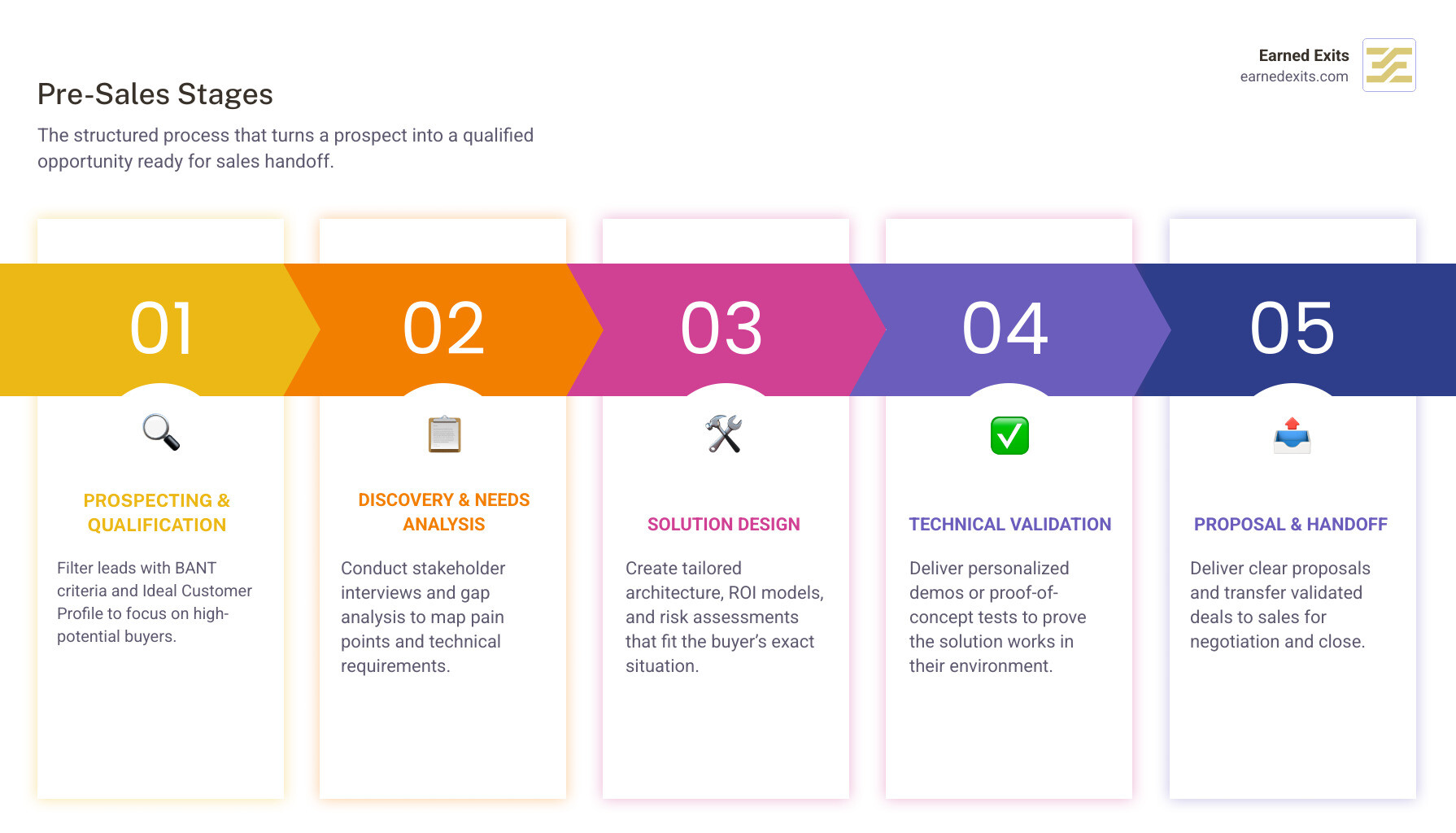
Defining the Core Pre-Sales Stages in 2026
In the current landscape of 2026, the pre-sales stages function as a strategic bridge between marketing’s lead generation and the finality of a signed contract. We’ve moved past the era where pre-sales was just “the demo people.” Today, it is a sophisticated lifecycle focused on technical validation and risk mitigation.
A well-defined pre-sales process ensures that we aren’t just throwing spaghetti at the wall to see what sticks. Instead, we are using data and technical expertise to verify that a solution is a perfect fit before a single contract is drafted. This level of organization is similar to the 10-Step Selling Process we use at Earned Exits to ensure business sales are seamless and high-value. By following a repeatable game plan, teams can build a winning pre-sales process that reduces friction and boosts buyer confidence.
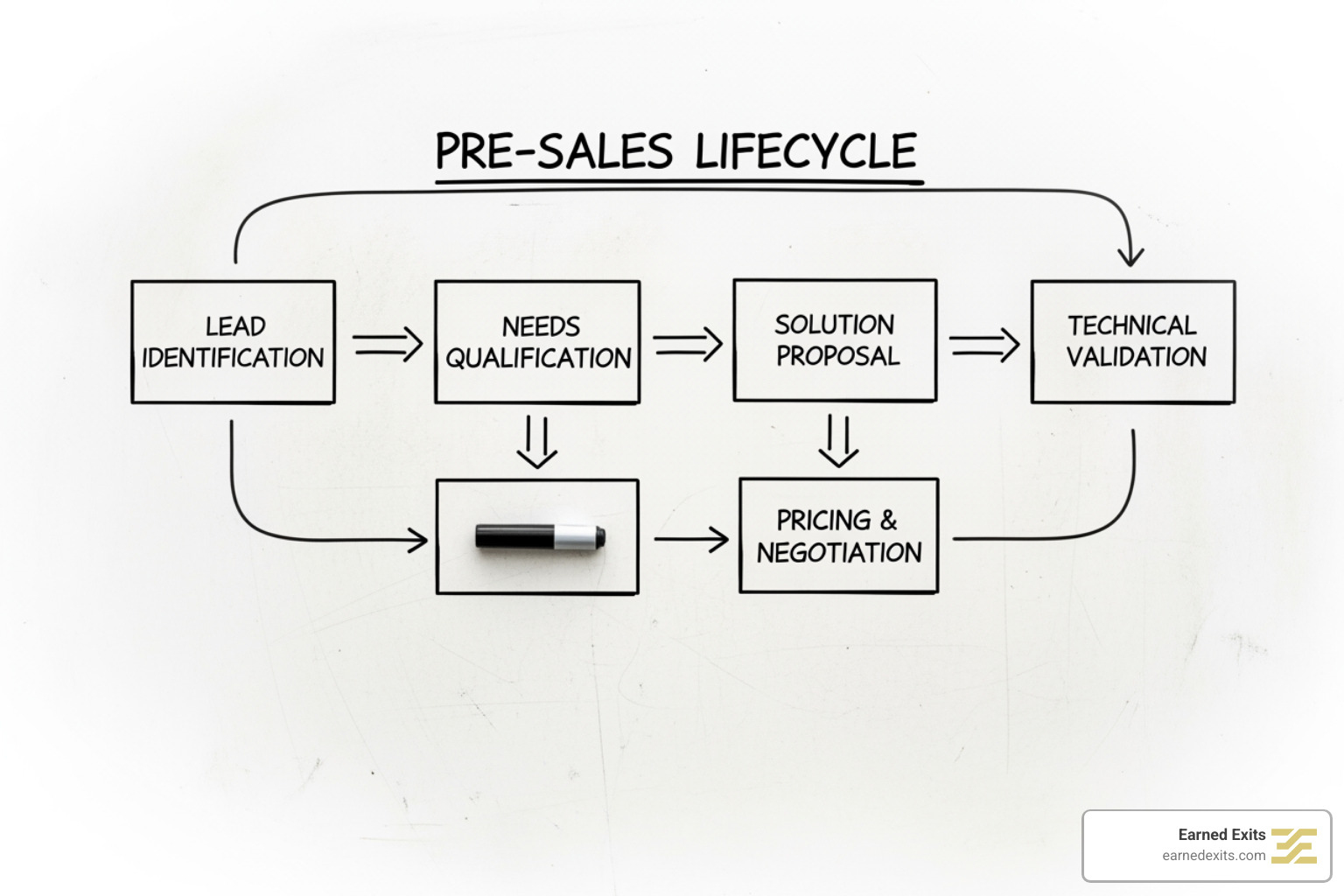
Stage 1: Prospecting and Lead Qualification
The first of the pre-sales stages is often the most critical: deciding who is actually worth our time. In 2026, we don’t just look for “interest”; we look for alignment. This involves using the BANT criteria—Budget, Authority, Need, and Timeline—to score leads.
However, modern teams go deeper by checking leads against an Ideal Customer Profile (ICP). We use data analysis and sales technology tools to determine which prospects are likely to convert and which are just “kicking the tires.” This prevents our highly paid engineers and specialists from wasting hours on deals that were never going to close. According to A Step-By-Step Guide to the Presales Process, effective qualification is the foundation of a high-performing sales engine.
Stage 2: Deep Discovery and Needs Analysis in the Pre-Sales Stages
Once a lead is qualified, we move into the discovery phase. This isn’t just a casual chat; it’s a deep dive into the prospect’s “pain.” We conduct stakeholder interviews across the organization—from the C-suite to the end-users—to understand the technical requirements and the “gaps” in their current setup.
Think of this like The Insider’s Guide to the CIM (Confidential Info Memo) in a business sale. Just as a CIM outlines every vital detail of a company to a buyer, a discovery session should uncover every technical hurdle and business objective. We are looking for the “why” behind the purchase. If we don’t understand the problem, we can’t design the solution.
Technical Execution: From Solution Design to Proposal
After discovery, the pre-sales team shifts from “listeners” to “architects.” This is where the solution is mapped out. We look at the technical architecture, necessary customizations, and potential risks. We also perform a rigorous ROI analysis. In 2026, buyers don’t just want to know what a tool does; they want to know exactly how much money it will save or generate.
| Feature | Proof of Concept (POC) | Standard Product Demo |
|---|---|---|
| Goal | Prove technical viability in the client’s environment | Show general features and benefits |
| Data Used | Client-specific or “sanitized” real-world data | Generic “dummy” data |
| Duration | Days to weeks | 30 to 60 minutes |
| Stakeholders | Technical evaluators and IT | Business users and decision-makers |
A great pre-sales lead acts as a technical consultant, ensuring the proposed solution is realistic. This role is explored in detail in The Ultimate Presales Guide: Roles, Activities, Tools & More, which highlights how technical assessments prevent post-sale “buyer’s remorse.”
Crafting Winning Proposals in the Pre-Sales Stages
A proposal in 2026 is far more than a price tag. It is a value narrative. When we respond to an RFP (Request for Proposal), we aren’t just checking boxes; we are telling a story of how the prospect’s life gets better with our solution.
This stage requires tight collaboration between pre-sales, legal, and finance teams to ensure pricing is standardized and the scope is clear. Just as we emphasize using The Essential Business Sale Contract Template and Legal Guide to protect all parties in a business exit, a pre-sales proposal must be legally sound and technically accurate to avoid future disputes.
Delivering High-Impact Product Demonstrations
The demo is the “showtime” of the pre-sales stages. But in 2026, the standard “feature walk-through” is dead. High-impact demos are personalized, interactive, and story-driven.
We use interactive demo platforms that allow prospects to “drive” the software themselves. We anticipate objections before they are raised and have technical proof points ready to go. The goal is to move the prospect from “this looks cool” to “we need this to survive.”
Optimizing the Pre-Sales Lifecycle for Maximum Velocity
To win in a competitive market, we must move fast without breaking things. This is where Revenue Operations (RevOps) and sales enablement come in. By aligning these departments, we can ensure that the transition between pre-sales stages is seamless.
Optimization isn’t just about working harder; it’s about working smarter. We use The Essential Checklist for Selling Your Online Business as a model for how structured workflows can speed up even the most complex transactions. When everyone knows their role, deal velocity naturally increases. For a deeper look at how these roles function, see this complete guide for 2026.
Essential Tools and AI for Modern Pre-Sales Stages
In 2026, technology is the wind in our sails. We no longer rely on manual spreadsheets. Essential tools include:
- CRM Integration: Bidirectional data flow ensures sales and pre-sales are always looking at the same “source of truth.”
- Demo Automation: Tools that allow for self-serve, interactive demos that prospects can explore at their own pace.
- AI-Native RFP Tools: AI that understands the intent behind complex technical questions and drafts accurate responses in seconds rather than days.
- Conversation Intelligence: Software that records and analyzes discovery calls to identify winning talk tracks and common objections.
Measuring Success: KPIs and Performance Metrics
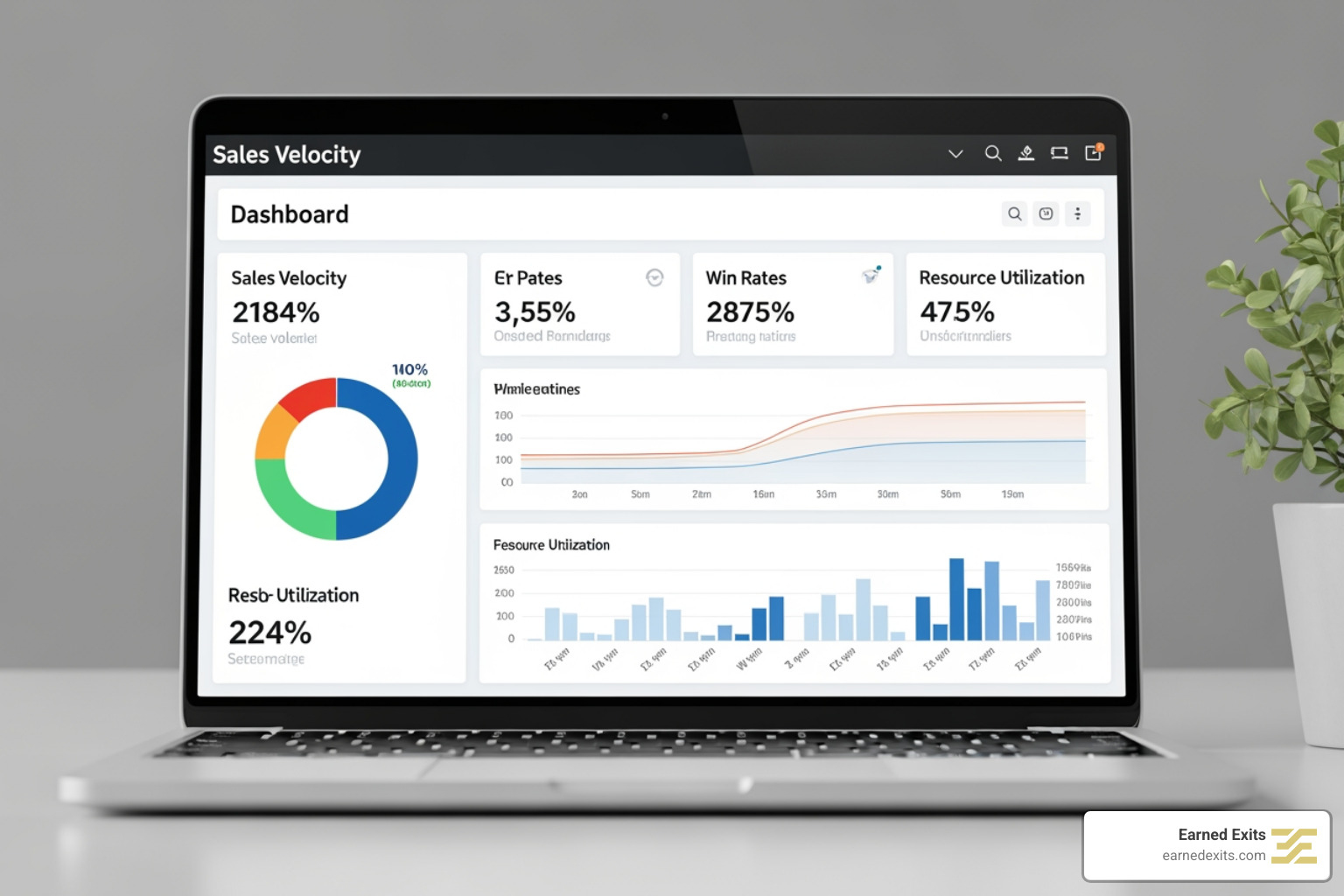
You can’t manage what you don’t measure. Organizations must track specific KPIs to gauge the health of their pre-sales stages. Key metrics include:
- Win Rate: The percentage of deals that close after a pre-sales engagement.
- Technical Cycle Time: How long it takes to move from discovery to technical validation.
- Discovery-to-Demo Conversion: Are we qualifying correctly, or are we demoing to people who can’t buy?
- Resource Utilization: Are our technical experts being used effectively?
Understanding these metrics is as vital as Unlocking Business Valuation when preparing for a company sale—it tells you exactly where the value is being created and where the leaks are.
Frequently Asked Questions about Pre-Sales
How does pre-sales differ from the traditional sales process?
The primary difference lies in the focus. Traditional sales is often about commercial negotiation—the “who, when, and how much.” Pre-sales is about the “how.” It focuses on technical validation, relationship nurturing through expertise, and solution design. While a salesperson “closes” the deal, a pre-sales professional “proves” the deal is worth closing. As Salesforce notes, this distinction is vital for maintaining trust with the buyer.
What are the most common challenges in the pre-sales process?
The most frequent hurdles we see include:
- Knowledge Silos: Technical teams and sales teams not sharing information, leading to conflicting messages.
- Manual RFP Processes: Teams spending days on documents that could be automated.
- Unqualified Leads: Sales reps bringing in “prospects” that have no budget or actual need.
- Resource Burnout: Overworking a small group of technical experts because the process isn’t scalable.
How does a strong pre-sales process impact post-sales success?
A strong pre-sales process is the best predictor of a happy customer. By setting clear expectations and ensuring a proper technical fit during the pre-sales stages, we eliminate the “over-promise, under-deliver” trap. It allows for a smooth knowledge transfer to the implementation team, which directly boosts customer retention and long-term revenue growth.
Conclusion
Mastering the pre-sales stages is about more than just closing a single deal; it’s about building a repeatable engine for growth. At Earned Exits, we understand that the preparation you do before the “big moment”—whether that’s a software sale or a strategic business exit—is what defines your success.
Our team provides the same level of seamless communication, CFO-level due diligence support, and organized processing for business owners that high-performing pre-sales teams provide for their prospects. If you are ready to move toward a strategic exit with the same precision we’ve discussed today, we are here to help.
Ready to take the next step? Whether you are looking to Sell My Business or simply want to optimize your current operations for a future exit, let’s talk. At Earned Exits, we make the complex simple, ensuring you get the value you’ve earned.
