


Local Business Brokerage Fees Explained: What You Will Actually Pay
How Business Broker Fee Structures Work and What You Will Pay
When planning an exit, understanding how advisors charge for their work is critical. The primary compensation model in the business brokerage industry is the success fee, which aligns our financial incentives directly with yours: we earn the bulk of our fee only when your transaction successfully closes.
Across the United States, standard commission rates for small to mid-market businesses typically range between 8% and 12% of the total enterprise sale price. However, this percentage often adjusts based on deal size. For larger transactions (often above $5M to $10M), brokers frequently implement a tiered structure—such as the Double Lehman scale—where the percentage decreases as transaction value milestones increase.
Beyond the baseline percentage, you should review fee agreements for three essential components:
- Minimum Success Fees: Most brokerage firms institute a minimum dollar threshold (often $15,000 to $35,000) regardless of the final price. This ensures broker operational costs are covered even on smaller deals.
- Upfront Retainers or Engagement Fees: Some brokerages charge an onboarding fee or valuation retainer ranging from $2,500 to $10,000. In reputable firms, this fee is often credited back against the final success commission at closing.
- Third-Party Transaction Costs: Beware of hidden expenses. Brokerage commissions cover advisory, packaging, marketing, buyer screening, and deal coordination. They do not cover independent third-party costs, such as closing attorneys, escrow agents, CPA financial recasting, or commercial lease transfer fees.
Reviewing the thorough guide to picking a trusted business sale broker can help you identify clear fee structures and avoid hidden surprises before signing an exclusive agreement. For a broader perspective on industry standards, the International Business Brokers Association provides additional resources on broker compensation models.
How to Evaluate and Find Business Sale Brokers Near Me
A business broker serves a fundamentally different role than standard professional advisors. While your CPA calculates tax liabilities and your attorney drafts legal safeguards, a business broker acts as the transaction quarterback. We package your financial story, source vetted buyers, manage competitive tension, navigate due diligence, and orchestrate all parties through closing.
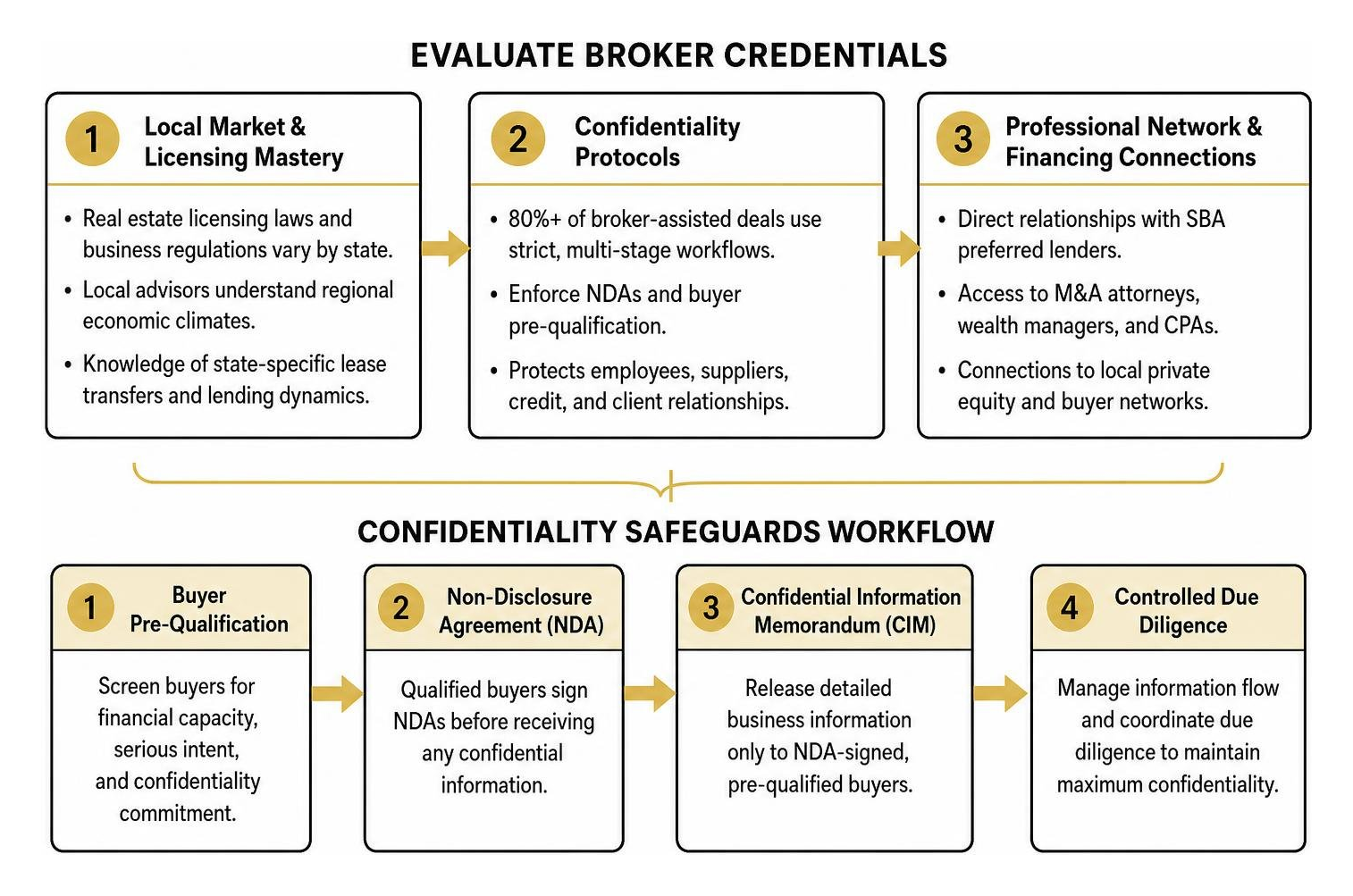
When vetting local brokerages, evaluate these core pillars:
- Local Market & Licensing Mastery: Real estate licensing laws and localized business regulations vary across states—from California and Texas to Florida and New York. Local advisors understand regional economic climates, state-specific commercial lease transfers, and regional lending dynamics.
- Confidentiality Protocols: Over 80% of broker-assisted transactions utilize strict, multi-stage confidentiality workflows. In a local market, a premature leak can alarm employees, disrupt supplier credit, or prompt client churn. Ensure your prospective broker enforces strict Non-Disclosure Agreements (NDAs) and buyer pre-qualification before releasing your confidential information memorandum (CIM).
- Professional Network & Financing Connections: A top-tier local broker maintains direct relationships with regional Small Business Administration (SBA) preferred lenders, M&A attorneys, wealth managers, and local private equity networks.
For practical tips on navigating local directories and vetting candidates, read through finding the best local business brokers near you without losing your mind.
Step-by-Step Vetting: Key Questions to Ask Business Sale Brokers Near Me
During your initial consultation, ask precise questions to gauge fit and capability:
- What is your specific closing track record in my industry and revenue band over the last 24 months?
- How do you confidentially market local businesses without tipping off my competitors, staff, or customers?
- What is your process for verifying buyer funds and SBA pre-qualification before sharing my financials?
- Will I work directly with you or be handed off to a junior associate after signing?
- What specific tools and financial due diligence support do you provide to keep the deal on schedule?
Using structured frameworks like the ultimate matchmaker guide: finding your perfect business broker will help you compare responses and select the right partner.
Comparing Experience and Qualifications for Business Sale Brokers Near Me
Not all brokers possess the same credentials or operational discipline. Look for accreditations such as the Certified Business Intermediary (CBI) or Mergers & Acquisitions Master Intermediary (M&AMI).
Reviewing side-by-side resources like the 10 best business brokers compared highlights how specialized brokerage services provide comprehensive due diligence readiness, CFO support, and high-touch communication throughout the exit journey.
How Local Brokers Determine Valuation and Maximize Sale Value
An accurate business valuation is the bedrock of a successful exit. Nearly half (45%) of business owners regret selling within their first year, often because they mispriced their company or accepted disadvantageous deal terms.
Brokers determine market value using financial recasting to uncover true owner earnings:
- Seller’s Discretionary Earnings (SDE): Primarily used for owner-operated small businesses under $1M-$2M in earnings. SDE adds back owner compensation, personal expenses run through the business, non-recurring expenses, and non-cash depreciation.
- Adjusted EBITDA: Used for larger, management-led middle-market companies ($2M+ EBITDA), adjusting for market-rate management salaries, non-operating revenues, and one-time extraordinary costs.
Multiples are influenced by revenue consistency, client concentration risks, industry growth trends, and localized comparables from similar regional transactions. You can explore these value drivers further in the hidden perks of hiring a broker to sell your business.
The 30% Valuation Advantage Over FSBO Deals
Selling a business For Sale By Owner (FSBO) carries hidden opportunity costs. Industry data shows that businesses sold through a professional intermediary achieve, on average, a 30% higher sale price compared to unrepresented sales.
Furthermore, businesses listed with a local broker are 3.5 times more likely to close successfully than those listed by the owner alone. Brokers achieve this by creating competitive bidding environments among vetted buyers, preventing deal fatigue, and structuring terms—such as seller financing notes, earn-outs, and equity rollovers—to optimize net post-tax proceeds.
The Business Sale Process: Step-by-Step Timeline and Common Pitfalls
Selling a business is an involved process. The median timeline with a broker is 6 to 12 months, whereas unassisted FSBO transactions routinely stretch past 18 to 24 months—or collapse during due diligence.
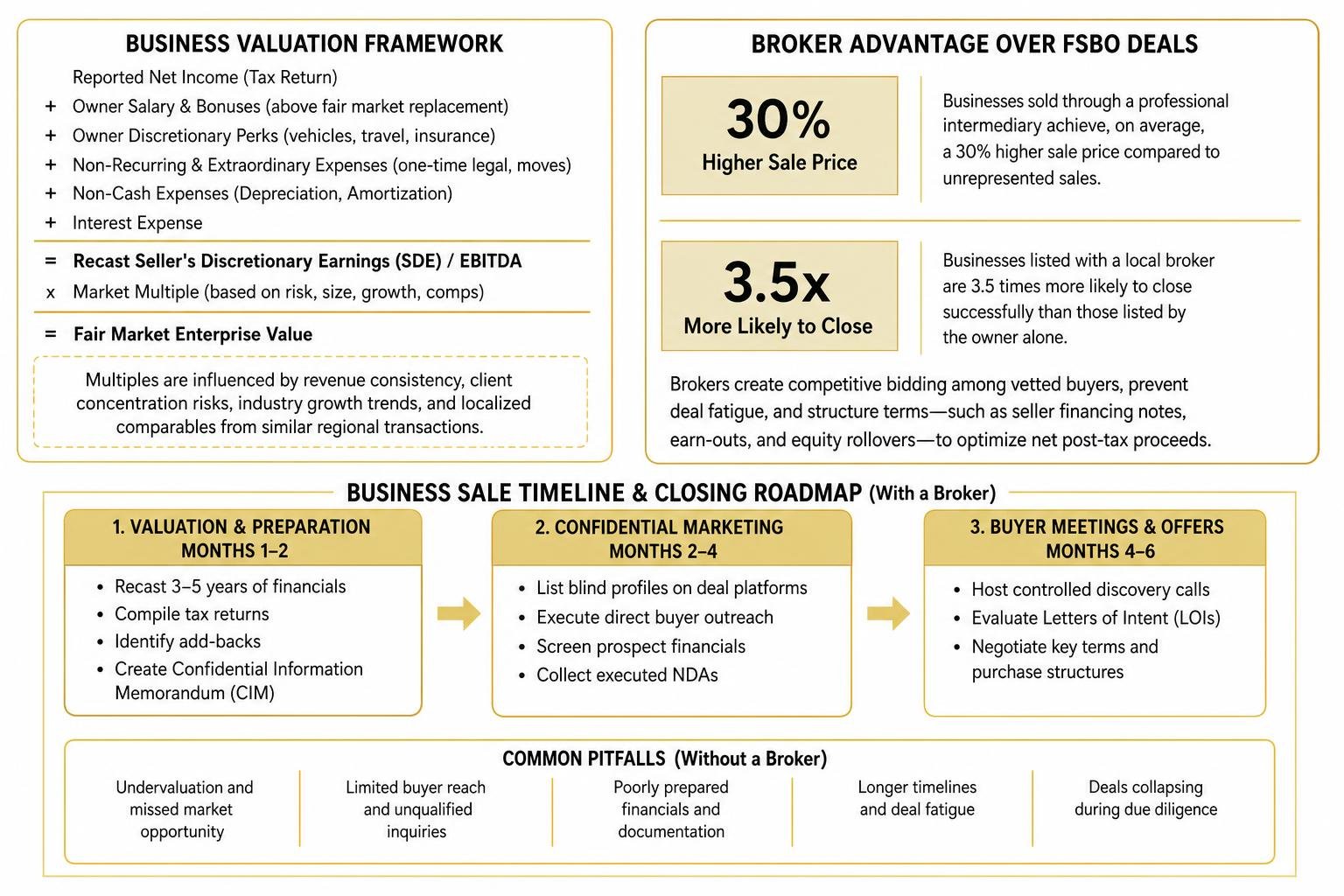
Here is how the standard sale timeline progresses:
- Valuation & Preparation (Months 1–2): Recasting 3–5 years of financials, compiling tax returns, identifying add-backs, and creating the Confidential Information Memorandum (CIM).
- Confidential Marketing (Months 2–4): Listing blind profiles on deal platforms, executing direct buyer outreach, screening prospect financials, and collecting executed NDAs.
- Buyer Meetings & Offers (Months 4–6): Hosting controlled discovery calls, evaluating Letters of Intent (LOIs), and negotiating key terms and purchase structures.
- Due Diligence & Financing (Months 6–9): Opening a secure virtual data room, coordinating CPA Quality of Earnings (QofE) audits, and supporting lender underwriting (such as SBA 7(a) packages).
- Definitive Agreements & Closing (Months 9–12): Finalizing the Asset or Stock Purchase Agreement, executing lease assignments, settling escrow accounts, and conducting staff transitions.
To understand the operational mechanics across each milestone, consult the ultimate guide to hiring a professional business broker.
Mistakes to Avoid When Working with a Local Brokerage Firm
Even with professional support, watch out for these common missteps:
- Premature Disclosure: Avoid sharing identifiable data with prospective buyers before receiving a signed NDA and verifying financial capability.
- Unrealistic Pricing Expectations: Avoid brokers who offer an inflated valuation simply to win your listing. Overpriced listings grow stale, damaging market credibility.
- Taking Your Eye Off Daily Operations: The single most common deal-killer is declining revenues during due diligence. Your primary focus must remain on running a profitable business while we manage the transaction mechanics.
Staying informed protects your timeline; review don’t get ghosted when choosing a leading business brokerage firm to spot advisory red flags early.
Frequently Asked Questions About Business Broker Fees
What is the standard commission rate for selling a business?
The national average commission rate for business brokerages ranges between 8% and 12% of the gross transaction value. Transactions with lower total enterprise values generally carry rates closer to 10%–12% (often subject to minimum fee thresholds of $15,000–$35,000), while larger mid-market sales scale down toward 4%–8%.
Are upfront retainers or valuation fees refundable?
Engagement fees and valuation retainers are typically non-refundable because they fund upfront labor, comprehensive financial recasting, and confidential marketing asset creation. However, many quality brokerage firms credit 100% of the upfront retainer against the final success commission upon closing.
How long does it take to sell a business with a broker?
A standard business sale through an intermediary takes 6 to 12 months from initial engagement to funded closing. In contrast, unrepresented FSBO transactions average 18 to 24 months and suffer significantly higher fallout rates due to buyer financing hurdles and due diligence delays.
Conclusion
Securing the right representation can mean the difference between an exhausting deal collapse and a profitable, well-structured exit. While broker fees represent an investment, the proven benefits—including an average 30% pricing premium, 3.5x higher closing rate, and total confidentiality protection—consistently deliver a substantial return on investment.
At Earned Exits, we pair deep regional insights with dedicated CFO-level due diligence support, proprietary buyer screening tools, and clear communication from valuation to closing. Ready to evaluate your exit options? Explore our comprehensive business brokerage services and schedule your confidential consultation today.
