


Keep It on the Down-Low: How to Sell Your Franchise Confidentially
Sell Your Franchise Confidentially Without Tipping Off the Market
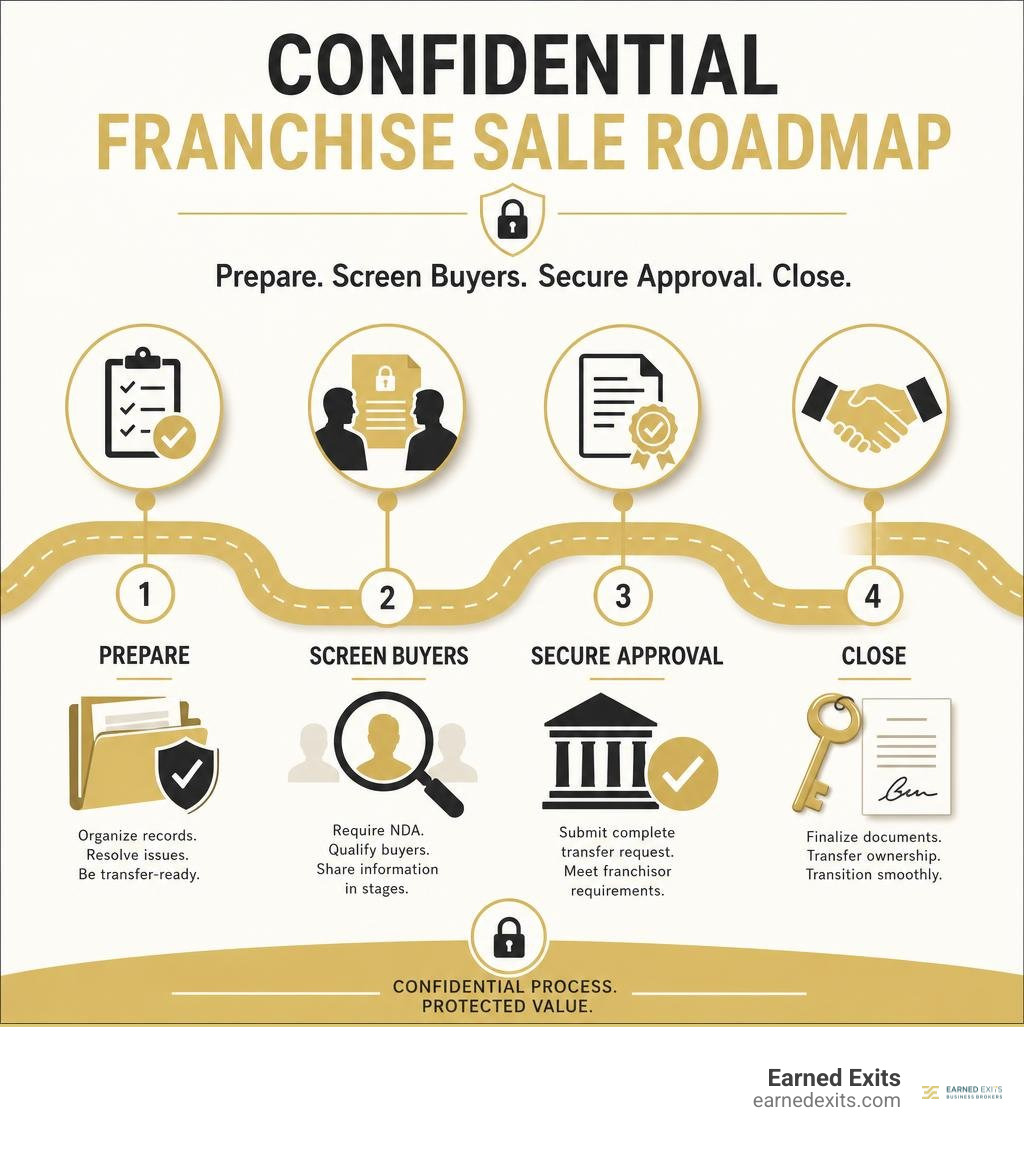
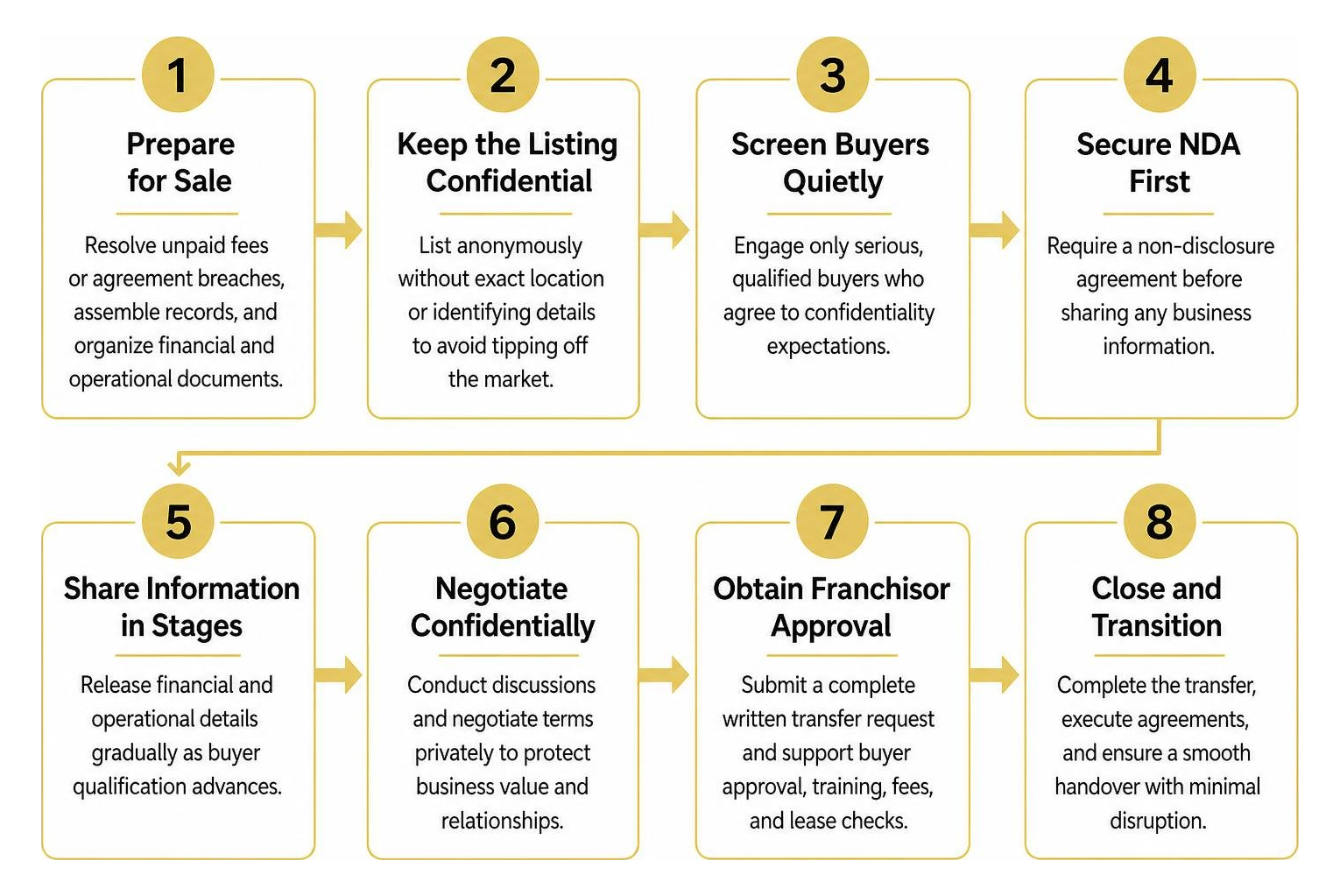
When owners tell me, “I need to sell my franchise confidentially,” the strategy begins by keeping the listing anonymous, requiring qualified buyers to sign a non-disclosure agreement (NDA), and releasing financial and operational details in stages. At the same time, prepare for the franchisor approval process early: resolve unpaid fees or agreement breaches, assemble your records, and submit a complete written transfer request when you have a serious buyer.
A confidential sale protects more than your asking price. It can help prevent customer worry, employee turnover, supplier questions, and competitors using the news against you. The goal is to keep daily operations steady while you quietly find, screen, and negotiate with the right buyer.
Selling a franchise also has a layer an independent business sale does not: the franchisor usually must approve the buyer and transfer. Approval may involve buyer training, an assignment fee, lease and premises checks, and either an assignment of your current agreement or a new agreement for the remaining term.
I am Britt Clas, a Business Broker and Partner at Earned Exits, where I help owners organize valuation, buyer outreach, due diligence, and closing so they can navigate a confidential sale without losing control of the process. My work focuses on creating a clear, well-managed exit that protects business value, employees, and long-term relationships.
Helpful franchise sale resources:
Essential Steps to Sell My Franchise Confidentially Without Disrupting Operations
Executing a discreet sale requires discipline, operational stability, and structured protocols. The moment word leaks that a unit is on the market, key staff members start polishing their resumes, vendors tighten payment terms, and competitors aggressively solicit your client base. To maintain enterprise value, daily operations must run as if you plan to own the business for the next twenty years.
Working with experienced intermediaries gives you the operational insulation needed to manage a transaction quietly. You can discover The Hidden Perks of Hiring a Broker to Sell Your Business when maintaining operational privacy while engaging the market. Following proven, systematic frameworks outlined in How to Sell a Business Steps to a Smooth Exit allows you to balance continuous revenue generation with buyer sourcing.
Why Non-Disclosure Agreements Are Critical in a Confidential Franchise Sale
A robust, legally binding Non-Disclosure Agreement (NDA) is your primary defensive barrier when sharing proprietary operational data. Standard boilerplates rarely suffice in franchise resales. An effective NDA must explicitly protect:
- Exact location details and physical store addresses
- Granular point-of-sale (POS) records and itemized margins
- Employee rosters, wage rates, and management structures
- Proprietary operational playbooks and customer lists
- Vendor agreements and franchisor-specific supply arrangements
Information should be released in controlled, sequential tiers. Initial inquiries should only receive generic industry performance figures. Detailed tax returns, internal profit and loss statements, and site lease contracts should remain locked until a buyer demonstrates verifiable financial liquidity, completes full identity verification, and executes the NDA.
Using Blind Profiles to Attract Qualified Buyers Discreetly
Blind listings, or “one-page teasers,” showcase the commercial strengths of your franchise without giving away its identity. Instead of advertising “Subway on 4th Street in Anchorage,” a blind profile describes a “High-Volume Quick-Service Restaurant Franchise in Greater Anchorage with Consistent Cash Flow and Tenured Staff.”
To protect your identity across regional markets:
- Mask specific geographic markers by referencing general metro areas or economic regions.
- Round gross revenues, earnings before interest, taxes, depreciation, and amortization (EBITDA), or Seller’s Discretionary Earnings (SDE) to the nearest ten thousand.
- Exclude proprietary interior photographs, distinct architectural footprints, or brand-specific taglines.
- Screen prospective buyers thoroughly for liquid net worth, creditworthiness, and relevant management experience before providing a comprehensive Confidential Information Memorandum (CIM).
Navigating Franchisor Consent, Approval Deadlines, and Agreement Transfers
Unlike independent corporate sales, selling a franchise involves a tripartite transaction between you, your buyer, and the corporate franchisor. The franchisor holds a vested interest in protecting brand equity, ensuring the incoming owner meets network standards, and securing compliance with statutory requirements.

State regulations can impact how franchise contracts, assignment rights, and renewals operate. For example, owners in the Northwest must evaluate local guidelines like Alaska Franchise Laws alongside the standard Federal Trade Commission (FTC) Franchise Rule and Franchise Disclosure Document (FDD) provisions.
Understanding the 42-Day Deemed Consent Timeline
When requesting transfer consent, statutory rules and standard franchise codes require franchisors to act within defined timeframes:
- Formal Written Submission: The franchisee submits a formal transfer request accompanied by all required buyer financial statements, operational resumes, and application forms.
- The 42-Day Clock: The franchisor has up to 42 days to respond to the written request. If the franchisor requests additional, reasonable information, the 42-day window restarts upon receipt of those final documents.
- Deemed Consent: If the franchisor fails to deliver a written refusal outlining reasonable grounds within this 42-day period, consent is legally deemed to have been granted.
- The 14-Day Revocation Window: After granting written consent, a franchisor maintains a strict 14-day window during which they may cancel their consent, provided they provide written reasons and act reasonably (for instance, if new material facts emerge regarding buyer insolvency).
Handling Grounds for Withheld Consent and Pre-Sale Breaches
Franchisors are legally restricted from unreasonably withholding consent, but they maintain clear statutory grounds to reject an unqualified applicant or an unprepared seller.
Common valid reasons for a franchisor to withhold transfer consent include:
- Un-remedied Agreement Breaches: Outstanding default notices, operational audit failures, or unauthorized product offerings.
- Financial Arrears: Unpaid monthly royalty fees, marketing fund dues, or hardware licensing debts owed directly to corporate headquarters.
- Unmet Buyer Selection Criteria: Inadequate liquid capital, poor credit history, or failure to pass standard executive brand interviews and background checks.
- Premises Non-Compliance: Uncompleted mandatory store refreshes, unapproved signage, or deferred equipment upgrades.
Prior to entering the market, settle all outstanding franchisor balances and complete necessary facility updates to prevent administrative delays during closing.
Valuing a Franchise and Avoiding Pitfalls That Destroy Deal Value
Arriving at an accurate valuation requires understanding how the franchise business model influences market multiples. Business buyers pay for predictable, defensible cash flows. In a franchise network, those cash flows depend heavily on unit-level financial performance and the remaining duration of your commercial agreements.

To establish an accurate valuation baseline, consult The Ultimate Guide to Small Business Valuation Methods. Multiples are typically applied to normalized SDE for owner-operators, or adjusted EBITDA for semi-absentee or multi-unit operations. If you are exploring regional expansion or cross-territory valuations, reviewing active benchmarks like Franchise Opportunities in Arkansas provides clear perspective on current franchise acquisition costs across different markets.
Asset Valuation vs. Brand Operating Rights
A common misconception among owners is valuing their unit as if they own independent, perpetual brand equity. When selling a franchise, you are primarily transferring two distinct elements:
- Tangible & Operating Assets: Tangible furniture, fixtures, equipment (FF&E), leasehold improvements, and established localized customer goodwill.
- Brand Operating Rights: The contractual license to execute an established business model under corporate marks for a specified period.
If your franchise agreement has only two years remaining on a ten-year term, a buyer faces immediate renewal fees, mandatory premises upgrades, or potential non-renewal risks. Transferring an existing contract term differs significantly from having the franchisor issue a fresh, 10-year franchise agreement to the buyer. Ensure your valuation accounts for these upcoming contractual milestones.
Common Pitfalls That Erode Resale Valuation
Deal value can deteriorate quickly when operational oversights surface during buyer audits. Below is an analysis of how high-readiness units compare against distressed franchise listings:
| Dimension | High-Value Franchise Readiness | Distressed / Value-Impaired Listing |
|---|---|---|
| Financial Records | 3–5 years clean, recast tax returns and normalized P&Ls | Commingled personal expenses, undocumented cash receipts |
| Franchise Agreement | 5+ years remaining, or pre-approved renewal terms | Expiring term with mandatory corporate remodel overdue |
| Physical Premises | Fully compliant with current brand standards and ADA codes | Deferred maintenance, outdated signage, worn FF&E |
| Staffing & Operations | Trained cross-functional team, low staff turnover | Heavy owner-dependency, high turnover, vacant core roles |
| Corporate Relationship | Clean record, zero open default notices, current royalties | History of royalty arrears, unresolved compliance disputes |
Managing Buyer Due Diligence, Cooling-Off Periods, and Closing
Due diligence is the stage where confidentiality is most vulnerable. A buyer must inspect the inner workings of your franchise, yet your team cannot know a deal is underway.
Manage this phase through secure Virtual Data Rooms (VDRs). Release documents systematically: high-level financial overviews first, lease agreements and equipment lists second, and customer identifiers or sensitive supplier terms only after formal financing approval is secured. When preparing your definitive purchase agreement, reference The Essential Business Sale Contract Template and Legal Guide to structure representations, warranties, and escrow holdbacks properly.
Navigating Buyer Change of Mind and Statutory Cooling-Off Periods
In franchise transactions, statutory consumer protections often grant buyers a formal cooling-off period. During this window, an incoming buyer has the legal right to reconsider their purchase and withdraw from the transaction.
To protect the deal during this period:
- Require meaningful, non-refundable earnest money deposits held in third-party escrow accounts, subject to statutory cooling-off constraints.
- Avoid announcing the transition to staff or landlords until all statutory cooling-off windows expire and franchisor approval is finalized.
- Maintain a secondary pipeline of qualified backup buyers to avoid losing deal momentum if a primary buyer experiences cold feet.
Finalizing the Transfer and Handover
Once the cooling-off period elapses and the franchisor grants formal written approval, the transaction moves toward closing:
- Franchisor Training: The buyer completes mandatory corporate onboarding and certification at corporate headquarters or online.
- Commercial Lease Assignment: The commercial landlord approves the assignment of the underlying real estate lease, or executes a new lease agreement.
- Transfer Fee Settlement: Payment of the contractual assignment fee (typically $5,000 to $15,000+) to the franchisor, as defined in the franchise agreement.
- Closing & Release: Execution of the bill of sale, settlement of pro-rated inventory, release of seller personal guarantees, and operational handover.
Frequently Asked Questions About Selling a Franchise Confidentially
What happens if my franchisor unreasonably withholds consent to transfer?
If a franchisor refuses a transfer without valid commercial or regulatory justification, review the dispute resolution section of your franchise agreement. Most modern agreements mandate formal executive mediation or binding arbitration before litigation. Statutory protections prevent arbitrary denials, provided the proposed buyer satisfies standard brand requirements and you have remedied all outstanding operational defaults.
When can I assume the franchisor has approved the sale?
You may legally assume consent has been granted if the franchisor has not provided a written refusal within 42 days of receiving your formal transfer request, or 42 days after receiving the last piece of requested documentation. However, confirm that the franchisor does not exercise their 14-day written revocation right following that determination.
How do I inform my employees about the sale without causing panic?
Do not inform general staff until all contingencies are cleared, the franchisor has granted final approval, the cooling-off period has expired, and financing is fully funded. Coordinate a joint meeting with the incoming buyer immediately following the close. Introduce the buyer as an incoming owner committed to growing the business, emphasize job security, and clarify wage continuity to ensure operational stability.
Conclusion
Successfully executing a confidential franchise sale requires balancing operational discretion with franchisor compliance. By implementing blind listings, securing binding non-disclosure agreements, normalizing your financials, and proactively managing the franchisor approval timeline, you protect both daily cash flows and your ultimate exit value.
At Earned Exits, we simplify this complex journey. Our team provides dedicated CFO-level due diligence, valuation modeling, and structured confidentiality systems to help you exit smoothly on your own terms. Explore our business brokerage services to discover how we can help you navigate your franchise sale discreetly and maximize your transaction value.
