


Is That Company for Sale? How to Make an Unsolicited Offer
The Smartest Deals Start Before a Business Is Listed
Not every great company for sale is sitting on a marketplace waiting for you to find it.
Some of the best acquisition opportunities are businesses that have never been publicly listed — and never will be. The owners just haven’t thought about selling yet. Or they’re waiting for the right person to ask.
That’s where unsolicited offers come in.
Looking for a business to buy? Here’s a quick overview of your main options:
| Path | What It Means | Best For |
|---|---|---|
| Listed marketplaces | Browse online business-for-sale platforms and directories | Buyers who want verified listings with financials |
| Off-market outreach | Directly approach a business owner who hasn’t listed | Buyers who want less competition and better deals |
| Business brokers | Work with an advisor who surfaces opportunities for you | Buyers who want curated, pre-vetted targets |
| Unsolicited offer | Make a formal approach to a company not actively for sale | Strategic acquirers targeting specific businesses |
Most first-time buyers head straight to the listing sites. That makes sense — there are tens of thousands of businesses available. Major online marketplaces often list tens of thousands of businesses across hundreds of countries, providing a vast pool of digital and brick-and-mortar assets.
But if you have a specific business in mind — a competitor, a supplier, or a niche player you’ve been watching — waiting for them to list may mean waiting forever.
The unsolicited offer is how strategic buyers get ahead of the market.
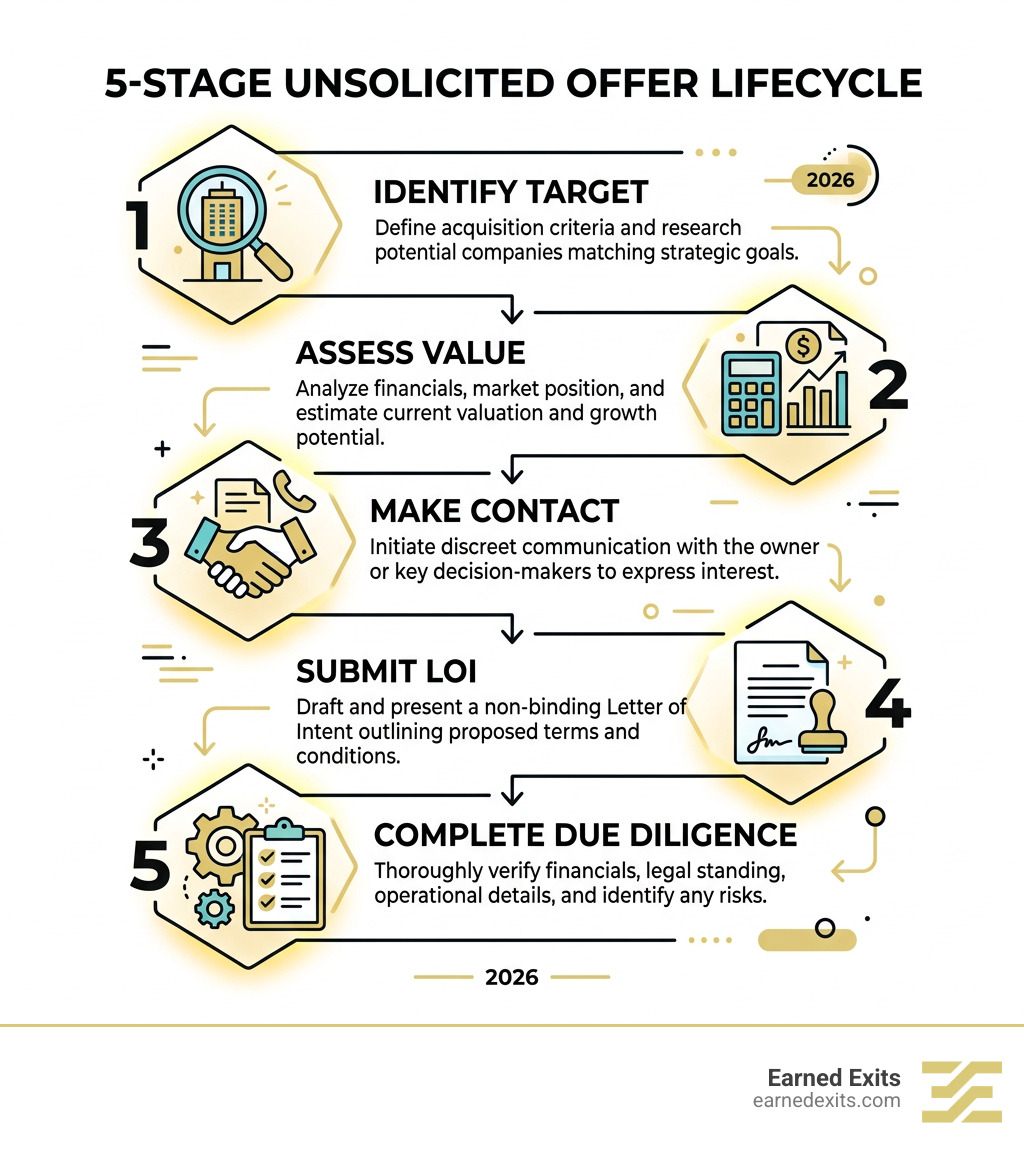
This guide walks you through exactly how to do it: how to identify the right target, figure out what it’s worth, make your approach, and close the deal — even when the owner never planned to sell.
Identifying the Right Company for Sale
When you decide to grow through acquisition, your first task is narrowing down the field. A company for sale doesn’t always have a physical storefront. We see a massive variety of digital assets changing hands every day.
If you aren’t sure where to start, you can browse our current Listings to see what a “ready-to-go” deal looks like. However, if you are looking to make an unsolicited move, you should categorize your targets into these popular digital buckets:
- SaaS (Software as a Service): These are highly prized for their recurring revenue models.
- E-commerce & Amazon FBA: These businesses often have physical inventory and established supply chains.
- Digital Agencies: Service-based businesses that offer specialized talent and a steady client base.
- Content Sites & Newsletters: These earn through advertising, affiliate marketing, or subscriptions.
- Mobile Apps: Ranging from utility tools to games, these can scale rapidly with the right marketing.
Researching a private company for sale
Before you send an email to an owner, you need to do your homework. Since the business isn’t publicly listed, you won’t have a pitch deck or a profit and loss statement (P&L) handed to you. You have to look at the external signals.
We recommend evaluating the following factors:
- Market Trends: Is the industry growing? For example, AI-powered tools and specialized e-commerce niches are currently seeing high demand.
- Competitive Advantage: Does the company have a “moat”? This could be a proprietary software, a massive email list, or a highly ranked domain.
- Growth Potential: Can you see obvious ways to improve the business? Perhaps their SEO is lacking, or they haven’t optimized their conversion rates.
- Management Quality: Even in a small business, the “human” element matters. If the owner is the only person who knows how the business runs, it might be harder to transition.
For those looking at the Amazon space, keep in mind that Amazon seller earnings statistics show that 50% of sellers make between $1,000 and $25,000 a month. This equates to roughly $12,000 to $300,000 annually, providing a wide range of targets for potential buyers.
Evaluating beginner-friendly opportunities
If this is your first time looking for a company for sale, you might want to start smaller. Not every acquisition needs to be a multi-million dollar merger. There are many low-cost startups and side hustles that serve as excellent “entry-level” businesses.
Dropshipping is a classic example. According to dropshipping revenue potential data, successful dropshippers can earn annual revenues of up to $100,000. Because these businesses don’t require you to hold inventory, the overhead is low, making them a great option for those looking for a manageable side hustle. We often help buyers find these “recession-proof” categories—like education, health, and essential goods—which tend to stay stable even when the economy gets bumpy.
Determining the Value of an Off-Market Business
This is where the rubber meets the road. How do you value a company for sale when there isn’t an asking price?
In our experience, most small to mid-sized businesses (SMBs) are valued based on a multiple of their earnings. Specifically, we look at Seller’s Discretionary Earnings (SDE). This is the net profit of the business with the owner’s salary and one-time expenses “added back” to show the true earning power of the asset.
To get a clear picture, you should explore our guide on Unlocking Business Valuation which covers market multiples in detail. Typically, digital businesses sell for anywhere between 2x and 6x their annual profit, depending on their age, growth rate, and risk profile.
A critical part of this process is Demystifying Add-Backs and SDE. If a business owner is running personal expenses through the company—like a car lease or a home office—those costs should be added back to the profit to give you a fair valuation. Understanding these “hidden” values allows you to make an offer that is fair to the seller but still profitable for you.
Steps to Making an Unsolicited Offer
Making an unsolicited offer is a delicate dance. You aren’t just buying a business; you’re often convincing someone to change their entire life plan.
| Feature | Solicited (Listed) Sale | Unsolicited (Off-Market) Sale |
|---|---|---|
| Competition | High (many buyers) | Low (usually just you) |
| Price | Market-driven asking price | Negotiated from scratch |
| Information | Data room ready | You must request data |
| Speed | Can be faster | Often slower (owner needs to prepare) |
| Leverage | Seller has multiple offers | Buyer can offer a “painless” exit |
The first step is Direct Outreach. We suggest a warm, professional approach. Don’t lead with a price. Lead with your interest in their brand and your desire to help preserve their legacy. Once you’ve established a rapport, you can move to a Letter of Intent (LOI). This is a non-binding document that outlines the proposed price and terms of the deal.
If you are unsure how to frame your approach, you can learn more about how to Buy a Business through our structured advisory services. We often find that a “valuation gap” exists where the seller thinks their business is worth more than the data suggests. Navigating this requires patience and clear communication.
Financing the purchase of a company for sale
How are you going to pay for it? Unless you have a mountain of cash, you’ll likely need financing. Common paths include:
- Equity: Using your own capital or bringing in partners.
- Debt: Taking out a loan (like an SBA loan in the US).
- Venture Capital / Angel Investing: Bringing in outside investors who take a piece of the company.
- Crowdfunding: Raising small amounts from a large group of people.
When looking at your budget, consider e-commerce profit benchmarks. The average net profit for an e-commerce business is around $132,600. Knowing these averages helps you determine if the business you are targeting is performing above or below the industry standard, which directly impacts how much financing you can secure.
Essential Due Diligence and Verification
Once your unsolicited offer is accepted, the real work begins. Due diligence is the process of “looking under the hood” to ensure the company for sale is exactly what the owner says it is.
You need to verify three main pillars:
- Financial Health: We look at tax returns, bank statements, and payment processor data. We help our clients by providing thorough CFO and due diligence support to spot any red flags.
- Traffic and Operations: For online businesses, we verify Google Analytics, social media engagement, and customer retention rates.
- Legal Verification: Are there any pending lawsuits? Does the company actually own its intellectual property?
We follow a rigorous 10 Step Selling Process that works just as well for buyers. This ensures nothing is missed during the transition. If you are worried about the numbers, our Business Valuation Services can provide a third-party perspective to ensure you aren’t overpaying.
Frequently Asked Questions about Buying a Business
What are the fastest growing online businesses?
Currently, AI-integrated SaaS, specialized content newsletters, and health-focused e-commerce brands are seeing the fastest growth. As technology evolves, businesses that solve specific problems using automation or unique data are commanding the highest multiples.
How much does it cost to buy an online business?
There is no single answer, but the range is vast. You can find “starter” sites on marketplaces for under $5,000, while established SaaS companies can go for tens of millions. On average, a profitable, stable online business will likely require an investment starting in the mid-five figures.
What is the easiest business to start?
If you aren’t ready to buy a company for sale, many entrepreneurs start with content sites or dropshipping. These have low barriers to entry and allow you to learn the ropes of digital marketing and operations without a massive upfront capital requirement.
Conclusion
Finding a company for sale is only the beginning of your journey. Whether you are browsing public marketplaces or making a bold unsolicited offer, the key to a successful acquisition is preparation, thorough valuation, and expert guidance.
At Earned Exits, we specialize in making this process seamless and organized. We believe in excellent communication and providing the thorough due diligence support you need to buy with confidence. From our Business Brokerage Services to our dedicated tools for sellers who want to Sell My Business, we are here to help you navigate every step of the M&A landscape.
Ready to find your next opportunity? Let’s get to work.
