


Is a Franchise Real Estate Agency Your Ticket to the Big Leagues
Is a Franchise Real Estate Agency Worth It?
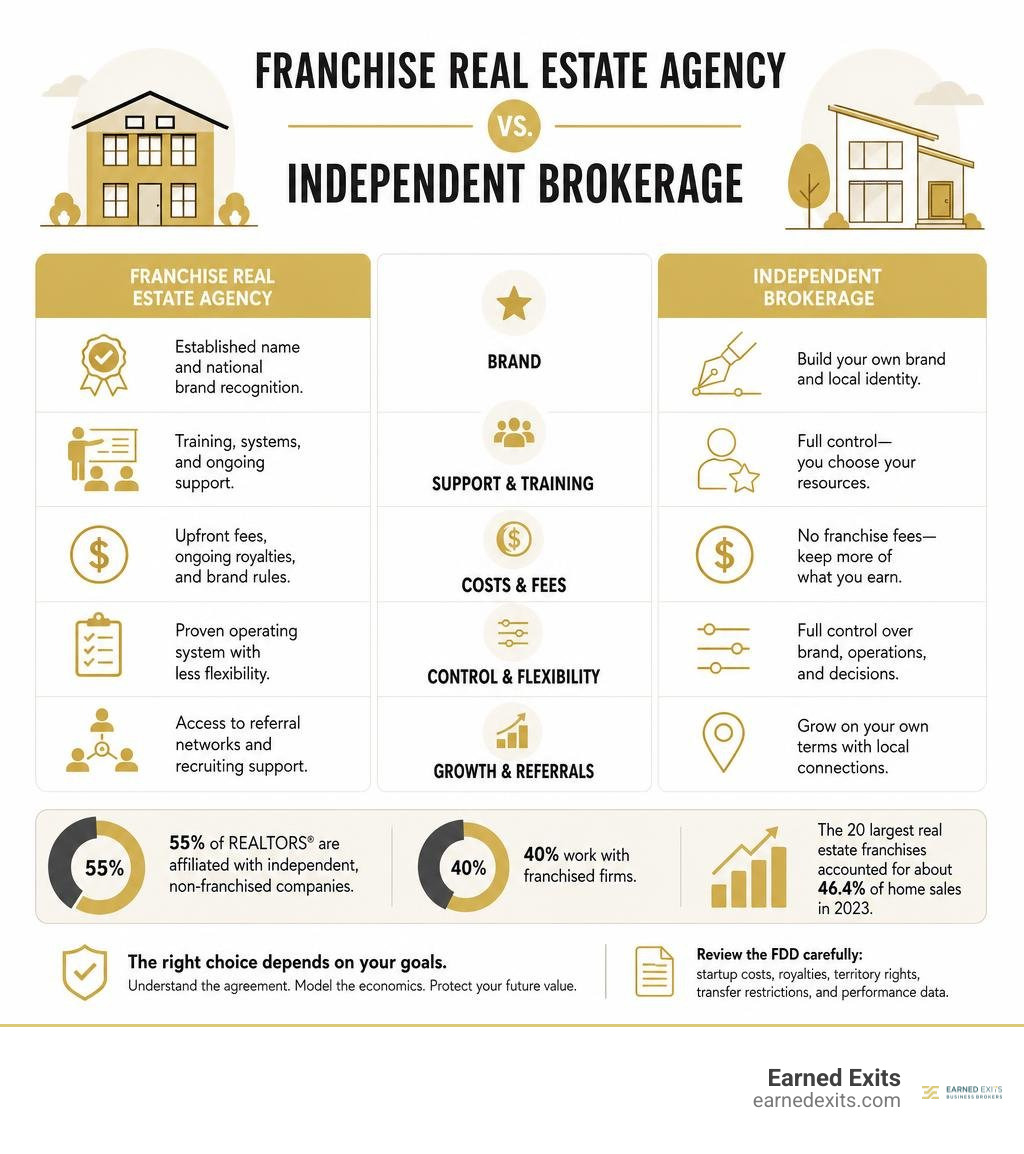
A franchise real estate agency can help a new broker-owner enter the market with an established name, training, marketing systems, technology, and referral connections. In return, you give up some control and take on upfront fees, ongoing royalties, and brand rules.
The right choice comes down to a simple comparison:
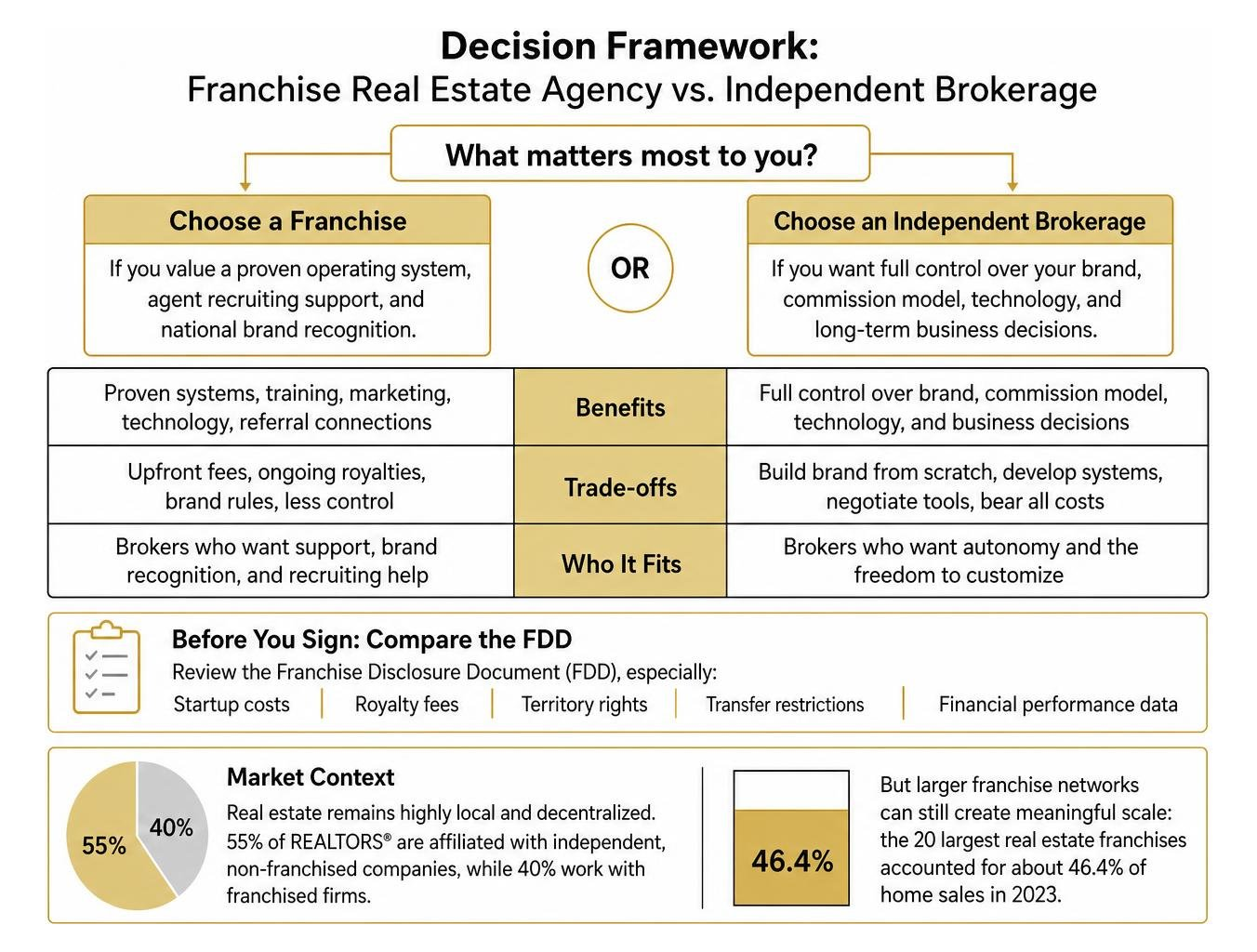
- Choose a franchise if you value a proven operating system, agent recruiting support, and national brand recognition.
- Choose an independent brokerage if you want full control over your brand, commission model, technology, and long-term business decisions.
- Before signing, compare the Franchise Disclosure Document (FDD), especially startup costs, royalty fees, territory rights, transfer restrictions, and any financial performance data.
Neither route guarantees profit. Real estate remains highly local and decentralized: 55% of REALTORS® are affiliated with independent, non-franchised companies, while 40% work with franchised firms. But larger franchise networks can still create meaningful scale; the 20 largest real estate franchises accounted for about 46.4% of home sales in 2023.
I am Britt Clas, a business broker and partner at Earned Exits Business Brokers, where I help owners evaluate value, conduct due diligence, and plan for a successful sale or transition. For anyone considering a franchise real estate agency, the same principles apply: understand the agreement, model the economics, and protect the value you may eventually want to sell.
Franchise real estate agency definitions:
- franchise brokers
- real estate brokerage franchise
- sell my franchise confidentially
Franchise vs. Independent Brokerage: Strategic Differences
Deciding whether to launch a standalone firm or align with a corporate flag shapes your day-to-day operations, overhead, and growth trajectory. In today’s market, where transaction velocity must navigate shifting interest rates and evolving buyer habits, market dynamics require clear positioning.
The fundamental tension lies between operational freedom and immediate brand trust. When you build an independent boutique brokerage, you retain complete authority over your firm’s identity, marketing creative, commission splits, and technology decisions. You are not bound by rigid brand style guides or corporate directives. However, an independent broker-owner bears the entire weight of creating consumer awareness from scratch, developing custom agent onboarding workflows, and negotiating third-party software contracts.
In contrast, partnering with a franchisor delivers immediate consumer credibility. Homeowners often recognize national brand marks before they ever meet the listing agent. This instant trust helps during agent recruitment: productive sales associates frequently gravitate toward brands that provide ready-made transaction systems, national lead distribution pipelines, and structured coaching frameworks.
The real estate sector remains deeply decentralized. Even with multi-thousand-office brands dominating national advertising, the combined residential market share of the largest corporate enterprises sits between 15% and 20%. This leaves substantial market room for both independent agencies and franchised offices to win local market share.
Independent Brokerage vs. Franchise Real Estate Agency Model
The operational differences between these two paths center on three core pillars: lead generation, compliance overhead, and technological infrastructure.
Independent brokerages must source, vet, and integrate their own CRM, transaction management, and digital signature platforms. The founder shoulders 100% of the cost and labor required to build coaching programs and marketing assets. For an agile broker who wants to pioneer unconventional commission structures or hyper-focused niche marketing, this freedom is invaluable.
Franchise networks streamline these hurdles by delivering turnkey operational ecosystems. When evaluating FDD benchmark data across real estate franchise brands, you see that franchisors trade operational independence for plug-and-play scalability. Franchisees access national marketing funds, structured masterminds, global referral networks, and standardized agent onboarding paths.
| Operational Factor | Independent Brokerage | Real Estate Franchise Network |
|---|---|---|
| Brand Recognition | Built locally over time from zero | Instant national and international awareness |
| Initial Capital Barrier | Variable; basic state licensing and local office costs | $10K to $500K+ (franchise fee + buildout + cash reserves) |
| Ongoing Fees | None (100% revenue retained internally) | ~5.4% sector average royalty + brand ad fund contributions |
| Operational Autonomy | Total freedom over splits, branding, and tools | Governed by franchise agreement and corporate guidelines |
| Agent Recruitment | Relies on local reputation and custom culture | Accelerated by established training and national brand prestige |
| Tech Stack | Sourced, integrated, and funded independently | Turnkey CRM, AI tools, transaction pipelines, and back-office portals |
| Referral Pipeline | Manual local/regional network development | Built-in corporate cross-territory and global referral networks |
The Impact of AI and PropTech on Brokerage Operations

Technology has reshaped the core value proposition of real estate brokerage networks. A decade ago, franchisors primarily provided physical signage templates, printed listing books, and basic website landing pages. Today, competitive advantage relies on automated, end-to-end digital infrastructure.
Modern networks deploy integrated software suites that manage the full transaction lifecycle. These platforms combine:
- Proprietary AI concierges and lead-routing engines that contact inbound consumer leads within seconds, dramatically lifting conversion rates.
- Virtual staging and automated listing presentation generators that allow agents to produce interactive marketing collateral in minutes.
- End-to-end transaction workflows integrating title, escrow, mortgage pre-approval, and digital signatures under a single client dashboard.
- Predictive agent analytics helping broker-owners identify which sales associates need coaching or pipeline support before production dips.
Cloud-native and tech-forward brokerage platforms have pushed traditional franchisors to enhance their tech offerings. For a broker-owner, licensing these capabilities directly through a franchise model often proves cheaper and less time-consuming than negotiating disparate vendor licenses independently.
Evaluating the True Cost of a Franchise Real Estate Agency
Investing in a franchise network requires a clear assessment of both upfront capital requirements and ongoing operating costs. A low entry fee does not automatically mean a low-cost launch; comprehensive capitalization must account for commercial lease commitments, local licensing compliance, working capital reserves, and staff onboarding.
Before executing agreements, prospective owners must evaluate the complete financial commitment. Total initial investments across real estate franchises span a wide spectrum, from entry-level and mobile models starting around $10,000 to $20,000, up to full-service regional headquarters or luxury agency fit-outs exceeding $500,000.
Upfront Franchise Fees, Liquid Capital, and FDD Review
Federal regulations require every franchisor to provide prospective buyers with a Franchise Disclosure Document (FDD). This document outlines the legal and financial rules governing the relationship.
When reviewing 2026 Franchise Disclosure Document filing benchmarks, pay close attention to several key sections:
- Item 5 & Item 6 (Fees): Examines the initial franchise fee alongside required ongoing contributions. Standard initial fees across major brokerage networks average around $25,000 to $31,000 for a primary office location, with discounted rates (often $5,000 to $10,000) for branch offices, qualified military veterans, or diversity program participants.
- Item 7 (Total Initial Investment): Provides an itemized breakdown of expected startup costs, including office leasehold improvements, signage, insurance, software licensing, and working capital for the initial operating months.
- Item 12 (Territory): Clarifies whether you receive an exclusive protected territory, a non-exclusive territory, or a right of first refusal for neighboring zip codes.
- Item 19 (Financial Performance Representations): Details historical unit-level gross revenues and sales performance if the franchisor chooses to disclose them. Many legacy real estate franchisors do not provide Item 19 figures, making independent validation with current franchisees essential.
- Item 20 (Outlets and Franchisee Information): Lists unit counts, openings, transfers, and terminations over the past three years. A high turnover rate requires careful inquiry.
Conducting due diligence on these disclosures helps avoid undercapitalization. Prospective owners can review best practices for mastering the art of the due diligence report to ensure historical metrics and franchisor commitments receive thorough scrutiny.
Ongoing Royalties, Desk Fees, and Marketing Funds
Ongoing franchise fees represent a continuing operational expense on your income statement. Unlike fixed rent or utility costs, franchisor royalties directly affect top-line Gross Commission Income (GCI).
The sector average ongoing royalty rate across major real estate brands sits at approximately 5.4% of gross sales revenue. Additionally, most franchisors mandate contributions to a National Brand Marketing Fund (BMF), usually ranging between 1% and 2% of gross revenue, alongside fixed monthly software licensing and desk fees.
To understand the long-term compounding impact on bottom-line profit margins, consider a brokerage generating $1,000,000 in annual Gross Commission Income:
- Ongoing Royalty (5.4%): $54,000
- Brand Marketing Fund (1.5%): $15,000
- Technology & Admin Platform Fees ($500/month): $6,000
- Total Annual Franchisor Fees: $75,000
Over a standard 10-year franchise term, that amounts to $750,000 in top-line deductions before accounting for agent splits, office rent, staff payroll, or owner distributions. A franchise must generate enough additional transaction volume and recruiting leverage to outweigh these ongoing obligations.
Comparing Real Estate Franchise Models and Compensation Structures

The real estate brokerage landscape includes several distinct operational models. Selecting the right fit depends on your capital, management style, and recruiting strategy:
- Traditional Full-Service Franchises: Legacy models (e.g., Century 21, RE/MAX, Coldwell Banker) emphasizing strong consumer recognition, physical offices, localized territory protection, and structured broker-led coaching.
- Agent-Centric / Flat-Fee “UNBrokerage” Models: Concepts (such as Realty ONE Group or NextHome) focusing on low overhead, 100% commission retention structures for producing agents with transaction fees, and modern branding.
- Cloud-Based Non-Franchise Networks: Platforms (like Real Brokerage) operating without physical franchise fees, utilizing an 85/15 split model, tiered revenue sharing, and public stock incentives to recruit and retain agents at scale.
- Niche & Ancillary Service Franchises: Franchised systems focusing on specialized segments such as luxury residential, property management, home inspection, or off-market distressed property acquisition.
Commission Splits, Revenue Sharing, and Equity Incentives
Agent recruitment and retention directly drive brokerage profitability. Because agents work as independent contractors, your agency’s compensation structure determines who joins your roster.
Brokerage networks handle agent compensation through several primary structures:
- Graduated Splits: Traditional splits (such as 60/40, 70/30, or 80/20) where the brokerage keeps a percentage of every closed transaction to cover office overhead and franchisor royalties.
- Production Caps: Systems where agents pay a percentage split until reaching a predetermined annual ceiling (e.g., $12,000 to $18,000), after which they retain 100% of their commission for the remainder of their anniversary year, paying only nominal transaction fees.
- Multi-Tiered Revenue Sharing: Platforms where agents earn a direct percentage of the commission revenue generated by sales professionals they attract to the company, distributed across multiple organizational tiers.
- Equity and Stock Purchase Programs: Programs allowing broker-owners and agents to convert a portion of their commission into publicly traded shares or receive stock grants upon reaching sales milestones.
Long-Term Value and Exit Planning for a Franchise Real Estate Agency
A brokerage is more than an annual income stream; it is an enterprise asset that can eventually be sold. However, building transferable equity inside a franchise framework requires navigating specific contractual guidelines.
When preparing an agency for succession or market sale, several factors dictate value:
- Client Database and Data Ownership: Ensure your franchise contract allows you to retain and transfer proprietary client rosters, past transaction records, and CRM pipelines upon exit.
- Contract Transfer Requirements: Most franchise agreements mandate franchisor approval for any prospective buyer, accompanied by assignment fees ranging from $2,500 to $10,000+ and qualification checks.
- Recurring vs. Transactional Revenue: Agencies with ancillary property management arms or integrated escrow partnerships trade at higher valuation multiples than firms relying purely on transactional home sales.
- Operational Independence: A brokerage whose production is not dependent on the personal sales volume of the founding broker-owner commands a stronger purchase premium.
When the time arrives to transition ownership, preserving confidentiality prevents agent departures and client disruption. Review our strategic guide on how to sell your franchise confidentially to protect your agency’s brand equity throughout negotiations.
Frequently Asked Questions About Real Estate Franchising
What is the average initial investment required for a real estate agency franchise?
The total investment required to open a franchised real estate agency generally ranges from $69,000 to $258,000, though specific opportunities can start as low as $10,000 for boutique or mobile concepts and exceed $500,000 for luxury, multi-agent offices. This capital covers:
- Initial Franchise Fee: Typically $10,000 to $35,000 for a primary territory.
- Leasehold Improvements and Signage: $15,000 to $100,000+ depending on space square footage and brand design guidelines.
- Technology, Launch Marketing, and Software: $5,000 to $20,000.
- Working Capital Reserves: $25,000 to $150,000 in liquid capital to cover ongoing overhead during early operations.
How do ongoing franchise royalty rates impact brokerage profitability?
Franchise royalties directly reduce a brokerage’s Gross Margin. Because the industry average royalty rate is roughly 5.4% of top-line gross commission income—often paired with 1% to 2% national advertising fund assessments—broker-owners must maintain disciplined control over local office overhead and agent split structures.
To maintain healthy net profit margins, a franchised agency must leverage its brand power to recruit more producing agents, drive higher average transaction values, or secure cross-market corporate referrals that an unaffiliated firm might miss.
Can an existing independent real estate brokerage convert into a franchise network?
Yes. Independent conversions represent a primary growth vehicle for major franchise systems. Franchisors routinely offer incentives to established independent firms, including:
- Substantial discounts or complete waivers on the initial franchise entry fee.
- Transition assistance funding to help rebrand exterior signage, digital assets, and marketing materials.
- Customized onboarding schedules that allow existing teams and commission models to adapt without disrupting active client pipelines.
Conclusion
Choosing between acquiring a franchise real estate agency and building an independent brokerage shapes your operational workload, financial obligations, and long-term business equity. A franchise provides immediate market credibility, established training platforms, and turnkey technology stacks that accelerate agent recruiting. An independent model preserves creative freedom, keeps 100% of earned revenues in-house, and provides total autonomy over your brand’s future.
At Earned Exits, we help entrepreneurs, brokers, and enterprise owners navigate complex business acquisitions, valuations, and transitions. Whether you are evaluating the economics of a new territory or preparing to transition an established agency to its next owner, our team provides the due diligence support and transaction guidance needed to maximize value. Explore our professional business brokerage services to discover how we help business owners achieve smooth, profitable exits.
