


How to Sell Your Texas Company for Top Dollar
What You Need to Know Before You Sell Your Texas Company
If you’re ready to Texas sell my company and want to know exactly what’s involved, here’s the short version:
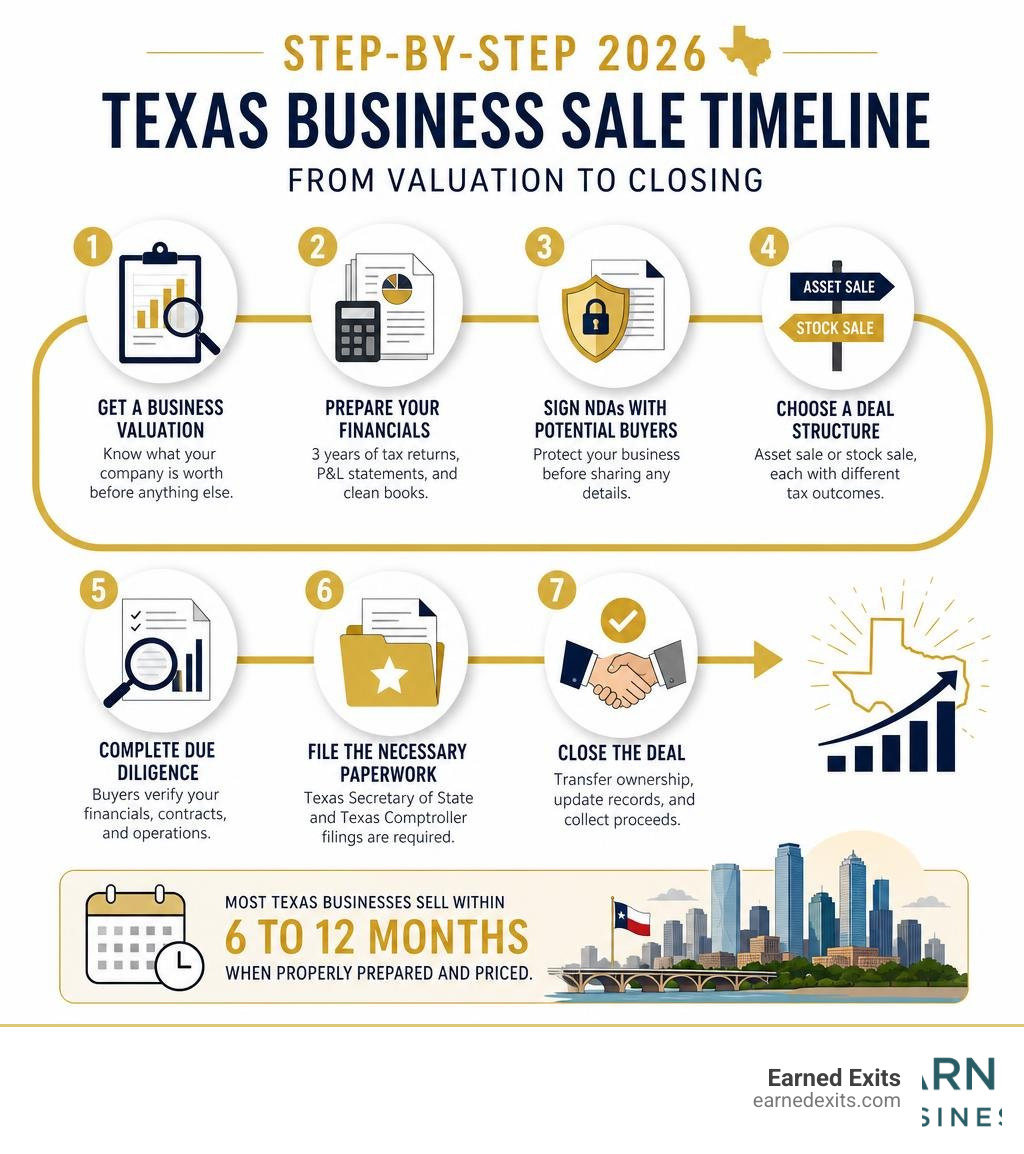
How to sell a business in Texas — quick overview:
- Get a business valuation — know what your company is worth before anything else
- Prepare your financials — 3 years of tax returns, P&L statements, and clean books
- Sign NDAs with potential buyers — protect your business before sharing any details
- Choose a deal structure — asset sale or stock sale, each with different tax outcomes
- Complete due diligence — buyers verify your financials, contracts, and operations
- File the necessary paperwork — Texas Secretary of State and Texas Comptroller filings are required
- Close the deal — transfer ownership, update records, and collect proceeds
Most Texas businesses sell within 6 to 12 months when properly prepared and priced.
Selling a business is one of the biggest financial events of your life — and for most owners, it’s something they’ve never done before. The process involves legal filings, tax decisions, buyer negotiations, and confidentiality concerns all happening at once. Texas has some real advantages as a place to sell: no state income tax, a fast-growing population of 30.5 million residents, and a business-friendly climate that attracts buyers from across the country and internationally. But the process still has real complexity, and going in unprepared can cost you time, money, and peace of mind.
I’m Britt Clas, a Business Broker and Partner at Earned Exits, and I’ve guided many entrepreneurs through the Texas sell my company process — from initial valuation all the way through closing. With over $2.1 billion in completed transactions across 17+ industries, our team at Earned Exits knows what it takes to get Texas business owners to the finish line with confidence.
Texas sell my company basics:
Understanding the Texas Business Sale Landscape in 2026

As we navigate the business environment of July 2026, Texas remains one of the absolute best places in the world to sell a company. The state’s economic momentum is undeniable. Texas is currently the second-largest U.S. state by population, home to over 30.5 million residents. Between 2019 and 2024, the state saw a massive population growth of +8.6%, and that trend has only continued to accelerate into 2026.
This steady influx of people brings a highly educated workforce, lower relative labor costs, and a massive customer base. For buyers, acquiring an established Texas business is an incredibly attractive proposition. Whether your company is located in the bustling Dallas-Fort Worth metroplex (8.1 million residents), the industrial powerhouse of Houston (7.3 million), the cultural hub of San Antonio (2.7 million), or the booming tech haven of Austin (2.5 million), you are operating in an economic sweet spot.
Even Austin’s cost of living, which sits just 1% above the national average, makes it a highly attractive destination for out-of-state buyers looking to relocate or expand.
Crucially, Texas has no state income tax. This is a massive selling point for both local business owners and incoming operators. When you sell your business in Texas, you won’t face a state-level bite out of your hard-earned capital gains, which is a stark contrast to states like California. For comparison, you can look at the strict regulations and tax environments of other states in the Sell or Close Your Business in California guide.
This business-friendly environment has created a highly active buyer market in 2026. Private equity firms, family offices, search funders, and strategic corporate acquirers are actively hunting for quality Texas companies. High-demand sectors include HVAC, plumbing, electrical, roofing, landscaping, pest control, healthcare services, and B2B services. If you operate in these spaces—or in West Texas’s robust energy sector—buyers are looking for you.
Key Steps to Prepare When You Decide to ‘Texas Sell My Company’

If you are thinking, “I want to Texas sell my company,” preparation is everything. You cannot simply put up a “For Sale” sign and hope for the best. To walk away with top dollar, you need to begin preparing your business months—ideally years—before you actually go to market.
A standard business sale in Texas takes about 6 to 12 months from the time you list to the day you sign the final closing documents. However, the preparation phase starts long before that.
First, you must clean up your corporate hygiene. This means organizing your corporate minute books, ensuring all shareholder or LLC member agreements are signed and up-to-date, and verifying that all customer, vendor, and employee contracts are legally assignable to a new owner. If your corporate records are a mess, buyers will either walk away or demand a steep discount to cover the risk.
To ensure you have the right representation to guide you through this complex process, read The Thorough Guide to Picking a Trusted Business Sale Broker. If you own a specialized business, such as an industrial or energy firm, you will also want to read our specialized guide on Selling Your Texas Oilfield Service for Top Dollar to understand niche value drivers.
How to Value Your Business When Thinking ‘Texas Sell My Company’
Before you can negotiate with buyers, you must know what your business is actually worth. Setting an unrealistic asking price is the number one reason businesses sit on the market and eventually fail to sell.
Valuation is not a guessing game. It is a data-driven process that typically relies on a multiple of your EBITDA (Earnings Before Interest, Taxes, Depreciation, and Amortization) or, for smaller businesses, your SDE (Seller’s Discretionary Earnings). In the Texas market, middle-market companies often sell for multiples ranging from 4.0x to 8.0x EBITDA, depending on your industry, recurring revenue percentage, and how dependent the business is on you, the owner.
To understand the core methodologies of business valuation, consult The Ultimate Guide to Small Business Valuation Methods as well as The Definitive Guide to Business Valuation.
One of the most critical steps in maximizing your valuation is identifying and presenting “add-backs.” These are personal or one-time expenses that are run through the business but won’t carry over to the new owner (such as your personal vehicle, owner salary, or one-time legal fees). Properly recalculating these expenses can instantly unlock hundreds of thousands of dollars in hidden value. We break this down step-by-step in our guide on Demystifying Add-Backs and Sellers Discretionary Earnings: Unlocking Business Value.
Legal and Tax Considerations for a ‘Texas Sell My Company’ Transaction
While Texas is incredibly business-friendly, you must still comply with strict state-level tax and regulatory rules when transferring ownership.
The most critical state agency you will deal with is the Texas Comptroller of Public Accounts. If your business collects sales and use tax, you are legally required to notify the Comptroller when selling or closing your business.
For buyers, there is a massive trap here: if they buy a business that owes back taxes to the state of Texas, the buyer can be held personally liable for those unpaid taxes under successor liability laws. To prevent this, the buyer’s legal team will insist that you obtain a Certificate of No Tax Due from the Texas Comptroller before closing. This certificate officially proves that your business is fully paid up on all sales, use, and franchise taxes.
Additionally, sales and use tax permits in Texas are non-transferable. If a buyer is acquiring your company’s assets, they cannot simply use your old permit. They must apply for a brand-new sales tax permit under their own business entity.
While navigating these steps, it is highly useful to look at how other states handle compliance to understand the broader regulatory landscape. For instance, you can review What should I do if I sell my business? – Alabama Department of … or see how western states manage these transactions in Selling a Business in Arizona: Tips, Tricks, and Financial … .
Structuring the Deal: Asset Sale vs. Stock Sale
One of the most important decisions you will make during the sale process is how to structure the transaction. In Texas, business sales are almost always structured as either an Asset Sale or a Stock Sale (or Membership Interest Sale for LLCs).
| Feature | Asset Sale | Stock Sale |
|---|---|---|
| What is Transferred | Individual assets (equipment, inventory, goodwill, contracts) | The entire legal entity (including all shares or ownership interests) |
| Buyer Preference | High. Buyers can “step up” the tax basis of assets to depreciate them faster, and they avoid historical liabilities. | Low. Buyers inherit all historical legal, financial, and tax liabilities of the corporation. |
| Seller Preference | Low. Sellers may face higher taxes due to depreciation recapture and ordinary income tax rates on certain assets. | High. Sellers typically pay lower long-term capital gains tax rates on the entire purchase price. |
| Contract Transfer | Harder. Customer and vendor contracts must be individually assigned or re-negotiated. | Easier. Contracts usually remain with the legal entity, assuming no “change of control” restrictions. |
Because buyers and sellers have naturally opposing goals when it comes to deal structure, negotiations can get intense. Often, a compromise is reached using performance-based payouts, or “earnouts,” which allow the buyer to pay part of the purchase price over time based on the business’s future performance. To learn how to navigate these complex arrangements, check out The Ultimate Guide to Structuring and Negotiating Earnouts.
Navigating Due Diligence and Closing the Transaction
Once you find a qualified buyer and agree on a price, you will sign a Letter of Intent (LOI). The LOI outlines the primary terms of the deal, but it is usually non-binding—except for clauses regarding exclusivity and confidentiality.
Once the LOI is signed, the clock starts on due diligence. This is a 30-to-90-day window where the buyer and their team of CPAs, attorneys, and industry experts dig into every single aspect of your company. They will verify your profit and loss statements, review your tax returns, inspect your equipment, interview key management (if permitted), and audit your customer contracts.
To survive this intense scrutiny, you need a robust, secure online “data room” containing:
- 3 years of federal tax returns and CPA-reviewed financial statements
- Up-to-date interim P&Ls and balance sheets
- Active customer, vendor, and lease contracts
- Employee handbooks, payroll records, and benefit plans
- Equipment lists, inventory counts, and intellectual property registrations
Throughout this entire process, confidentiality is paramount. If your employees, customers, or competitors find out your business is for sale, it can cause immediate panic, loss of staff, and declining sales—which will quickly kill the deal. Always ensure that any prospective buyer signs a legally binding Non-Disclosure Agreement (NDA) before you share even the most basic details about your company.
For a comprehensive breakdown of how to handle this phase, read Sealing the Deal: A Guide to Evaluating Offers When Selling Your Business.
Texas Secretary of State Filings and Ownership Records
When the transaction officially closes, you must formalize the transfer of ownership with the state. The Texas Secretary of State (SOS) does not actually maintain private shareholder ownership records for corporations or membership lists for LLCs. However, they do maintain records of the entity’s registered agents, directors, and officers.
To update these public records, you must file an amendment to your Certificate of Formation or update the information during your annual Public Information Report (PIR) filing with the Texas Comptroller.
These fundamental Texas corporate rules:
- For-profit corporations must have at least one director, one president, and one secretary. In Texas, a single individual is legally allowed to hold all of these positions simultaneously.
- Nonprofit corporations are different; they require at least three directors, and the same person cannot serve as both president and secretary.
Filing these amendments promptly ensures that you are legally removed from the management records of the entity, protecting you from any future operational liabilities.
Frequently Asked Questions about Selling a Texas Business
How long does it take to sell a company in Texas?
On average, it takes 6 to 12 months to sell a Texas business when utilizing traditional marketing and brokerage channels. The exact timeline depends heavily on your industry, the size of your business, the accuracy of your financial records, and whether your asking price aligns with current market multiples. Well-prepared businesses with clean books and realistic pricing always sell faster.
Do I need a Certificate of No Tax Due to sell my Texas business?
Yes. While you can technically close a transaction without it, almost any sophisticated buyer—and certainly their legal counsel—will refuse to close the deal until you provide a Certificate of No Tax Due from the Texas Comptroller. This certificate protects the buyer from inheriting your historical sales, use, or franchise tax liabilities under successor liability laws.
What are the tax implications of selling a business in Texas?
Because Texas has no state income tax, you will not pay any state-level taxes on the profits of your business sale. However, you will still be subject to federal taxes, including federal capital gains taxes (which typically range from 15% to 20% depending on your income bracket), depreciation recapture taxes on equipment, and ordinary income tax on certain assets in an asset sale. You will also need to file your final Texas franchise tax return up to the date of the sale.
Conclusion
Selling your Texas company is a complex journey, but with the right preparation and professional guidance, it can be the most rewarding transition of your professional life.
At Earned Exits, we specialize in making the business sale process as seamless, organized, and stress-free as possible. We don’t just list your business; we provide thorough CFO and due diligence support, build highly professional marketing materials, and leverage our proprietary client tools to maximize efficiency and communication. Our team works tirelessly to protect your legacy, maintain absolute confidentiality, and ensure you walk away with top dollar for your life’s work.
If you are ready to take the next step and find out what your Texas company is truly worth in today’s market, explore our Sell My Business resources or contact us today for a confidential, no-cost business valuation assessment. Let us help you secure your earned exit!
