


How to Sell Your Manufacturing Business Without Breaking the Machine
What Most Manufacturing Owners Don’t Know Before They Sell
This manufacturing firm sale guide covers everything you need to know to sell your company successfully — from preparation and valuation to finding buyers and closing the deal.
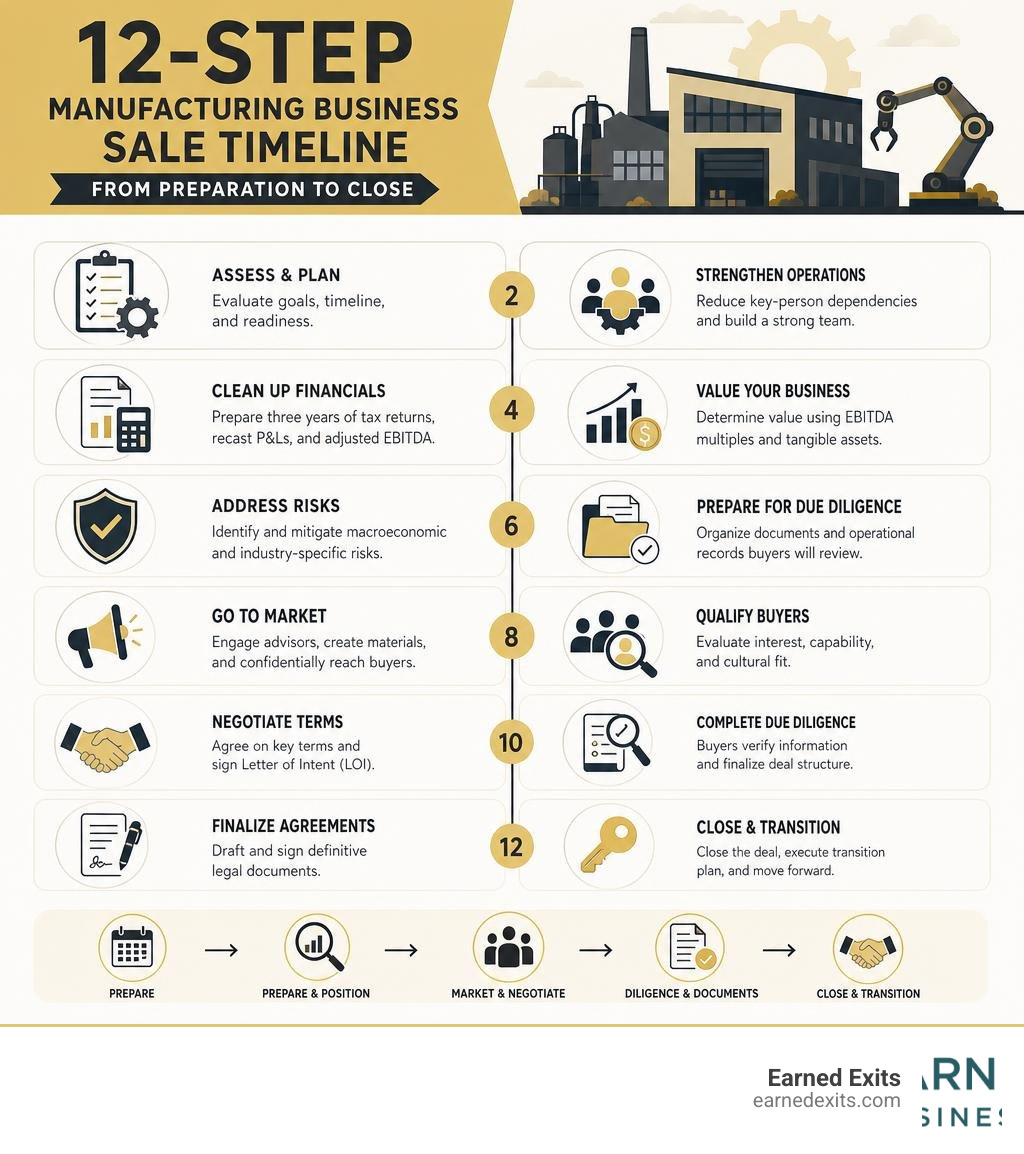
Here are the essential steps at a glance:
- Reduce key-person dependencies — build a management team that runs without you
- Clean up your financials — three years of tax returns, recast P&Ls, adjusted EBITDA
- Value your business accurately — EBITDA multiples, equipment appraisals, tangible assets
- Address macroeconomic risks — tariffs, supply chain exposure, input cost inflation
- Go to market with the right support — M&A advisor, confidential buyer outreach, NDAs
- Negotiate and structure the deal — LOI terms, due diligence, asset vs. stock sale
- Close and transition — legal docs, tax strategy, working capital, post-closing obligations
Selling a manufacturing business is one of the most complex financial transactions you will ever navigate. Unlike selling a service business, manufacturing deals involve equipment appraisals, environmental assessments, inventory audits, workforce dependencies, and supply chain risks — all of which buyers will scrutinize closely.
The stakes are real. According to Harvard Business Review, 70–90% of business sales don’t deliver the owner’s ideal outcome in terms of price, timeline, or who takes over the business. Meanwhile, US manufacturers generate nearly $600 billion in sales every month — meaning buyers are actively looking, but competition for quality deals is fierce.
The owners who achieve the best exits aren’t the ones who list and hope. They’re the ones who prepare 12–24 months in advance, get their documentation in order, and work with people who understand the manufacturing world specifically.
My name is Britt Clas — I’m a Business Broker and Partner at Earned Exits Business Brokers, where I’ve guided founders through every stage of exit planning, including manufacturing firm sale guide strategy, valuation, and due diligence. Earned Exits focuses on businesses generating $1M–$40M in revenue, and our team has been part of more than $2 billion in completed transactions.
Related content about manufacturing firm sale guide:
The Definitive Manufacturing Firm Sale Guide: Key Steps to Success

To successfully navigate a transaction without interrupting daily production, you must treat the sale of your business as a structured, multi-phase project. Think of it like adding a new, highly complex production line to your facility. You wouldn’t just plug in a multi-million-dollar CNC machine without laying down concrete foundations, routing the electrical lines, and training the operator first.
To maximize operational efficiency and attract premium offers, you must first look at your business through the eyes of a buyer. This means auditing your shop floor, verifying equipment maintenance logs, performing a thorough facility cleanup, and organizing your inventory. If a buyer tours your facility and notices grease-covered machines, disorganized raw material racks, or a lack of preventative maintenance records, they will immediately discount their offer to account for the perceived risk of operational neglect.
Furthermore, buyers are deeply concerned about the current industrial labor market. With an estimated 1.9 million manufacturing jobs expected to go unfilled in the next year, a workforce skills gap is a massive risk. Buyers want to see that you have proactive hiring pipelines, in-house apprenticeship initiatives, or localized training structures to protect production capacity. For instance, if you look at regional resources like the SBDC Alaska Guide, you’ll find that successful industrial businesses thrive by building highly resilient, localized operational frameworks that do not fall apart when ownership changes hands.
Step 1: Reducing Key-Person Dependencies and Operational Gaps
The single biggest value-killer in lower-middle-market manufacturing is the “Hero Owner.” If you are the only person who can program the custom tooling machines, the only one who holds the relationships with your top three customers, or the only person who can troubleshoot a system breakdown, your business is effectively unsellable to institutional buyers.
To bridge these operational gaps, you must build a strong middle management bench and transition yourself from an active operator into a strategic overseer. This requires a structured 5-stage transition timeline:
- Operator Owner: You run the daily shop floor operations.
- Documenter: You begin translating your tribal knowledge into written Standard Operating Procedures (SOPs).
- Delegator: You train your supervisors and department heads to run the machinery and manage client accounts.
- Closer: You step back, allowing your managers to make decisions while you only step in for final sign-offs.
- Transitioned: The shop floor runs profitably and efficiently without your physical presence.
Documenting SOPs for every step of your manufacturing process—from machine calibration to quality control checks—reassures buyers that your business can seamlessly transition. For more information on how to design this process, read our expert insights on ensuring a smooth handover: the seller to buyer transition.
Financial Documentation for a Manufacturing Firm Sale Guide
If your financial records are kept on a cash-basis system inside a basic QuickBooks file, you are not ready to go to market. Sophisticated buyers, private equity groups, and bank underwriters require highly accurate, accrual-basis accounting statements.
Before listing your business, you must compile at least three years of clean tax returns and audited or reviewed financial statements. We highly recommend working with an M&A-experienced CPA to “recast” your profit and loss statements (P&Ls). Recasting allows you to add back non-operational expenses, one-time capital expenditures, and owner-discretionary compensation to build an adjusted EBITDA bridge.
Additionally, you need to normalize your capital expenditures (CapEx). Buyers will want to see the difference between maintenance CapEx (what it costs to keep your current machinery running) and growth CapEx (what you spent to expand capacity). Finally, you must establish a realistic working capital peg—the amount of inventory, accounts receivable, and cash required to keep the business running smoothly post-close. To make sure you have all your files in order, you can reference the essential checklist for selling your online business for general documentation best practices.
Valuing a Manufacturing Company in 2026
Determining what your business is worth is a blend of financial science and operational positioning. In 2026, manufacturing valuations are typically based on a multiple of adjusted EBITDA (Earnings Before Interest, Taxes, Depreciation, and Amortization) for larger firms, or SDE (Seller’s Discretionary Earnings) for smaller, owner-operated machine shops.
Underpinning these valuations is the sheer value of your tangible assets. Heavy machinery, specialized tooling, real estate, and raw inventory can represent 30% to 50% of your total sale price. To establish a defensible baseline, we recommend hiring a certified industrial appraiser to perform an equipment appraisal.
Buyers will also look closely at your capacity utilization rates. If your plant is running at 50% capacity, you have a major growth story to sell: a buyer can double output without spending a dime on new real estate. However, if you are running at 100% capacity, a buyer will have to factor in the heavy capital cost of expanding the facility.
Furthermore, you must distinguish between pass-through revenue and value-added margin. If you generate $10 million in revenue but spend $7 million on raw metal imports that you simply stamp and ship, your value-added margin is low. Buyers will pay a premium for businesses that perform high-precision, proprietary work on raw materials, as this commands far higher margins. To learn more about valuation methodologies, check out the definitive guide to business valuation.
Key Valuation Drivers in a Manufacturing Firm Sale Guide
Not all manufacturing companies are valued equally. Two firms with the exact same EBITDA can receive completely different valuation multiples based on specific risk and quality drivers:
- Customer Concentration Risk: If a single customer accounts for more than 25% of your revenue, buyers will heavily discount your business or structure the deal with an aggressive, risk-mitigating earnout. Spreading your revenue across a diverse set of industries is vital.
- Proprietary Technology and Intellectual Property (IP): If you own patents, proprietary molds, or custom product designs, you possess a massive competitive moat that commands premium multiples.
- Quality Certifications: Maintaining strict, industry-specific quality systems is a massive value driver. Baseline ISO 9001 certifications are expected, but having specialized credentials like AS9100 (aerospace and defense) or ISO 13485 (medical devices) can add 1.0x to 2.0x to your valuation multiple because they represent incredibly high barriers to entry.
For a real-world example of how these drivers translate to premium exit prices, review our custom components manufacturer 99% customer retention 1.3M SDE case study.
Macroeconomic Impacts: Tariffs, Supply Chains, and Inflation
The modern geopolitical landscape directly impacts what a buyer will pay for your business. In 2026, supply chain resilience is a primary focus for M&A due diligence.
Ongoing trade disputes mean that companies with heavy China-dependent supply chains are facing average tariffs of 51.1% on 100% of imported goods. Meanwhile, roughly 40% of surveyed manufacturing firms anticipate double-digit increases in product input costs due to general tariff exposure.
To offset these risks and protect your valuation, you must demonstrate operational resilience. If you have successfully insulated your margins through dual-sourcing strategies, localized supply chains, or contractual inflation-pass-through clauses with your clients, you will stand out as a safe haven for investor capital. If you are operating in highly competitive manufacturing hubs, such as the southwest, referencing localized resources like the guide on how to start a manufacturing business in Phoenix can help you understand how domestic supply networks are structured to bypass these international bottlenecks. Additionally, you can review the 2025 Guide to Preparing Your Manufacturing Business for Sale – AMB to see how industry leaders have successfully repositioned their supply chains ahead of a liquidity event.
Finding, Evaluating, and Negotiating with Potential Buyers

When you are ready to take your manufacturing business to market, you will encounter several distinct buyer archetypes, each with different motivations, timelines, and capital structures:
- Strategic Buyers: These are competitors or larger manufacturing companies looking to acquire your technology, geographic footprint, or client base. They typically pay the highest multiples because they can realize immediate operational synergies.
- Private Equity Platforms: PE firms look for platform businesses with strong management teams and $1M+ in EBITDA. They aim to acquire your business, fund capital improvements, and roll up smaller competitors.
- Family Offices: These groups invest private wealth with a much longer time horizon than traditional PE. They focus on steady, long-term cash flow and are often highly protective of your company’s existing culture and legacy.
- Individual Operators: Often funded by SBA 7(a) loans, these are experienced corporate executives looking to buy a business they can actively run themselves.
The sale process kicks off when buyers submit non-binding Indications of Interest (IOIs) outlining a valuation range. This is followed by management presentations and, ultimately, a formal Letter of Intent (LOI) which grants the buyer exclusivity to perform deep-dive due diligence. To understand how to weigh these offers against one another, read our guide on sealing the deal: a guide to evaluating offers when selling your business.
The Role of Specialized M&A Advisors
Selling a manufacturing business is a full-time job. Attempting to run a competitive marketing process while managing daily plant production is a recipe for operational decline—which buyers will immediately use to negotiate a lower price.
Working with a specialized M&A advisor or business broker can increase your final sale price by 6% to 25% through competitive bidding. More importantly, an advisor can save you 30+ hours a week by managing buyer outreach, vetting financial capacity, and coordinating due diligence requests. To find the right intermediary for your shop, visit our dedicated resources on manufacturing business brokers and the ultimate guide to hiring a professional business broker.
Maintaining Confidentiality During the Sale Process
If your employees, competitors, or customers find out you are selling, it can instantly damage your business. Competitors will use the news to steal your clients, and key machinists might leave out of fear of job instability.
To protect your legacy, we use strict confidentiality protocols. Before sharing any sensitive operational details, all prospects must sign robust Non-Disclosure Agreements (NDAs). We build anonymized marketing materials (teasers) that describe your business’s capabilities and financials without revealing your name or precise location. In the initial data rooms, we use customer identifiers (e.g., “Customer 1” instead of “The Boeing Company”) to prevent premature exposure. To learn more about these protective measures, read the art of confidentiality: protecting your business during the sale process.
Legal, Tax, and Post-Closing Considerations
The structure of your deal is often more important than the headline purchase price. A $10 million offer structured as an asset sale might net you less cash after taxes than an $8.5 million stock sale, depending on your corporate structure and tax liabilities.
| Feature | Asset Sale | Stock Sale |
|---|---|---|
| What is Transferred | Individual assets (equipment, inventory, goodwill, contracts) | Ownership shares of the legal entity |
| Tax Implications | Higher tax exposure for the seller due to depreciation recapture | Generally taxed at favorable capital gains rates for the seller |
| Buyer Preference | High (allows asset step-up for future depreciation and limits liability) | Low (buyer inherits all historical legal and environmental liabilities) |
| Contractual Ease | Complex (requires re-assigning customer and supplier contracts) | Simple (contracts remain within the acquired legal entity) |
Beyond the asset vs. stock debate, manufacturing deals require several industry-specific legal and operational checkpoints:
- Phase I Environmental Site Assessment (ESA): Even if you lease your facility, buyers and commercial lenders will require a Phase I ESA to ensure there are no Recognized Environmental Conditions (RECs) on the property. Discovering soil or groundwater contamination during diligence can stall a deal for months or cost hundreds of thousands in remediation.
- Reps and Warranties (R&W) Insurance: In larger transactions, R&W insurance is used to protect both parties. It covers losses resulting from breaches of representations made in the purchase agreement, allowing the seller to walk away with less money tied up in escrow.
- Working Capital Adjustments: The final purchase price will be adjusted up or down post-closing based on the actual inventory and accounts receivable left in the business on closing day compared to the agreed-upon “working capital peg.”
- Earnouts and TSAs: To bridge gaps in valuation, deals may include performance-based earnouts. Additionally, you will likely sign a Transition Services Agreement (TSA), committing to stay on for 3 to 12 months to train the new ownership team.
Frequently Asked Questions about Selling a Manufacturing Business
How long does it take to sell a manufacturing company?
The typical timeline to sell a manufacturing business is 6 to 12 months from the moment you engage an M&A advisor to the day the funds clear. This timeline is heavily dependent on your level of preparation. The initial preparation and document cleanup phase takes 1 to 3 months, marketing and buyer vetting takes 2 to 4 months, and the formal due diligence period after signing an LOI typically takes 60 to 90 days.
How do tariffs affect my manufacturing business valuation?
Tariffs can compress valuation multiples if your business has single-source supply chain dependencies in tariff-heavy regions. If a buyer sees that your raw material input costs are vulnerable to sudden double-digit increases, they will price that risk into their offer. You can protect your valuation by diversifying your supplier base, establishing domestic raw material sources, and proving that you have the pricing power to pass cost increases along to your customers.
Should I tell my employees that I am selling the business?
No. You should not inform your general workforce about a potential sale until the purchase agreement is signed and the transaction is legally closed. Prematurely disclosing a sale creates immense anxiety, which can lead to key staff departures, decreased productivity, and operational mistakes—all of which can cause a buyer to walk away or renegotiate the price during due diligence.
Conclusion
Selling your manufacturing business is the culmination of years of hard work, grit, and capital investment. To exit successfully without “breaking the machine,” you need an organized, highly communicative advisory partner who understands the unique realities of the shop floor.
At Earned Exits, we specialize in helping manufacturing owners navigate this complex journey. From recasting your P&Ls and normalising your CapEx to managing confidential buyer outreach and providing hands-on due diligence and CFO support, we ensure your legacy is protected and your exit value is maximized.
If you are ready to explore your options and plan your transition, take the first step today by reading our comprehensive guide on how to sell my business or reach out to us for a confidential valuation of your manufacturing firm.
