


How to Sell a Business: Steps to a Smooth Exit
What You Need to Know Before You Sell a Business
Knowing how to sell a business — and doing it well — can be the difference between walking away with a life-changing outcome or leaving serious money on the table. Whether you’re ready to retire, pursue a new venture, or simply cash in on years of hard work, the process is more involved than most first-time sellers expect.
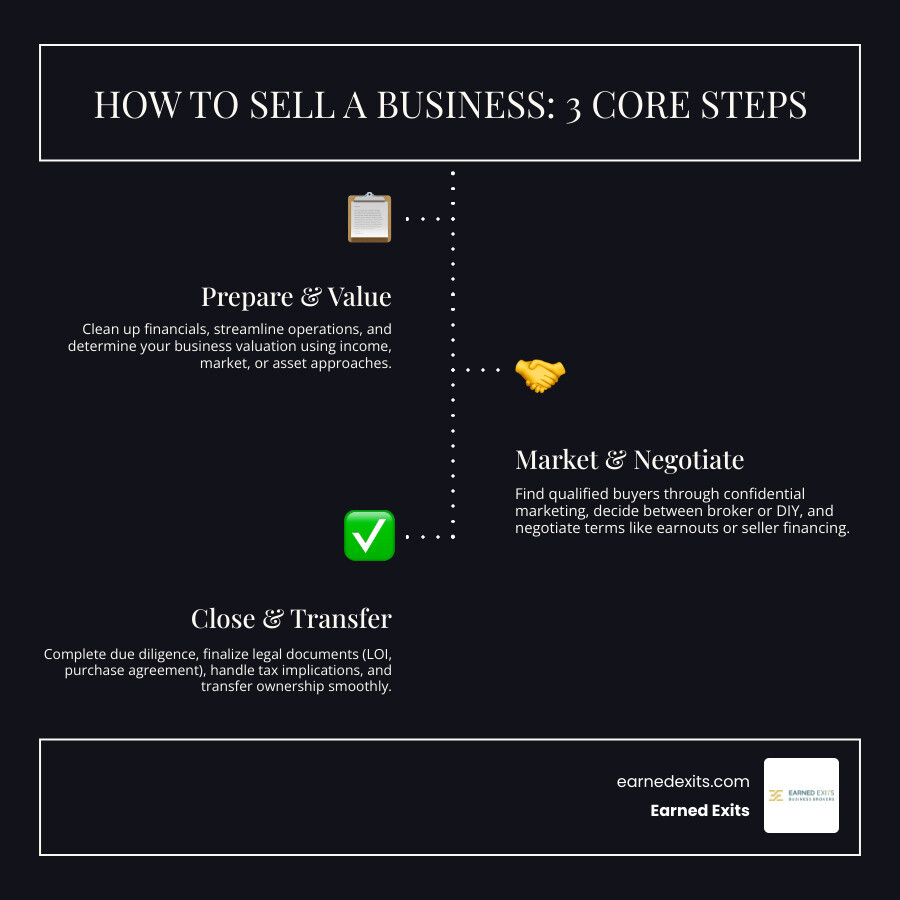
Here’s a quick overview of the key steps:
- Prepare your business — Clean up your financials, streamline operations, and document your processes
- Value your business — Use the income, market, or assets approach to determine a realistic asking price
- Choose your exit strategy — Outright sale, gradual sale, ESOP, or lease agreement
- Find qualified buyers — Market confidentially and pre-qualify interested parties
- Decide: broker or DIY — Weigh the cost of a broker (5%–10% commission) against the risks of going it alone
- Complete due diligence — Prepare legal, financial, and operational documents for buyer review
- Close the deal — Finalize contracts, handle tax obligations, and transfer ownership
Most experts recommend starting this process at least one to two years before your target exit date. That runway gives you time to maximize value, find the right buyer, and avoid costly last-minute surprises.
Selling a business is one of the most significant financial events of your life — and for most owners, it’s something they’ve never done before. That unfamiliarity is exactly what makes preparation so critical.
I’m Britt Clas, a Business Broker and Partner at Earned Exits, where I’ve guided entrepreneurs through every stage of how to sell a business — from early exit planning and valuation through negotiations and closing. I work specifically with companies generating $1M–$40M in revenue, and I’ve seen that the sellers who prepare early and build the right team consistently achieve better outcomes.
How sell a business terms explained:
- company for sale
- sell a business
- sell an idea to a company
Preparing Your Company for a Successful Sale
Preparing your company for transition is like detailing a car before putting it on the market. You wouldn’t leave empty coffee cups in the cup holders, and you shouldn’t leave disorganized accounts in your ledger. Proper preparation is the foundation of a highly profitable company exit.

When considering how sell a business, your preparation timeline should ideally begin 12 to 24 months before you want to hand over the keys. This runway allows you to fix operational inefficiencies, boost profitability, and present a polished machine to prospective buyers. If you are just starting out, check out our Beginners Guide to Selling a Business to understand the baseline requirements. For a deeper dive into organizing your departure, read our guide on How to Organize a Clean and Profitable Company Exit.
Organizing Financial and Operational Records
The number one deal-killer in business transactions is messy financial records. Buyers want to see clean, verifiable data that proves your business actually makes what you claim it does.
At a minimum, you must gather:
- Three to five years of federal tax returns
- Year-to-date profit and loss (P&L) statements
- Current balance sheets
- Detailed inventory lists and equipment valuations
If you do not have a dedicated financial wizard on staff, this is the perfect time to bring in professional help. Utilizing fractional or specialized financial leadership can dramatically improve your presentation. Discover How a Skilled CFO Maximizes Your Business Valuation to ensure your books are completely bulletproof before they are subjected to buyer scrutiny.
Streamlining Operations and Securing Assets
A business that relies entirely on its owner is incredibly difficult to sell. If you walk away and the business crumbles, what is the buyer actually purchasing?
To make your company highly attractive, you must:
- Document Standard Operating Procedures (SOPs): Write down step-by-step guides for every key process in your company, from customer acquisition to inventory management.
- Secure Intellectual Property (IP): Ensure all patents, trademarks, copyrights, and software licenses are legally registered in the company’s name.
- Address Customer Concentration: If a single client accounts for more than 15% to 20% of your total revenue, work to diversify your client base. High customer concentration is a major red flag for buyers who fear that the key client will leave once you sell.
How Sell a Business: Choosing the Right Exit Strategy
Every business owner has a unique vision for their post-sale life. Some want to hand over the keys and head straight to a beach in Florida, while others prefer to stay on as consultants to ensure their legacy remains intact.
Choosing the correct path requires evaluating your financial needs, emotional readiness, and the current 2026 market trends. To help you think through your options, we have compiled The Ultimate List of Business Exit Strategies for Every Owner, detailing the pros and cons of each path.
Outright Sale vs. Gradual Sale
The most common decision you will make is choosing between an outright sale and a gradual transition:
- Outright Sale: The buyer purchases 100% of the business upfront. While this offers a clean break and a lump-sum payment, it often requires the seller to offer some form of seller financing or accept an earnout structure to bridge valuation gaps.
- Gradual Sale: The ownership transfers over a set period. This can be structured as a multi-year buyout, allowing you to secure ongoing monthly income while helping the new owner transition into the role.
If you choose a structured deal, you will likely encounter earnouts. To protect your financial interests, check out The Ultimate Guide to Structuring and Negotiating Earnouts.
Lease Agreements and Employee Stock Ownership Plans (ESOPs)
If you are not ready for a permanent sale, or if you want to preserve your company’s existing culture above all else, other strategies exist:
- Lease Agreements: You retain ownership of the business entity but lease the operational rights and physical assets to an operator in exchange for monthly rental payments. This is a fantastic option for temporary sabbaticals or generating passive retirement income.
- Employee Stock Ownership Plans (ESOPs): Selling to your employees preserves your company’s legacy and rewards the team that helped you build it. While ESOPs offer substantial tax benefits, they can be highly complex to set up and may result in a lower initial payout than selling to an outside strategic buyer.
For additional guidance on federal and local programs that support these transitions, consult the official SBA Guide on Transferring Ownership.
Determining Your Business Value and Valuation Methods
You cannot successfully market a business if you do not know what it is worth. Guessing your valuation based on “gut feeling” or what a competitor supposedly sold for is a recipe for disappointment.
To avoid leaving money on the table or scaring away buyers with an inflated price tag, you should Stop Guessing What Your Business Is Worth and secure a professional valuation. Understanding the math behind your price tag is the first step toward a successful negotiation. You can explore the mechanics of this process in The Ultimate Guide to Small Business Valuation Methods.
The Three Core Valuation Approaches
Professional appraisers and brokers rely on three primary valuation approaches to determine a business’s economic worth:
| Valuation Approach | Core Methodology | Best Suited For |
|---|---|---|
| Income Approach | Calculates the present value of future projected cash flows, factoring in risk and growth rates. | Highly profitable service companies, SaaS, and established recurring-revenue brands. |
| Market Approach | Compares your business to similar companies that have recently sold in your industry and region. | Retail, construction, manufacturing, and businesses with abundant transaction data. |
| Assets Approach | Calculates the fair market value of all physical and intangible assets, minus outstanding liabilities. | Asset-heavy businesses, underperforming companies, or those facing liquidation. |
To understand how these methods are applied in real-world scenarios, read A Practical Guide to Company Valuation for Beginners.
Understanding EBITDA and Seller’s Discretionary Earnings (SDE)
Most small to mid-market businesses are valued using a multiple of their earnings. However, the “earnings” used in business sales are different from the net profit shown on your standard tax returns.
- Seller’s Discretionary Earnings (SDE): Used primarily for owner-operated small businesses (typically under $1M in earnings). SDE adds back your salary, personal benefits, and one-time non-recurring expenses to show the true total financial benefit a single owner-operator derives from the business.
- EBITDA (Earnings Before Interest, Taxes, Depreciation, and Amortization): Used for larger mid-market companies where management is separated from ownership.
To maximize your final purchase price, you must carefully calculate your “add-backs.” We break down this crucial accounting practice in our guide on Demystifying Add-Backs and Seller’s Discretionary Earnings: Unlocking Business Value.
Finding Qualified Buyers and Marketing Your Business
Once your business is prepared and valued, you must bring it to market. The trick here is finding qualified buyers without letting your competitors, employees, or customers know that the business is for sale. Publicly listing your business name can cause employee panic and customer churn, destroying the very value you are trying to sell.
To balance marketing reach with absolute safety, read The Art of Confidentiality: Protecting Your Business During the Sale Process and learn how to safely generate buzz in Stop Hiding Your Business and Start Marketing It for Sale.
How Sell a Business Online Safely
In 2026, the internet is the primary vehicle for matching business buyers and sellers. However, you must utilize specialized platforms and strict protocols:
- Blind Profiles: Create a marketing package (often called a “teaser”) that describes your business’s industry, general location, financial highlights, and growth opportunities without revealing its name or specific identity.
- Non-Disclosure Agreements (NDAs): Never share proprietary information, financial statements, or your business identity with a prospect until they have signed a legally binding NDA.
- Financial Pre-Qualification: Ask prospective buyers for proof of funds or a letter of financial capability before granting them access to your confidential files.
For a comprehensive walkthrough of online sales strategies, refer to The Definitive Guide to Selling Business Online.
Leveraging Professional Networks and Databases
While online listings are great for reaching individual buyers, the most lucrative deals often come from strategic or financial buyers who are not actively browsing public listing sites.
- Strategic Buyers: Competitors, suppliers, or complementary businesses that can scale rapidly by acquiring your operational footprint, customer list, or technology.
- Financial Buyers: Private equity groups, search funds, or high-net-worth individuals looking for a strong return on investment.
Reaching these high-value buyers requires deep connections. At Earned Exits, we leverage our National Industry Network: The Secret Weapon for Selling Your Business to discretely pitch your company directly to pre-vetted corporate buyers and investment funds.
Navigating the Broker vs. DIY Decision
Should you sell your business yourself, or hire a professional? It is a classic entrepreneurial dilemma. While some owners attempt to handle the transaction on their own to save on commission fees, the DIY route is fraught with hidden hazards.
Before making up your mind, read Selling Your Business on Your Own: A Risk You Don’t Want to Take to understand the common pitfalls of unrepresented sales.
How Sell a Business with a Professional Broker
Partnering with an experienced business broker or M&A advisor turns a chaotic, stressful process into an organized, strategic campaign.
A professional broker provides immense value by:
- Performing an accurate, market-validated business valuation.
- Drafting professional marketing materials (such as the Confidential Information Memorandum, or CIM).
- Vetting and qualifying buyers so you only speak with serious prospects.
- Managing negotiations to secure the best price and deal structure.
While business brokers typically charge a commission fee of 5% to 10% of the final sale price, their ability to drive up the purchase price and prevent deal collapse almost always offsets their fee. If you decide to take this route, read The Ultimate Guide to Hiring a Professional Business Broker to find the perfect partner for your transition.
The Risks of Selling a Business on Your Own
The primary danger of a DIY sale is deal fatigue and operational neglect. Selling a business is essentially a full-time job. If you are spending 40 hours a week answering buyer inquiries, drafting legal agreements, and chasing down documents, your focus will inevitably slip from running your day-to-day operations.
If your revenue drops during the sale process, buyers will use that decline to negotiate a lower valuation or walk away from the deal entirely. Furthermore, without a buffer (the broker), you lose valuable negotiating leverage and risk exposing confidential information to competitors who are merely “window shopping.”
Legal Documents, Tax Implications, and Due Diligence
As you enter the final stages of the transaction, the focus shifts from marketing and negotiations to legal, financial, and tax compliance. This is where deals are finalized—or broken.
To ensure your contract protects your post-sale interests, utilize The Essential Business Sale Contract Template and Legal Guide as a starting framework.
Essential Legal Documents for the Transaction
A successful business transfer requires a sequence of critical legal documents:
- Letter of Intent (LOI): A non-binding agreement that outlines the proposed purchase price, deal structure, and key terms. Once signed, it usually grants the buyer an exclusivity period to conduct due diligence.
- Asset Purchase Agreement (APA) or Stock Purchase Agreement (SPA): The definitive, legally binding contract that details every aspect of the sale.
- Bill of Sale: Transfere ownership of tangible assets from the seller to the buyer.
- Non-Compete Agreement: Prevents you from opening a competing business within a specific geographic area and time frame after the sale.
Tax Implications: Asset Sale vs. Stock Sale
The structure of your sale has massive tax implications that can change your net proceeds by hundreds of thousands of dollars.
- Asset Sale: The buyer purchases specific assets of the business (equipment, inventory, customer lists, IP). Buyers prefer asset sales because they can “step up” the tax basis of the assets and write them off. However, for you (the seller), this can trigger higher ordinary income tax rates on certain assets rather than lower capital gains rates.
- Stock Sale: The buyer purchases your shares or membership interest in the entire legal entity. This is highly advantageous for sellers because the entire proceeds are typically taxed at long-term capital gains rates.
When structuring the transaction, you and the buyer must agree on the purchase price allocation and report it to the IRS using Form 8594. Always consult with a qualified CPA or tax attorney to optimize your tax strategy before signing the final agreement.
Preparing for the Due Diligence Process
Due diligence is the buyer’s opportunity to verify everything you have told them about the business. They will bring in accountants, attorneys, and industry experts to audit your financials, review your contracts, inspect your equipment, and interview key staff.
To ensure you survive this intense scrutiny, we recommend creating a comprehensive due diligence checklist well in advance.
You can learn how to organize and present your company’s records professionally in our guide: Mastering the Art of the Due Diligence Report.
Frequently Asked Questions About Selling a Business
What are the most common mistakes to avoid when selling a business?
The most frequent errors include overpricing the business based on emotion, failing to clean up financial records, hiding operational issues (which will always be discovered during due diligence), and neglecting day-to-day operations during negotiations.
How long should I keep business records after the sale is finalized?
Even after you hand over ownership, you must keep certain records to protect yourself from future liabilities or tax audits. Common guidelines advise keeping tax and employment records for anywhere from three to seven years after closing a business transaction.
What is the typical timeline for selling a small business?
The typical timeline spans six to twelve months from the moment you decide to list the business to the final closing date. This timeline includes 1–2 months of preparation and valuation, 2–4 months of marketing and finding a buyer, 2–3 months of due diligence and contract negotiation, and a 1–3 month transition period where you help train the new owner. You can study our step-by-step roadmap in the 10 Step Selling Process.
Conclusion
Selling a business is not just a financial transaction; it is a major life transition. The keys to achieving a smooth, highly profitable exit are early preparation, accurate valuation, and building a professional advisory team. By organizing your records, choosing the right exit strategy, and navigating the sale with professional support, you can protect your legacy and maximize the value of your hard work.
At Earned Exits, we specialize in making this complex process seamless, organized, and highly rewarding. If you are ready to explore your options, we invite you to Sell My Business with us and take the first step toward a successful transition today.
