


How to Organize a Clean and Profitable Company Exit
Why a Profitable Business Exit Strategy Determines What You Actually Keep
A profitable business exit strategy is the documented plan that converts the company you’ve built into the financial outcome you deserve — and without one, most owners leave significant money on the table.
Here’s a quick summary of what makes an exit profitable:
| Factor | What It Means for Your Outcome |
|---|---|
| Start early | Begin planning 3-5 years before your target sale date |
| Know your number | Determine your after-tax proceeds target before choosing an exit path |
| Choose the right path | Strategic sale, PE, ESOP, MBO, family transfer, IPO, or liquidation |
| Clean up financials | Accrual-basis books and normalized EBITDA are non-negotiable for buyers |
| Reduce owner dependence | Businesses that run without you sell for significantly more |
| Use the right advisors | M&A advisor, CPA, and attorney working together protect your proceeds |
Despite how much is at stake, only 32% of business owners have a documented exit plan — even though 69% say exiting is a priority. And only 22% have aligned their personal, financial, and business goals around that exit. That gap between intention and preparation is exactly where value gets lost.
For most owners, the business represents the majority of their personal net worth. Yet the exit process itself — valuations, deal structures, buyer negotiations, due diligence — is completely unfamiliar territory. That’s a stressful combination.
This guide walks you through every stage of organizing a clean, profitable exit: from choosing the right path to preparing your financials, managing taxes, and closing with confidence.
I’m Britt Clas, a Business Broker and Partner at Earned Exits, and I’ve guided entrepreneurs through the full arc of a profitable business exit strategy — from early planning through closing — across companies ranging from $1 million to $40 million in revenue. If this process feels overwhelming right now, that’s exactly what this guide is designed to fix.
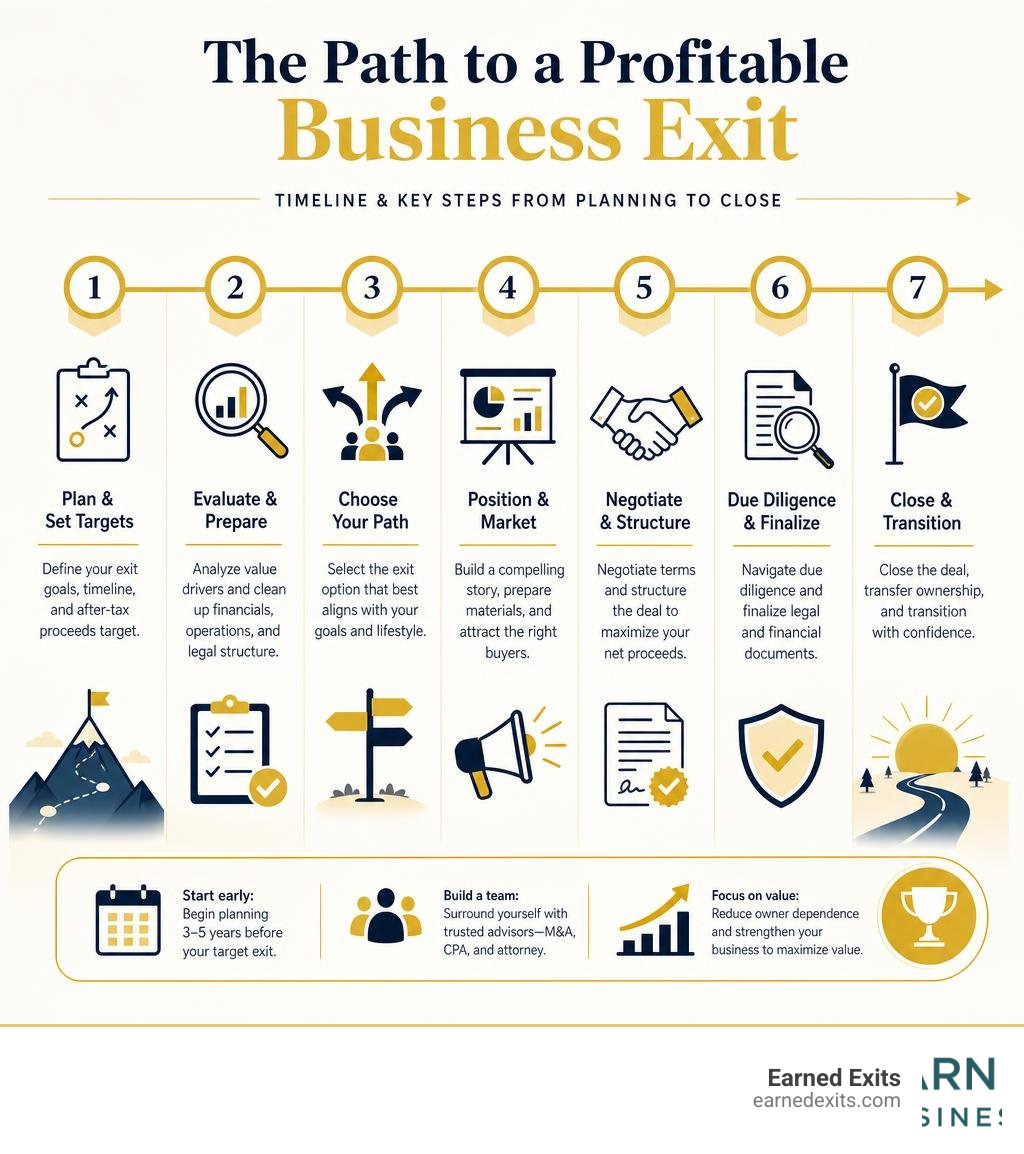
Profitable business exit strategy word guide:
What is a Profitable Business Exit Strategy and Why Plan Ahead?
At its core, an exit strategy is not just about ending a business; it is a proactive roadmap designed to transition ownership while preserving the enterprise value you have spent years creating. Think of it as a financial flight plan. NASA’s Cassini spacecraft traveled 4.9 billion miles and collected 635 gigabytes of data over a stellar 20-year mission, but it had no exit strategy. It ended its run by being crushed and vaporized in Saturn’s atmosphere. Will your business end the same way?
Without a profitable business exit strategy, many founders find themselves running what is essentially a highly demanding job rather than owning a transferable asset. When they want to step away, they discover that because the business cannot function without them, it holds very little value to anyone else.
Having a documented exit plan is the single greatest differentiator between a chaotic, reactive fire sale and a highly lucrative transition. According to industry research, while 69% of business owners cite an exit strategy as a priority, only 32% have actually documented one. More concerning still, only 22% of business owners have successfully aligned their personal, business, and financial goals for an exit.
By planning your exit years in advance, you unlock critical strategic benefits:
- Strategic Decision-Making: Every operational decision—from hiring a COO to signing a long-term lease—can be evaluated through the lens of how it impacts your ultimate valuation.
- Enhanced Buyer Attractiveness: Buyers pay a premium for companies that demonstrate structured planning, institutionalized knowledge, and clear growth trajectories.
- Maximized Proceeds: Early planning gives you the runway to restructure your entity, leverage tax codes, and time the market.
To understand the full spectrum of options available to you, explore our guide on The Ultimate List of Business Exit Strategies for Every Owner. For deeper reading on how to frame these choices early on, you can also consult What is an Exit Strategy and Why Every Business Owner Needs One.
The Seven Primary Exit Paths for Business Owners
When mapping out your transition, you aren’t limited to a single path. In fact, many operators use hybrid models or keep multiple options open until a definitive agreement is signed. The seven primary exit paths include:
- Strategic Sale: Selling to a competitor or an adjacent industry player looking to expand.
- Financial Buyer (Private Equity): Selling to institutional investors who use leverage and operational improvements to scale the business.
- Family Succession: Passing the torch to the next generation of your family.
- Management Buyout (MBO): Selling the company to your existing leadership team.
- Employee Stock Ownership Plan (ESOP): Transitioning ownership to your employees via a specialized trust.
- Initial Public Offering (IPO): Taking the company public (a rare path for lower-middle-market companies, but common for high-growth tech firms).
- Liquidation: Winding down operations and selling off individual physical assets.
Let’s explore how these paths differ in execution, valuation, and post-sale dynamics.
Designing a Profitable Business Exit Strategy via Third-Party Sales
Selling to an external third party is the most common way to maximize your exit’s cash value. However, the type of buyer you target changes everything about the deal structure, valuation, and your post-sale life.
Strategic Buyers vs. Financial Buyers (Private Equity)
Strategic buyers are typically competitors, suppliers, customers, or larger companies in adjacent sectors. They are buying your business for its synergies—such as your intellectual property, customer base, geographic footprint, or proprietary technology. Because they can combine operations to reduce overhead and accelerate their own growth, strategic buyers historically pay the highest multiples. In recent years, strategic transactions have accounted for roughly 60% of mid-market deal value. A healthy lower-middle-market business might command a 6x to 12x EBITDA multiple from a strategic acquirer.
Financial buyers, such as private equity groups (PEGs) and search funds, view your business as an investment engine. They look at cash flow quality, historical growth, and market stability. PE firms typically buy a “platform” company and then acquire smaller “bolt-on” companies to build scale. In the lower middle market (sub-$25M EBITDA), entry multiples for private equity have held steady above 6.5x EBITDA in recent quarters.
The table below highlights how these two buyer classes compare:
| Feature | Strategic Buyers | Financial Buyers (Private Equity) |
|---|---|---|
| Primary Motivation | Synergies, market share, IP, geographic expansion | Standalone cash flow, yield, buy-and-build potential |
| Valuation Multiple | Higher (typically 6x-12x EBITDA due to synergy premium) | Moderate to high (typically 4x-8x for smaller, 8x-14x for platforms) |
| Post-Sale Role | Short transition period (3-6 months), then complete exit | Rollover equity (20-40% common); founder often stays 1-3 years |
| Integration Risk | High (your brand or team may be absorbed) | Low (business usually continues operating independently) |
Choosing the right time to launch a third-party sale is critical to capturing these premium multiples. Learn more about market timing in Seizing the Moment: Why Business Owners Should Consider Selling Now and master the transaction process with How to Master Your Mid-Market Business Sale for Maximum Value.
Internal Transfers: Family Succession, MBOs, and ESOPs
If keeping your legacy intact or rewarding those who helped you build the business is your primary goal, an internal transfer may be the ideal route.
Family Succession
Passing your business to a family member is highly personal and often deeply emotional. While it is the dream of over 50% of business owners, the reality is stark: only about 30% of family businesses survive into the second generation, 12% into the third, and just 3% into the fourth. Navigating family dynamics requires removing emotion from the financial equation, establishing clear governance structures, and ensuring the successor has the operational capability to lead.
Management Buyouts (MBOs)
In an MBO, your existing management team steps up to buy the business. Because the buyers already know the operations, customers, and culture, MBOs carry very low transition risk. These deals can close quickly—typically in 4 to 7 months compared to the 9 to 14 months required for a fully marketed external sale. However, management teams rarely have the capital to buy the business outright. These deals usually require heavy seller financing (seller notes) or backing from a lower-middle-market private equity sponsor.
Employee Stock Ownership Plans (ESOPs)
An ESOP is a highly tax-efficient trust that purchases some or all of your company’s shares on behalf of the employees. There are roughly 6,500 ESOPs covering about 14 million participants in the United States.
The major benefit of an ESOP is tax avoidance (which we’ll discuss below), but it does come with a valuation trade-off. Because an ESOP trustee has a strict fiduciary duty under federal law not to overpay, an ESOP transaction usually closes at 85% to 95% of a strategic-sale fair market value.
For a complete breakdown of internal versus external paths, read the 8 Business Exit Strategies – Pros and Cons of Each Approach.
Navigating Tax Implications and Deal Structures
A common trap for business owners is focusing entirely on the gross purchase price on the Letter of Intent (LOI). What actually matters is your net after-tax proceeds. The deal structure—specifically whether the transaction is treated as an asset sale or a stock sale—and the utilization of tax codes will dictate how much wealth you retain.
Asset Sales vs. Stock Sales
In an asset sale, the buyer purchases specific assets of the business (such as equipment, inventory, customer lists, and IP) and leaves behind the legal entity and most of its liabilities. In a stock sale, the buyer purchases the actual corporate stock, taking over the entire legal entity, including all historical liabilities.
| Tax & Legal Factor | Asset Sale (Buyer Preferred) | Stock Sale (Seller Preferred) |
|---|---|---|
| Tax Treatment for Seller | Higher tax bill. Assets are subject to depreciation recapture (taxed at ordinary income rates) and capital gains. | Lower tax bill. The entire transaction is generally taxed at long-term capital gains rates. |
| Tax Treatment for Buyer | High benefit. Step-up in basis allows the buyer to re-depreciate assets, reducing their future tax liability. | Low benefit. The buyer inherits the historical tax basis of the assets. |
| Liability Exposure | Low risk. Buyer only assumes liabilities explicitly written into the asset purchase agreement. | High risk. Buyer inherits all historical legal, tax, and environmental liabilities. |
Powerful Tax Minimization Strategies
To maximize your net proceeds, work with your advisory team to evaluate these specialized tax planning tools well before you sign an LOI:
- Section 1202 Qualified Small Business Stock (QSBS): If your business is structured as a C-corporation and meets specific asset and industry requirements, Section 1202 allows you to exclude up to 100% of your capital gains (up to $10 million or 10 times your adjusted basis, with some exclusions rising to $15 million under recent guidelines) if you hold the stock for at least five years.
- Section 1042 ESOP Rollover: If you sell at least 30% of your C-corporation to an ESOP, you can defer 100% of your capital gains taxes by reinvesting the sale proceeds into “Qualified Replacement Property” (such as domestic corporate stocks and bonds). If you hold these replacement assets until death, your heirs receive a step-up in basis, effectively eliminating the capital gains tax permanently.
- Section 453 Installment Sales: Instead of taking 100% cash at close, you can structure a portion of the purchase price as a seller note paid out over several years. This allows you to spread your tax liability over multiple tax years, potentially keeping you in a lower tax bracket.
- Earnouts: An earnout structures a portion of the purchase price to be contingent on the business hitting specific post-close performance metrics. While they bridge valuation gaps, they must be structured carefully to prevent buyer interference. Learn how to draft these agreements securely in The Ultimate Guide to Structuring and Negotiating Earnouts.
Step-by-Step Timeline to Prepare Your Company for Sale
Preparing a business for a clean, profitable exit is a multi-year project. Launching a sale process without adequate preparation is the primary reason why fewer than 30% of small business sale attempts ever close at their original target price.
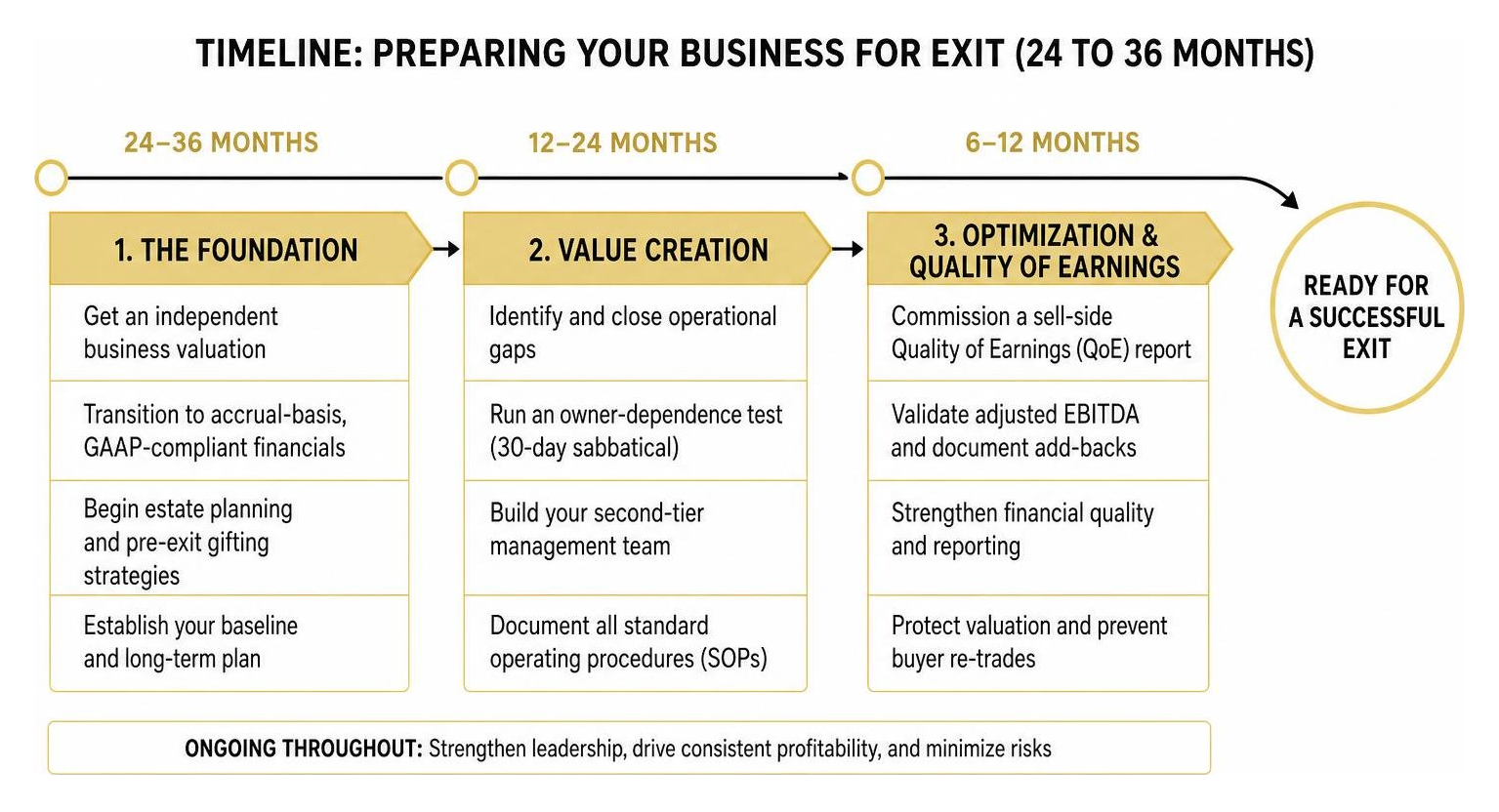
The 24-to-36-Month Exit Runway
- Months 24–36: The Foundation: Begin by getting an independent, professional business valuation to establish your baseline. Transition your accounting from cash-basis to accrual-basis, GAAP-compliant financial statements. This is also the time to begin estate planning and pre-exit gifting strategies.
- Months 12–24: Value Creation: Identify and close the operational gaps in your business. Run an “owner-dependence test”—can you take a 30-day sabbatical without the business suffering? If not, build out your second-tier management team and document all standard operating procedures (SOPs).
- Months 6–12: Optimization & Quality of Earnings (QoE): Commission a sell-side Quality of Earnings report. A sell-side QoE is a pre-emptive audit by an independent CPA firm that validates your adjusted EBITDA and documents your financial add-backs. While it costs between $25,000 and $75,000, it delivers a 5x to 20x return on investment by protecting your valuation during due diligence and preventing buyer “re-trades” (price reductions).
- Months 0–6: The Transaction: Engage your M&A advisor, build your Confidential Information Memorandum (CIM), market the business to pre-qualified buyers, negotiate the LOI, survive the 60-to-90-day due diligence gauntlet, and close the deal.
For more strategic insights on structuring this timeline, refer back to The Ultimate List of Business Exit Strategies for Every Owner.
Building Value Drivers for a Profitable Business Exit Strategy
When buyers evaluate your business, they aren’t just looking at your net income; they are assessing the risk of that income disappearing after you leave. To command a premium multiple, focus on optimizing these core value drivers:
- Customer Diversification: If any single customer represents more than 15% to 20% of your total revenue, buyers will heavily discount your business or demand aggressive earnouts. Diversify your client base early.
- Recurring Revenue Streams: Contractual, subscription, or highly repeatable revenue commands a 1.5x to 3.0x multiple premium over project-based, transactional revenue.
- Management Depth: Build a leadership team that can run operations, sales, and finance without your day-to-day involvement. Buyers want to purchase a company, not hire themselves into a stressful job.
- Documented Processes: Ensure all critical workflows, training guides, and system architectures are clearly written down in accessible SOPs.
To understand how to weave these drivers into a compelling narrative that appeals to high-value acquirers, read Selling Your Business: Crafting a Meaningful Exit Beyond Just the Price.
The Role of Professional Advisors in Executing Your Exit
Exiting a business is a highly specialized team sport. Trying to manage a transaction on your own while running your daily operations is a recipe for operational burnout and deal failure.

A comprehensive exit planning team should include:
- M&A Advisors / Business Brokers: Professionals who manage the entire transaction process. They package your business, market it confidentially to a broad network of strategic and financial buyers, run a competitive bidding environment to drive up the price, and coordinate the transaction to close.
- Tax Experts & CPAs: Specialized transaction tax professionals who structure the deal to minimize your capital gains, ordinary income, and depreciation recapture liabilities.
- Valuation Specialists: Independent appraisers who provide an objective, market-backed assessment of what your business is actually worth.
- Transition Managers & Wealth Advisors: Financial planners who help you model your post-exit lifestyle, manage your liquid wealth, and execute estate-freezing and gifting techniques to protect your family’s multi-generational wealth.
For a deeper look at how to coordinate these professionals, read Your business exit strategy – RBC Wealth Management.
Frequently Asked Questions about Business Exit Planning
When is the best time to start planning a business exit?
The ideal timeframe is 3 to 5 years before your target departure date. A longer runway gives you the necessary time to transition your accounting to accrual-basis, clean up personal expenses from your books, build a self-sustaining management bench, and reduce customer concentration. It also gives you the flexibility to time your exit with favorable macroeconomic cycles and strong industry performance.
How does the 2026 estate tax exemption affect my exit strategy?
On January 1, 2026, the federal estate, gift, and generation-skipping transfer (GST) exemption rises to approximately $15 million per individual (and roughly $30 million per married couple). For high-value business owners, this creates a critical window to execute pre-sale wealth transfers. By gifting discounted minority shares of your business to dynasty trusts or family members 12 to 24 months before signing an LOI, you can transfer massive amounts of future appreciation out of your taxable estate before the transaction locks in your maximum valuation.
What is the difference between an asset sale and a stock sale?
In an asset sale, the buyer purchases individual assets and liabilities, allowing them to “step up” the tax basis and write off depreciation quickly. In a stock sale, the buyer purchases the entire legal entity, inheriting all historical legal and tax liabilities. Sellers heavily prefer stock sales because the proceeds are taxed at lower capital gains rates, while buyers prefer asset sales to maximize their tax deductions and limit liability.
Conclusion
Developing and executing a profitable business exit strategy is the most important financial project of your entrepreneurial career. The path you choose—and the rigor with which you prepare your financials, operations, and tax structures—will directly dictate the wealth you take home and the legacy you leave behind.
At Earned Exits, we operate in the business brokerage and M&A advisory space with a single, clear mission: to make your exit seamless, organized, and highly profitable. We support you through every stage of the journey with thorough CFO-level preparation, robust due diligence management, and advanced client tools designed for absolute efficiency.
Whether you are looking to sell to a strategic buyer, transition to private equity, or explore internal options, we are here to guide you with clear communication and unmatched transaction expertise.
Ready to discover what your business is truly worth and map out your profitable transition? Explore our Professional Mergers and Acquisitions Advisory Services or connect with us today at Earned Exits to schedule a confidential consultation.
