


How to Master Your Mid-Market Business Sale for Maximum Value
Why a Mid-Market Business Sale Is the Most Important Deal You’ll Ever Make
A mid-market business sale is the process of selling a privately held company — typically with annual revenues between $5 million and $100 million — through a structured M&A process involving professional advisors, competitive buyer outreach, and negotiated deal terms.
Here’s what you need to know at a glance:
- What it is: Selling a business valued roughly between $5M and $100M in enterprise value
- Who buys: Strategic acquirers, private equity groups, and well-financed entrepreneurs
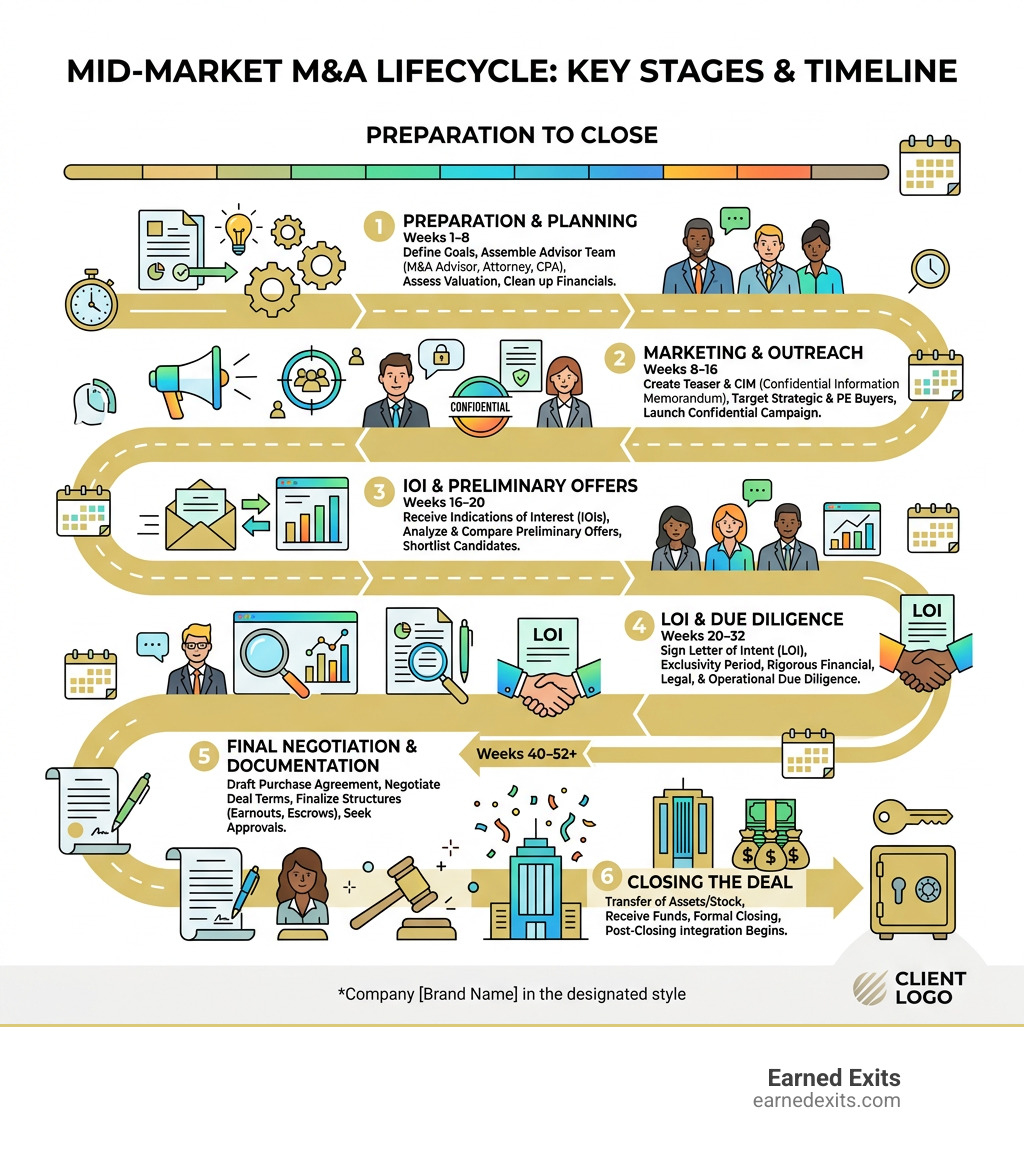
- How long it takes: Typically 6 months to over a year from preparation to close
- What drives value: EBITDA multiples, financial transparency, management depth, and growth potential
- Who helps: M&A advisors, transaction attorneys, and CPAs — sellers who use advisors average 25% higher valuations
- Biggest risk: 30–40% of deals collapse during due diligence, usually from undisclosed problems
For most business owners, this transaction is a once-in-a-lifetime event. You’ve likely spent decades building something real. But selling a mid-market company is a different skill set entirely — one that most owners have never needed before.
The process is more complex than selling a small “main street” business. It involves formal auction processes, detailed financial documentation, multiple buyer types with very different motivations, and deal structures that can include earnouts, seller notes, and equity rollovers.
Get it right, and you walk away with the financial outcome your years of work deserve. Get it wrong, and you may leave significant money on the table — or watch a deal collapse after months of effort.
This guide breaks down every stage of the mid-market sale process in plain language, so you know exactly what to expect and how to prepare.
Defining the Mid-Market Business Sale Landscape
When we talk about the “middle market,” we aren’t talking about the local dry cleaner, nor are we talking about Apple or Microsoft. We are looking at the massive engine of the American economy that sits right in the center.
Revenue Thresholds and the $5M to $100M Range
In M&A, the middle market is most often defined by annual revenue. While definitions vary slightly, most experts agree that the lower middle market starts at $5 Million to $50 Million in annual revenue. The broader middle market can extend up to $100 million or even several hundred million dollars.
However, revenue is only half the story. Sophisticated buyers look at EBITDA (Earnings Before Interest, Taxes, Depreciation, and Amortization) and Enterprise Value. A company with $20 million in revenue but zero profit is a very different beast than a $20 million company with $4 million in EBITDA. To understand where you sit, utilizing professional Business Valuation Services is a critical first step.

Differences Between Main Street and Enterprise Deals
Selling a mid-market company is fundamentally different from selling a “Main Street” business (like a single-location restaurant or retail shop).
- The Auction Process: Mid-market deals often utilize a “controlled auction.” Instead of posting a public listing with an asking price, advisors contact a curated list of qualified buyers simultaneously to drive up the price through competition.
- Shorter Decision Cycles: Compared to massive enterprise deals (think billion-dollar mergers), mid-market sales often have less “red tape” and shorter decision cycles because you are often dealing with the actual owners of the buying firm or a focused private equity team.
- Professional Intermediaries: You aren’t just putting a “For Sale” sign in the window. You are hiring a team. Professional intermediaries manage the heavy lifting so the CEO can stay focused on running the business. This is vital because Unlocking Business Valuation: Exploring Methods and Market Multiples requires sophisticated financial modeling that goes far beyond basic bookkeeping.
Identifying Typical Mid-Market Buyers
Who is actually going to write the check? In a mid-market business sale, buyers generally fall into three buckets:
- Strategic Buyers: These are often larger companies in your industry. They want your customers, your tech, or your geographic footprint. They often pay the highest price because they can achieve “synergies”—cost savings or revenue boosts created by combining the two companies.
- Private Equity Groups (PEGs): These firms raise pools of capital to buy businesses, improve them, and sell them later. They might buy your company as a “platform” to build upon or as an “add-on” to an existing portfolio company.
- Financed Entrepreneurs: These are high-net-worth individuals, often former executives, who have secured SBA 7(a) loans or private backing to buy and operate a single business.
Understanding which buyer type is the best fit is a core part of how a Master the Sale: How a Business Broker Elevates Your Exit Strategy works.
Key Steps to Prepare Your Business for Market
You wouldn’t sell a house without fixing the leaky roof and slapping on a fresh coat of paint. Selling a business requires the same “curb appeal,” but for your balance sheet.
Financial Normalization and Quality of Earnings
Buyers don’t want to see your “tax-minimized” books; they want to see the true earning power of the business. This requires “normalization” or “add-backs.” If you run your personal car lease, family travel, or a one-time legal settlement through the business, those expenses are “added back” to the profit to show the buyer what the business would look like under their ownership.
Many sellers now opt for a “Sell-Side Quality of Earnings” (QoE) report. This is an audit-lite process that verifies your EBITDA is sustainable and real, which builds massive trust with buyers and prevents price “re-trading” later.
Management Depth and Operational Scalability
One of the biggest “value killers” in a mid-market business sale is owner dependency. If the business stops functioning the moment you go on vacation, it’s not a business—it’s a job. Buyers want a management team that can stay on and run the show.
Preparation often involves:
- Strengthening the middle management layer.
- Documenting key processes (HR, sales, operations).
- Diversifying the customer base (so no single client represents more than 15-20% of revenue).
For a deeper dive into the logistics, check out The Ultimate Guide to DD Process in M&A and remember that Selling Your Business: Crafting a Meaningful Exit Beyond Just the Price means ensuring the legacy of your team is protected.
Maximizing Value Before Your Mid-Market Business Sale
To get the highest multiple, you need to tell a compelling story. This is done through the Confidential Information Memorandum (CIM). A great CIM doesn’t just list facts; it highlights growth projections and “low-hanging fruit” that a buyer can exploit.
The Power of Storytelling in Business Sales: Creating Lasting Value Beyond the Numbers is what separates a 3x multiple from a 5x multiple. You are selling the future, not just the past.
The Critical Role of Internal Due Diligence
Don’t wait for the buyer to find the skeletons in your closet. Conduct your own “internal due diligence” first.
- Data Rooms: Organize all contracts, leases, and tax returns into a Virtual Data Room (VDR).
- Legal Compliance: Ensure all trademarks, patents, and employee agreements are up to date.
- Risk Mitigation: Address any outstanding litigation or environmental issues now.
Learning from Insights into Successful Business Exits: Lessons from the Trenches shows that being organized is the best way to keep a buyer from getting “cold feet.”
Navigating Deal Structures and Valuation Multiples
Valuation is more of an art than a science. While everyone wants a “10x multiple,” the reality is usually more grounded.
EBITDA Multiples and Industry Factors
In 2025, the average business sold for roughly 2.61x annual earnings. However, this varies wildly by industry. Online and technology businesses often see higher multiples (averaging 3.25x or more), while manufacturing or services might sit in the 3x to 5x range depending on their size and capital intensity.
| Feature | Asset Purchase | Stock Purchase |
|---|---|---|
| Buyer’s Preference | High (Step-up in basis/lower risk) | Low (Inherits all liabilities) |
| Seller’s Preference | Low (Potential double taxation) | High (Lower tax/clean exit) |
| Liability Transfer | Limited to specific assets | All historical liabilities transfer |
| Complexity | Higher (Title transfers required) | Lower (Ownership shares transfer) |
Research shows that sellers who retain Mergers and Acquisitions Advisory Services typically enjoy 25% higher valuations. Why? Because advisors know how to play buyers against each other and which “levers” to pull to justify a higher multiple.
Financing and Structuring a Mid-Market Business Sale
Rarely does a buyer show up with a briefcase full of cash for 100% of the price. Most deals are “structured.”
- Cash at Closing: Usually 60% to 80% of the deal.
- Seller Notes: You essentially “lend” the buyer part of the purchase price, paid back with interest over 3-5 years.
- Earnouts: A portion of the price is contingent on the business hitting future performance targets. These are included in over one-third of lower-middle-market deals.
- Equity Rollover: Common with Private Equity, where you keep 10-20% ownership in the new entity to get a “second bite of the apple” when they sell again in five years.
For help navigating these waters, Business Brokerage Services are indispensable.
Common Pitfalls and How to Avoid Deal Fatigue
“Deal fatigue” is real. The longer a deal takes, the more likely it is to die.
- Due Diligence Failure: 30–40% of deals fall apart here. Usually, it’s because the seller was dishonest about a problem that the buyer eventually uncovered.
- Exclusivity Periods: Once you sign a Letter of Intent (LOI), you are usually “locked in” and cannot talk to other buyers for 60-90 days. If the buyer stalls, you lose leverage.
- Cultural Misalignment: If your team hates the buyer’s management style, they might quit before the deal closes, tanking the value.
Make sure to ask the 10 Questions to Ask a Business Broker before you sign any representation agreements.
Frequently Asked Questions about Mid-Market Sales
How long does it typically take to sell a mid-market business?
Most deals take between 6 and 12 months. The first 2-3 months are spent on preparation and marketing, followed by 1-2 months of buyer vetting and meetings, and finally 60-90 days for formal due diligence and legal closing. If your business is “off-market” (not actively listed), it can take 12-18 months to nurture a relationship with the right buyer.
What is the average EBITDA multiple for a mid-market company?
While the broad average is around 3x to 4.5x for the lower middle market, high-growth tech companies or essential medical services can see 8x to 10x+. Conversely, a “lifestyle” business with no management team might struggle to hit 2x. Transparency and recurring revenue are the biggest “multiple boosters.”
Why do 30-40% of M&A deals fall apart during due diligence?
The #1 reason is “surprises.” Whether it’s a major customer threatening to leave, unrecorded tax liabilities, or financial statements that don’t match the initial claims, any discrepancy erodes trust. Once trust is gone, the buyer either walks away or slashes the price so low the seller walks away.
Conclusion
A mid-market business sale is a marathon, not a sprint. It requires a blend of meticulous financial preparation, strategic storytelling, and the stamina to survive a grueling due diligence process.
At Earned Exits, we specialize in making this complex journey feel seamless. We provide the CFO-level support and due diligence tools you need to stay organized and efficient, ensuring that you don’t just sell your business, but that you earn the exit you deserve.
If you are ready to explore what your business is worth and how to prepare for the market, it’s time to Sell My Business with a partner who understands the high stakes of the middle market. Let’s get to work on your legacy.
