


How to Master Software Company Exit Planning Before You Sell
What Is Software Company Exit Planning — and Why It Changes Everything
Software company exit planning is the multi-year process of preparing your business to be sold at the highest possible value, to the right buyer, on your terms.
If you’re looking for a quick overview of what it involves, here it is:
| Step | What It Means |
|---|---|
| Start early | Begin 2–5 years before your target sale date |
| Know your number | Define what you need to net from the deal |
| Optimize key metrics | ARR, NRR, churn, gross margin, Rule of 40 |
| Reduce risk | Cut founder dependency, customer concentration, and messy books |
| Understand buyers | Strategic vs. PE buyers value your company differently |
| Prepare documentation | Financials, IP, contracts, and a clean data room |
| Run a competitive process | Multiple buyers = more leverage and higher price |
| Plan the transition | Earnouts, rollover equity, and post-close handover matter |
Most software founders spend years building something valuable — then leave money on the table because they didn’t prepare for the sale.
The numbers tell the story clearly. Software M&A activity jumped from 460 deals in 2020 to 546 in 2024, and there were already 714 announced transactions in just the first quarter of 2025 — a 36% year-over-year increase. Buyer demand for software businesses is strong right now. But demand alone doesn’t guarantee a great outcome for sellers.
The difference between a good exit and a great one almost always comes down to preparation. Companies that begin exit preparation 18–24 months before going to market consistently achieve significantly higher valuations than those that scramble when an offer arrives. And detailed preparation — the kind that truly maximizes value — can take anywhere from two to five years to complete.
That gap between “thinking about selling” and “ready to sell” is exactly where most founders lose leverage.
I’m Britt Clas, a Business Broker and Partner at Earned Exits, and I’ve guided entrepreneurs through every stage of software company exit planning — from early valuation benchmarking through final close. In this guide, I’ll walk you through exactly what it takes to prepare your software business for a successful, high-value exit.
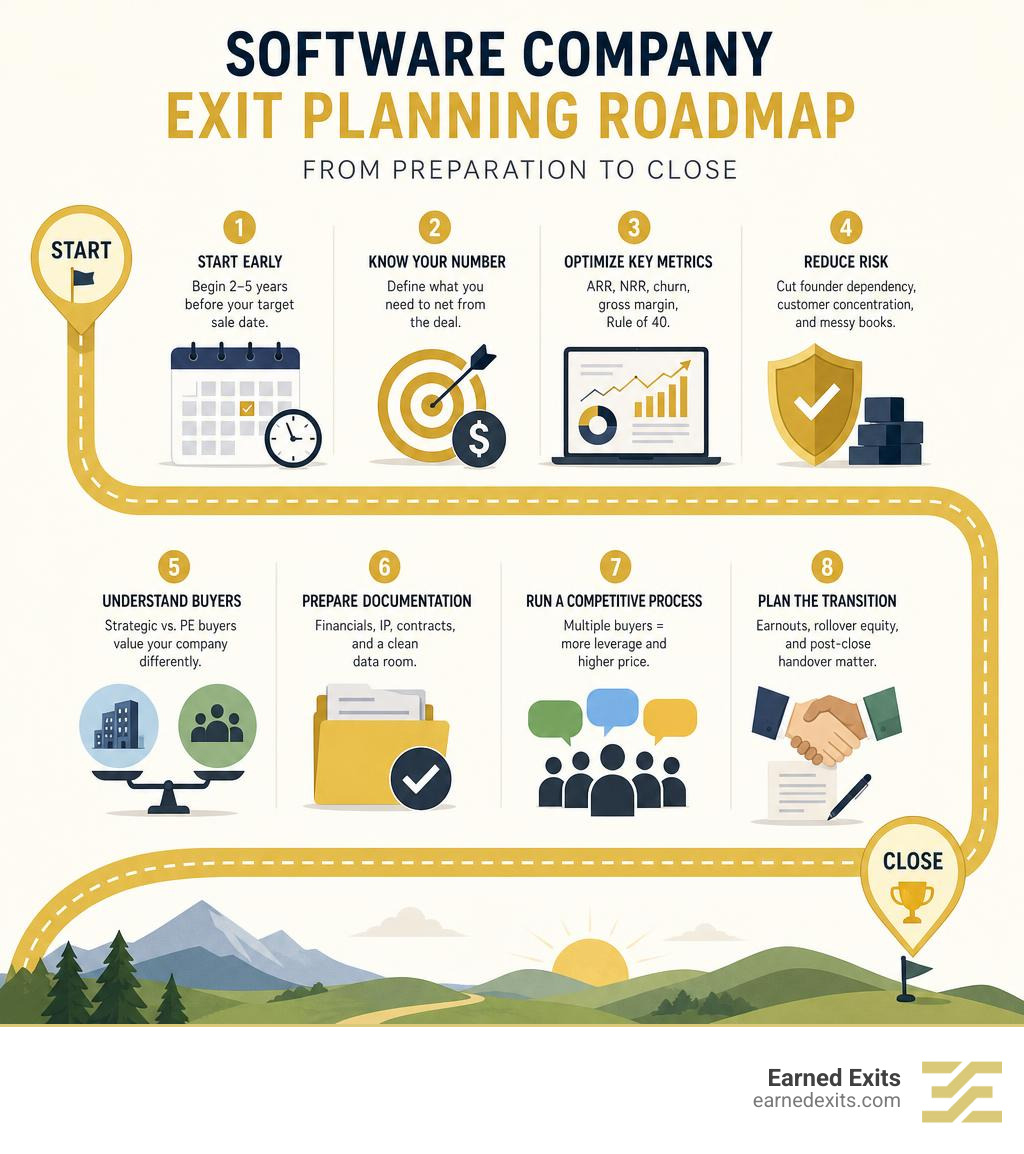
Easy software company exit planning word list:
Start Software Company Exit Planning 2–5 Years Before You Sell
A strong exit is not an event. It is a project.
The transaction itself may take 6-12 months, but the value-building work usually takes 2-5 years. That is because buyers do not just pay for your current revenue. They pay for confidence that the revenue will continue after you leave.
Your first questions should be:
- When do we want to exit?
- What do we need to net after taxes, debt, fees, and rollover?
- Who is the best buyer for this business?
- What would stop that buyer from paying a premium?
- What needs to be true 24-36 months from now for us to have leverage?
This is where planning turns into valuation leverage.
Why Software Company Exit Planning Starts Earlier Than Most Founders Think
Founders often start planning when they feel tired, when a buyer knocks, or when growth slows. That is understandable. It is also dangerous.
Buyers want proof, not promises. If you fix churn, clean up your financials, diversify customers, or hire a strong management team, buyers usually want to see 12-24 months of track record before giving full credit in valuation.
That is why a 2-5 year window matters. It gives you time to:
- Improve recurring revenue quality
- Reduce founder dependency
- Normalize financials
- Clean up legal and IP issues
- Build management depth
- Strengthen retention and customer success
- Time the market rather than being forced into it
Forced exits usually happen on the buyer’s terms. Planned exits happen on yours.
For a broader strategic framework, this exit planning framework is a helpful reference.
Build Your Exit Timeline Backward From the Target Close Date

Work backward from the date you want money wired.
A simple timeline looks like this:
| Timing | Focus |
|---|---|
| 36 months out | Define target number, exit path, valuation gap, management needs, and KPI targets |
| 24 months out | Improve churn, retention, margins, reporting, contracts, and customer concentration |
| 12 months out | Prepare data room, quality of earnings support, buyer list, CIM, and process strategy |
| 6 months out | Finalize positioning, financial schedules, management presentations, and outreach plan |
| Go-to-market | Contact buyers, manage NDAs, receive indications of interest, and create competition |
| LOI to close | Navigate exclusivity, due diligence, legal documents, working capital, escrow, and transition |
| Post-close | Execute handover, earnout governance, customer messaging, and team retention |
The closer you get to market, the harder it is to make real improvements. Six months before launch is for polishing, not rebuilding the engine while the car is on the highway.
Choose the Right Exit Strategy for Your SaaS or Software Business
Not every exit path fits every company. A $2M ARR vertical SaaS company, a services-heavy custom software firm, and a venture-backed AI platform may all need different routes.
| Exit Strategy | Complexity | Typical Timeline | Best Fit | Founder Outcome |
|---|---|---|---|---|
| Strategic acquisition | Medium to high | 6-12 months | Product, customer, or market fit with a larger buyer | Often highest valuation if synergies are strong |
| Private equity majority recap | High | 6-12 months | Profitable, scalable software with repeatable revenue | Liquidity now plus possible second bite through rollover equity |
| Minority recap | Medium | 3-9 months | Founder wants growth capital but not full exit | Partial liquidity while retaining control or influence |
| Roll-up acquisition | Medium | 4-9 months | Niche software that fits a platform strategy | Often structured with cash, rollover, and integration requirements |
| IPO | Very high | 18-36+ months | Large, fast-growing company with institutional readiness | Liquidity potential, but heavy regulation and market risk |
| Management buyout | Medium | 6-18 months | Strong internal team with financing access | Continuity, but often lower valuation and financing constraints |
| Generational transfer | Medium | Multi-year | Family successor with technical and leadership capability | Legacy preservation, less competitive pricing |
| Acquihire | Low to medium | 2-6 months | Strong team, weaker product or revenue base | Team retention, usually lower enterprise value |
| Liquidation | Low | Variable | Distressed or non-transferable business | Usually lowest value; sometimes necessary |
Most software founders should evaluate strategic buyers and financial buyers first, then compare those options against personal goals.
Optimize the SaaS Metrics Buyers Use to Value Software Companies
Software valuation is a confidence equation.
Buyers ask: “How predictable, durable, scalable, and transferable is this revenue?”
That means your metrics matter long before negotiation.
Recurring Revenue, Churn, and Customer Concentration
The cleanest software revenue is recurring, contracted, diversified, and retained.
Buyers will evaluate:
- ARR and MRR: Annual and monthly recurring revenue
- Recurring revenue percentage: Subscription revenue versus services, implementation, or one-time license revenue
- Net revenue retention: Revenue retained from existing customers after expansion, contraction, and churn
- Gross revenue retention: Revenue retained before upsells
- Logo churn: Percentage of customers leaving
- Revenue churn: Percentage of revenue lost
- Customer concentration: How much revenue comes from your largest accounts
Customer concentration can compress valuation quickly. As a rule of thumb, many buyers get nervous when one customer represents more than 10-20% of revenue. Top-five concentration above 40% can also raise concerns, especially if contracts are short or relationships depend on the founder.
The goal is not just more customers. It is better revenue quality.
Good signs include:
- Multi-year contracts
- Automatic renewals
- Low churn
- High usage
- Embedded workflow value
- Expansion revenue
- Limited cancellation rights
- No single customer that can sink the ship
Because yes, buyers do check whether one customer is secretly the whole business wearing a fake mustache.
Growth, Profitability, and the Rule of 40
Buyers like growth. They like profitability. They really like both together.
The Rule of 40 is a common SaaS benchmark: revenue growth percentage plus EBITDA margin percentage should equal 40 or more.
For example:
| Growth | EBITDA Margin | Rule of 40 Score |
|---|---|---|
| 35% | 5% | 40 |
| 25% | 20% | 45 |
| 15% | 30% | 45 |
| 50% | -20% | 30 |
A high-growth but deeply unprofitable company can still be attractive, especially in venture-backed categories, but the market in May 2026 is more disciplined than the frothiest software years. Buyers are paying close attention to efficient growth, margins, burn, and cash conversion.
Important metrics include:
- Year-over-year ARR growth
- Gross margin, often 70%+ for strong SaaS companies
- EBITDA margin
- CAC payback period
- LTV/CAC ratio
- Sales efficiency
- Forecast accuracy
- Cohort retention
- Pipeline conversion
- Expansion revenue
If you want a broader foundation on valuation, read The Definitive Guide to Business Valuation.
Clean Financials, Add-Backs, and Quality of Earnings
Messy books create doubt. Doubt lowers price.
Software financials need special care because of deferred revenue, subscription billing, implementation revenue, capitalization policies, contractor costs, hosting costs, and revenue recognition.
Before going to market, clean up:
- Accrual accounting
- Deferred revenue schedules
- Revenue by product line
- Revenue by cohort
- Churn and retention calculations
- Gross margin by revenue type
- Add-backs and owner expenses
- Contractor versus employee costs
- One-time legal, recruiting, or development expenses
- Tax filings
- Budget versus actual reporting
A quality of earnings review can help buyers trust EBITDA and revenue quality. It can also prepare you for buyer diligence before the buyer’s accounting team starts asking 200 questions at 11:47 p.m. on a Friday.
For add-backs and seller’s discretionary earnings, see our guide on add-backs and SDE.
Understand Buyers, Valuation Logic, and Deal Structures Before Negotiating
Price matters. Structure matters just as much.
Two offers with the same headline purchase price can produce very different outcomes depending on cash at close, earnout risk, escrow, rollover equity, tax treatment, and control after closing.
Strategic Buyers vs. Financial Buyers
Strategic buyers are operating companies. They may buy you for:
- Product expansion
- Technology integration
- Customer access
- Geographic or vertical market expansion
- Talent
- Competitive positioning
- Cross-sell opportunities
Strategic buyers may pay a premium if your company solves a problem they cannot solve quickly themselves. They often value synergies, not just standalone cash flow.
Financial buyers, such as private equity firms and family offices, usually evaluate:
- Predictable recurring revenue
- EBITDA and cash flow
- Scalability
- Management depth
- Acquisition opportunities
- Leverage capacity
- Exit potential in 3-7 years
A financial buyer may offer a majority recap where you sell most of the company but roll over equity. That can create a “second bite” if the company grows and sells again later.
Neither buyer type is automatically better. The right choice depends on your goals: maximum cash at close, continued upside, employee continuity, speed, cultural fit, or reduced post-close obligations.
Common Software M&A Deal Structures
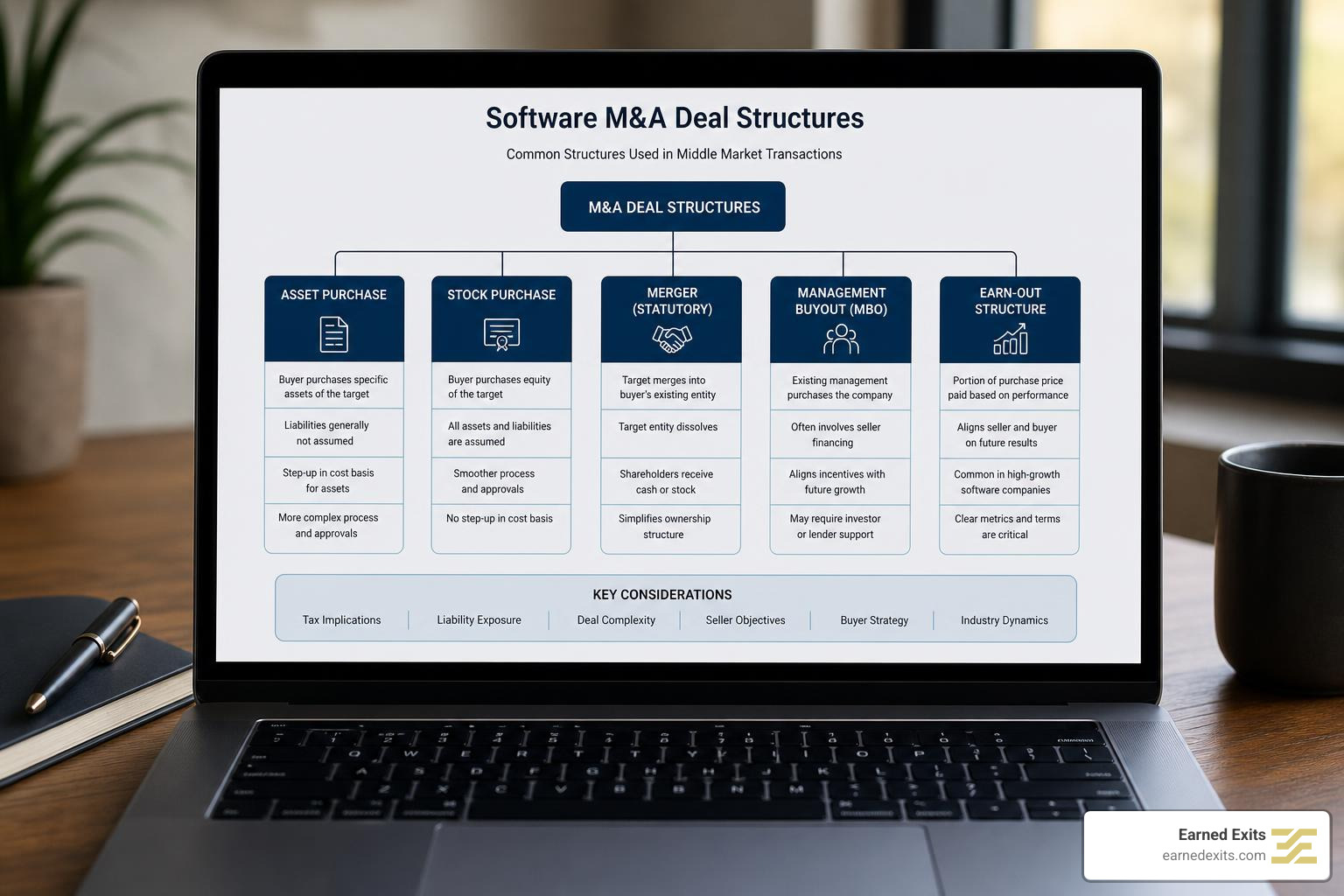
Common deal structures include:
- All-cash sale: Maximum certainty, often preferred by founders seeking a clean exit.
- Cash plus earnout: Part of the price depends on future performance.
- Majority recap: Founder sells control but retains rollover equity.
- Minority recap: Founder sells a smaller stake and keeps control or major influence.
- Seller note: Buyer pays part of the price over time.
- Escrow or holdback: A portion is held back for reps, warranties, or indemnity claims.
- Rollover equity: Seller reinvests part of proceeds into the new ownership structure.
- Retention package: Incentives for founders or key employees to stay post-close.
- Asset sale: Buyer purchases selected assets and liabilities.
- Stock or equity sale: Buyer purchases the legal entity itself.
Deal structure determines what you actually take home, how much risk remains, and how tied you are to the business after closing.
How Earnouts, Rollover Equity, and Escrows Affect Founder Outcomes
Earnouts can bridge a valuation gap, but they are not the same as cash.
If you accept an earnout, negotiate:
- Clear metrics
- Controllable targets
- Revenue-based measures where possible
- Quarterly reporting rights
- Operating covenants
- Anti-sandbagging protections
- What happens if the buyer changes strategy, pricing, budget, or team
Rollover equity can be powerful if you believe in the buyer’s plan. It can also create risk because your future payout depends on someone else’s execution.
Escrows are normal in M&A. They protect buyers against breaches of reps and warranties. The key is understanding amount, duration, claim process, and exclusions.
Before accepting an offer, compare cash at close, risk-adjusted value, tax impact, employment obligations, and control. Our guide on evaluating offers when selling your business explains this in more detail.
Make the Business Transferable: Team, Operations, IP, and Due Diligence
A buyer is not only buying software. They are buying a system that should keep working after you leave.
That means transferable value matters.
Reduce Key-Person Dependency Before Buyers Find It
Founder dependency is one of the biggest value killers in software exits.
If the founder owns product vision, sales, customer relationships, architecture decisions, pricing, hiring, and support escalations, the buyer sees risk. If the founder leaves, what exactly did they buy?
Build a team that can operate without you:
| Function | Buyer Wants to See |
|---|---|
| CEO/GM/COO | Day-to-day operational leadership |
| CFO/controller | Reliable reporting, forecasting, and diligence support |
| CTO/engineering lead | Technical roadmap, security, architecture ownership |
| VP sales/revenue | Repeatable pipeline and sales process |
| Customer success lead | Retention, onboarding, renewal discipline |
| Product lead | Roadmap, customer feedback, release planning |
Also document:
- SOPs
- Sales playbooks
- Customer success workflows
- Deployment processes
- Product roadmap ownership
- Support escalation paths
- Renewal processes
- Vendor management
Your goal is simple: become important, but not irreplaceable.
Prepare Legal, IP, Security, and Compliance Documentation
Software diligence gets very specific. Buyers will look for anything that threatens ownership, scalability, security, or assignability.
Prepare:
- IP assignment agreements from employees and contractors
- Contractor work-for-hire agreements
- Open-source software inventory
- Software licenses and third-party dependencies
- Patent, trademark, and domain records
- Customer contracts and assignment clauses
- Data processing agreements
- Privacy policy and terms of service
- SOC 2 or security documentation, if applicable
- GDPR, CCPA, HIPAA, PCI, or industry-specific compliance records, if relevant
- Cybersecurity policies
- Incident response history
- Cap table and equity grant documentation
- Employment agreements and invention assignment agreements
- Board minutes and approval records
If you have open-source exposure, undocumented contractor code, unsigned customer agreements, or unclear equity promises, fix them before buyers discover them.
Build a Buyer-Ready Data Room
A data room is where your exit preparation becomes visible.
Include:
- Formation documents
- Cap table
- Financial statements
- Tax returns
- ARR/MRR schedules
- Customer-level revenue reports
- Churn and retention analysis
- Sales pipeline reports
- Customer contracts
- Vendor contracts
- Employment agreements
- IP assignments
- Product roadmap
- Architecture diagrams
- API documentation
- Deployment documentation
- Security policies
- Compliance reports
- Board minutes
- Insurance policies
- Litigation or dispute records
- KPI dashboard
A clean data room speeds diligence and builds buyer confidence. A chaotic data room does the opposite.
For more on how buyers consume company information, read The Insiders Guide to the CIM.
Run the Exit Process Without Losing Momentum
The sale process can become a second full-time job. Unfortunately, you still have the first full-time job: running the business.
A well-run process protects momentum.
When to Engage an M&A Advisor or Investment Banker
Founders often ask whether they need an advisor. Technically, you can sell alone. Practically, many founders underestimate the complexity.
An M&A advisor or business broker can help with:
- Valuation positioning
- Exit readiness review
- Buyer list development
- Confidential outreach
- NDA management
- Competitive process design
- Offer comparison
- Negotiation
- Diligence coordination
- Closing support
Research cited in the exit planning market suggests advisor-represented businesses often sell for 6-25% more than self-represented companies and have materially higher success rates. Typical success fees vary by deal size. A $10M transaction may average just over 4%, while a $20M transaction may average around 3%.
Engage help 12-24 months before your target close if possible. That gives time to position the business before the market judges it.
If you want a credentialed exit planner as part of your broader team, you can also use the CEPA directory.
Keep Operating Performance Strong During the Sale Process
Buyers hate surprises. A missed quarter during diligence can lead to a lower price, tougher terms, or a dead deal.
Protect the business by keeping focus on:
- Sales pipeline
- Renewals
- Product releases
- Customer success
- Support response times
- Employee morale
- Forecast discipline
- Cash management
- Churn prevention
- Board and investor communication
Limit who knows about the process internally until timing is right. Too much chatter can create employee anxiety and customer concern.
At Earned Exits, we focus on organized communication, diligence support, and efficient tools so founders are not buried in spreadsheet archaeology while they should be running the company.
Plan the Founder Transition and Post-Close Handover
The handover should be planned before close, not improvised after the wire lands.
Clarify:
- How long the founder will stay
- Whether the role is advisory or operational
- Customer communication plan
- Employee communication plan
- Product roadmap governance
- Integration timeline
- Earnout reporting
- Decision rights
- Retention plans for key employees
- Transition services
A smooth transition protects customers, employees, and your final economics. For more detail, see our guide on the seller-to-buyer transition.
Avoid the Mistakes That Kill Software Company Exits
Most failed exits do not fail because the business is bad. They fail because preventable issues appear too late.
The Most Common Software Company Exit Planning Mistakes
Here are the deal-killers we see most often:
- Waiting until burnout to sell
- Going to market with messy financials
- Overestimating valuation based on outdated market multiples
- Ignoring churn or weak retention
- Having one customer represent too much revenue
- Keeping all major relationships with the founder
- Failing to document IP ownership
- Using contractors without proper assignment agreements
- Having unclear equity promises or cap table issues
- Accepting vague earnouts
- Negotiating with only one buyer
- Letting performance slip during diligence
- Failing to plan for taxes
- Misaligning founders, investors, or board members
- Hiding issues instead of disclosing them strategically
The painful part? Most of these are fixable if you start early.
How to Fix Exit Readiness Gaps Before Going to Market
Start with an exit readiness assessment. Then run a gap analysis across:
- Financials
- KPIs
- Legal documents
- IP
- Customer concentration
- Churn
- Management team
- Sales process
- Security and compliance
- Data room readiness
- Tax planning
- Buyer positioning
Turn every gap into an owner, deadline, and measurable milestone.
For example:
| Gap | Fix |
|---|---|
| Largest customer is 28% of revenue | Reduce below 15-20% through new sales and expansion |
| Founder owns enterprise renewals | Transition renewals to customer success lead |
| Financials are cash-basis | Move to accrual reporting with deferred revenue schedules |
| Contractor IP is unclear | Execute assignment agreements and legal cleanup |
| Churn is poorly tracked | Build cohort reporting and monthly retention dashboard |
To compare valuation approaches, read The Ultimate Guide to Small Business Valuation Methods.
Frequently Asked Questions About Software Company Exit Planning
How long does it take to sell a software company?
The active sale process usually takes 6-12 months from advisor engagement or buyer outreach to close.
A typical process includes:
- 1-3 months for preparation and materials
- 2-4 months for buyer outreach and management meetings
- 1-2 months for LOI negotiation and exclusivity
- 2-3 months for due diligence
- 1-2 months for final agreements and closing
But real value creation takes longer. Plan for 12-24 months of preparation at minimum, and 2-5 years if you want to materially improve valuation drivers.
What metrics matter most when selling a SaaS business?
The most important SaaS metrics are:
- ARR and MRR
- Net revenue retention
- Gross revenue retention
- Logo churn
- Revenue churn
- Gross margin
- EBITDA margin
- Rule of 40
- CAC payback
- LTV/CAC
- Customer concentration
- Recurring revenue percentage
- Expansion revenue
- Forecast accuracy
Buyers also care about qualitative factors: management depth, product differentiation, technical debt, security, customer love, and whether the business can scale without the founder.
Do I need an advisor to sell my software company?
You do not legally need one, but most founders benefit from experienced transaction support.
An advisor helps create competition, position valuation, manage buyers, protect confidentiality, negotiate structure, and keep diligence organized. This is especially valuable in software because buyers analyze SaaS metrics, IP, contracts, technical scalability, and revenue quality in detail.
The right advisor should help you understand not just “what is the price?” but “what do we actually keep, and what risk remains?”
Conclusion
A great software exit is built long before the LOI.
The founders who win are the ones who prepare early, know their number, improve the metrics buyers care about, reduce risk, document the business, and run a competitive process without letting performance slip.
That is exactly where we help.
At Earned Exits, we support founders with an organized sale process, clear communication, CFO-level diligence preparation, valuation guidance, buyer outreach, and tools that make the exit process more efficient. If you are thinking about selling in the next few years, the best time to prepare is now.
When you are ready, start here: Sell your business with expert support.
