


How a Skilled CFO Maximizes Your Business Valuation
What CFO Support for a Company Exit Actually Does (And Why It Matters)
CFO support for a company exit is one of the most powerful — and most overlooked — tools a business owner has when preparing to sell. Here’s a quick breakdown of what it covers:
What a CFO does to support a business exit:
- Cleans up financials — ensures books are accurate, audit-ready, and easy for buyers to trust
- Improves EBITDA — identifies cost savings and margin improvements that directly raise your sale price
- Prepares for due diligence — organizes records, builds a data room, and resolves red flags before buyers find them
- Optimizes tax strategy — structures the deal to minimize what you owe after closing
- Coordinates the advisory team — connects M&A advisors, attorneys, and wealth managers around a unified plan
- Builds financial forecasts — gives buyers a credible picture of future growth potential
The numbers behind all of this are sobering. 70–80% of businesses that go to market fail to sell. And for owners who do sell, 75% report profound regret within a year — often because they weren’t financially or personally prepared. With 80% of a typical owner’s net worth tied up in their business, the stakes couldn’t be higher.
A skilled CFO — whether full-time or fractional — helps you avoid becoming part of those statistics. They turn your business into something buyers want to pay a premium for, rather than a deal that stalls in due diligence or closes at a disappointing price.
I’m Britt Clas, a Business Broker and Partner at Earned Exits, where I’ve guided entrepreneurs through every stage of the sale process — including working alongside CFOs and financial advisors to ensure CFO support strengthens a company exit from the very first conversation. In my experience, the deals that close well almost always have strong financial leadership behind them.
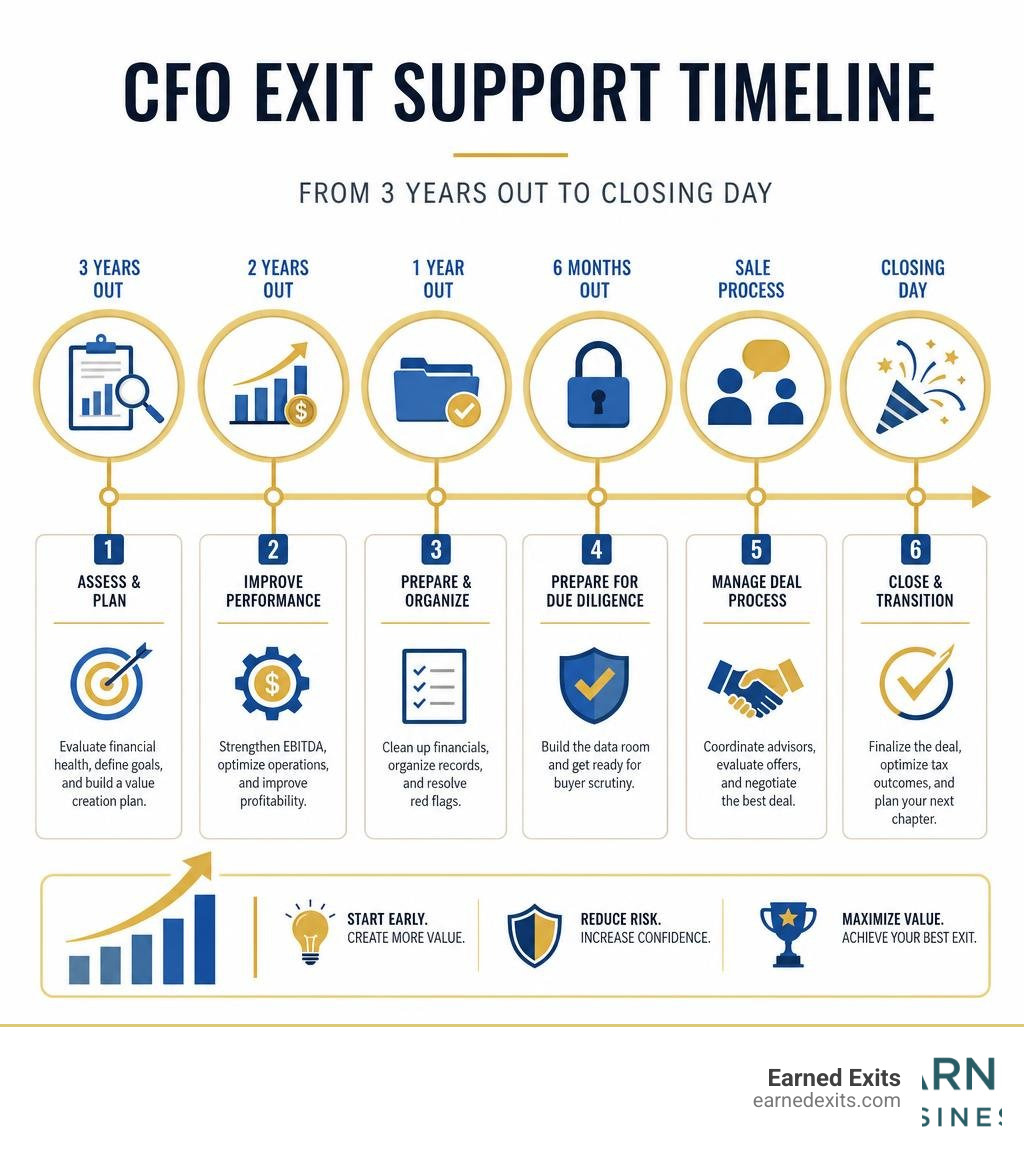
Learn more about CFO support company exit:
Why Early CFO Support Company Exit Planning is Essential

When we talk to business owners in June 2026, many assume exit planning is a project for the final six months of their business journey. In reality, the most successful exits are planned years in advance. Waiting until you are ready to sign a letter of intent is often too late to make the structural and financial improvements that buyers actually pay premiums for.
By starting early, a CFO helps you navigate the “Value Maturity” stages — Identify, Protect, Build, Harvest, and Manage. This structured timeline is critical because 50% of all business transitions are involuntary, driven by the “Five D’s”: death, disability, divorce, disagreement, and distress. If you are forced into an abrupt exit without preparation, your business’s value can plummet.
Early financial strategy helps you calculate and bridge your “wealth gap” — the difference between your current net worth and the amount you actually need to fund your post-exit lifestyle. To explore how other business owners have navigated these exact hurdles, take a look at our Insights into Successful Business Exits: Lessons from the Trenches.
To build a truly transferable and resilient asset, many owners turn to strategic networks like NOW CFO: Fractional CFO Services For Business Growth to establish robust growth models. For example, local teams such as the Anchorage office opens financial strategy to Alaskan … – NOW CFO help business owners in Alaska and across the country secure high-level financial strategy long before they ever list their company for sale.
The Cost of Skipping CFO-Level Preparation
Skipping strategic financial leadership before an exit leads directly to value leakage. Without a CFO to stress-test your numbers, you risk:
- Overestimating your business value: Entering negotiations with unrealistic expectations, only to have buyers slash their offers during due diligence.
- Failed sales: Watching a deal collapse because your historical records cannot support your revenue claims.
- Poor market timing: Being forced to sell during an economic downturn because you didn’t proactively build a liquid, transaction-ready business.
- Lack of owner independence: Buyers will walk away if they realize the business cannot run for 90 days without you at the helm.
How a CFO Drives EBITDA, Cash Flow, and Valuation Multiples
At Earned Exits, we frequently remind our clients of a powerful mathematical reality: every single dollar of EBITDA increase can translate to $3 to $7 (or more) in added enterprise value, depending on your industry. If a CFO helps you find $150,000 in unnecessary expenses and optimizes your pricing structure, they haven’t just saved you $150,000 — they have potentially added over $1,000,000 to your final purchase price!
A skilled CFO systematically improves your profit margins, optimizes cash flow, and cleans up balance sheet liabilities. They restructure debt, renegotiate vendor contracts, and ensure your working capital is managed tightly. For more details on how these adjustments protect your hard-earned equity, read about How CFO Support Can Save Your Business Sale.
To visualize the impact of high-level financial optimization, consider this comparison of a typical mid-sized business before and after a CFO steps in:
| Financial Metric | Before CFO Optimization | After CFO Optimization | Impact on Valuation |
|---|---|---|---|
| Annual Revenue | $10,000,000 | $10,500,000 (Optimized pricing) | + $500,000 top-line |
| Gross Margin | 45% ($4,500,000) | 50% ($5,250,000) | Improved cost of goods sold |
| Operating Expenses | $3,500,000 | $3,100,000 (Streamlined overhead) | – $400,000 overhead |
| Normalized EBITDA | $1,000,000 | $2,150,000 | Over doubled profit |
| Valuation Multiple | 4.5x | 6.0x (Lower risk profile) | Buyers pay more for clean books |
| Enterprise Value | $4,500,000 | $12,900,000 | +$8,400,000 in exit proceeds |
Identifying and Optimizing Key Value Drivers
Buyers do not just look at your past performance; they buy your future cash flows. A CFO helps you command a premium multiple by optimizing key value drivers:
- Shifting to recurring revenue: Subscription-based or contracted revenue is highly predictable and can easily double the valuation multiple compared to project-based, transactional revenue.
- Mitigating customer concentration: If a single customer represents more than 15% of your sales, buyers see massive risk. A CFO helps diversify your client base or structures the financial narrative to mitigate this concern.
- Defending margins: Proving that your margins are stable or expanding over a three-to-five-year period signals operational efficiency.
Navigating Due Diligence and Preventing Deal-Derailing Red Flags

Due diligence is where deals go to die. When a buyer signs a Letter of Intent (LOI), their accounting firm will initiate a thorough financial audit. If they find inconsistencies, they will “re-trade” (lower the purchase price) or walk away entirely.
A CFO prevents this by running a pre-emptive Quality of Earnings (QoE) analysis. They review revenue recognition policies to ensure compliance with ASC 606, identify legitimate add-backs (such as above-market owner salaries or personal expenses run through the business), and organize a secure, digital data room.
Structuring these financial narratives is a highly specialized skill. For comprehensive cross-border or middle-market transactions, utilizing global CFO support services – IQ-EQ can ensure your compliance and reporting standards meet the strict expectations of institutional buyers and private equity firms.
Key Responsibilities of CFO Support Company Exit Preparation
To make your business “deal-ready,” a CFO takes on several critical operational and financial tasks:
- Financial Cleanup: Transitioning your books from basic cash-basis accounting to standardized GAAP accrual accounting.
- Accrual Adjustments: Aligning your revenue and expenses with the periods in which they were actually earned and incurred.
- Forecasting Models: Building a dynamic, five-year financial model that details forward-looking assumptions, capital expenditures, and working capital needs.
- Historical Record Organization: Gathering three to five years of audited or reviewed financial statements, tax returns, and key performance indicator (KPI) dashboards.
Having a dedicated professional handle these tasks allows you to keep running your business successfully during the sale process. To understand why this role is so vital to your success, read our guide on The CFO Hero: Your Business Sale Needs.
If you are looking for localized accounting and operational support to prepare your books, regional networks like Outsourced Accounting | CFO Network | Little Rock Ar provide excellent hands-on accounting infrastructure to keep your records spotless.
Tax Strategies and Advisory Team Coordination
It is not about how much you sell your business for; it is about how much you actually keep after Uncle Sam takes his cut. A CFO implements sophisticated tax planning strategies years before the sale to maximize your after-tax proceeds.
These strategies include:
- Entity Structure Optimization: Evaluating whether transitioning from a C-corporation to an S-corporation (or vice versa) will prevent double taxation on an asset sale.
- Qualified Small Business Stock (QSBS) Planning: Under Section 1202, qualifying shareholders may exclude up to $10 million (or more) in capital gains from their federal taxes.
- Installment Sales: Spreading your sale payments over multiple tax years to stay in lower tax brackets and defer liability.
- State Tax Mitigation: Structuring your residency or trusts to minimize state-level tax exposure on the transaction.
While the CFO manages the numbers, coordinating the entire transaction requires a dedicated broker. To build the rest of your advisory team, check out The Ultimate Guide to Hiring a Professional Business Broker.
Coordinating the Exit Advisory Team
Your CFO acts as the central financial hub of your exit team, collaborating seamlessly with:
- M&A Advisors and Brokers: Supplying the financial data needed to build the Confidential Information Memorandum (CIM).
- Legal Counsel: Ensuring that representations, warranties, and working capital peg definitions in the purchase agreement protect your interests.
- Wealth Managers: Aligning the net proceeds of the sale with your personal financial plan and post-exit estate planning.
Fractional CFOs vs. Traditional Accountants
Many business owners ask us: “Can’t my everyday CPA or bookkeeper handle my exit?”
The short answer is no. While accountants are excellent at historical reporting, tax compliance, and looking backward, a CFO provides forward-looking strategy, valuation optimization, and transactional leadership.
| Feature | Traditional Accountant / CPA | Fractional or Full-Time CFO |
|---|---|---|
| Primary Focus | Historical compliance, tax filing, and accurate bookkeeping. | Forward-looking strategy, valuation growth, and deal execution. |
| Perspective | Backward-looking (What happened last quarter?). | Forward-looking (Where will the business be in 3 years?). |
| M&A Experience | Rarely has direct experience negotiating with private equity or institutional buyers. | Highly experienced in due diligence, QoE audits, and deal structuring. |
| Role in Exit | Provides historical reports and tax returns. | Acts as the financial “quarterback” of the transaction. |
For businesses that do not need a permanent, six-figure executive, utilizing specialized Fractional CFO Services: 1 Way to Unlock Potential – Spitz CPA provides high-level financial leadership on a flexible, part-time basis. Similarly, firms like Part-Time CFO Services CT – Lake Accounting & Tax offer business owners in New England tailored, strategic oversight without the overhead of a full-time hire.
How Fractional CFO Support Company Exit Strategies Reduce Costs
A fractional CFO is the ultimate life hack for small-to-mid-sized business owners. You gain access to a seasoned corporate finance veteran — someone who has successfully negotiated dozens of private equity and trade sales — for just a fraction of the cost of a full-time executive.
Instead of paying a $250,000 salary plus benefits, you can bring in fractional expertise for a few days a week or on a project basis. This model is highly scalable; you can start with a light advisory retainer 24 months before your exit and increase their hours as you enter the intense, live-process phase of the sale.
If you are located in Colorado, working with advisors like those offering Fractional CFO Services | WhippleWood can help you systematically build transferable value. Down in the South, resources like Southwest Alabama – Mobile | FocusCFO specialize in helping family-owned businesses prepare for smooth, lucrative generational transitions.
With this strategic, cost-effective guidance in place, you can focus on what truly matters: preparing for your next chapter. To read more about designing a transition that respects your legacy, see Selling Your Business: Crafting a Meaningful Exit Beyond Just the Price.
Frequently Asked Questions about CFO Exit Support
How early should I engage a CFO before planning an exit?
Ideally, you should engage a CFO 18 to 24 months before going to market. If you want to maximize your strategic positioning and tax structuring, 3 to 5 years is even better. This runway gives the CFO enough time to clean up historical reporting, establish consistent KPI trends, optimize your tax structure, and remove owner dependencies.
What are the most common financial red flags that derail exits?
The most common deal-killers include:
- Messy or inconsistent bookkeeping: Which immediately destroys buyer trust.
- High customer concentration: Relying on one or two clients for the majority of your revenue.
- Unrecorded liabilities: Hidden debts, pending lawsuits, or unresolved sales tax compliance issues.
- Working capital spikes: Sudden, unexplained fluctuations in inventory or accounts receivable.
Can I use my regular accountant instead of a CFO for exit planning?
Your regular accountant is essential for tax compliance and day-to-day bookkeeping, but they generally lack the M&A transaction experience required to negotiate with sophisticated buyers. A CFO brings forward-looking financial modeling, valuation expertise, and due diligence leadership that standard accountants do not provide.
Conclusion
Preparing your company for sale is one of the most significant financial milestones of your life. Don’t leave your hard-earned equity to chance by skipping high-level financial preparation. Proactive CFO support for a company exit ensures that your books are bulletproof, your EBITDA is maximized, and your due diligence process is seamless.
At Earned Exits, we specialize in helping business owners navigate this transition with absolute clarity and confidence. We provide the tools, the communication, and the thorough due diligence support you need to secure a premium valuation.
Are you ready to discover what your business is truly worth and start building a lucrative, stress-free exit strategy? Get professional business brokerage services from the team at Earned Exits today!
