


Shipping for Success with a Freight Brokerage Franchise
Why the Freight Brokerage Franchise Market Is Booming Right Now
A freight brokerage franchise gives entrepreneurs a fast-track entry into one of the most resilient industries in the U.S. economy. Here’s a quick look at what that means in practice:
What is a freight brokerage franchise?
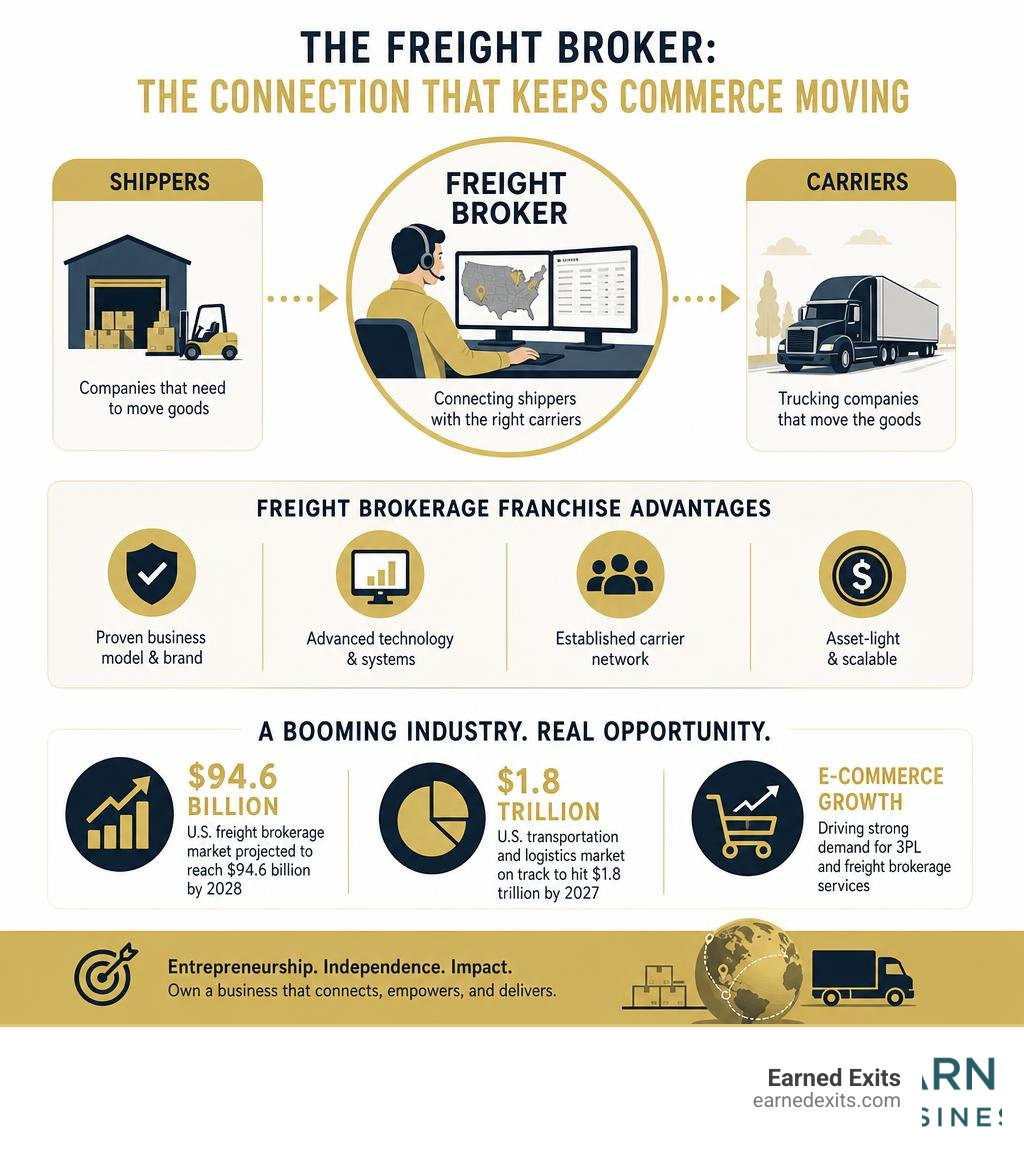
- A licensed business that connects shippers (companies needing to move goods) with carriers (trucking companies)
- Operates under an established franchisor’s brand, technology, and carrier network
- Typically asset-light — no trucks or warehouses required
- Franchisees earn revenue by taking a margin on each shipment arranged
Why it matters right now:
- The U.S. freight brokerage market is projected to reach $94.6 billion by 2028
- The broader U.S. transportation and logistics market is on track to hit $1.8 trillion by 2027
- E-commerce growth is creating a surge in demand for third-party logistics (3PL) services
The logistics industry isn’t slowing down. Businesses of every size need reliable, cost-effective ways to move goods — and they increasingly turn to freight brokers to make that happen. For entrepreneurs exploring business ownership, a franchise model can offer a ready-built system to tap into that demand without starting from scratch.
I’m Britt Clas, Business Broker and Partner at Earned Exits, where I help entrepreneurs navigate complex transactions including buying and selling businesses in growth industries like the freight brokerage franchise space. My experience working with founders across a wide range of industries gives me a practical lens on what makes these opportunities worth evaluating — and what to watch out for before you sign anything.
Freight brokerage franchise terms explained:
- freight brokerage companies for sale
- start freight broker business
- national industry network business brokers
What is a Freight Brokerage Franchise?
At its core, a freight brokerage franchise operates as an intermediary in the supply chain. Shippers have freight they need moved, and carriers have the trucks to move it. The broker steps into the middle to coordinate the transaction, negotiate rates, track the shipment, and ensure successful delivery.
Unlike traditional trucking companies, a freight brokerage is an asset-light business model. You do not need to buy, lease, or maintain a fleet of physical semi-trucks, dry vans, or warehouse facilities. Instead, your primary tools are a computer, a phone, and specialized logistics software. This keeps your overhead incredibly low and allows you to run a highly scalable B2B service-based business, often right from a home office.
To understand how to build this type of business from the ground up, explore our comprehensive resource: The Freight Escape: A Guide to Start Freight Broker Business.
Franchise vs. Independent Freight Brokerage
When you decide to enter the logistics sector, you face a major strategic choice: do you launch an independent brokerage or buy into a franchise network?
Starting an independent freight brokerage is a notoriously steep uphill climb. As an independent startup, you must secure your own federal operating authority, purchase a $75,000 surety bond, and build a brand from scratch. Shippers are often hesitant to trust new, unproven brokers with their valuable cargo, and carriers may refuse to haul your loads until you have established credit history and trade references.
By contrast, joining a freight brokerage franchise provides immediate access to:
- Instant Brand Recognition: You operate under a respected national brand that shippers already trust.
- Established Credit and Trade Relationships: Franchisors have pre-approved credit ratings, allowing you to book carriers immediately without payment-delay concerns.
- Pre-Negotiated Carrier Networks: You can leverage massive, pre-vetted networks of Less-Than-Truckload (LTL) and Full Truckload (FTL) carriers.
- Turnkey Systems: You bypass the years of trial-and-error required to build operational workflows from the ground level.
If you are weighing these two paths and want to see what established options are currently on the market, take a look at our guide on Shopping for Success with Freight Brokerage Companies for Sale.
Key Benefits of Joining a Logistics Network
Investing in a logistics franchise is highly attractive due to its capacity for generating recurring revenue. Shippers rarely require one-off transport; most businesses have ongoing, daily, weekly, or monthly shipping needs. Once you secure a client and consistently deliver smooth service, you unlock a steady stream of repeat business.
The scalability of this model is another massive benefit. Because you are not constrained by physical assets, your growth is limited only by your sales ability and operational efficiency. You can easily expand your client base without worrying about buying more trucks or hiring drivers. For a deeper dive into why investors choose this industry, check out the resources at Freight Brokerage | KLC Franchise.
Technology and Support in a Freight Brokerage Franchise
One of the largest hurdles for independent brokers is the sheer cost and complexity of modern logistics technology. A premier franchisor solves this by providing proprietary software and robust Transportation Management Systems (TMS).
These platforms typically feature:
- Real-Time Tracking: Automated GPS tracking that gives shippers peace of mind and reduces the need for constant “check calls” to drivers.
- Automated Load Management: Systems that match loads with available carrier capacity in seconds.
- E-Documentation: Digital signature capture, automated billing, and electronic bills of lading (e-BOLs) to minimize paperwork.
- Back-Office Support: The franchisor’s corporate office usually handles carrier invoicing, customer billing, and collections, freeing you up to focus entirely on sales and customer relationship management.
Finding Shippers and Carriers with Established Networks
As a franchisee, you step into the market with immense bulk buying power. Because the franchise network collectively moves millions of tons of freight annually, the franchisor can negotiate deeply discounted rates with major national carriers.
This volume-based pricing allows you to offer highly competitive rates to small and medium-sized businesses (SMBs) — rates they could never secure on their own. This gives you an immediate competitive edge when cold calling or pitching local shippers. Furthermore, you gain access to thousands of pre-vetted carrier partners, making it incredibly simple to find reliable capacity for even the most challenging shipping routes.
Financial Investment and Profitability Timelines
While the asset-light nature of a freight brokerage keeps startup costs lower than brick-and-mortar franchises, you still need a clear understanding of the financial requirements.

Initial Costs and Royalty Structures
The investment required to open a logistics franchise varies depending on the brand, territory model, and scale of operations. Typical initial franchise fees range from $10,000 to $50,000, with total initial investments spanning $30,000 to $250,000.
Royalty structures in the logistics space are also unique. While some brands charge a flat percentage of gross sales, others utilize a gross margin royalty model, taking a percentage of your actual profit margin (the difference between what the shipper pays you and what you pay the carrier).
| Franchise Brand | Initial Franchise Fee | Est. Total Initial Investment | Royalty Structure |
|---|---|---|---|
| US-FEX | $10,000 | $32,100 – $50,000+ | 2% per load of shipment fee |
| Speedy Freight | $49,500 | $90,000 – $180,000 | 30% of gross margin |
| Haberer Transport | $50,000 | $50,000 – $250,000 | 10% of gross revenue |
| World Options | Contact for details | Low-overhead (Home-based) | Margin-share basis |
Timeline to Profitability
The typical timeline to achieve profitability in a freight brokerage franchise is 12 to 24 months.
Because this is a relationship-driven B2B sales business, it takes time to build trust with local shippers, run trial shipments, and secure contracted freight lanes. We highly recommend that incoming franchise owners plan for at least 18 months of living expenses to cover personal costs while building the business.
Most owners start as owner-operators, working solo to keep overhead minimal. Once the recurring revenue from your initial client base covers your operating costs, you can scale by hiring sub-agents or sales staff to accelerate your outreach.
Comparing Top Freight Brokerage Franchise Models
Different franchises cater to different business goals, experience levels, and budgets.

Evaluating Leading Logistics Networks
When researching the market, you will encounter several prominent models:
- Unishippers: Operating as a major player in the 3PL space, Unishippers is part of the WWEX Group (alongside Worldwide Express and GlobalTranz). They are the nation’s largest non-retail authorized reseller of UPS services, giving franchisees a powerful small-package and freight offering. Learn more on the Shipping Logistics Franchise Opportunities page.
- World Options: This model focuses heavily on a simplified, home-based setup. Franchisees introduce small and medium-sized businesses to a proprietary online shipping portal where clients can compare rates, book, and track shipments themselves. To understand this portal-focused approach, review Shipping, Freight, and Logistics Business | World Options and the Proven Shipping & Logistics Business Model | World Options page.
- Speedy Freight: Offers a highly flexible, non-territorial model within the US, allowing you to acquire customers nationwide without geographic restrictions.
Choosing the Right Freight Brokerage Franchise for Your Goals
Your choice should align with your professional background and operational preferences:
- For Experienced Brokers: If you already have active shipper relationships but lack the technology, credit, or back-office infrastructure to go independent, a SaaS-based platform like US-FEX is highly attractive. With a low $10,000 franchise fee and a 2% per-load royalty, it offers maximum financial independence. Read more at US-FEX – Franchise Opportunities .
- For Global Logistics Players: Licensed freight forwarders, customs brokers, and shipping agents looking for exclusive port or airport territory rights often look toward specialized networks like the Cosmo Freight Network E-Exclusive Franchise | Cosmo Freight ® .
Legal, Regulatory, and Licensing Requirements
Even within a franchise system, operating a freight brokerage requires strict adherence to federal and state transportation laws.
FMCSA Authority and Surety Bonds
All freight brokers operating in the United States must obtain operating authority from the Federal Motor Carrier Safety Administration (FMCSA).
- The $75,000 Surety Bond: To obtain your license, you must secure a $75,000 surety bond (or trust fund). This bond serves as a financial guarantee that you will pay the carriers who haul your shippers’ freight. While you don’t need to put up $75,000 in cash, you will pay an annual premium (typically 1% to 5% of the bond value) based on your creditworthiness.
- Process Agents (BOC-3): You must designate a process agent in every state where you maintain an office or write contracts, using the FMCSA BOC-3 form.
- Note: Some franchise models (such as Haberer Transport) allow you to operate directly under their corporate motor carrier authority and surety bond, saving you the time and expense of securing your own.
State-Specific Compliance and Training
Brokers must also register under the Unified Carrier Registration (UCR) agreement, which supports state highway safety programs.
Because compliance is complex, getting professional training is highly recommended. Excellent educational programs are available across our active locations, such as:
- Online Freight Broker/Agent Training | MSU Denver
- Freight Broker/Agent Training – Central Arizona College
- Freight Broker/Agent Training – Little Rock
- Online Freight Broker/Agent Training – SMC Community Education
For localized market insights and brokerage services, you can also explore regional resources like Alabama Freight Transport and Shipping Company , Alaska Freight Broker Services , US Franchises available in American Samoa , and national audit providers like Freight Brokerage Services | CT LOGISTICS .
Frequently Asked Questions about Freight Brokerage Franchises
Do I need prior logistics experience to buy a franchise?
No. Most freight brokerage franchisors do not require prior logistics or shipping experience. Instead, they look for candidates with strong B2B sales skills, excellent communication, organizational abilities, and an entrepreneurial drive. The franchisor provides comprehensive initial training (often 80+ hours of classroom and virtual instruction) and ongoing sales coaching to teach you the logistics industry from the inside out.
How much does a typical freight franchise cost?
While some low-cost networks have initial fees around $10,000, a typical full-service freight franchise requires an initial franchise fee of roughly $45,000 to $50,000, with total startup costs ranging from $90,000 to $180,000. You should also meet minimum liquid cash and net worth requirements to ensure your business has sufficient working capital during the startup phase.
Can I operate a freight brokerage from home?
Yes! Because this is an asset-light, tech-enabled business model, many freight brokerage franchises are designed to be run entirely from a home office. All you need is a reliable laptop, a phone, high-speed internet, and access to the franchisor’s cloud-based shipping portal. This home-based flexibility keeps your operating overhead incredibly low.
Conclusion
A freight brokerage franchise represents an incredible blend of high-growth potential, recurring B2B revenue, and low-overhead operational flexibility. By partnering with an established franchisor, you bypass the credit, branding, and carrier trust hurdles that stall so many independent startups.
At Earned Exits, we specialize in helping business owners navigate the complex waters of business sales, acquisitions, and valuations. Whether you are looking to buy an existing logistics business, sell your current brokerage, or plan a highly profitable exit, our team is here to guide you with a seamless, organized, and deeply analytical approach.
Explore our professional advisory services to see how we can help you achieve your business goals:
