


Florida Business Broker Secrets: Sell Your Company Efficiently
What First-Time Sellers Need to Know About Selling a Business Efficiently in Florida
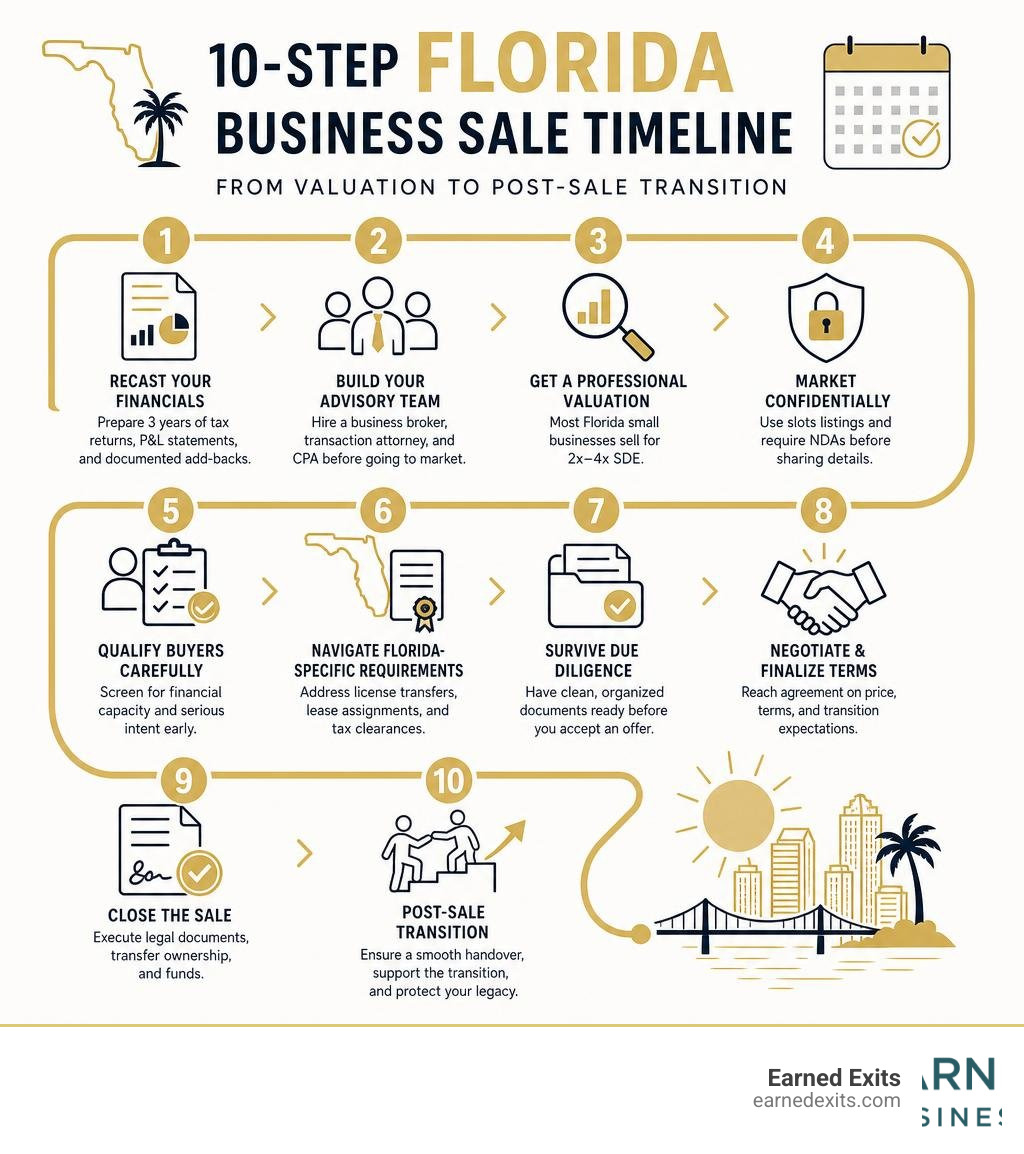
If you want to sell business efficiently in Florida, here are the key steps:
- Recast your financials — prepare 3 years of tax returns, P&L statements, and documented add-backs
- Build your advisory team — hire a business broker, transaction attorney, and CPA before going to market
- Get a professional valuation — most Florida small businesses sell for 2x–4x Seller’s Discretionary Earnings (SDE)
- Market confidentially — use slots listings and require NDAs before sharing any business details
- Qualify buyers carefully — screen for financial capacity and serious intent early
- Navigate Florida-specific requirements — address license transfers, lease assignments, and tax clearances
- Survive due diligence — have clean, organized documents ready before you accept an offer
- Close and transition — plan your post-sale handover well before the closing date
Selling a business is one of the biggest financial events of your life — and for most owners, it happens exactly once. That unfamiliarity is what makes the process stressful. Florida adds its own layer of complexity: a booming market with over 2.8 million small businesses, strong demand from out-of-state and international buyers, seasonal timing considerations, and state-specific legal requirements that can derail a deal if you’re not prepared.
The good news? Florida is genuinely one of the best places in the country to sell a business right now. There’s no state income tax, which means more of your proceeds stay with you. Buyer demand is strong. And with the right preparation and the right team, most well-priced businesses sell within 6 to 12 months.
But “well-prepared” is doing a lot of work in that sentence. The gap between sellers who get strong offers quickly and those who stall on the market often comes down to one thing: how organized and ready they were before they listed.
This guide walks you through exactly what that preparation looks like — step by step.
I’m Britt Clas, a Business Broker and Partner at Earned Exits, where I’ve guided founders through the full arc of exit planning, valuation, and closing to help them sell their business efficiently in Florida and beyond. At Earned Exits, our team has completed more than $2 billion in business transactions, and everything in this guide reflects what actually works in the current market.
The Blueprint to Sell Business Efficiently Florida
The Florida business landscape in June 2026 is highly competitive but incredibly rewarding for prepared sellers. Florida has over 2.8 million small businesses, representing 99.8% of all businesses in the Sunshine State and employing approximately 3.8 million people. Because of Florida’s massive population growth and its reputation as a business-friendly environment, we are seeing an unprecedented influx of out-of-state investors, independent search funds, and private equity groups looking to acquire established companies.
However, selling a business is not like selling real estate. You cannot simply put a “For Sale” sign in the yard and wait for offers. To sell business efficiently florida, you need a structured strategy that protects your operational stability while quietly attracting qualified buyers.
A successful transaction requires balancing daily business operations with the complex mechanics of an exit. If you try to manage the entire process yourself, you risk neglecting your company’s performance, which immediately hurts its market value. To understand the foundational concepts before diving into the Florida-specific details, we highly recommend reading our beginner’s guide to selling a business.
Step 1: Recast SDE and Prepare Financial Documentation
The absolute cornerstone of a swift, high-value business sale is clean, transparent financial documentation. Buyers—and more importantly, their lenders—will scrutinize your financial history. If your books are disorganized, deals will fall through during due diligence.
Before listing, you must gather three years of federal tax returns, profit and loss (P&L) statements, balance sheets, and accounts receivable/payable aging reports. Once you have these documents, the next step is to calculate your Seller’s Discretionary Earnings (SDE).
SDE is the true historical cash flow of the business available to a single owner-operator. Because most business owners write off legitimate expenses to minimize their tax liabilities, your reported net income on tax returns does not reflect the actual earning power of the business. Recasting financials involves “adding back” these non-operational or one-time expenses to show the true profitability of the company.
Common add-backs include:
- Owner’s salary and payroll taxes
- Personal health insurance and vehicle leases paid by the business
- One-time legal fees or major equipment repairs
- Non-cash expenses like depreciation and amortization
By documenting these add-backs with clear receipts and payroll records, you present a normalized financial picture that justifies a higher valuation multiple.
Step 2: Assemble Your Florida Advisory Team
You should not try to sell your business alone. Relying solely on your own negotiation skills or using inexperienced generalist advisors often leads to costly legal errors and lower purchase prices. To maximize efficiency, you should assemble a dedicated advisory team consisting of:
- A Certified Business Broker / M&A Advisor: They manage the entire transaction, from creating marketing materials to pre-qualifying buyers and facilitating negotiations.
- A Transaction Attorney: Unlike a general corporate attorney, a specialized transaction or M&A attorney drafts the legal documents (such as the Asset Purchase Agreement) and ensures state-level regulatory compliance.
- A CPA with Transaction Experience: They analyze the tax consequences of different deal structures and help you minimize your capital gains tax burden.
Choosing the right broker is critical to keeping the transaction moving. To find the right partner for your exit, consult our comprehensive ultimate guide to hiring a professional business broker.
Valuation and Market Factors in the Sunshine State

Valuation in Florida is driven by both national financial standards and local economic factors. The Sunshine State’s lack of a personal state income tax is a massive selling point, allowing out-of-state buyers to retain more of their earnings. This tax-friendly environment regularly commands premium valuations for Florida businesses compared to identical companies in high-tax states.
However, buyers will also evaluate Florida-specific risk factors. These include seasonal revenue fluctuations (especially in tourism-heavy areas), hurricane preparedness plans, and local labor market constraints.
How to Value and Sell Business Efficiently Florida
To set a realistic asking price, we look at several valuation methodologies. While some industries use asset-based or revenue-based metrics, the most common methods for small-to-mid-sized businesses are multiples of SDE or EBITDA (Earnings Before Interest, Taxes, Depreciation, and Amortization).
Generally, businesses with annual revenues between $700,000 and $70 million are actively sought after by professional buyers. Valuation multiples in Florida typically fall within these ranges depending on industry stability and operational independence:
- Restaurants & Food Service: 2.5x to 3.5x SDE
- HVAC, Plumbing & Specialty Trades: 3.0x to 4.0x SDE
- Professional Services & B2B: 2.5x to 4.0x SDE
- Manufacturing & Distribution: 4.0x to 6.0x EBITDA
To secure a multiple at the higher end of these brackets, your business must demonstrate that it can run smoothly without your daily involvement. If the business relies entirely on your personal relationships or technical skills, buyers will discount the price to account for the transition risk.
Whether you are looking at how to sell a small business in Colorado or trying to navigate the Florida market, knowing your exact value before listing is the key to preventing wasted months on the market.
Navigating Florida-Specific Legal and Regulatory Requirements
A transaction can easily stall if you overlook local compliance steps. In Florida, several specific legal requirements must be addressed:
- DBPR Licenses: If your business is regulated by the Florida Department of Business and Professional Regulation (such as restaurants, construction firms, or cosmetology salons), you must plan for license transfers or new applications well in advance.
- Lease Assignments: Most commercial leases require landlord approval before they can be assigned to a new owner. Engaging your landlord early prevents them from holding up the closing.
- Sales Tax Clearance: Florida requires sellers to obtain a certificate of clearance from the Florida Department of Revenue to prove that all state sales taxes have been paid up to the transfer date.
- Bulk Sales Laws: These laws protect buyers from inheriting unpaid sales taxes or creditor claims on the business’s inventory and equipment.
Managing the Transaction: Confidentiality, Deal Structure, and Due Diligence

Managing the transaction requires balancing strict privacy with structured negotiation. In the current 2026 lending climate, deal structures are highly scrutinized. Elevated interest rates mean that every 50 basis point increase in financing costs reduces a buyer’s purchasing power by 5% to 7%.
To close deals efficiently, sellers must be open to flexible deal structures. SBA 7(a) loans remain the primary vehicle for business acquisitions, typically requiring the buyer to put 10% to 20% down, with the bank covering the remainder. However, recent SBA updates often require a 5% to 10% seller note on standby for transactions over $500,000 to bridge equity gaps and align the seller’s interests with the post-sale success of the company.
To understand how to protect your business’s proprietary information during these discussions, review our guide on the art of confidentiality.
When structuring the transaction, you and your attorney must decide between an Asset Sale and a Stock Sale. In Florida, the differences are distinct:
| Feature | Asset Sale | Stock Sale |
|---|---|---|
| What is Transferred | Individual assets (equipment, inventory, goodwill, contracts) | The entire legal entity (shares/membership interests) |
| Tax Impact for Buyer | Favorable (step-up basis allows for higher depreciation) | Less favorable (retains historical asset basis) |
| Tax Impact for Seller | Higher tax exposure due to depreciation recapture | Favorable (primarily capital gains rates) |
| Liability Transfer | Buyer generally avoids historical business liabilities | Buyer inherits all past legal and financial liabilities |
| License/Contract Ease | Requires individual transfers and re-assignments | Contracts and licenses usually transfer automatically with the entity |
Marketing Secrets to Sell Business Efficiently Florida
To find the right buyer without alerting your competitors, employees, or customers, you must use a “blind listing” strategy. A blind listing describes the business’s financial highlights, region, and industry without revealing its name or specific location.
Before any details are shared, prospective buyers must sign a robust Non-Disclosure Agreement (NDA) and undergo a rigorous financial pre-qualification process. We actively screen buyers to ensure they have the liquid capital and professional experience required to secure financing. This selective approach prevents “tire-kickers” from wasting your time and protects your operational stability.
Once qualified, serious buyers receive a detailed Confidential Information Memorandum (CIM) outlining your recast financials and operations. For more insights on comparing incoming offers, check out our guide on evaluating offers when selling your business.
Surviving Due Diligence and Closing the Deal
Once you accept a Letter of Intent (LOI), the transaction enters the due diligence phase, which typically lasts 30 to 60 days. During this time, the buyer and their advisors will verify everything you have presented.
To survive due diligence without deal fatigue:
- Be Proactive: Have your due diligence folder ready before the LOI is signed.
- Be Transparent: If there are outstanding legal disputes, seasonal revenue dips, or customer concentration issues, disclose them early. Discovering bad news late in due diligence is the number one reason deals fall through.
- Keep Your Focus: Continue running your business as if you aren’t selling it. A drop in revenue during due diligence can cause the buyer to renegotiate the purchase price or walk away entirely.
Once due diligence is complete, the transaction attorneys will finalize the Asset Purchase Agreement, coordinate the escrow account for the funds, and execute the final closing documents.
Frequently Asked Questions about Florida Business Sales
How long does it take to sell a business in Florida?
On average, it takes 6 to 12 months to sell a business in Florida. The timeline is split into three phases: 1 to 3 months of pre-listing preparation and valuation, 3 to 6 months of active marketing to find a qualified buyer, and 60 to 90 days of due diligence and closing once an LOI is accepted.
What are the tax advantages of selling a business in Florida?
Florida has no state personal income tax. This means that when you sell your business, your sale proceeds are only subject to federal capital gains and depreciation recapture taxes. This can save you tens or hundreds of thousands of dollars compared to selling in high-tax states like California or New York.
Do I need a business broker to sell my company in Florida?
While Florida law does not legally require you to use a business broker, partnering with a professional intermediary consistently leads to higher sale prices and a much higher closing rate. Brokers handle the complex marketing, buyer screening, and transaction management, allowing you to focus entirely on maintaining your business’s profitability during the sale.
Conclusion
Selling your Florida business is the culmination of years of hard work, sleepless nights, and personal sacrifice. Achieving a successful, efficient exit requires more than just finding a buyer; it demands a structured process, meticulous financial preparation, and a commitment to absolute confidentiality.
By taking the time to recast your financials, build a professional advisory team, and understand the unique legal and financial nuances of the Florida market, you can secure a profitable deal that protects your legacy and funds your next chapter.
At Earned Exits, we specialize in making this complex transition seamless. Our experienced advisory team provides the deep financial recasting, comprehensive due diligence support, and custom client tools needed to maximize your valuation and accelerate your timeline.
Ready to discover what your business is worth in today’s market? Contact us today to explore our Earned Exits Business Brokerage Services and take the first step toward a successful, stress-free exit.
