


Finding the Right Texas Business Broker to Secure Your Retirement
Find a Texas Business Broker Who Fits Your Retirement Goals
The right Texas business broker should do more than find a buyer. Look for someone who has sold businesses like yours, explains how they set an asking price, protects your privacy, and responds when you need an answer. Before you sign, ask who will handle your sale day to day, how buyers are screened, and what you will pay if the deal closes.
Selling a business may fund your retirement, but the highest offer is not always the safest one. A qualified broker can help you weigh the price against the buyer’s financing, the deal terms, and what happens to your employees after the sale.
I’m Britt Clas, a business broker and partner at Earned Exits, where I help owners plan, value, market, and negotiate the sale of their companies. If you’re searching for a Business Broker Texas owners can rely on, this guide will help you compare candidates and know what to ask before choosing one.

Why Partnering with a Business Broker Texas Owners Rely on Maximizes Value

Deciding to retire from the company you built over decades is an emotional milestone. In a state boasting over 3 million small businesses, the transaction landscape is bustling, but navigating it on your own can quickly overwhelm even the most seasoned operator. Texas ranks third nationally for business acquisition activity, with thousands of deals closing every year. However, discovering what does it really take to sell a business in the Lone Star State requires looking far beyond hanging a generic “for sale” sign on your front door.
A professional intermediary bridges the gap between running your daily operations and managing a high-stakes transaction. When you attempt to sell independently, word can leak to competitors, employees, and suppliers, destabilizing your company right when its financial health matters most. An experienced intermediary protects confidentiality, calculates an accurate valuation based on current economic trends, and helps you sell your Texas business for top dollar in today’s market.
The Texas economy remains uniquely resilient. With no state personal income tax, steady corporate relocation, and robust capital inflows, buyer demand remains strong across major metros like Dallas-Fort Worth, Houston, Austin, and San Antonio, as well as West Texas hubs. This economic vitality creates premium exit opportunities, but only if your business is packaged, positioned, and defended effectively during negotiations.
Core Responsibilities of a Business Broker Texas Specialist
A qualified intermediary is not merely a listing agent; they act as a project manager, financial analyst, and lead negotiator rolled into one. Here is why every business sale broker is your new best friend during a complex divestiture:
- Financial Recasting and Normalization: Uncovering your true earning power by calculating Seller’s Discretionary Earnings (SDE) and adjusted EBITDA, adding back owner perks, non-recurring expenses, and discretionary distributions.
- Buyer Vetting and Qualification: Requiring strict Non-Disclosure Agreements (NDAs) and verifying financial capability before sharing proprietary operational records.
- Strategic Deal Structuring: Balancing cash at close against seller financing, earnouts, equity rollovers, and tax implications to protect your retirement net proceeds.
- Negotiation and Buffer Management: Serving as an objective intermediary so tough bargaining does not poison the post-sale relationship during buyer training and handover.
By handling these vital steps, your broker shows you how to sell your Texas company for top dollar while allowing you to keep your foot firmly on the business gas pedal.
High-Demand Texas Industries Driving Broker Activity
Buyer appetite in Texas spans various sectors, but certain industries experience exceptionally high transaction volume and premium multiples:
- Oilfield Services and Energy Logistics: From Permian Basin operations to Eagle Ford support teams, selling your Texas oilfield service for top dollar requires brokers who understand heavy equipment depreciation, master service agreements (MSAs), and commodity price cycles.
- Industrial Manufacturing and Distribution: Texas’s central geography and port access make precision machining, fabrication, and supply-chain enterprises prime targets for private equity add-ons.
- Healthcare and Medical Practices: Niche clinics, dental networks, and specialized outpatient centers command high valuations due to steady insurance reimbursements and aging population demographics.
- Business and Commercial Services: HVAC, commercial plumbing, roofing, and IT managed service providers (MSPs) attract intense interest from buyers looking for recurring revenue streams. Many investors deploy smart strategies to buy an established business in Houston, Texas and throughout the state’s booming metro corridors.
How to Evaluate and Choose the Right Intermediary
Not all intermediaries bring the same level of discipline or ethical standards to the table. In Texas, the legal framework governing business brokers is distinct. While selling personal business assets or corporate stock does not strictly mandate a state-issued brokerage credential, any transaction that involves commercial real estate—whether buying real property or assigning a commercial facility lease—requires an active license from the Texas Real Estate Commission (TREC).
Evaluating credentials is essential. Look for professionals holding designations such as Certified Business Intermediary (CBI) through the International Business Brokers Association (IBBA) or Mergers & Acquisitions Master Intermediary (M&AMI).
Before signing an engagement agreement, ensure you understand local business brokerage fees explained to confirm fee alignment with transaction success:
| Enterprise Value Range | Typical Fee Structure | Engagement / Retainer Fee | Key Considerations |
|---|---|---|---|
| Main Street (<$1M) | 10% – 12% Success Fee | $0 – $2,500 (often credited) | Minimum fee thresholds often apply (e.g., $25,000 minimum). |
| Lower Middle Market ($1M – $5M) | 8% – 10% Success Fee | $2,500 – $7,500 upfront | Tiered commission structures begin to take effect. |
| Middle Market ($5M – $25M+) | Modified Lehman Formula (e.g., 5-4-3-2-1%) or 4%–6% Flat | $5,000 – $15,000 / month (credited against success fee) | Involves formal Quality of Earnings (QofE) and institutional pitchbooks. |
Key Questions to Ask a Business Broker Texas Candidate Before Signing
Interviewing brokers should feel like vetting an executive for your company. Use the thorough guide to picking a trusted business sale broker as your foundation, and always ask these targeted questions:
- “How many deals have you closed in Texas over the last 24 months in my specific revenue range?”
- “What is your protocol for protecting client confidentiality, and how do you prevent leaks to my staff and competitors?”
- “Will you personally manage my deal from valuation through closing, or will you hand me off to a junior associate?”
- “How do you calculate your recommended listing price, and can you walk me through your recent comparable sales data?”
Asking these upfront ensures you don’t get ghosted when choosing a leading business brokerage firm midway through due diligence.
Avoiding Costly Mistakes When Selecting Representation
One of the most dangerous traps for retiring owners is falling for “valuation flattery.” Unscrupulous brokers often inflate your company’s estimated value simply to win your exclusive listing, only to demand price drops six months later after momentum has died. It is critical to stop guessing what your business is worth and demand an appraisal grounded in demonstrable market evidence.
Consulting the definitive guide to business valuation will help you understand market multiples and keep your retirement planning realistic. Beware of brokers who demand exorbitant non-refundable upfront fees with no performance incentives, or those who attempt dual representation without clear disclosures.
The Step-by-Step Texas Business Sale Process

Selling your business through an organized intermediary follows a structured roadmap that compresses timelines and protects value. While private sales frequently drag out for 12 to 18 months, professional brokerage representation shortens the median timeline to 6 to 9 months.
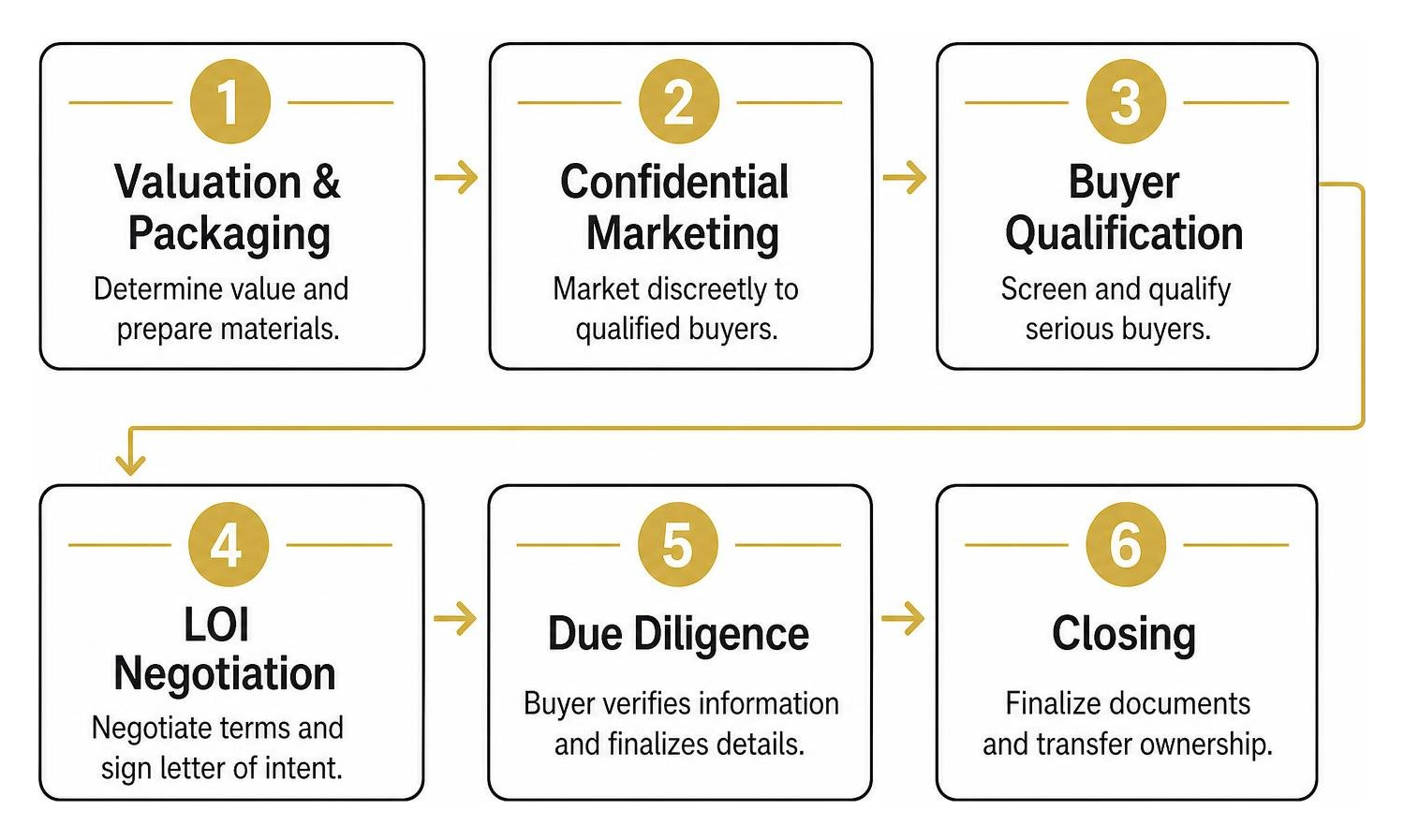
Understanding each phase allows you to prepare your leadership team and documentation well in advance, demystifying the business broker selling process and keeping your transaction on track.
Having your records organized and understanding the essential business sale contract template and legal guide ensures that minor legal discrepancies do not derail your timeline.
Confidential Marketing and Sourcing Qualified Buyers
A successful sale requires reaching active buyers without revealing your company’s identity to the public. Experienced intermediaries accomplish this through:
- Blind Teasers: One-page summaries highlighting key financials, industry classification, general Texas geography, and growth vectors without naming the company.
- Confidential Information Memorandums (CIM): Comprehensive deal books provided only after a buyer signs an NDA and provides verified proof of funds.
- Targeted Buyer Outreach: Engaging private equity groups, corporate strategic buyers, and high-net-worth operators across regional and national industry networks.
When you stop hiding your business and start marketing it for sale through structured confidential channels, you generate competitive bidding tensions that lift your ultimate sale price. In addition to local Texas investors, cross-regional and international buyers frequently look for American opportunities, as seen on global financial platforms like Best Online Brokers in American Samoa in 2026 – BrokerChooser .
Navigating Due Diligence and Closing the Deal
Receiving an executed Letter of Intent (LOI) is only halftime. The real test begins during due diligence, where buyers and their accounting teams examine your financial statements, tax filings, customer concentration, and vendor contracts.
This is where seasoned representation proves invaluable. At Earned Exits, we provide hands-on CFO and due diligence support to organize data rooms, defend working capital targets, and resolve discrepancies before lenders raise red flags. Discovering how CFO support can save your business sale makes the difference between closing smoothly and watching a buyer re-trade your purchase price. Mastering these stages is essential when learning how to master your mid-market business sale for maximum value.
Frequently Asked Questions About Texas Business Brokers
What commission rate do business brokers in Texas typically charge?
Most Texas business brokers charge a success fee ranging between 8% and 12% of the total enterprise value for Main Street businesses (under $2M). For lower-middle-market and middle-market transactions ($2M to $25M+), fees usually follow a scaled or modified Lehman formula (e.g., 10% on the first million, 8% on the second, stepping down to 2-4% on amounts above $5M), often subject to an agreed minimum engagement threshold.
How long does it take to sell a Texas business with a broker?
On average, selling an established Texas business with a broker takes between 6 and 9 months from initial engagement to closing. The process breaks down into 30–45 days for valuation and marketing preparation, 60–90 days for buyer sourcing and LOI negotiation, and 60–90 days for due diligence, SBA or commercial bank financing approval, and definitive legal document drafting.
Do business brokers in Texas need a real estate license?
In Texas, business brokers do not need a real estate license if the transaction is strictly an asset or stock sale of personal property. However, if the business owns real estate that is being transferred or leased, or if an existing commercial lease assignment requires formal real estate negotiation, the individual or firm handling that component must hold an active license issued by the Texas Real Estate Commission (TREC).
Conclusion
Securing your retirement after decades of building an enterprise requires careful planning, rigorous financial analysis, and strategic market positioning. The Texas business landscape offers incredible liquidity and buyer appetite, but capturing maximum value requires a proven, organized exit strategy.
At Earned Exits, we combine clear communication, robust due diligence and CFO support, and client-first digital tools to deliver a seamless transaction from initial valuation through final escrow disbursement. When you are ready to transition into your next chapter with confidence, take the first step and plan your exit with seasoned business brokerage services.
