


Finding the Best Local Business Brokers Near You Without Losing Your Mind
What Are Local Business Brokers and How Do They Help You?
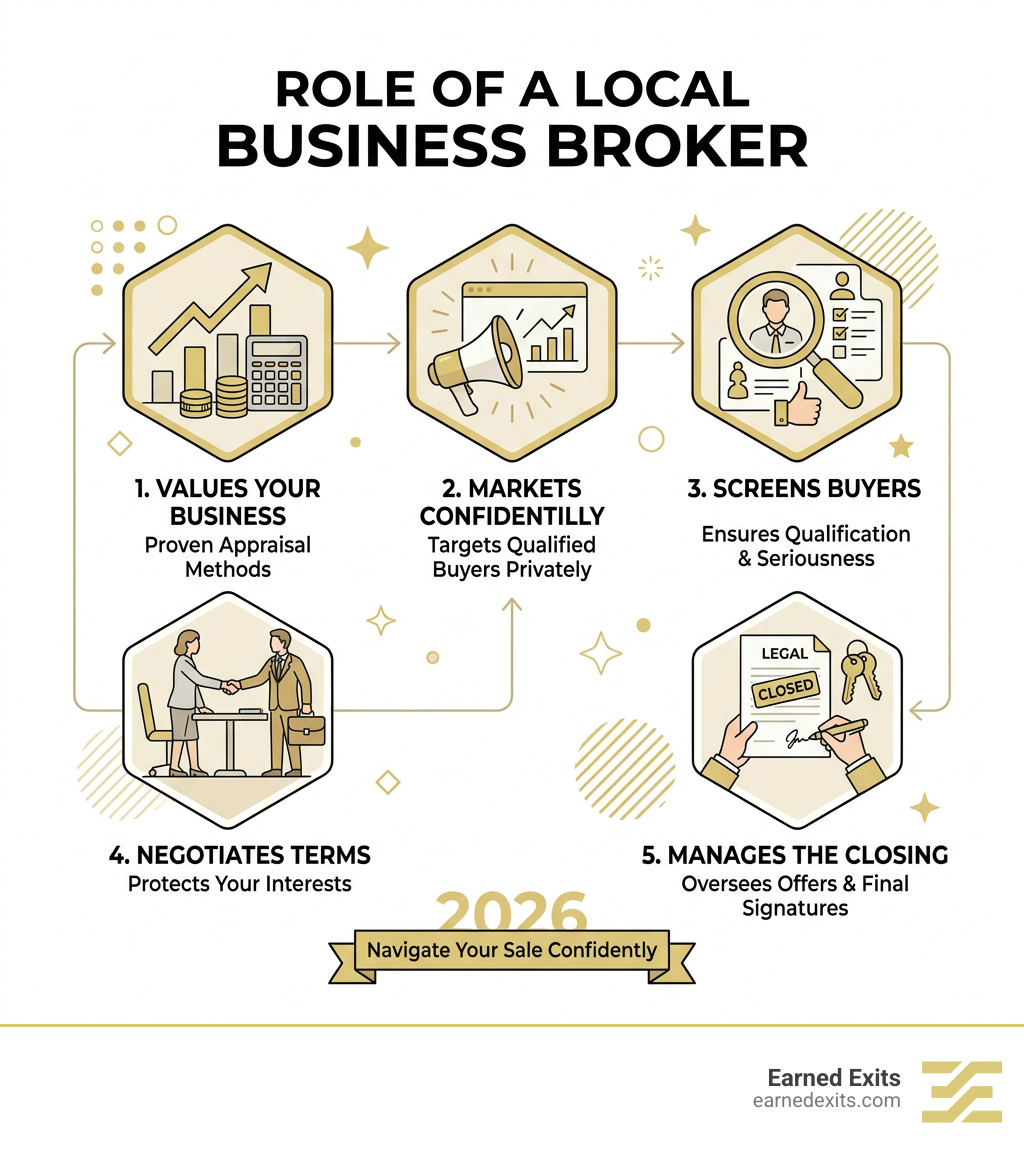
Local business brokers near me are licensed professionals who help you buy or sell a privately held business in your area. They handle valuation, marketing, buyer vetting, negotiations, and closing — so you don’t have to figure it out alone.
Here’s what a local business broker does for you:
- Values your business accurately using proven appraisal methods
- Markets confidentially so employees and customers don’t find out prematurely
- Screens buyers to make sure they’re qualified and serious
- Negotiates on your behalf to protect your interests
- Manages the closing process from offer to final signature
Top ways to find a local business broker:
- Search reputable online broker directories and professional association listings
- Look for established national networks with local offices in your region
- Ask your accountant, attorney, or banker for referrals
- Search Google for “business brokers near me” + your city or state
Selling a business for the first time is stressful. There are dozens of moving parts — pricing, paperwork, negotiations, due diligence — and one wrong move can cost you significantly.
The good news? You don’t have to navigate this alone.
A good local broker brings three things to the table: market knowledge, transaction experience, and confidentiality. According to community discussions among buyers and brokers, the best deals rarely hit public listings — they move quietly through broker networks. That means who you work with matters as much as what you’re selling.
This guide walks you through everything: how to find reputable brokers near you, what credentials to look for, how the process works, and what it costs.
Why You Need local business brokers near me to Navigate a Sale

Attempting to sell a business on your own is often referred to as “FSBO” (For Sale By Owner), and in the business world, it is a path fraught with landmines. When you search for local business brokers near me, you are not just looking for a salesperson; you are looking for a buffer.
Brokers provide deep market knowledge that individual owners simply do not have. They know what similar businesses in your specific county or state have actually sold for, not just what they were listed for. This prevents the common mistake of overpricing (which leads to a stale listing) or underpricing (which leaves money on the table).
Furthermore, Master the Sale: How a Business Broker Elevates Your Exit Strategy involves more than just finding a buyer. It is about vetting them. Research shows that many public listings are filled with “tire kickers” who lack the funds or experience to close. A broker ensures that any buyer who sees your sensitive financial data has been pre-qualified and has signed a strict non-disclosure agreement (NDA).
For additional background on how brokers fit into the transaction ecosystem, see the overview of Business broker.
| Feature | DIY Sale | Broker-Led Sale |
|---|---|---|
| Confidentiality | High risk of alerting staff/competitors | Highly protected via NDAs |
| Valuation | Often based on “gut feeling” | Based on market data & USPAP standards |
| Buyer Vetting | Owner must filter every email | Broker pre-qualifies for funds & fit |
| Success Ratio | Significantly lower | 3 to 4 times greater than average |
| Time Commitment | Massive (distracts from operations) | Broker handles the heavy lifting |
Finding Reputable local business brokers near me
Finding the right partner starts with knowing where to look. While a simple Google search is a start, savvy sellers use targeted platforms. Online marketplaces provide directories of brokers who are active in specific regions.
Beyond online lists, we recommend looking into trade associations. These organizations often have search tools to help you find members who have committed to a code of ethics. Local networking through your Chamber of Commerce or referrals from your CPA can also lead you to “off-market” brokers who may not advertise heavily but have a massive roster of ready buyers.
Credentials to Look for in local business brokers near me
Not all brokers are created equal. When you are interviewing local business brokers near me, look for specific “alphabet soup” behind their names. These are not just vanity titles; they represent hundreds of hours of training.
- CBI (Certified Business Intermediary): This is the gold standard from the International Business Brokers Association. It signifies a high level of expertise and ethical commitment. You can search for certified professionals through industry associations to ensure you are working with a pro.
- M&AMI (Mergers & Acquisitions Master Intermediary): This is for brokers who handle larger, more complex transactions (typically middle-market). There are fewer than 100 professionals worldwide who hold both the CBI and M&AMI designations.
- USPAP Compliance: When it comes to valuations, ensure the broker or their partnered appraisers follow the Uniform Standards of Professional Appraisal Practice. This helps make the valuation more defensible to banks and the IRS.
How to Evaluate and Choose the Best Local Professional
Choosing a broker is like choosing a business partner for the most important transaction of your life. You need to look beyond the sales pitch. Start by asking about their success ratio. Some high-volume firms might list hundreds of businesses but only close a small fraction. You want a broker with a proven track record of getting to the finish line.
Guiding Your Success: Why Finding the Right Business Broker is Crucial because a bad fit can result in a leaked sale or a collapsed deal during due diligence. Look for a communication style that matches yours. Do they provide weekly updates? Are they transparent about the flaws in your business?
To dig deeper, use these 10 Questions to Ask a Business Broker: Choosing the Right Partner for a Meaningful Exit. Always ask for client testimonials or “tombstones” (records of past completed deals) that are relevant to your industry.
National Networks vs. Boutique Firms
You will likely encounter two types of offices: large national franchises and small boutique firms.
National Networks:
- Pros: Massive reach. Large networks often have hundreds of offices and attract millions of monthly page views to their listings. They have standardized processes and huge buyer databases.
- Cons: Sometimes less personalized. You might be one of fifty listings for a single agent.
Boutique Firms:
- Pros: Highly personalized service. You often work directly with the principal of the firm. They usually have deep, “boots-on-the-ground” local insights.
- Cons: Smaller marketing budgets and fewer internal buyers.
Industry and Regional Specializations
Geography and industry matter immensely. A broker who specializes in Florida markets will understand the nuances of state-specific taxes and regulations that a broker in Washington wouldn’t. Similarly, if you own a specialized company, you want a broker who understands your “language.”
We often see better results when owners work with:
- Manufacturing Business Brokers who understand equipment depreciation and supply chains.
- Construction Business Brokers who know how to handle bonding and licensing transfers.
- SaaS Business Brokers who focus on recurring revenue metrics and churn rates rather than physical assets.
The Step-by-Step Process of Buying or Selling
Whether you are buying or selling, the process is a marathon, not a sprint. On average, it takes about two years to find and close on a business acquisition. Having a structured Business Brokerage Services plan is what separates a successful exit from a stressful failure.
The first step is always the valuation. You cannot go to market without a clear, data-backed number. Professional Business Valuation Services look at your “SDE” (Seller’s Discretionary Earnings), which includes your net profit plus add-backs like your salary, personal travel, and one-time expenses.
Steps Involved in Selling a Business
If you want to Sell My Business, the process generally follows this path:
- Pre-listing Prep: Cleaning up financial statements and identifying “low-hanging fruit” to increase value.
- Confidential Marketing: Creating a “Blind Profile” that describes the business without naming it.
- Qualifying Prospects: The broker interviews buyers to ensure they have the cash (often 10-20% for SBA loans) and the skills to run the shop.
- Offer & Negotiation: Handling the back-and-forth on price, training periods, and non-compete agreements.
- Due Diligence: The “proctology exam” of the business world where the buyer verifies every claim you’ve made.
- Closing Logistics: Finalizing the purchase agreement and transferring funds.
Steps Involved in Buying a Business
For those looking to Buy a Business, the journey is about finding the right fit:
- Criteria Definition: Deciding if you want a “job” you own or a passive investment with a management team.
- Search Execution: Using local business brokers near me to find listings and off-market opportunities.
- Proof of Funds: Showing the broker you are a serious contender.
- SBA Financing: Working with lenders to secure the 80-90% of the purchase price often covered by government-backed loans.
- Purchase Agreement: Drafting the legal document that outlines the transition.
Costs, Commissions, and Avoiding Common Pitfalls
Hiring a broker is an investment. Most work on a success fee basis, meaning they only get paid if the business actually sells. Typical commission structures range from 8% to 12% of the sale price, though there is often a “minimum fee” (e.g., $15,000 to $25,000) for smaller businesses.
Some specialized Ecommerce Business Brokers or M&A firms may also charge a small up-front “retainer” or “engagement fee” to cover the costs of the valuation and marketing materials.
Common Mistakes to Avoid
We’ve seen many deals fall apart due to avoidable errors. Here are the big ones:
- Overvaluing Assets: Thinking your 10-year-old equipment is worth what you paid for it.
- Poor Documentation: If it’s not on the tax returns, most buyers (and all banks) won’t count it as income.
- Breaching Confidentiality: Telling your best employee you’re selling before a deal is signed. If they quit, your business value drops instantly.
- Skipping Vetting: Spending months talking to a buyer who doesn’t actually have the money.
- Rushing Diligence: Trying to hide a flaw in the business. It will come out during due diligence, and it will likely kill the deal.
Understanding Business Valuations
There are three main ways local business brokers near me will value your company:
- Market Multiples: Comparing your business to similar ones that sold recently (e.g., “3x SDE”).
- Income Approach: Looking at future expected cash flows and discounting them back to today’s value.
- Asset-Based: Adding up the fair market value of all physical equipment, inventory, and real estate.
Most small to mid-sized businesses are sold based on a multiple of their earnings. A broker’s “Opinion of Value” is a great starting point, but for larger deals, a “Certified Valuation Report” is often required.
Frequently Asked Questions about Business Brokers
How much does it cost to hire a business broker?
As mentioned, most brokers charge a 10% commission upon a successful sale. Some may charge a valuation fee up-front, which is sometimes credited back to you at the closing table. Always clarify if there are “administrative fees” or “marketing fees” hidden in the contract.
What services do local brokers provide?
Beyond just finding a buyer, they act as a project manager. They coordinate with your CPA, the buyer’s attorney, the landlord, and the bank. They are the “calm in the storm” when emotions run high during negotiations.
How do I find off-market deals locally?
The best deals are often found through direct outreach. Brokers maintain “buyer lists” and will often call potential sellers who haven’t listed yet if they have a qualified buyer in hand. You can also view current Listings to see what’s available, but networking at local events is where the “quiet” deals happen.
Conclusion
Finding the right local business brokers near me shouldn’t feel like a second job. At Earned Exits, we understand that your business is likely your largest asset, and selling it is a monumental life event.
We pride ourselves on a seamless, organized process that keeps you in the loop without overwhelming you. Our approach includes thorough CFO and due diligence support to ensure your financials are “bank-ready” before we ever hit the market. By using modern client tools and maintaining excellent communication, we help you achieve a meaningful exit on your own terms.
If you’re ready to explore your options, whether through traditional brokerage or more complex Mergers and Acquisitions Advisory Services, we are here to guide the way. Don’t leave your legacy to chance — work with a professional who knows your local market inside and out.
