


Everything You Need to Know About Accredited Business Valuation
What Is Accredited Business Valuation — and Why It Matters
Accredited business valuation refers to the formal process of determining a company’s worth, performed by a credentialed professional who has met rigorous standards set by a recognized authority.
The most recognized credential in this space is the Accredited in Business Valuation (ABV), issued exclusively by the American Institute of Certified Public Accountants (AICPA). Here’s a quick snapshot of what it involves:
| ABV At a Glance | Details |
|---|---|
| Issued by | AICPA |
| Who can apply | CPAs and qualified finance professionals |
| Experience required | 1,500 hours (CPAs) or 4,500 hours (non-CPAs) |
| Exam format | 2 modules, 90 questions each, 3 hrs 15 min per module |
| Exam waivers | Available for CFA, ASA, or CBV holders |
| Avg. ABV salary | ~$106,000/year vs. ~$82,910 for general CPAs |
| Maintenance | 60 CPD hours every 3 years + 4 ethics hours |
If you’re selling a business, understanding who is qualified to value it — and what their credentials actually mean — can make a significant difference in the outcome of your transaction.
Not all valuations are equal. A professional who has earned the ABV designation has passed a rigorous two-part exam, logged thousands of real-world hours, and committed to ongoing professional education. That’s a very different standard than someone who simply offers valuation as a side service.
I’m Britt Clas, a Business Broker and Partner at Earned Exits, where I guide entrepreneurs through every stage of selling their business — including navigating the often confusing world of accredited business valuation. Having worked on transactions ranging from $1M to $40M in revenue, I’ve seen how a credentialed valuation professional can protect a seller’s interests and maximize deal outcomes.
Understanding the Accredited in Business Valuation (ABV) Credential
When we talk about an accredited business valuation, we are specifically highlighting a level of expertise that goes far beyond a simple “rule of thumb” calculation. The ABV credential is the gold standard for professionals who specialize in calculating the fair market value of businesses, fractional interests, and intangible assets.
This isn’t just about looking at a balance sheet. An ABV professional is trained to look at the “story behind the numbers,” analyzing everything from economic trends and industry risks to the specific competitive advantages that make a company unique. By adhering to strict professional standards, these experts provide valuations that can withstand the scrutiny of the IRS, the courts, and sophisticated buyers.
To dive deeper into the specifics of what this credential entails, you can explore What is the ABV credential?.
Defining the Accredited Business Valuation (ABV) Designation
The ABV designation was originally created as a specialty for Certified Public Accountants (CPAs) who wanted to demonstrate their mastery of the valuation craft. However, the landscape has evolved. Today, both CPAs and qualified non-CPA finance professionals can pursue this accreditation.
At its core, the designation proves that the holder has a deep understanding of valuation methodologies, including income, market, and asset-based approaches. It signals to the market that the professional doesn’t just “do” valuations; they are a specialist who has been vetted by the most prominent accounting body in the United States.
The Role of the AICPA in Business Valuation
The American Institute of Certified Public Accountants (AICPA) is the national organization that oversees the ABV credential. With over 400,000 members, the AICPA is the global voice of the accounting profession. Within the AICPA, the Forensic and Valuation Services (FVS) section provides the specialized resources, standards, and community for ABV holders.
One of the most critical roles of the AICPA is maintaining the Statement on Standards for Valuation Services (SSVS). These rules ensure that every accredited business valuation is performed with integrity, objectivity, and professional competence. For more on the intersection of valuation and investigative accounting, see Forensic Services | AICPA & CIMA.
Requirements for Obtaining an Accredited Business Valuation Certification
Obtaining the ABV is no walk in the park. It requires a specific combination of education, testing, and—most importantly—significant “boots on the ground” experience.
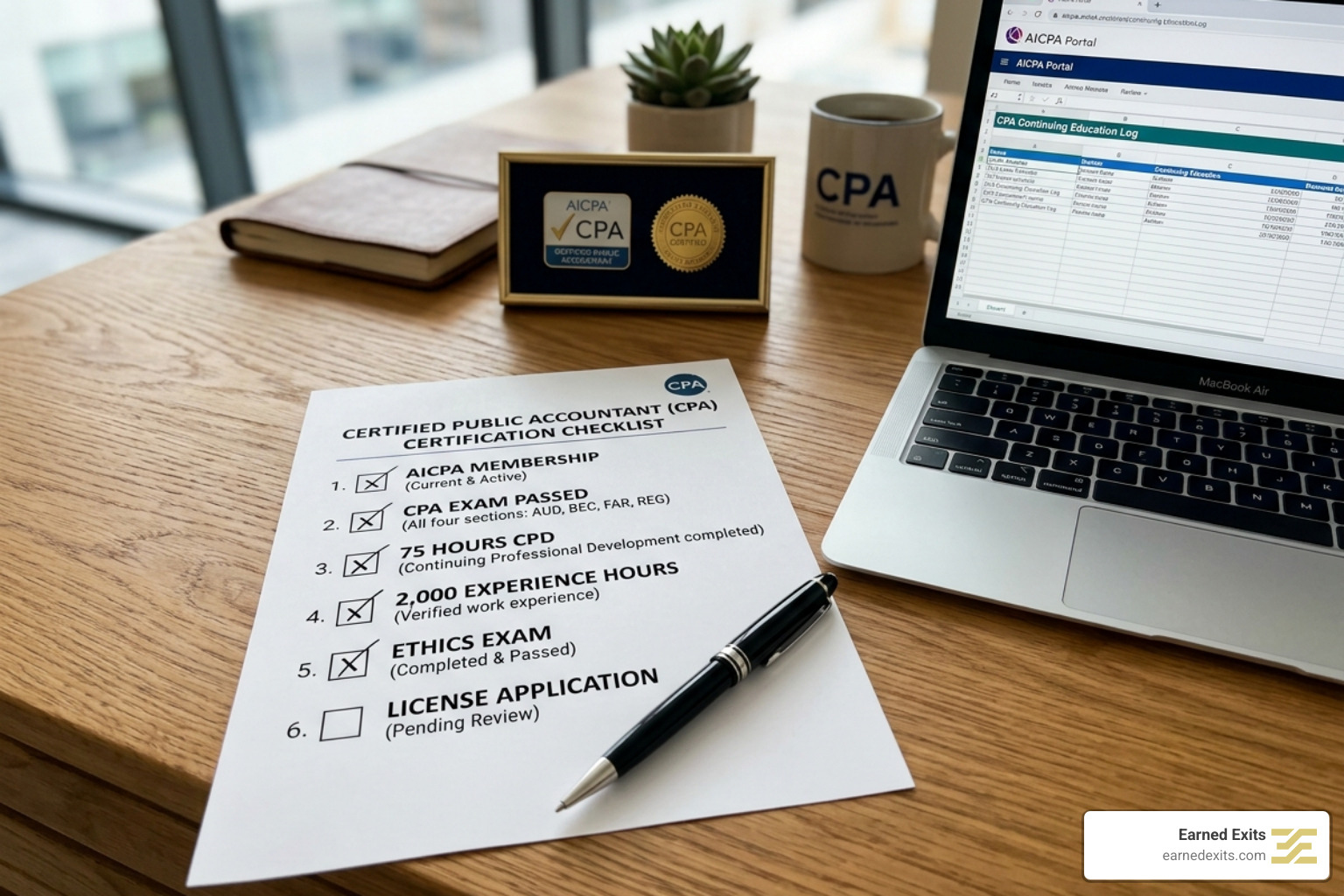
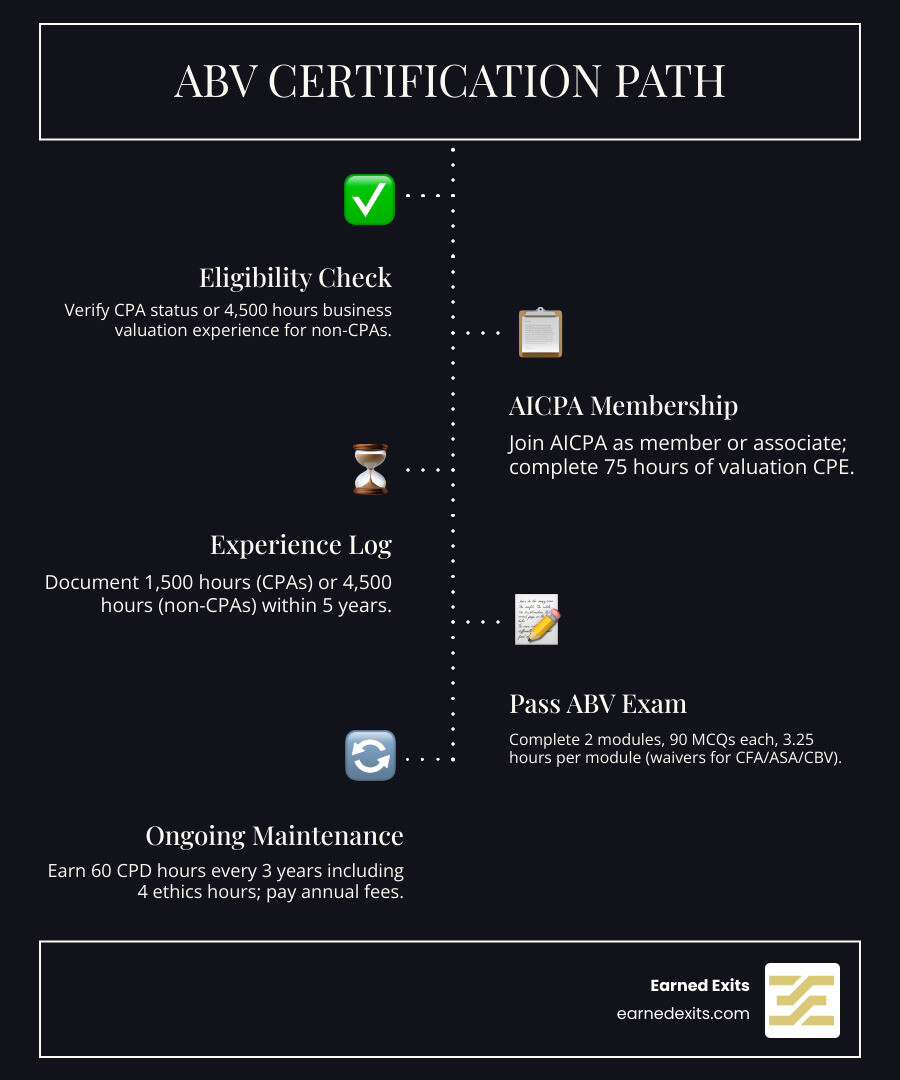
The path begins with membership in the AICPA. From there, candidates must prove they have the technical knowledge and the practical hours to be called an expert. If you are looking for a professional who meets these standards, you can learn more about business valuation services to see how we integrate these standards into our brokerage process.
Experience Pathways for CPAs and Finance Professionals
The AICPA recognizes two distinct pathways based on your professional background. As of April 2026, the experience requirements are:
- The CPA Pathway: Candidates must hold a valid CPA license and demonstrate at least 1,500 hours of business valuation experience within the five years preceding their application.
- The Finance Professional Pathway: Non-CPAs must demonstrate 4,500 hours of business valuation experience within the same five-year window.
This difference reflects the foundational training CPAs already possess. In both cases, the experience must be substantial. It can include performing valuations, reviewing valuation reports, or even providing litigation support and expert witness testimony.
Education and Professional Conduct Training
Beyond the hours spent in the field, candidates must complete 75 hours of valuation-related continuing professional development (CPD) within the five years before applying. This ensures that their knowledge of the ultimate guide to small business valuation methods is current and comprehensive.
Furthermore, non-CPA finance professionals must hold a bachelor’s degree (or equivalent) and complete specific training on the AICPA Code of Professional Conduct. This ensures that everyone holding the ABV credential adheres to the same high ethical standards, regardless of their initial license.
The ABV Examination: Structure, Costs, and Waivers
The ABV exam is a rigorous assessment designed to filter out anyone who doesn’t have a complete grasp of the valuation body of knowledge. It is a computer-based exam divided into two distinct modules.
| Requirement | CPA Pathway | Finance Professional Pathway |
|---|---|---|
| Experience Hours | 1,500 hours | 4,500 hours |
| CPD Hours | 75 hours | 75 hours |
| Exam Modules | 2 (unless waived) | 2 (unless waived) |
| Ethics Training | Part of CPA license | Required for ABV |
For the most up-to-date registration details, visit Accredited in Business Valuation (ABV) | Credentials | AICPA & CIMA.
Exam Content and Format Details
Each of the two modules contains 90 multiple-choice questions. These are broken down into 78 discrete questions and 12 questions based on case studies. Candidates are given 3 hours and 15 minutes per module.
The exam covers a broad spectrum of topics:
- Qualitative Analysis: Assessing industry trends, management quality, and company-specific risks.
- Quantitative Analysis: Financial statement normalization, ratio analysis, and forecasting.
- Valuation Approaches: Mastery of the Income Approach (DCF), Market Approach (Multiples), and Asset-Based Approach.
- Special Topics: Valuing intangible assets, financial reporting (fair value), and litigation support.
Candidates must pass both modules within a 12-month window to qualify.
Exam Waivers for Elite Credentials
The AICPA recognizes that other high-level certifications also require intense valuation testing. Because of this, they offer exam waivers for holders of certain “elite” credentials. If you have already passed the exams for the following, you may be exempt from the ABV exam:
- CFA (Chartered Financial Analyst): Must have passed all three levels.
- ASA (Accredited Senior Appraiser): Specifically in the Business Valuation discipline.
- CBV (Chartered Business Valuator): The primary Canadian valuation credential.
These waivers acknowledge the overlapping rigor between these prestigious organizations.
Career Impact: Salary and Professional Advantages
Why do professionals put themselves through this? The data suggests it is well worth the effort. As of October 2025, accounting professionals with an ABV certification earned an average annual salary of $106,000. Compare that to the $82,910 average for general CPAs, and you’re looking at a $23,000+ annual premium.
Beyond the paycheck, the ABV provides instant credibility. When we tell a client to stop guessing what your business is worth, having an ABV-credentialed expert perform the analysis ensures the number is defensible and accurate.
Why Choose an Accredited Business Valuation Expert?
For business owners, hiring an ABV expert is about risk mitigation and value maximization. You might need an accredited business valuation for:
- Mergers and Acquisitions (M&A): Knowing exactly what a target is worth before you sign.
- Litigation and Disputes: Providing expert witness testimony in shareholder disputes or marital dissolutions.
- Succession Planning: Determining the value for a buy-sell agreement or estate tax purposes.
- Financial Reporting: Ensuring compliance with fair value accounting standards.
Competitive Edge in Accounting and Finance
In the professional world, the ABV is a massive career accelerator. It opens doors in investment banking, top-tier consulting firms, and specialized valuation boutiques. It transforms a professional from a generalist into a high-value specialist. For those looking at asset-heavy industries, combining this knowledge with a complete asset-based valuation guide creates a formidable professional profile.
Maintaining the ABV Credential and Professional Standards
The ABV is not a “one and done” certificate. To keep the letters after your name, you must prove that you are staying current with the latest industry shifts and ethical requirements.

Continuing Professional Development (CPD) Requirements
ABV holders must complete 60 hours of CPD every three years. To ensure consistency, the AICPA requires a minimum of 10 hours annually. This education must be specifically related to business valuation. This might include attending the AICPA Forensic and Valuation Services Conference or engaging in deep dives like unlocking business valuation: exploring methods and market multiples for small to mid-size businesses.
Compliance and Recertification Process
Every year, credential holders must pay their annual dues and sign a declaration of intent to comply with recertification requirements. This includes completing 4 hours of professional ethics education every three years.
The AICPA also performs audits on these applications. If a professional fails to meet the hours or pay the fees, their credential can lapse. Reinstatement often requires catching up on all missed CPD hours and paying additional fees—so most experts are very diligent about their maintenance.
Frequently Asked Questions about ABV
Can non-CPAs obtain the ABV credential?
Yes! While it was originally for CPAs, the AICPA opened the credential to non-CPA finance professionals. These individuals must have a bachelor’s degree, 4,500 hours of experience, and 75 hours of CPD. They also join the AICPA as “Associate Members.”
How much does the ABV exam cost?
As of current 2026 pricing, the ABV exam modules typically cost between $176 and $275 each, depending on your membership status and whether you are purchasing a bundle. There is also a credential application fee (around $199 for members) once you pass the exam and meet the experience requirements.
What is the passing criteria for the ABV exam?
The exam is scored on a scale, and you must pass both modules. The most important rule to remember is the 12-month window. If you pass Module 1 but fail to pass Module 2 within the next year, you will have to retake the first module. It’s a “use it or lose it” timeframe!
Conclusion
At Earned Exits, we know that a business is more than just a collection of assets—it’s the result of years of hard work. That’s why we advocate for the use of accredited business valuation standards in our brokerage process. Whether you are in Alabama, California, Florida, or any of our other service areas, having a clear, defensible understanding of your company’s value is the first step toward a successful exit.
Our seamless, organized process is designed to take the stress out of selling. With thorough CFO support and a focus on due diligence, we ensure that your valuation is not just a number, but a powerful tool for negotiation. If you’re ready to see the true value of your life’s work, get started with professional business valuation services today. We are here to help you navigate the complexities of the market with confidence and clarity.
