


Draft Your Business Purchase Agreement Without Costly Closing Delays
Build a Purchase Agreement That Keeps Your Business Sale Moving
A purchase agreement business sale should clearly state what is being sold, the price and payment method, which liabilities move to the buyer, the conditions required before closing, and what happens if either side fails to perform. To avoid costly delays, agree on these points early and attach detailed schedules for assets, debts, contracts, and required closing documents.
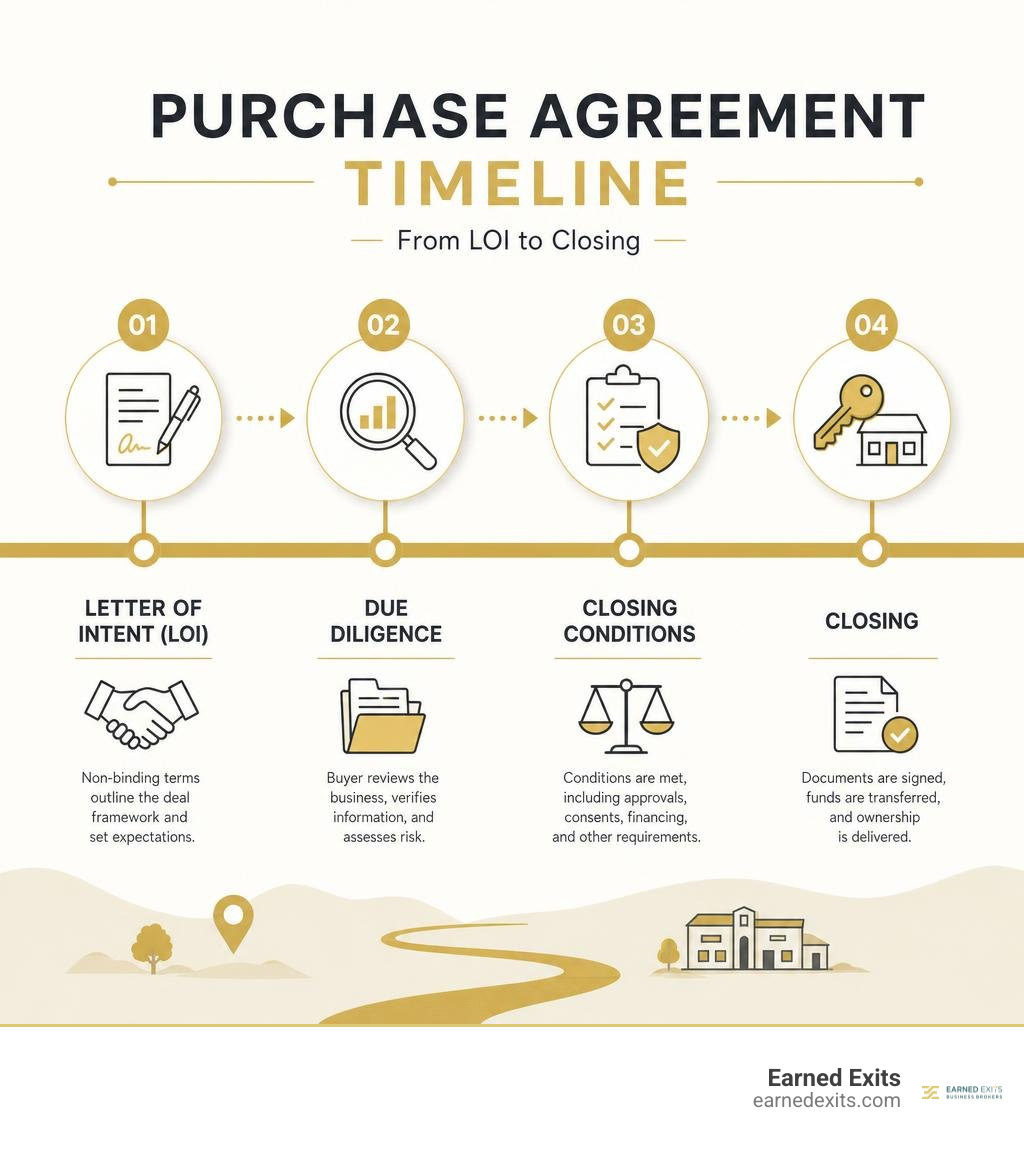
A strong agreement is more than a form to sign at the end. It is the transaction’s practical roadmap from letter of intent to closing. It helps prevent common problems, such as unclear asset ownership, undisclosed liens, missing landlord consent, failed financing, or disputes over the seller’s post-sale obligations.
For a first-time seller, the priority is simple: make the deal terms specific enough that the buyer, lender, attorneys, and other third parties know exactly what must happen and when.
I am Britt Clas, a Business Broker and Partner at Earned Exits. I help founders navigate the purchase agreement business sale process, from deal structure and negotiations through due diligence, closing, and a successful transition to the right buyer.
Terms related to purchase agreement business sale:
Understanding the Purchase Agreement Business Sale Framework
At its core, the definitive purchase agreement is the legally binding contract that finalizes the transfer of commercial ownership. While early deal stages rely on broad term sheets, the purchase agreement codifies every operational, legal, and financial variable. It eliminates ambiguity, sets enforceability boundaries, and confirms party capacity and corporate authorization so neither side can walk away without legal consequence once contingencies are cleared.
To execute a smooth transfer, parties often reference the essential business sale contract template and legal guide to structure key sections before attorneys customize the provisions. A vague contract turns minor operational questions into expensive courtroom arguments; a precise agreement ensures seamless execution.
Asset Sale vs. Equity Sale: Choosing the Right Structure
Choosing between an asset purchase and an equity (stock or membership interest) purchase is the most critical structural decision in the transaction. This choice determines tax treatments, liability exposure, and how operational title transfers to the buyer.
In an asset purchase, the buyer purchases specific tangible and intangible assets (such as equipment, inventory, customer lists, and intellectual property) and selects explicitly defined liabilities. The corporate entity stays with the seller. This structure is favored by buyers because it allows for a step-up in tax basis for depreciable assets and shields them from unknown or historical business liabilities.
In an equity purchase, the buyer acquires the entity’s stock or membership interests directly. The buyer takes ownership of the entire company, including all historical liabilities—known, unknown, or contingent. Sellers typically prefer equity sales because proceeds are generally taxed at favorable long-term capital gains rates, and it provides a cleaner operational exit. Major corporate filings, such as this SEC Definitive Acquisition Agreement Filing, showcase how complex transactions document entity transfers while ring-fencing pre-closing operational liabilities.
| Feature | Asset Sale | Equity (Stock/Membership) Sale |
|---|---|---|
| What is Transferred | Specified assets and selected liabilities | 100% of entity ownership (all assets & debts) |
| Buyer Liability Exposure | Minimal; restricted only to assumed debts | High; assumes all historical and contingent liabilities |
| Tax Impact for Buyer | Step-up in asset basis (favorable depreciation) | Carryover tax basis in corporate assets |
| Tax Impact for Seller | Potential double taxation or ordinary income rates | Typically lower long-term capital gains rates |
| Contract Assignments | Requires individual third-party consents | Contracts generally remain intact (unless change-of-control triggers) |
| Entity Continuity | Seller retains shell corporation | Entity transfers whole to the buyer |
Purchase Agreement Business Sale Essentials: Core Components and Definitions
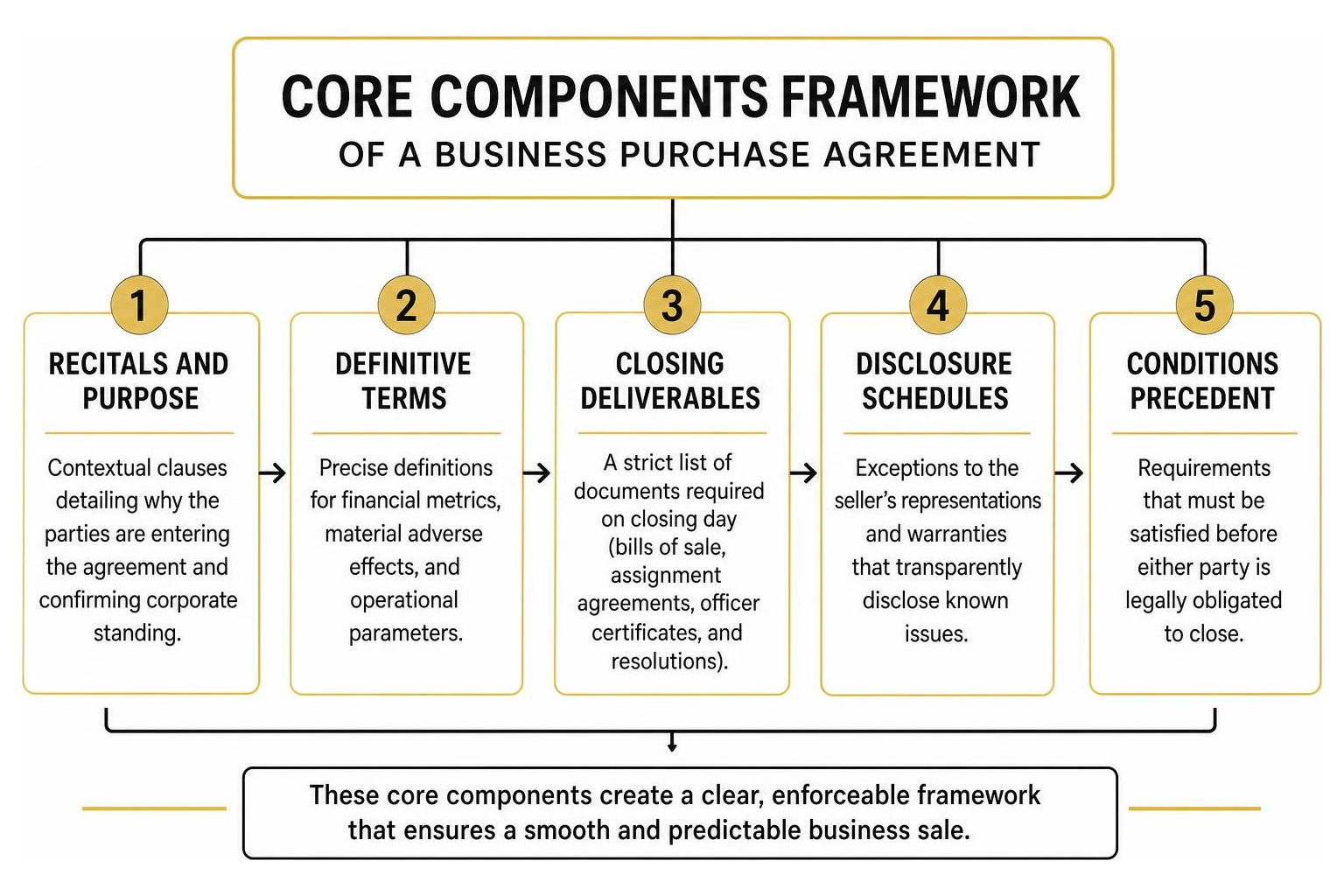
Every comprehensive purchase contract relies on standardized pillars:
- Recitals and Purpose: Contextual clauses detailing why the parties are entering the agreement and confirming corporate standing.
- Definitive Terms: Precise definitions for financial metrics, material adverse effects, and operational parameters.
- Closing Deliverables: A strict list of documents required on closing day (bills of sale, assignment agreements, officer certificates, and resolutions).
- Disclosure Schedules: Exceptions to the seller’s representations and warranties that transparently disclose known issues.
- Conditions Precedent: Requirements that must be satisfied before either party is legally obligated to close.
When evaluating offers when selling your business, understanding these core terms ensures you do not accept an offer that looks appealing on paper but imposes severe closing friction.
Critical Clauses to Negotiate in a Purchase Agreement
Negotiating the body of the agreement requires balancing purchase price mechanisms against financial and operational risks.

Purchase Price, Payment Terms, and Escrow Holdbacks
The purchase price section details not just the headline valuation, but the exact flow of funds across closing day and beyond:
- Lump-Sum Cash Consideration: Delivered at closing via wire transfer.
- Seller Financing: Documented through structured promissory notes that specify interest rates, maturity dates, and default covenants.
- Adjustment and Indemnity Escrows: Cash held by a third-party escrow agent to settle post-closing net working capital true-ups or indemnity claims. For instance, in large mid-market transactions, adjustment escrows of $5 million to $10 million are routinely held to cover balance sheet variances.
- Earnouts: Performance-based consideration tied to future metrics (gross revenue, EBITDA, or client retention). For detailed strategies on these provisions, review our breakdown on structuring and negotiating earnouts.
- Lender Alignment: When a transaction utilizes third-party financing, aligning contract terms with SBA loan requirements during a business sale ensures standby periods on seller debt meet agency guidelines without delaying funding.
Asset Allocation and Assumed vs. Excluded Liabilities
In asset deals, the purchase price must be allocated across asset classes under Internal Revenue Code Section 1060 and documented on IRS Form 8594.
Buyers push to allocate value to Class V equipment for immediate depreciation deductions, while sellers prefer Class VII goodwill to maximize capital gains treatment. Even in small transactions—such as a $20,000 asset transfer allocating $15,000 to tangible assets and $5,000 to goodwill—formal classification is legally binding.
The contract must also draw explicit lines between Assumed Liabilities (e.g., current trade payables, equipment leases) and Excluded Liabilities (e.g., historical tax liabilities, pre-closing litigation, undisclosed debt).
Due Diligence Contingencies and Pre-Closing Conditions
Contingencies give the buyer clear cancellation rights if material discrepancies emerge. Standard provisions include:
- Document Review Contingencies: A deadline allowing buyers to walk away with a full deposit refund if due diligence uncovers material inaccuracies.
- Financing and Lease Contingencies: Protection ensuring the deal is conditioned on securing commercial loan approval and negotiating acceptable commercial lease assignments.
- Lien and Tax Clearance: Stipulating that sellers deliver clear UCC searches and state certificates of no tax due prior to closing.
Sellers can streamline this phase by assembling a thorough due diligence report in advance, while managing confidentiality throughout the transaction to protect sensitive proprietary data.
Risk Mitigation: Protections, Covenants, and State Nuances

Representations, Warranties, and Indemnification Caps
Representations and warranties (“reps and warranties”) are formal statements of fact made by the seller regarding the company’s financial condition, legal standing, tax filings, environmental compliance, and asset ownership.
To prevent endless liability, sellers negotiate specific indemnification guardrails:
- Fundamental vs. General Reps: Fundamental reps (ownership of assets, corporate authority, capitalization) often survive indefinitely or for statutory limitation periods (e.g., 6 years). General operational reps typically survive between 12 and 24 months.
- Indemnification Baskets: A deductible or “tipping” threshold (e.g., 0.5% to 1% of transaction value) that prevents buyers from filing claims over minor, immaterial variances.
- Liability Caps: Limiting total indemnification recovery (often 10% to 20% of the purchase price for general reps, capped at 100% of deal value for fundamental reps).
- Anti-Sandbagging Clauses: Preventing a buyer from asserting an indemnity claim after closing if they had actual knowledge of the breach prior to executing the agreement.
Reviewing a public SEC Material Definitive Agreement Exhibit provides practical insights into how institutional buyers and sellers negotiate these survival caps and disclosure schedules.
Restrictive Covenants: Non-Compete and Non-Solicitation Enforceability
Buyers require restrictive covenants to safeguard the business’s goodwill. To remain legally enforceable, these clauses must be reasonable in geography, scope, and duration:
- Non-Compete Restrictions: Typically span 2 to 5 years and define a specific geographic radius (e.g., a 3-mile radius for local retail or specific regions for regional operations). In many agreements, distinct consideration (such as a separate $3,000 to $10,000 allocation) is assigned to reinforce enforceability.
- Non-Solicitation Provisions: Prohibit the seller from soliciting former employees, contractors, suppliers, or existing clients for 1 to 3 years.
- Injunction Remedies: Standard language establishing that monetary damages alone are insufficient for breach of restrictive covenants, entitling the non-breaching party to immediate injunctive relief without posting bond.
Navigating Purchase Agreement Business Sale Rules in Florida and Key Jurisdictions
State laws directly impact closing deliverables and operational transfer requirements:
- Florida UCC Chapter 679: Requires comprehensive UCC lien searches at the state level to verify priority of secured collateral and confirm that all outstanding financing statements are terminated at closing.
- Florida Department of Revenue (DOR) Clearances: In Florida asset sales, buyers can face successor liability for unpaid sales and use taxes. Business purchase agreements must require a formal Certificate of Compliance or Tax Clearance from the DOR before escrow funds are released.
- Landlord Estoppel Certificates: With commercial leases, Florida contracts must condition closing on obtaining formal landlord consent alongside an estoppel certificate verifying rent status, security deposits, and lease terms.
- Regulated Licensing: Transfers in sectors like healthcare, hospitality, or construction must account for specific agency processing timelines (such as AHCA or DBPR approvals) directly within the closing conditions schedule.
Handling Breaches, Disputes, and Post-Closing Transitions
Breach Remedies, Dispute Resolution, and Termination Rights
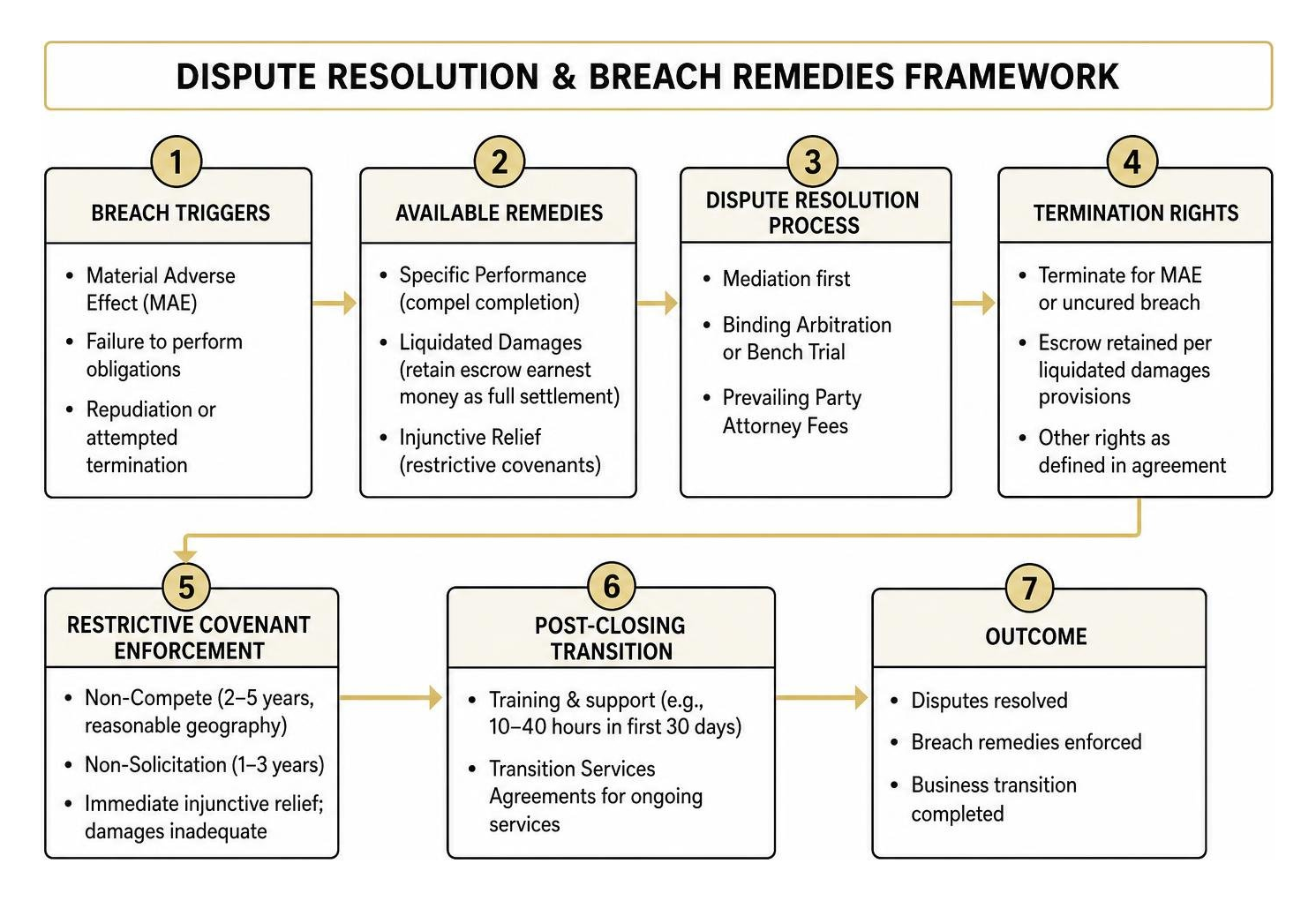
If a party breaches obligations prior to closing or repudiates the transaction, the purchase agreement provides defined remedies:
- Material Adverse Effect (MAE): A clause allowing a party to terminate if an unforeseen event materially impairs the target company’s financial condition or operations before closing.
- Specific Performance: An equitable remedy allowing buyers to compel sellers to complete the transfer if they improperly attempt to back out of a unique business sale.
- Liquidated Damages: Allowing the seller to retain the buyer’s escrow earnest money deposit (e.g., a $2,000 initial deposit on small sales or 5% to 10% on larger deals) as full settlement if the buyer defaults without cause.
- Dispute Resolution: Provisions mandating mediation followed by binding arbitration or bench trials, complete with “prevailing party” attorney fee recovery clauses.
Post-Closing Operational Training and Seller Transition
Closing day is not the end of the seller’s involvement; operational handovers require explicit commitments:
- Training Hours: Agreements frequently stipulate mandatory post-closing support (e.g., 10 to 40 hours of complimentary training over the first 30 days) to transition operational knowledge, software systems, and supplier contacts.
- Transition Services Agreements (TSA): For larger operations, structured billing, IT hosting, or accounting services agreements govern intermediate management.
- Record Retention: Commitments requiring both parties to maintain and provide access to pre-closing corporate, tax, and medical/personnel records for up to 6 years to handle audits or third-party claims.
Establishing a structured seller to buyer transition plan minimizes operational hiccups and guarantees client retention from day one.
Frequently Asked Questions About Business Purchase Agreements
What is the difference between an LOI and a definitive purchase agreement?
A Letter of Intent (LOI) is an introductory document outlining broad deal terms, proposed valuation, and transaction structure. Except for exclusivity and confidentiality clauses, an LOI is largely non-binding. A definitive purchase agreement is a comprehensive, legally binding contract containing detailed covenants, representations, warranties, indemnification terms, and closing deliverables.
Can a seller back out of a signed business purchase agreement?
A seller can only cancel a signed purchase agreement if the buyer fails to satisfy mandatory closing conditions (such as missing financing deadlines), if a contractual termination right is triggered, or by mutual written consent. If a seller breaches the contract by walking away without legal justification, the buyer can sue for monetary damages or seek specific performance to force the sale.
How are working capital adjustments resolved after closing?
At closing, the transaction is funded based on an agreed-upon “working capital peg” target. Within 30 to 90 days post-closing, the buyer presents a final balance sheet calculation detailing actual current assets and liabilities. If net working capital exceeds the target, the buyer pays the difference to the seller; if it falls short, the variance is returned to the buyer, typically from an adjustment escrow account. Disagreements are referred to an independent CPA firm for binding resolution.
Conclusion
Drafting a definitive business purchase agreement requires precision, operational clarity, and forward-looking risk management. By establishing the right transaction structure, negotiating clear payment mechanics, setting reasonable indemnification caps, and accounting for state-specific regulatory mandates, you protect your enterprise value and avoid deal-breaking closing delays.
At Earned Exits, we combine financial advisory expertise with hands-on brokerage guidance to navigate every stage of your sale. When you are ready to plan your exit, partner with our team for expert advisory to sell your business with complete confidence.
