


Don’t Let FAFSA Fool You: How to Correctly Value Your Business Assets
What Business Owners Need to Know Before Filing FAFSA
Knowing how do I value my business for FAFSA can save your family thousands of dollars in financial aid — or cost you just as much if you get it wrong.
Here’s the quick answer:
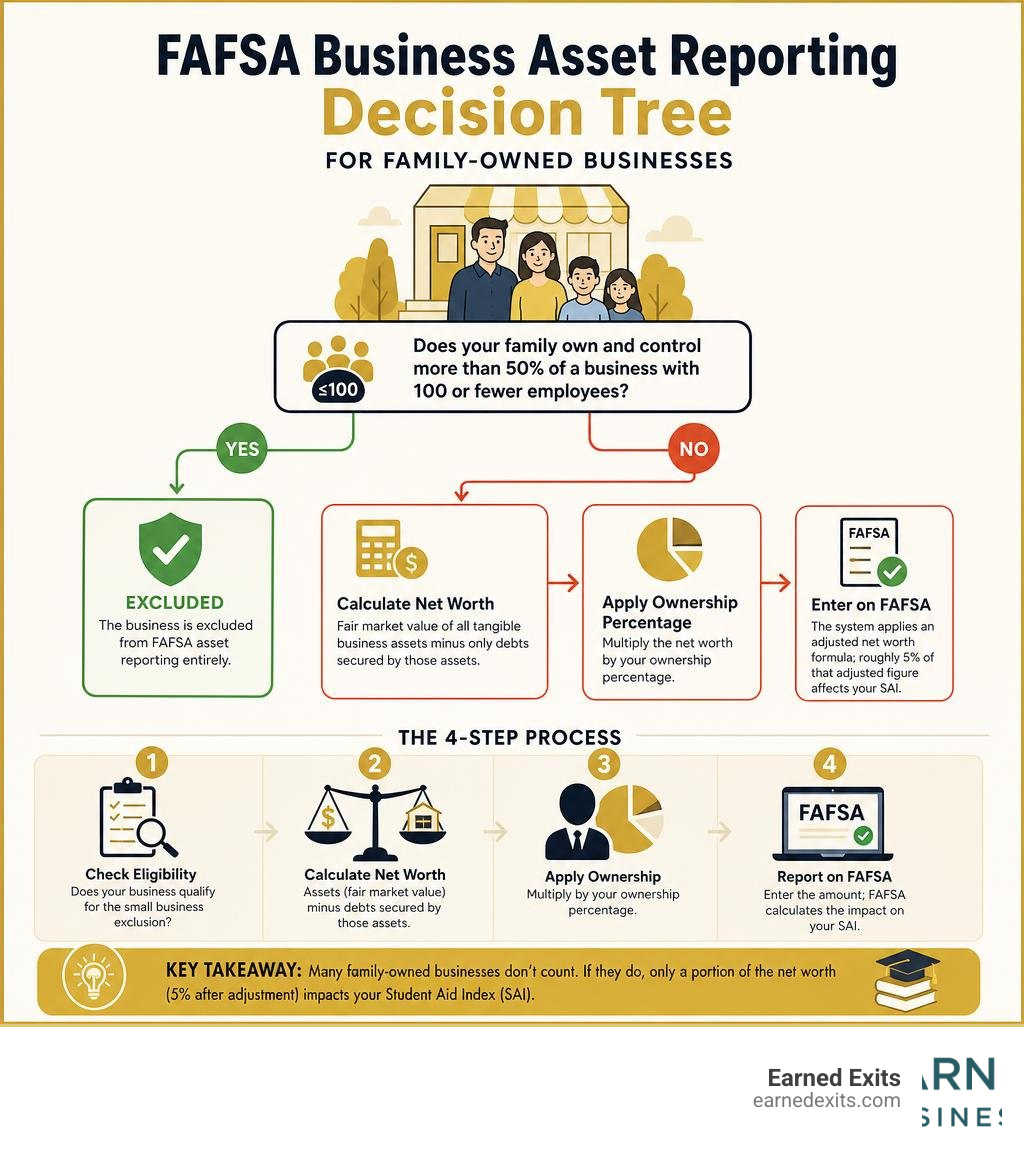
- Check if your business qualifies for exclusion — If your family owns and controls more than 50% of a business with 100 or fewer employees, the 2026-27 FAFSA excludes it from asset reporting entirely.
- If it doesn’t qualify, calculate net worth — Take the current fair market value of all tangible business assets (cash, inventory, equipment, receivables, real estate) and subtract only the debts secured by those business assets.
- Apply your ownership percentage — If you own 60% of a business with $100,000 net worth, you report $60,000.
- Enter it on the FAFSA — The system then applies an adjusted net worth formula, and roughly 5% of that adjusted figure affects your Student Aid Index (SAI).
That’s the core of it. The details — exclusions, partial ownership, rental properties, real estate held in a business entity — matter a lot, and we’ll walk through all of it below.
Business valuation is rarely simple, and FAFSA adds its own layer of rules on top. A business that looks valuable on paper may not count against you at all. Or it might — but far less than you’d expect. Getting this right starts with understanding exactly what the FAFSA is asking for and why.
I’m Britt Clas, a Business Broker and Partner at Earned Exits, where I’ve guided hundreds of business owners through the financial complexities of valuing and transitioning their companies — experience that directly shapes how I think about how do I value my business for FAFSA and what families actually need to know. Let’s break it down step by step.
The 2026-27 Small Business Exclusion: Does Your Business Even Count?
If your family owns a small business, a family farm, or a commercial fishing operation, the 2026-27 FAFSA brings a massive sigh of relief.
To understand why this is such a big deal, we have to look at the recent legislative roller coaster. When the FAFSA Simplification Act was first rolled out for the 2024-25 school year, it controversially eliminated the long-standing “small business exclusion.” Suddenly, families were forced to report the net worth of businesses of any size, even if it was a tiny mom-and-pop shop or a multi-generational family farm with high land value but very little cash flow.
Fortunately, federal lawmakers realized the strain this placed on working families. Starting with the 2026-27 FAFSA, the small business exclusion is officially restored. This means the net worth of qualifying family-owned businesses and farms is once again excluded from the Student Aid Index (SAI) calculation.
To qualify for this exclusion, your business must meet two strict criteria:
- The Employee Threshold: The business must have 100 or fewer full-time or full-time equivalent employees.
- Family Ownership and Control: The family must own and control more than 50% of the voting rights.
The voting rights rule is precise: exactly 50% ownership does not qualify you for the exclusion. Your family must own more than 50% (at least 50.1%) to claim control. If your business meets these benchmarks, you do not have to report its asset value on the FAFSA at all. You can read more about how this policy shift affects family aid packages in this detailed breakdown of The FAFSA Just Stopped Counting Family Farms and Businesses: What This 2026-27 Change Means for Your Aid | CollegeLens.
How Do I Value My Business for FAFSA If It Doesn’t Qualify for Exclusion?
What happens if your business does not qualify for the small business exclusion? Perhaps you have 120 employees, or your family only owns a 30% minority stake in a partnership. In these scenarios, you are required to report the business as an asset.
When a business must be reported, FAFSA rules dictate that you only report your specific share of the business’s net worth, calculated by your ownership percentage. For example, if a partnership has a total calculated net worth of $200,000 and you own exactly 30% of it, you would only report $60,000 on the FAFSA.
However, control and active participation play a massive role in how these assets are classified. If you are a silent partner with zero voting rights or operational control, your share of the business may be classified as an investment asset rather than a business asset. This distinction is critical because investment assets do not benefit from the favorable progressive adjustment formulas that business assets receive. For more technical rules on how partial ownership and partnerships are handled under the federal methodology, consult the Small Business Exclusion – Finaid guide.
How Do I Value My Business for FAFSA: The Step-by-Step Net Worth Formula
If you determine that you must report your business asset on the FAFSA, you need to calculate its net worth. FAFSA defines net worth using a simple formula:
$$\text{Business Net Worth} = \text{Fair Market Value of Tangible Assets} – \text{Liabilities Secured by Those Assets}$$

While the formula looks simple, the execution is where many business owners make costly mistakes. Many owners make the mistake of reporting their annual revenue, gross sales, or an arbitrary “guesstimate” of what they think the business is worth on the open market. Doing so can artificially inflate your asset base and severely hurt your child’s financial aid package.
For FAFSA, you are not valuing the business based on future earnings multiples or brand goodwill. Instead, you are looking at the current liquidation value of your tangible assets minus your secured liabilities. For a deeper look at general valuation concepts, you can check out The Ultimate Guide to Small Business Valuation Methods.
Step 1: Determine the Fair Market Value of Tangible Assets
To begin, you must sum up the fair market value of all tangible assets owned by the business. This includes:
- Cash and Cash Equivalents: The balances in all business checking, savings, and payroll accounts on the day you file the FAFSA.
- Inventory: The actual cost or market value of raw materials, work-in-progress, and finished goods.
- Equipment and Machinery: The current market value of your vehicles, computers, specialized machinery, and office furniture (not the original purchase price, but what they could be sold for today).
- Accounts Receivable: Money owed to the business by clients, adjusted for any accounts you expect will never be paid.
- Business Real Estate: The market value of any land or buildings owned directly by the business entity.
Intangible assets, such as your brand’s reputation, trademarks, patents, and goodwill, should generally not be included in your FAFSA valuation because they cannot be easily liquidated to pay for college. If you are struggling to separate these concepts, our guide on how to Stop Guessing What Your Business is Worth can help you establish a realistic baseline.
Step 2: Subtract Liabilities Secured by Business Assets
Once you have your total tangible asset value, you subtract any liabilities that are directly secured by those specific business assets.
This distinction is incredibly important: you can only subtract debt if the business asset itself was used as collateral.
For example:
- If you have a $50,000 commercial mortgage secured by a warehouse owned by the business, you can subtract that $50,000 from the warehouse’s value.
- If you have a $20,000 loan secured by a business vehicle, you can subtract that $20,000 from the vehicle’s value.
- The Home Equity Trap: If you took out a personal home equity line of credit (HELOC) on your primary residence to fund your business, you cannot subtract that debt from your business assets on the FAFSA. Because the debt is secured by your home (which is already an excluded asset on the FAFSA) and not by the business assets, it cannot be used to offset the business’s valuation.
Business Assets vs. Personal Assets: What to Include and Exclude
A common source of confusion when answering how do I value my business for FAFSA is mixing personal and business finances. FAFSA treats these two categories very differently.

To ensure you don’t accidentally overreport, keep these boundaries clear:
- Primary Residence: Your primary home is always excluded from the FAFSA asset section. However, if your business operates out of a portion of your home, or if your business owns the property you live in, the lines can blur. Only the portion of the property used directly for business operations should be counted as a business asset.
- Retirement Accounts: Personal retirement accounts like 401(k)s, traditional IRAs, and Roth IRAs are never reported as assets on the FAFSA, even if they were funded by business profits. Keep these entirely off your asset worksheets.
- Business Bank Accounts: If your business is structured as a separate legal entity (like an LLC or S-Corp), the cash in the business accounts belongs to the business and is calculated as a business asset. If you are a sole proprietor with no separate business accounts, that cash is treated as personal cash and must be reported dollar-for-dollar.
How Do I Value My Business for FAFSA When It Owns Real Estate or Rental Properties?
Real estate is one of the most strategic areas of FAFSA planning. How your rental properties or investment real estate are deeded can make a massive difference in your Student Aid Index.
If you own a rental property personally, it is reported on the FAFSA as an investment asset. Investment assets are counted dollar-for-dollar against your asset protection allowance, with no valuation discounts.
However, if that same rental property is owned by a business entity (such as an LLC) and is reported on your taxes under Schedule C (as an active business) rather than Schedule E (passive rental income), it may be treated as a business asset.
- If the business qualifies for the small business exclusion: The rental property’s value is completely excluded from the FAFSA.
- If it does not qualify for the exclusion: The property’s value is still treated as a business asset, meaning it goes through the FAFSA’s adjusted net worth formula (which heavily discounts its impact compared to personal investment assets).
To qualify as a business asset rather than a personal investment, the property must typically be held by a formally recognized business entity, and the owner must provide “significant services” (such as regular cleaning, linen service, or active management) that elevate it from a passive investment to an active commercial enterprise.
How Business Net Worth Impacts Your Student Aid Index (SAI)
If your business does not qualify for the small business exclusion, its net worth will impact your Student Aid Index (SAI). However, FAFSA does not count business assets dollar-for-dollar like it does with personal savings accounts.
Instead, the federal methodology uses a tiered, progressive adjustment formula to calculate the “adjusted net worth” of your business. This formula is designed to protect business owners from having to liquidate their operational assets to pay for college.
The progressive brackets adjust the reported business net worth as follows:
| Reported Business Net Worth | Adjusted Net Worth Calculation |
|---|---|
| Less than $0 | $0 |
| $1 to $170,000 | 40% of the net worth |
| $170,001 to $510,000 | $68,000 + 50% of the amount over $170,000 |
| $510,001 to $850,000 | $238,000 + 60% of the amount over $510,000 |
| Over $850,000 | $442,000 + 100% of the amount over $850,000 |
Once the adjusted net worth is calculated, the FAFSA formula expects parents to contribute only about 5.64% of that adjusted value toward college expenses for a single year.
To see how this plays out in the real world, let’s look at a rental property with $350,000 in equity.
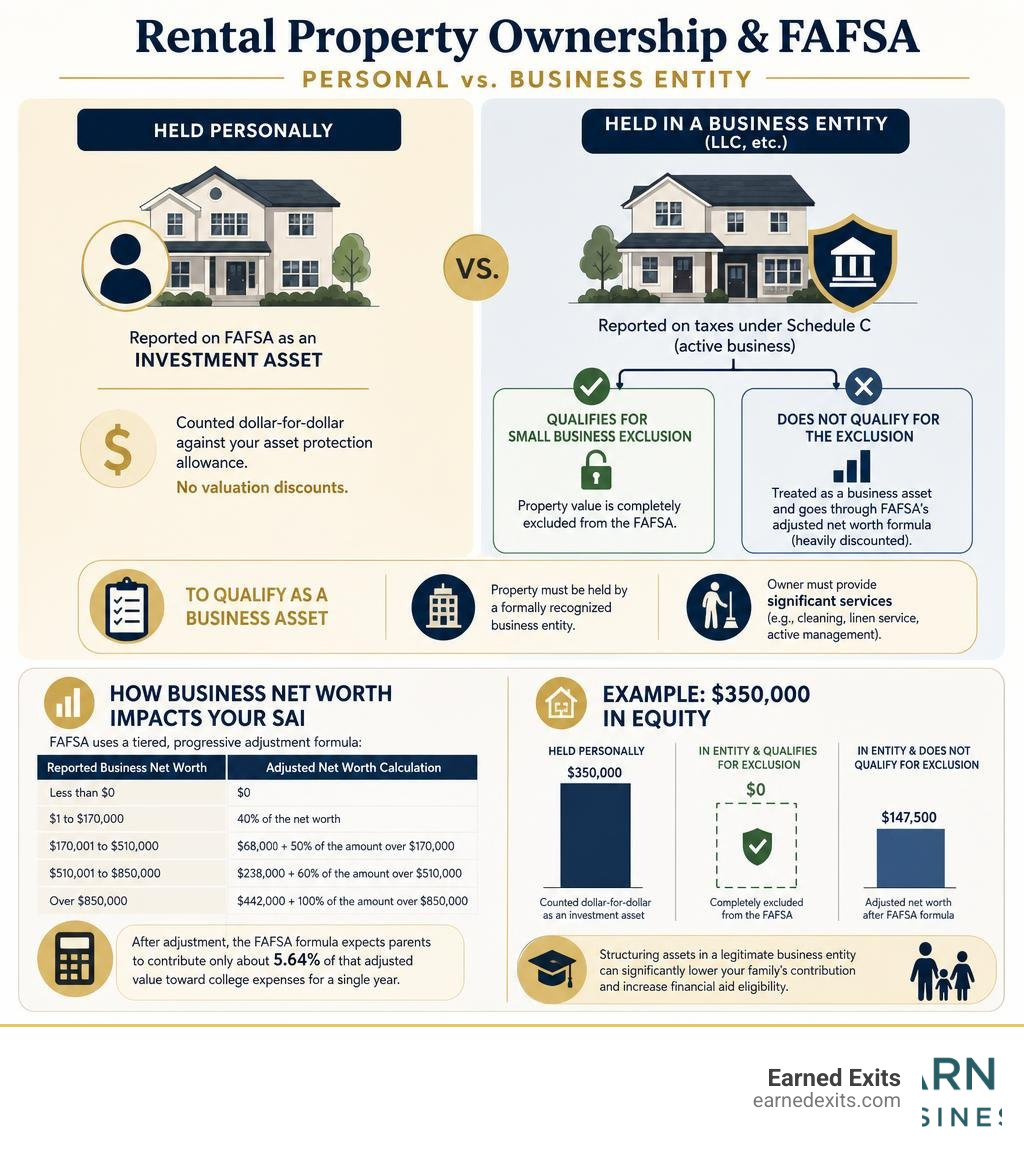
As this data illustrates, structuring your assets within a legitimate business entity can dramatically lower your family’s calculated contribution, making you eligible for significantly more financial aid. To explore how these asset calculations interact with different aid programs, read more on How business assets count for financial aid – College Money Method.
Frequently Asked Questions about FAFSA Business Valuation
FAQ 1: Does business income still count if the business asset is excluded?
Yes. It is vital to understand that the small business exclusion only applies to the asset value of your business. Any income, salary, distributions, or pass-through profits generated by the business must still be reported.
When you file the FAFSA, the system pulls your Adjusted Gross Income (AGI) directly from your federal tax returns via the IRS Direct Data Exchange. If you own an S-Corporation, Partnership, or LLC, your share of the business’s net income flows through to your personal tax return (via Schedule C, Schedule E, or Schedule K-1) and will be factored into the income portion of the SAI formula.
FAQ 2: How does the FAFSA treatment of business assets differ from the CSS Profile?
While the FAFSA is used for federal and state aid, many private colleges and universities also require the CSS Profile to award their own institutional financial aid.
The CSS Profile is much more thorough and does not recognize the FAFSA’s small business exclusion. On the CSS Profile, you must report the value of all family-owned businesses, regardless of size or employee count. Furthermore, colleges using the CSS Profile often use their own “institutional methodology” to value your business, which may take into account your business’s cash flow, historical earnings, and local market conditions rather than just book value.
FAQ 3: What documentation should I prepare for FAFSA verification?
If your FAFSA is selected for verification, or if you are appealing your financial aid package, you must be prepared to back up your asset and income numbers with documentation. We recommend keeping the following records organized:
- Tax Returns: Complete federal tax returns, including Schedule C, Schedule F (for farms), and Form 1065 or 1120S with all associated Schedule K-1s.
- Balance Sheets: Year-end balance sheets showing the book value of your business assets and liabilities.
- Valuation Reports: If your business is large or complex, having a written valuation or a professional assessment can protect you during an audit.
Conclusion
Navigating the intersection of business ownership and college financial aid can feel like learning a completely different language. The rules around how do I value my business for FAFSA are highly technical, but understanding them can make a massive difference in your family’s financial future.
Whether your business is completely excluded under the 2026-27 rules or you need to carefully calculate its adjusted net worth, accuracy is your best defense against overpaying for college.
At Earned Exits, we specialize in helping business owners understand the true value of what they’ve built. Whether you are preparing to fund college, planning your next corporate step, or looking to exit your business entirely, we provide the seamless, CFO-level support and communication you need.
To take the first step in understanding your company’s true worth, get started today with our Free Business Valuation tool. Let us help you protect your hard-earned assets while securing your family’s educational future.
