


Don’t Guess the Guestimate: Business Valuation Methods Explained
What “Business Valuation Methods Explained” Actually Means (And Why It Matters)
Business valuation methods explained simply means understanding the different ways experts calculate what a company is worth.
Here’s a quick overview of the main methods:
| Method | How It Works | Best For |
|---|---|---|
| Market Capitalization | Share price × shares outstanding | Publicly traded companies |
| Times Revenue | Revenue × industry multiplier | Early-stage or growth businesses |
| Earnings Multiplier (P/E) | Earnings × multiple | Profitable, stable businesses |
| Discounted Cash Flow (DCF) | Future cash flows discounted to present value | Businesses with predictable income |
| Book Value | Total assets minus liabilities | Asset-heavy businesses |
| Liquidation Value | What assets would sell for today, minus liabilities | Distressed or closing businesses |
| Comparable Transactions | Prices paid for similar businesses | M&A deals |
| EBITDA Multiple | EBITDA × industry multiple | Mid-market business sales |
No single method gives you the answer. Each one shows a different angle of what your business is worth.
Think of it like getting your house appraised. One appraiser looks at what similar homes sold for. Another looks at what it would cost to rebuild. A third looks at rental income potential. All three are valid — and together, they paint a fuller picture.
For a first-time seller, this can feel overwhelming. You’ve spent years building something valuable, and now someone is going to put a number on it using methods you’ve never heard of. That’s exactly why understanding the basics matters before you walk into a negotiation.
As Pablo Fernández of IESE Business School found after analyzing more than a thousand real-world valuations, even experienced professionals make significant errors — from using the wrong discount rates to misdefining cash flows. If the experts get it wrong, it pays to know enough to ask the right questions.
Why Business Valuation Methods Explained Matter for Your Exit
When we talk about selling a business, we aren’t just talking about a transaction; we’re talking about your legacy and your financial future. Whether you are in Alabama, California, or Florida, the “why” behind a valuation remains the same: you need an objective yardstick to measure years of subjective hard work.
An accurate valuation is the cornerstone of any successful exit strategy. Without it, you’re essentially flying blind. If you price your business too high, it sits on the market until it becomes “stale.” Price it too low, and you leave life-changing money on the table. We see this often in Mergers and Acquisitions (M&A); a seller might have a “gut feeling” their business is worth $10 million, but the market data says $6 million. Bridging that gap requires a deep dive into business valuation services.
Beyond just selling, valuations are critical for:
- Raising Capital: Investors need to know what percentage of the company they are buying.
- Tax Planning: The IRS (specifically through Revenue Ruling 59-60) has very specific thoughts on how businesses should be valued for estate and gift taxes.
- Shareholder Disputes: If a partner wants out, a neutral valuation prevents a legal “boxing match.”
- Growth Potential: Knowing your current value helps you identify “value drivers”—the things you can improve now to get a higher price later.
At Earned Exits, we believe valuation is both an art and a science. The science is the math; the art is knowing which math to use based on your specific industry and risk assessment.
The Three Pillars of Business Valuation
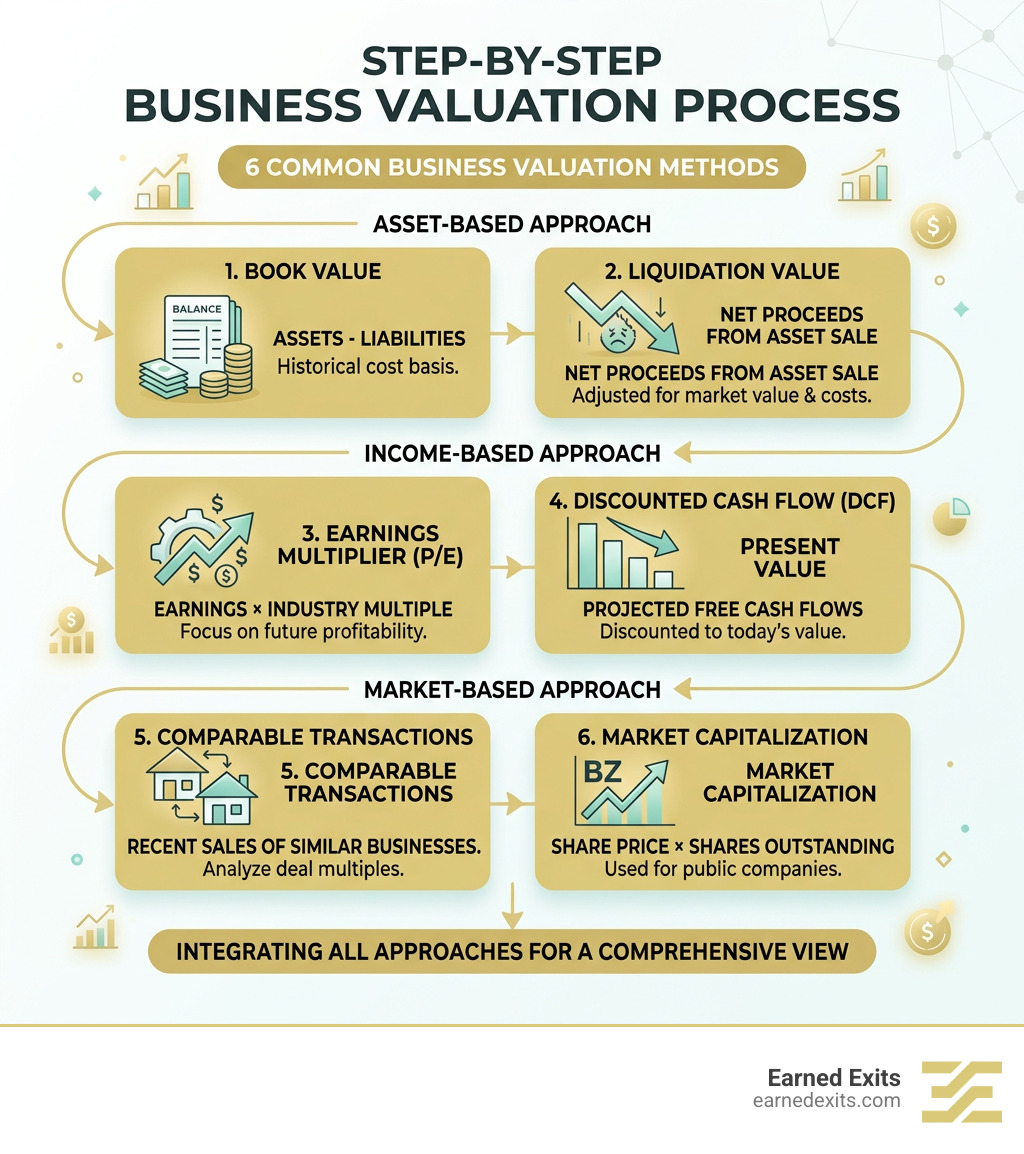
Professional appraisers generally group business valuation methods explained into three “pillars.” Each pillar looks at the business from a different perspective: what it owns, what it earns, or what others are paying for similar companies.

| Approach | Focus | Core Philosophy |
|---|---|---|
| Income Approach | Future Earnings | A business is worth the sum of the cash it will generate in the future, adjusted for today’s value. |
| Market Approach | Comparison | A business is worth what the market is currently paying for similar businesses. |
| Asset Approach | Net Worth | A business is worth the sum of its parts (tangible and intangible assets) minus its debts. |
Understanding the Economic Principles behind the Market, Asset and Income Approaches is vital. Most valuations will use a combination of these to reach a “reconciled” value. For instance, if you own a manufacturing plant in Ohio, we might look at your assets (the machines) and your income (the widgets you sell) to find a fair middle ground.
The Income Approach: Discounted Cash Flow (DCF)
The Income Approach is often considered the “gold standard” because it focuses on the reason most people buy a business: to make money. The most famous method here is the Discounted Cash Flow (DCF).
DCF is a multi-period model. We project how much “Free Cash Flow” (cash left over after all expenses and reinvestments) the business will produce over the next 5 to 10 years. Because a dollar today is worth more than a dollar five years from now, we “discount” those future dollars back to the present using a rate called the Weighted Average Cost of Capital (WACC).
For example, a business expected to earn $2 million annually for five years, discounted at a 10% rate, has a DCF value of approximately $7.6 million today. This method is conceptually correct because it views the company as a cash flow generator. However, it’s highly sensitive to assumptions. If you’re Valuing Firms in Distress, the DCF can be tricky because future cash flows are unpredictable.
The Market Approach: Business Valuation Methods Explained via Multiples
The Market Approach is the most intuitive. It’s the “real estate” method of business sales. We look at “comps”—comparable businesses that have recently sold.
In small to mid-sized businesses, we often use multiples of Sellers Discretionary Earnings (SDE) or EBITDA (Earnings Before Interest, Taxes, Depreciation, and Amortization).
- SDE: Typically used for owner-operated businesses with less than $1M in earnings. It includes the profit plus the owner’s salary and “perks.”
- EBITDA: Used for larger businesses where the management is separate from ownership.
Research shows that multiples vary wildly by industry. A software firm with $10 million in revenue might be valued at 3x revenue ($30 million), while a local service business might only get 0.5x revenue. You can learn more about these nuances in our guide on unlocking business valuation: exploring methods and market multiples.
Asset-Based Business Valuation Methods Explained
The Asset Approach is often used as a “floor value.” It asks: “If we closed the doors today and sold everything, what would be left?”
- Book Value: This is the value according to the balance sheet (Assets – Liabilities). However, book value can be misleading because it uses historical costs. A piece of real estate bought in 1990 is worth much more today than its “book value.”
- Liquidation Value: This is the cash a business owner would receive if they sold all assets in a short period (usually under 12 months) and paid off all debts. It’s often the lowest possible valuation.
- Adjusted Net Asset Method: This is a more sophisticated version where we adjust every asset and liability to its current Fair Market Value.
This approach is best for asset-heavy companies (like a trucking fleet in Texas) or holding companies. It often ignores “Goodwill”—the intangible value of your brand and customer loyalty. To understand how we adjust these numbers, check out our piece on demystifying add-backs and sellers discretionary earnings.
Deep Dive into Common Valuation Methodologies
Let’s look at some specific formulas and real-world data points that finance professionals use to pin down a number.
Market Capitalization
For public companies, this is the easiest calculation. It is simply the current share price multiplied by the total number of outstanding shares.
- Example: As of October 2, 2025, Microsoft Inc. had 7.43 billion shares outstanding trading at $515.74, resulting in a market capitalization of $3.83 trillion. Note: Market cap only tells you the value of the equity. It doesn’t account for the company’s debt or cash on hand.
Enterprise Value (EV)
If you want to know the total “takeover” price of a company, you look at Enterprise Value.
- Formula: EV = Market Capitalization + Total Debt – Cash. In 2016, Tesla had a market cap of $50.5 billion but an Enterprise Value of $64.5 billion because of its debt levels.
The Earnings Multiplier (P/E Ratio)
The Price-to-Earnings ratio is a staple for investors. It compares the share price to the annual profit.
- Statistic: A company earning $5 million annually might be valued at an 8x multiplier, resulting in a $40 million valuation. Multiples reflect the market’s expectation of growth. According to the Capital IQ database, high-growth companies like Tesla have seen EV/EBITDA ratios as high as 36x, while established giants like Ford or GM trade at 15x or even 6x. This shows that the market pays a premium for future potential. You can find more on How to Evaluate a Stock Before You Buy | SoFi.
Times Revenue Method
Common in the tech and SaaS (Software as a Service) sectors, this method ignores current profit and focuses on top-line growth.
- Example: A software firm with $10 million in revenue is valued at 3x revenue = $30 million. While simple, this method is risky because it doesn’t account for whether the business is actually making money.
Avoiding Common Pitfalls and Errors in Valuation
Valuation isn’t just about getting the math right; it’s about avoiding the “96 common errors” identified by Professor Pablo Fernández. Even professional appraisals can go wrong if the inputs are flawed.
1. Using the Wrong Discount Rate
One of the most frequent errors is using a historical risk-free rate or an incorrect “Beta” (a measure of volatility). If your discount rate is too low, your valuation will be artificially high. If it’s too high, you’ll undervalue the company.
2. Failing to Normalize Earnings
A “normalized” income statement removes one-time expenses that a new owner won’t have. For example, if you took a $50,000 personal trip to Hawaii and charged it to the business, that needs to be “added back” to the profit. Without normalization, the business looks less profitable than it actually is.
3. Ignoring Market Conditions
Valuations are a snapshot in time. The US stock market’s price-to-book (P/BV) ratio was 5.29 in August 2000 (the height of the dot-com bubble) but dropped to 3.2 by February 2007. If you value your business based on “bubble” multiples, you’ll never find a buyer in a normal market.
4. IRS Revenue Ruling 59-60 Compliance
For private companies, the IRS Revenue Ruling 59-60 provides the framework for “Fair Market Value.” It emphasizes that for operating companies, earnings are usually more important than assets. Ignoring this can lead to major tax headaches during an audit.
5. Discounts and Premiums
A common mistake is failing to apply a Discount for Lack of Marketability (DLOM). Private companies are harder to sell than public ones, so they usually receive a 35% to 50% discount compared to their public peers. Conversely, if you are selling a “controlling interest,” you might apply a Control Premium (typically 25-50%) because the buyer gets to make all the decisions.
Frequently Asked Questions about Business Valuation
What is the difference between a company’s value and its market price?
Value is what a business is worth based on its fundamentals (intrinsic value). Price is what a buyer actually pays. These two can be very different. A buyer might pay more than the “value” because they see “synergies”—for example, they can fire the accounting team and use their own, instantly increasing profit. Or, a seller might accept a lower “price” because they need to exit quickly. As the saying goes: “Price is what you pay, value is what you get.”
How do you choose the right valuation method for a small business?
It depends on your industry and stage:
- Service Businesses: Usually valued on a multiple of SDE or EBITDA.
- Asset-Heavy (Construction/Trucking): Often use the Adjusted Net Asset Method.
- Startups: Often use the Times Revenue or “Entry Cost” method (what would it cost to build this from scratch?).
- Mature/Stable Firms: DCF is the preferred choice for accuracy.
How is goodwill incorporated into a final valuation?
Goodwill represents the “intangible” value—your brand, your trained employees, and your secret sauce. In an asset-based valuation, goodwill is the difference between the total purchase price and the fair market value of the tangible assets. If a buyer pays $5 million for a business with $3 million in equipment, the remaining $2 million is “Goodwill.”
Conclusion
At the end of the day, business valuation methods explained are tools to help you stop guessing and start planning. Whether you’re preparing for a sale in Georgia or looking for an acquisition in Washington, the goal is the same: to find a number that is defensible, realistic, and fair.
At Earned Exits, we specialize in helping business owners navigate this complex landscape. We don’t just give you a number; we provide a thorough CFO-level valuation and due diligence support to ensure your exit is as seamless as possible.
Don’t leave your life’s work to a “guestimate.” If you’re ready to see what your hard work is actually worth, we’re here to help you sell my business with confidence and clarity. Let’s make sure your exit is exactly what you’ve earned.
