


Don’t Go It Alone: How to Hire a Franchise Sales Broker
Hire a Franchise Sales Broker With Clear Goals and Guardrails
To hire a franchise sales broker well, choose a partner with relevant brand experience, a proven way to qualify candidates, and a transparent commission agreement. Before signing, check references, review the brands they represent, confirm their compliance process, and set shared targets for lead quality, reporting, and closed deals.
A franchise sales broker can help a franchisor reach qualified prospective owners and move them through the sales process. But brokers represent the franchisor portfolios that pay them, not every franchise opportunity in the market. That makes fit especially important for newer brands that need growth without lowering standards or overselling territories.
For business owners, the same principle applies: outside expertise can create a better process, but only when incentives, communication, and due diligence are clear from the start.
I am Britt Clas, a Business Broker and Partner at Earned Exits Business Brokers. My work helping owners prepare, market, negotiate, and close complex transactions informs this guide on how to hire franchise sales broker partners who protect value as well as growth.
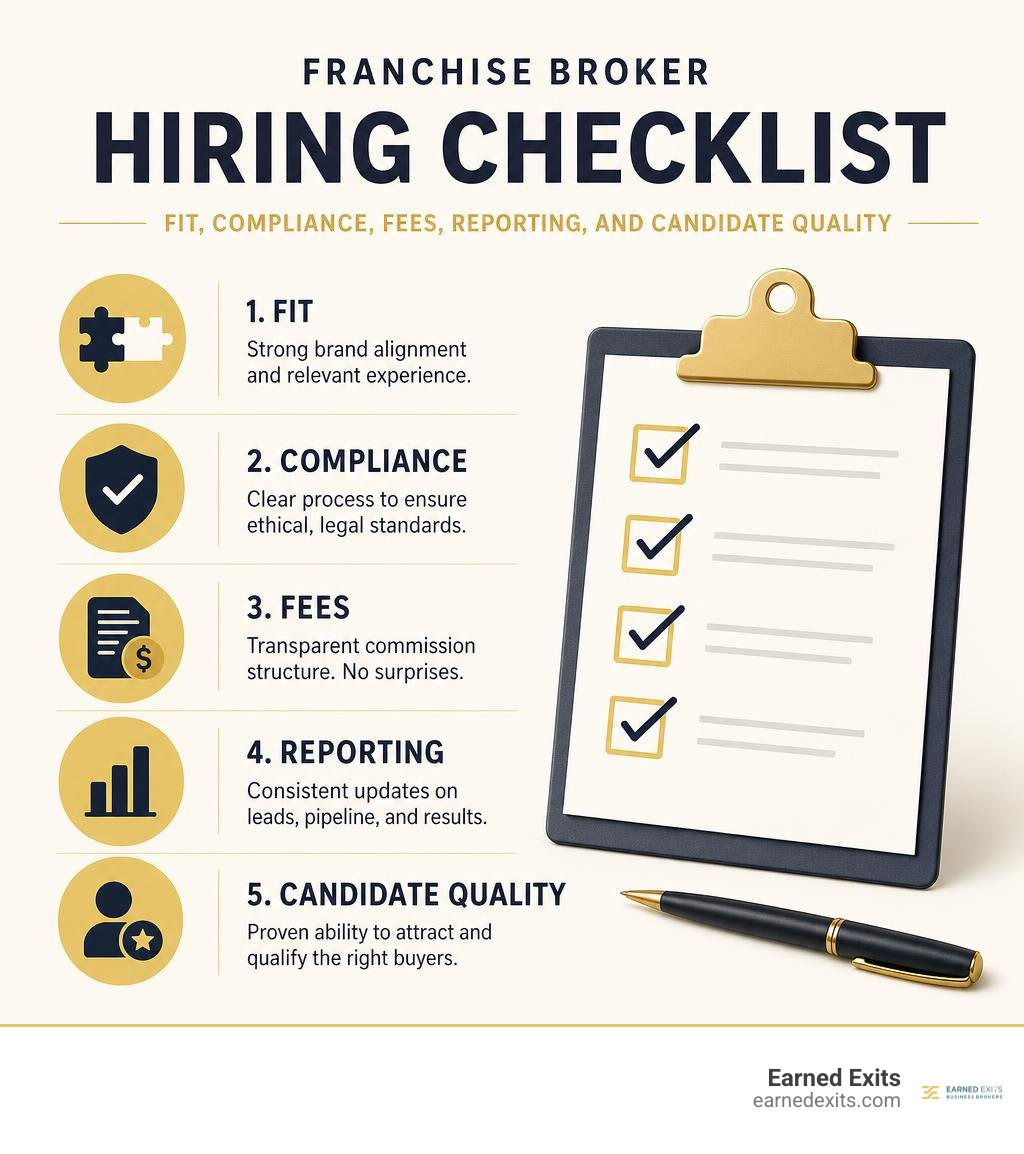
Simple hire franchise sales broker word guide:
Understanding the Role: What Does a Franchise Sales Broker Do?
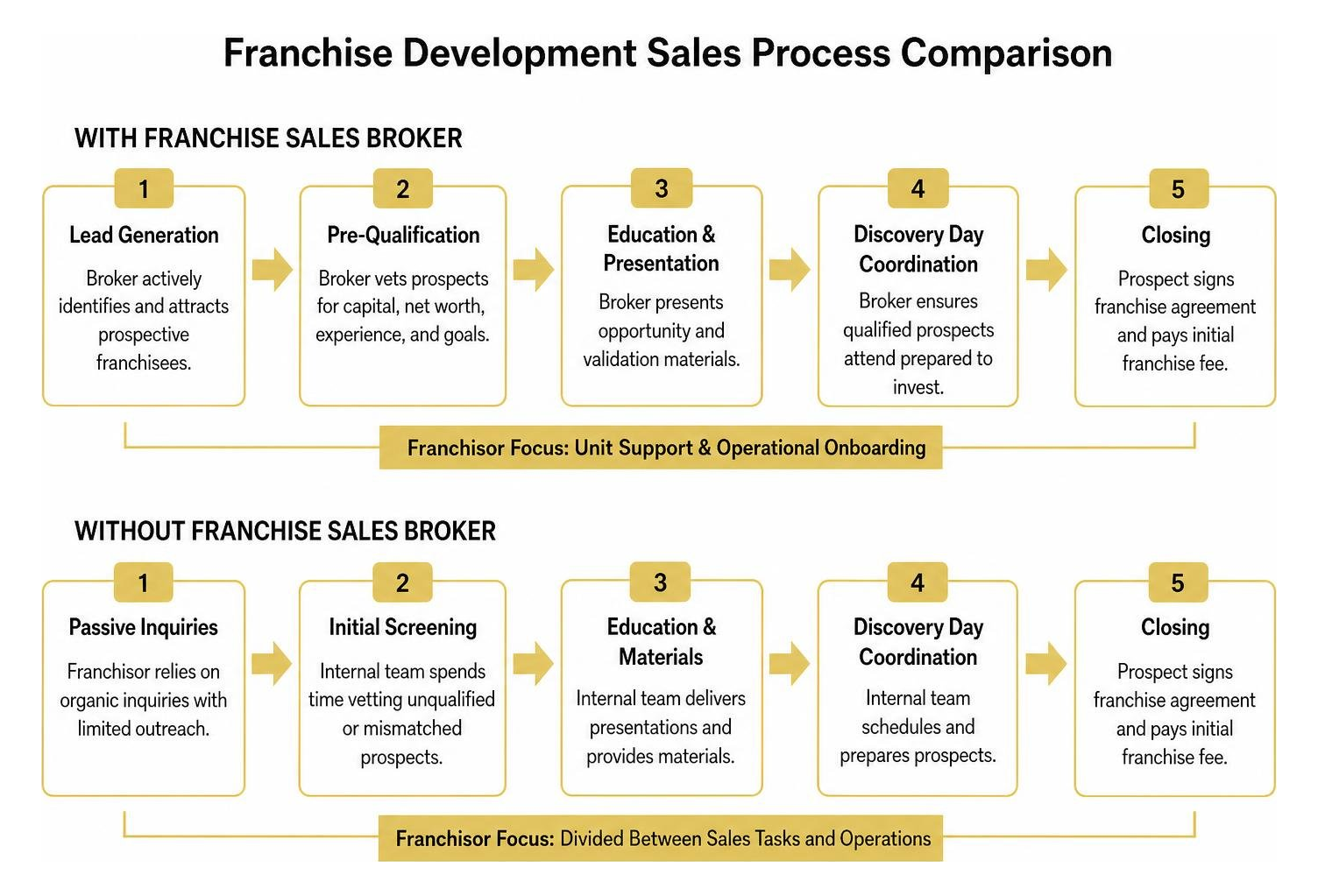
Expanding a franchise system requires more than having a great concept; it demands consistent pipeline management, qualified lead generation, and disciplined sales execution. A franchise sales broker operates as a specialized intermediary contracted by franchisors to identify, educate, and pre-qualify prospective franchisees.
Rather than waiting for organic inquiries, a skilled broker acts as an active conduit between your concept and qualified buyers looking to enter business ownership. They evaluate a prospect’s liquid capital, net worth, operational background, and personal goals before matching them to territories within their brand portfolio. Understanding this dynamic is similar to demystifying the business broker selling process: step-by-step to success, where structured candidate vetting protects everyone’s time.
The broker guides prospects through initial presentations, coordinates the review of validation materials, and ensures prospects attend Discovery Days prepared to make an investment decision. By managing this early-stage funnel, brokers accelerate sales velocity so franchisor leadership can focus on unit-level support and operational onboarding.
Franchise Sales Brokers vs. Franchise Consultants and Business Brokers
The terminology in business brokerage and franchise expansion can be confusing. While the titles are sometimes used interchangeably, their legal representation, compensation, and scope of work differ significantly.
A franchise sales broker represents the franchisor’s contracted inventory and is compensated by the franchisor upon deal closing. A franchise consultant often markets advisory services directly to prospective buyers, though many consultants operate on broker commission splits behind the scenes. In contrast, standard business brokers handle existing asset transfers and resales across broader industries.
| Feature | Franchise Sales Broker | Franchise Consultant (Buyer-Paid) | In-House Development Director |
|---|---|---|---|
| Primary Client | Franchisor (Contracted Portfolio) | Prospective Franchisee | Franchisor (Single Brand) |
| Compensation Model | Success-based commission (40%–50% of fee) | Hourly/Retainer or Broker Split | Base Salary ($110k–$135k+) + Performance Bonus |
| Inventory Scope | Curated portfolio of partner brands | Open market advisory | Exclusively the employer’s brand |
| Legal Role | Franchise Seller (under FTC & State rules) | Advisory / Due Diligence Guide | Direct Franchisor Employee |
| Territory Focus | Regional or National expansion | Buyer-selected markets | Strategic brand expansion territories |
How Commission Structures and Fees Work in 2026
As of September 2026, the International Franchise Association recognizes well over 3,000 franchise brands, creating intense competition for qualified owner-operators. To attract active broker representation, franchisors offer standardized commission tiers.
Franchise brokers typically earn 40% to 50% of the initial franchise fee paid by the incoming franchisee. With standard initial fees ranging between $30,000 and $50,000, a broker commission often lands between $15,000 and $25,000 per closed unit, with industry minimum thresholds generally established around $12,000.
Some brokers negotiating comprehensive development rights also seek performance overrides, such as:
- Multi-unit placement bonuses (e.g., discounted fee splits on 3-pack or 5-pack territory agreements).
- Fractional upfront onboarding retainers (common when an outsourced broker builds your sales deck from scratch).
- Occasional continuing royalty splits on placed units (rare, but requested by certain specialized master-developer brokers).
Navigating these terms requires the same tactical preparation found in mastering the negotiate business sale broker dance to keep acquisition costs aligned with your long-term unit economics.
When to Hire Franchise Sales Broker Specialists for Brand Expansion
Deciding when to hire a third-party broker network depends on your brand’s growth stage, capital reserves, and internal bandwidth.

If your corporate leadership team spends 50+ hours a month answering unqualified leads instead of coaching existing franchisees, outsourcing development can restore operational focus. A structured recruitment framework can increase recruiter pipeline productivity by up to 92%, filtering out window-shoppers before they ever reach your calendar.
Strategic Benefits of Outsourced Franchise Development
Partnering with professional brokers delivers distinct advantages for expanding systems:
- Immediate Lead Flow: Brokers maintain active lists of corporate executives and serial entrepreneurs looking to deploy capital.
- National Territory Velocity: Established networks help you target regional expansion across multiple states simultaneously, from California to Florida or expanding into emerging regions like US Franchises available in American Samoa.
- Third-Party Pre-Qualification: Candidates arrive at Discovery Day pre-screened for liquid capital, credit profile, and cultural alignment.
Selecting the right representation aligns closely with principles detailed in the thorough guide to picking a trusted business sale broker, where proven closing credentials matter far more than flashy sales pitches.
Risks and Drawbacks for Emerging Brands
Despite the upside, early-stage franchisors face genuine risks when depending exclusively on outside brokers:
- Margin Compression: Giving up 50% of your upfront franchise fee leaves limited capital for initial franchisee training, site selection assistance, and launch marketing.
- Inventory Dilution: Unlike an in-house director, a broker network represents dozens of competing concepts. If another franchisor offers a higher fee split or easier approval, your brand can get sidelined.
- Misaligned Incentives: Brokers are compensated on upfront transactions, not on whether that franchisee remains profitable five years later. Without strict qualification guardrails, you risk awarding territories to under-capitalized operators.
Legal Obligations and FDD Compliance in Franchise Brokerage
Franchise sales are heavily regulated at both federal and state levels. In the eyes of regulatory bodies, a third-party broker is legally classified as a “franchise seller.”

Under the Federal Trade Commission (FTC) Franchise Rule, prospective franchisees must receive the Franchise Disclosure Document (FDD) at least 14 calendar days before signing any binding agreement or paying any consideration. Brokers who alter timelines or distribute unauthorized marketing materials expose both themselves and the franchisor to severe regulatory penalties.
State Registration and Regulatory Disclosure Rules
State compliance adds another layer of scrutiny. In registration and filing states, brokers must formally submit credentials or be named in franchisor filings:
- Specific states (such as New York and Washington) require independent franchise brokers to register directly with state agencies before offering franchises.
- Regulators like the California Department of Financial Protection and Innovation actively track broker compliance via Franchise Brokers – DFPI – CA.gov.
- Franchisors must list all sales agents, brokers, and development personnel on the FDD Item 2 receipt page for every completed transaction.
Item 19 and Financial Performance Representation Risks
One of the greatest liabilities in franchise development involves unauthorized earnings claims. Brokers cannot legally make any verbal or written financial statements that deviate from the explicit data provided in your FDD Item 19.
If an eager broker promises a candidate that your units make “$200,000 in net profit their first year” when your Item 19 makes no such representation, the franchisor can face rescission demands, regulatory fines, and civil lawsuits. To mitigate this risk:
- Require brokers to carry Errors & Omissions (E&O) insurance (which typically costs between $1,000 and $3,000 annually).
- Mandate signed candidate disclosure acknowledgment forms prior to closing.
- Conduct regular audits of recorded sales webinars and email communication.
Independent Brokers vs. Broker Networks: Choosing the Right Model
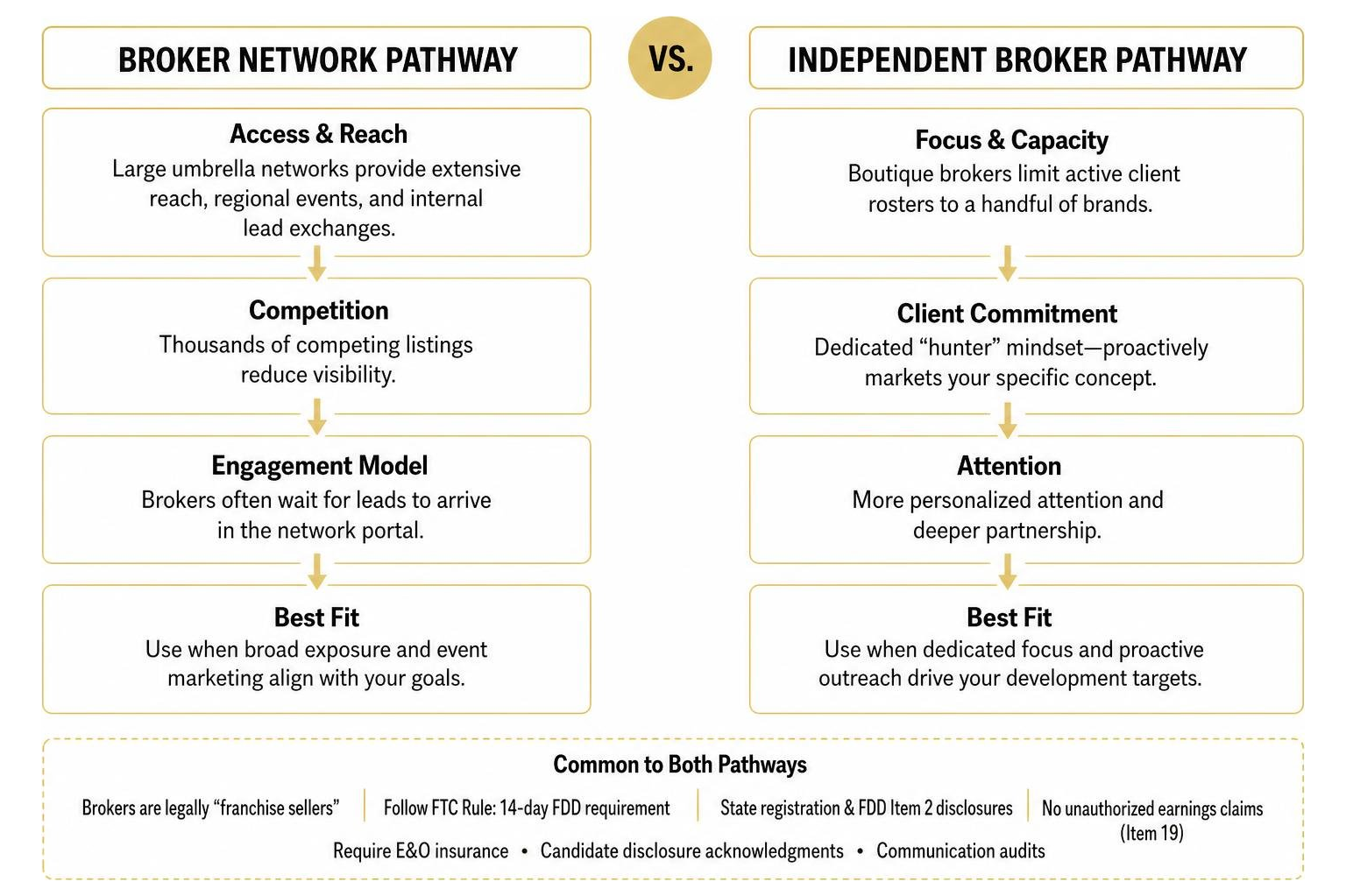
When structuring your sales outreach, you can choose between large umbrella broker networks and dedicated independent brokers.
Larger broker organizations provide extensive reach, hosting regional events and maintaining proprietary internal lead exchanges. However, only a small percentage of franchisors effectively use broker networks because large networks feature thousands of competing listings.
Independent brokers or boutique development agencies, by comparison, limit their active client rosters to a handful of brands. This structure often fosters a dedicated “hunter” mindset, where the broker proactively markets your specific concept rather than waiting for leads to drop into a network portal. Reviewing our Buyer’s Guide: Best Franchise Brokers for 2026 can help clarify which organizational format fits your development targets.
Key Vetting Criteria Before You Hire Franchise Sales Broker Experts
Before engaging an outside sales professional, evaluate their qualifications systematically:
- Verified Industry Experience: Look for credentials such as the Certified Franchise Executive (CFE) designation.
- Portfolio Alignment: Confirm they do not represent a direct competitor in your niche and price tier.
- Auditable Closing Track Record: Request verified placement metrics over the past 24 to 36 months, including candidate retention rates.
- Rigorous Due Diligence Process: Ensure they use structured financial calculators and operational assessments before forwarding leads to your team.
Essential Steps to Hire Franchise Sales Broker Partners
To build a productive, legally sound brokerage partnership, follow these foundational onboarding steps:
- Define Your Ideal Franchisee Persona: Document non-negotiable standards for net worth, liquid capital, industry background, and management capabilities.
- Draft a Clear Broker Agreement: Define exact commission splits, territory exclusivity rules, and payment milestones (e.g., 50% upon signing, 50% upon completed training).
- Provide Comprehensive Sales Collateral: Equip your broker with compliant sales decks, territory boundary maps, validated unit economics, and FDD receipt workflows.
- Establish Pipeline Accountability: Require weekly CRM dashboard reviews covering active leads, drop-off stages, and discovery schedule velocity.
Frequently Asked Questions About Franchise Sales Brokers
How much do franchise sales brokers charge franchisors?
Franchise brokers typically charge a contingent commission equal to 40% to 50% of the initial franchise fee, usually working out to $15,000 to $25,000 per single unit closed. Minimum fees generally start near $12,000. Some boutique firms also charge a nominal setup retainer to build out sales processes and FDD presentation assets.
Do franchise brokers need a license or state registration?
Yes, in several states. While there is no universal federal broker license, states such as New York and Washington require franchise brokers to file annual registrations. Additionally, all brokers must comply with FTC disclosure rules, and franchisors must document the broker’s identity on FDD receipt acknowledgments.
Can a franchisor rely solely on brokers for growth?
Relying entirely on third-party brokers is risky. A balanced development strategy combines broker placement with organic digital marketing, direct referrals from existing operators, and in-house outreach. Diversifying lead sources prevents inventory stagnation and protects unit-level economics.
Conclusion
Hiring a franchise sales broker can accelerate your brand’s regional and national footprint, but success requires clear expectations, legal vigilance, and aligned financial incentives. By establishing strict candidate qualification standards and enforcing rigorous compliance with FDD guidelines, you can build a sustainable pipeline that delivers high-performing operators to your system.
At Earned Exits, we help business owners navigate sales, expansions, and exits through a seamless, organized process supported by thorough due diligence, clear communication, and modern execution tools. Whether you are expanding a franchise model or preparing for a future company sale, explore our professional business brokerage services to ensure your transactions build lasting value.
