


Don’t Get Burned by Bad Suppliers (Use This Checklist)
Why a Due Diligence Supplier Checklist Can Make or Break Your Business
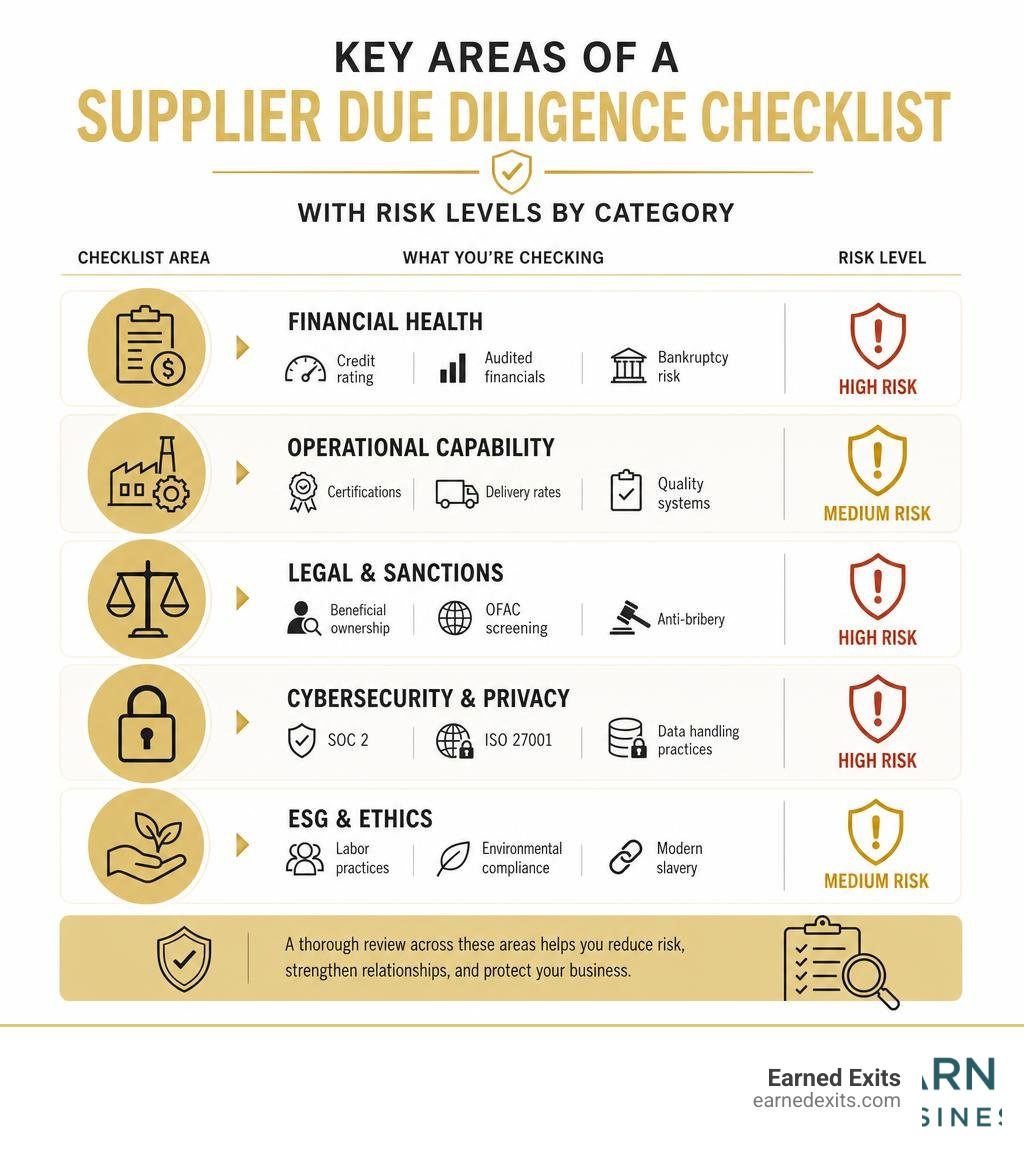
A due diligence supplier checklist is a structured tool used to evaluate the risks, reliability, and compliance of any supplier before — and after — you do business with them. Here’s what a solid checklist covers at a glance:
| Checklist Area | What You’re Checking |
|---|---|
| Financial Health | Credit rating, audited financials, bankruptcy risk |
| Operational Capability | Certifications, delivery rates, quality systems |
| Legal & Sanctions | Beneficial ownership, OFAC screening, anti-bribery |
| Cybersecurity & Privacy | SOC 2, ISO 27001, data handling practices |
| ESG & Ethics | Labor practices, environmental compliance, modern slavery |
Your suppliers can quietly become your biggest liability.
72% of organizations have experienced at least one significant disruption from a third-party relationship. And 62% of network intrusions start with a third party — not an internal failure.
That’s not a small risk. That’s a business-ending risk.
Yet most companies still rely on gut feel and a few phone calls when vetting new suppliers. More than two-thirds of businesses use manual processes for third-party risk management. Many don’t revisit supplier risk at all after the first contract is signed.
The result? Hidden financial instability. Compliance violations that land on your desk. Supply chain disruptions that cost far more to fix than they would have cost to prevent.
This checklist exists to close that gap — before a bad supplier relationship becomes your problem to solve.
I’m Britt Clas, a Business Broker and Partner at Earned Exits, where I guide business owners through the full complexity of selling their companies, including the supplier and third-party due diligence that directly affects valuation and deal structure. Understanding what a rigorous due diligence supplier checklist reveals — and what gaps it can expose — is something I work through with clients every day.
Vendor vs. Supplier Due Diligence: Why the Difference Matters
In many corporate boardrooms, the terms “vendor” and “supplier” are thrown around interchangeably. But if you want to protect your business, precision in terminology matters. The difference between vendor due diligence and supplier due diligence isn’t just academic — it changes the entire scope of your risk assessment.
A vendor typically provides software, services, or finished products. Think of your SaaS platforms, payroll providers, or external marketing agencies. When you vet a vendor, your primary concerns are data privacy, cybersecurity, and service-level agreements (SLAs).
A supplier, on the other hand, is deeply embedded in your physical supply chain. They provide raw materials, manufacturing capacity, logistics, and components. Vetting a supplier requires you to look beyond their server security to assess physical constraints: factory locations, raw material sourcing, transport dependencies, and labor practices.
If a SaaS vendor goes down for an hour, your team might complain about a slow afternoon. If a critical raw material supplier goes bankrupt, your entire manufacturing line stops, your customer orders are backlogged, and your brand reputation takes a nosedive.
| Diligence Dimension | Vendor Due Diligence (VDD) | Supplier Due Diligence (SDD) |
|---|---|---|
| Primary Focus | Data security, software uptime, regulatory compliance (GDPR, HIPAA) | Physical capacity, raw materials, logistics, ESG compliance |
| Key Risks | Data breaches, system downtime, intellectual property theft | Port strikes, raw material shortages, factory fires, forced labor |
| Core Evidence | SOC 2 reports, ISO 27001 certificates, DPAs | Audited financials, ISO 9001, bills of lading, factory audits |
| Dependency | Digital / Infrastructure dependency | Geographic, physical, and logistical dependency |
Understanding this split prevents you from sending a 400-question cybersecurity questionnaire to a local packaging supplier, or conversely, forgetting to check the physical shipping bottlenecks of a critical component manufacturer.
The Ultimate Due Diligence Supplier Checklist for 2026

To help you navigate this process, we have broken down the ultimate due diligence supplier checklist into five key operational pillars. In 2026, a truly robust due diligence program relies on collecting hard evidence (“artifacts”) rather than taking a supplier’s word for it (“attestations”).
Let’s explore the core areas you must evaluate to build a bulletproof supply chain.
1. Financial Health and Commercial Stability
You cannot build a stable business on a financially crumbling foundation. If a key supplier experiences sudden insolvency, your operations will suffer immediate collateral damage.
When evaluating a supplier’s financial health, look for these specific indicators:
- Credit Scoring and Delinquency Risk: Obtain independent credit reports from commercial data providers. A supplier whose delinquency score has deteriorated over several quarters is a major red flag, even if they claim business is booming.
- Working Capital and Cash Flow: Review balance sheets and cash flow statements. Does the supplier have enough working capital to weather market downturns, or are they operating dangerously close to their debt covenants?
- Audited Financial Statements: For high-value, Tier-1 suppliers, require at least two years of audited or reviewed financial statements.
- Liability and Debt Exposure: Analyze their outstanding loans and liabilities to ensure they aren’t leveraged to the point of collapse.
2. Operational Capability and Quality Assurance
A supplier can have pristine financials, but if they cannot deliver quality products on time, they are still a liability. You need to verify that their physical capacity matches your demand.
Key areas to verify include:
- Manufacturing Capacity & Equipment: Ensure the supplier has the physical machinery, labor force, and raw materials required to scale with your business.
- Quality Management Systems (QMS): Look for industry-standard certifications like ISO 9001 (quality management), which signal a systemic commitment to consistency.
- Delivery and Defect Rates: Request historical performance data. Track their On-Time In-Full (OTIF) delivery rates and defect rates (measured in parts per million).
- Raw Material Integrity: Use a specialized Raw Material Sourcing Checklist: Manufacturing Supply Chain & Quality Assurance | Manufacturing Templates | ChecklistGuro to ensure that the raw materials entering your product line meet strict purity and grade standards.
3. Legal, Regulatory, and Sanctions Compliance
Regulatory authorities do not accept “we didn’t know” as an excuse for supply chain violations. In fact, under laws like the Uyghur Forced Labor Prevention Act (UFLPA) in the US, there is a legal presumption that goods sourced from certain regions involve forced labor unless proven otherwise.
Your compliance screening must cover:
- Beneficial Ownership (KYS): Identify the Ultimate Beneficial Owners (UBOs) of the supplier to ensure you aren’t indirectly doing business with sanctioned individuals or hostile state actors.
- Sanctions & PEP Screening: Cross-reference the supplier, their directors, and UBOs against global watchlists, including the OFAC Specially Designated Nationals (SDN) list, EU Consolidated lists, and UK HMT lists.
- Anti-Bribery and Corruption (ABC): Verify that the supplier has active, documented policies and training programs to prevent bribery and corruption.
- Licensing and Permits: Ensure they hold all necessary local and international operational licenses. You can find structured templates for these baseline legal checks in this Due Diligence Checklist for Engaging Suppliers 2025.
4. Cybersecurity, Data Privacy, and AI Governance
With 62% of network intrusions originating from a third-party relationship, cybersecurity is no longer just an IT concern. If your supplier has access to your network, your customer data, or your intellectual property, their security posture is your security posture.
Additionally, as we move through 2026, technology-specific regulations are expanding rapidly. Under the EU AI Act, if a supplier provides or deploys AI systems within your operations, they face strict risk classification and conformity assessment rules.
Ensure your checklist covers:
- GDPR Article 28 Compliance: If the supplier processes personal data on your behalf, verify the depth and enforceability of their Data Processing Agreement (DPA). Ensure they have clear processes for data deletion, subprocessor governance, and breach notifications.
- Security Certifications: Require independent, third-party proof of security rather than self-reported questionnaires. Look for SOC 2 Type II reports and ISO 27001 certifications.
- AI Governance: Ensure the supplier complies with the latest standards, such as ISO 42001 (Artificial Intelligence Management System), especially if they use machine learning for data processing or decision-making.
To map out these technical requirements, we recommend utilizing the Supplier Due Diligence Checklist 2026 | Whisperly and The Vendor Due Diligence Checklist: A 5-Step Guide – Bitsight to verify that your data remains secure.
5. Ethical, Environmental, and Social Responsibility (ESG)
ESG has evolved from a marketing buzzword into a strict legal duty of care. The European Union’s Corporate Sustainability Due Diligence Directive (CSDDD) holds large companies legally responsible for environmental and human rights violations across their entire value chains.
Even if you aren’t directly subject to these laws, your major clients likely are — meaning they will expect you to prove your supply chain is clean.
Your ESG due diligence should verify:
- Ethical Labor Practices: Ensure the supplier enforces zero-tolerance policies for child labor, forced labor, and human trafficking.
- Environmental Impact: Track their carbon footprint, waste management protocols, and environmental permits.
- Supply Chain Diversity: Identify opportunities to work with diverse and inclusive suppliers, which can strengthen your brand and meet corporate mandates.
For a step-by-step framework on mapping environmental and human rights risks, consult the Checklist: Conducting environmental, social and governance (ESG) due diligence in supply chains (UK) – Lexology Pro.
Designing a Risk-Based Strategy for Supplier Vetting
If you try to perform a 100-point, exhaustive due diligence check on every single supplier, your procurement team will grind to a halt. You need a risk-based approach that balances thoroughness with operational efficiency.

Implementing a Tiered Due Diligence Supplier Checklist
The smartest way to scale your due diligence is to segment your suppliers into tiers based on their criticality to your business, the difficulty of replacing them, and their potential risk exposure:
- Tier 1 (Critical / High Risk): These are suppliers of custom components, sole-source raw materials, or partners with direct access to sensitive data. They receive the full due diligence supplier checklist (all 30+ items), including audited financials, on-site audits, SOC 2 reviews, and continuous monitoring.
- Tier 2 (Moderate Risk): These are standard suppliers who are relatively easy to replace but still vital for daily operations (e.g., standard packaging, logistics providers). They receive a moderate check (15–20 items), focusing on basic financial health, legal compliance, and quality standards.
- Tier 3 (Low Risk): These are commodity suppliers (e.g., office supply vendors). They require only a baseline check (5–6 items) to verify legal existence, business registration, and basic sanctions screening.
When to Trigger a Due Diligence Supplier Checklist Refresh
Due diligence is not a “one-and-done” onboarding task. It must be repeated systematically throughout the supplier lifecycle. A refresh should be triggered by:
- Contract Renewals: Re-evaluate the supplier’s performance and financial standing before signing a renewal.
- Scope Changes: If a Tier-2 supplier suddenly starts handling sensitive customer data, their risk level changes, triggering a Tier-1 security review.
- Significant Incidents: A data breach, a sudden drop in delivery performance, or negative media coverage should trigger an immediate, out-of-cycle review.
- Time-Based Cadence: As a rule of thumb, refresh Tier-1 suppliers annually, Tier-2 every 18 to 24 months, and Tier-3 on a longer 3-year cycle. You can find a detailed timeline strategy in the Supplier Due Diligence Checklist (2026 Template).
Mapping Fourth-Party (Nth-Party) Risks and Supply Chain Visibility
Your supply chain is only as strong as its weakest link. Often, that weak link isn’t your direct (Tier-1) supplier, but their supplier (your fourth-party or Nth-party risk).
For example, during the semiconductor shortages of recent years, many manufacturers discovered that while their direct suppliers were financially stable, those suppliers relied on a single, highly concentrated source for raw materials in an earthquake-prone or geopolitically unstable region.
To mitigate Nth-party risks:
- Require Tier-1 suppliers to disclose their critical sub-processors and raw material sources.
- Map out geographic concentrations to ensure you aren’t vulnerable to a single regional disruption.
- Include “flow-down” clauses in your contracts, requiring your suppliers to perform the same level of due diligence on their subcontractors.
Best Practices for Building and Maintaining Your Due Diligence Process
Building a reliable due diligence program requires collaboration, standardized tools, and the right technology. Here is how to make your process both thorough and efficient.
- Foster Cross-Departmental Collaboration: Due diligence shouldn’t live solely in procurement. Involve your IT team for cyber risk, your legal department for contract compliance, and your finance team to evaluate balance sheets.
- Use Industry-Standard Questionnaires: Don’t reinvent the wheel. Use proven, pre-built frameworks like the Consensus Assessments Initiative Questionnaire (CAIQ) or the Standardized Information Gathering (SIG) Lite to dramatically cut down on response times.
- Focus on Material Questions: Customize your questionnaires so you aren’t asking a physical raw material supplier about their cloud software patch management. For software-specific vetting, utilize a targeted Vendor Due Diligence Checklist (Free Template) to keep your questions relevant.
Leveraging Technology and Automation in Supplier Risk Management
If you are still managing your supplier risk via spreadsheets and email attachments, you are exposing your business to massive compliance leaks. 67% of vendor sub-processor pages change within a 90-day window, meaning manual documentation becomes stale almost immediately.
Modern Supplier Relationship Management (SRM) and Vendor Risk Management (VRM) software can automate this entire lifecycle:
- Automated Data Collection: Platforms can automatically pull business registry filings, credit scores, and sanctions lists.
- Trust Portals: Rather than sending long questionnaires, leverage vendor “trust portals” to instantly download pre-verified security and compliance artifacts.
- Continuous Monitoring & Alerts: Set up automated systems to monitor public databases for sudden credit score drops, sanctions additions, or adverse media mentions, allowing you to react before a crisis hits.
Essential Documentation and Record-Keeping for Audit Defensibility
If a regulatory body audits your business, or if a buyer conducts due diligence on your company during an acquisition, you must be able to prove that you vetted your supply chain thoroughly.
- Maintain a Due Diligence Manifest: Keep a centralized, digital record of all collected artifacts, signed contracts, and completed questionnaires.
- Document Explicit Waivers: If you decide to onboard a supplier despite a minor risk flag, document the business justification and the mitigation steps you put in place.
- Use Standardized Templates: Keep your records organized and audit-ready by using standardized tools like this Free Vendor Due Diligence Checklist | PDF | SafetyCulture.
Frequently Asked Questions about Supplier Due Diligence
How often should supplier due diligence be updated?
For critical, Tier-1 suppliers, you should conduct a full refresh annually, supplemented by continuous automated monitoring for financial distress, sanctions, or data breaches. Tier-2 suppliers should be updated every 18 to 24 months, and Tier-3 suppliers every 3 years or when a specific trigger event occurs (such as a contract renewal or change in scope).
What are the biggest red flags in supplier due diligence?
The most critical red flags include:
- A declining commercial credit score or deteriorating working capital over consecutive quarters.
- Matches on global sanctions, PEP, or watchlists for the company or its Ultimate Beneficial Owners (UBOs).
- Unwillingness to provide independent audit reports (like SOC 2) or certified quality documents (like ISO 9001).
- Frequent, unnotified changes to their sub-processors or manufacturing locations.
- Negative media reports regarding labor disputes, environmental violations, or regulatory investigations.
Can you use the same due diligence checklist for all suppliers?
No. Using a single, massive checklist for every supplier creates administrative bottlenecks and frustrates your business partners. Instead, use a tiered approach. Keep your evidence categories consistent, but scale the depth of the check based on the supplier’s risk tier, data access, and operational criticality.
Conclusion: How Supplier Due Diligence Protects Your Business Valuation
At Earned Exits, we specialize in helping business owners navigate the complex process of selling their companies. One of the most common places we see business valuation take a hit during the M&A process is in the supply chain.
When a sophisticated buyer conducts due diligence on your business, they don’t just look at your revenue. They look at your operational resilience. If they discover that your business relies on a single, unvetted raw material supplier with shaky financials, or that you have no record of compliance with modern data privacy and ESG laws, they will see massive risk. That risk translates directly into a lower purchase price or worse — a canceled deal.
By implementing a rigorous due diligence supplier checklist today, you aren’t just preventing operational disruptions; you are actively building a more valuable, transferrable, and audit-defensible business.
If you are preparing your business for a future sale and want to ensure your operations, contracts, and supplier relationships are positioned to attract premium offers, check out The Essential Checklist for Selling Your Online Business and learn how to package your business for success with The Essential Guide to the CIM Confidential Info Memo.
Ready to take the next step toward a highly profitable exit? Contact us today to explore our M&A Advisory Services and let’s build a secure, valuable future for your business.
