


Demystifying the Earnout Clause When Selling Your Business
How an Earnout Clause Can Bridge a Business Sale Price Gap
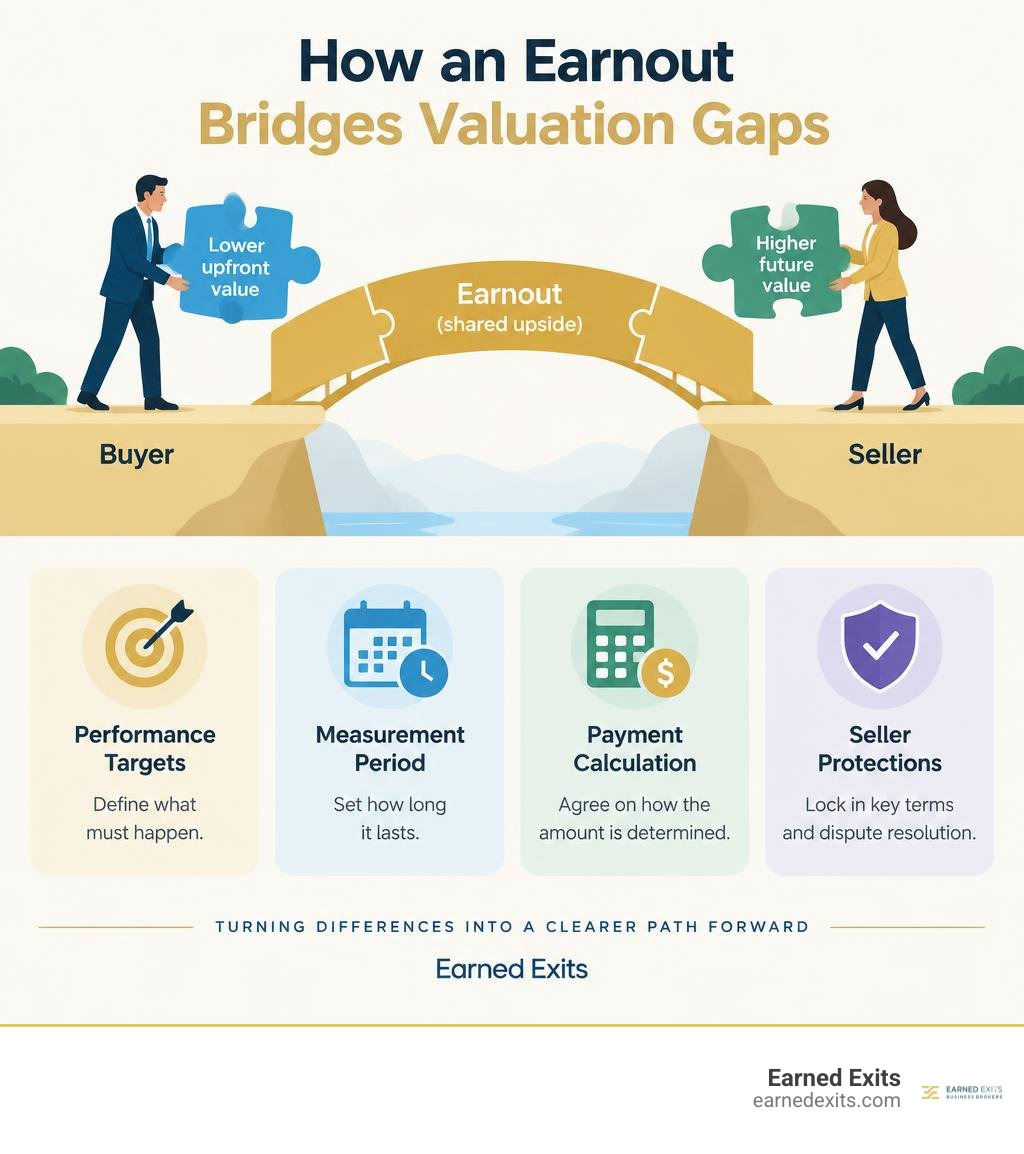
An earnout clause in sale agreements makes part of the purchase price payable later, but only if the business reaches clear post-closing targets. It can help close a deal when you believe your company is worth more based on future growth than a buyer is willing to pay upfront.
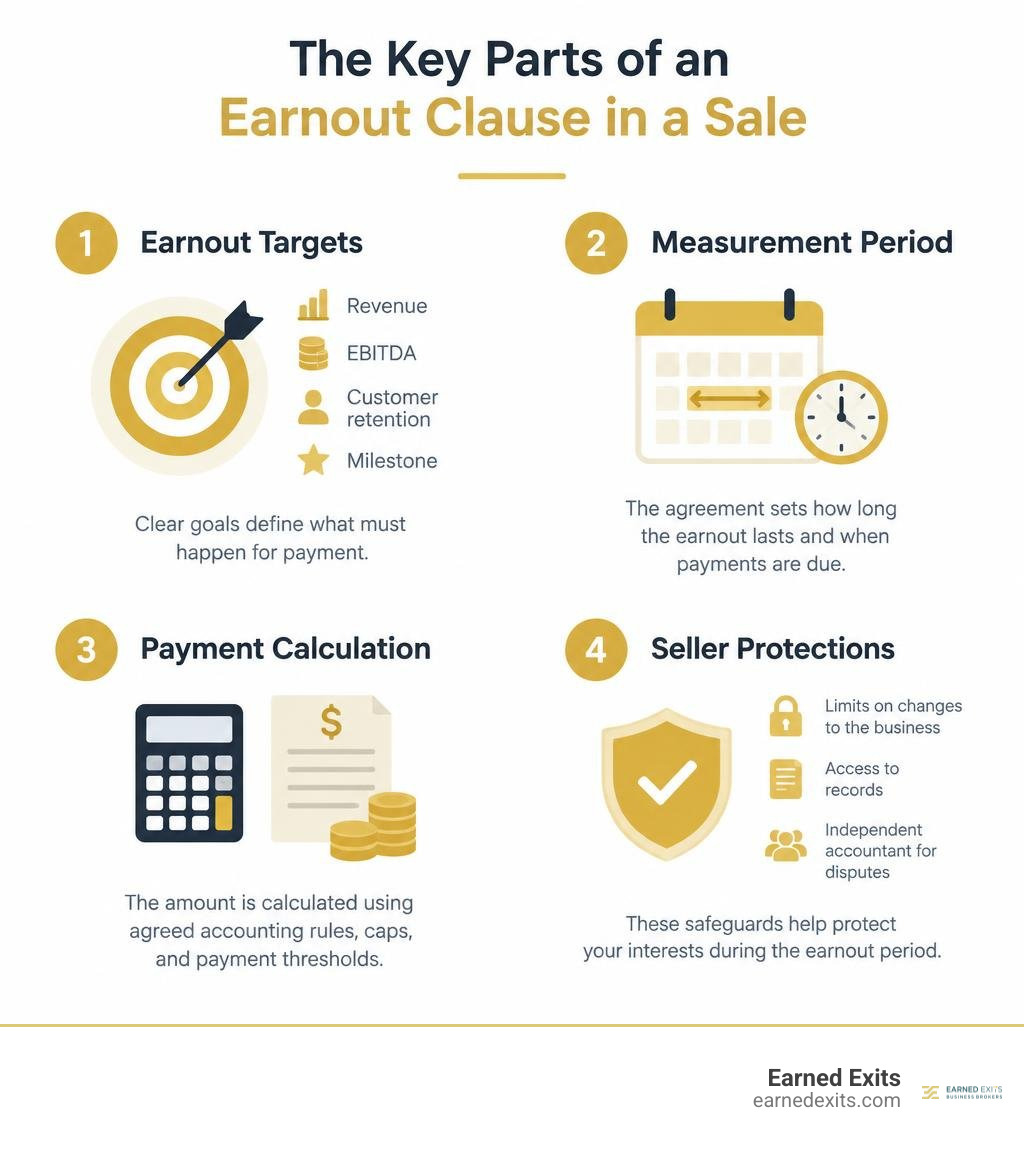
Before agreeing to one, make sure the purchase agreement clearly states:
- What must happen for payment, such as revenue, EBITDA, customer retention, or a product milestone.
- How the amount is calculated, including accounting rules, caps, and partial-payment thresholds.
- How long the earnout lasts and when the buyer must pay.
- What the buyer can and cannot change in the business during the earnout period.
- How disputes will be handled, including access to records and an independent accountant for calculation disagreements.
Earnouts can be useful, but they shift part of your sale price into the future. Outside life sciences, the median earnout period is about 24 months, while biotech and pharmaceutical deals often use longer periods tied to clinical, regulatory, or commercialization events. The goal is simple: turn a valuation disagreement into a measurable agreement, not a vague promise that creates conflict after closing.
I am Britt Clas, a Business Broker and Partner at Earned Exits, where I help owners prepare, value, market, negotiate, and close business sales. I work with founders to understand how an earnout clause in sale negotiations affects not only headline price, but also control, risk, employees, and the value they may actually receive.
Simple earnout clause in sale glossary:
What Is an Earnout Clause in Sale Agreements and Why Is It Used?
At its core, an earnout clause represents a deferred, contingent portion of the total transaction purchase price. Instead of delivering 100% of the company’s valuation in guaranteed cash at closing, the buyer agrees to pay supplemental consideration if—and only if—the business hits specific performance benchmarks after closing.
In middle-market transactions, earnouts act as a financial mechanism to bridge valuation gaps. A founder often projects aggressive future growth based on a newly developed product pipeline or expanding margins. A buyer, conversely, wants to avoid overpaying for unproven forecasts. By linking a portion of the enterprise value to verified future results, both parties share the execution risk.
From an accounting standpoint, these mechanisms introduce technical reporting obligations. Under US GAAP, contingent payment accounting under ASC 805 requires the buyer to estimate the fair value of contingent consideration at closing as a balance sheet liability, subsequently remeasuring it through earnings each period.
Navigating this structure is an integral part of the overarching steps to selling a business. When constructed carefully, an earnout enables transactions to close that would otherwise stall during price negotiations.
Historical Usage and Current Market Dynamics
Market adoption of earnouts fluctuates alongside capital costs and economic sentiment. Close to one in five private transactions outside the life sciences sector utilized an earnout over the past decade. Usage rose from 15% in 2019 to a peak of 30–37% in 2023 amid elevated interest rates and wider bid-ask spreads, before settling back to approximately 22% in 2024.
The median size of earnout structures outside life sciences represents roughly 31% of closing payments. Deal professionals widely recognize that keeping at least 40% of the overall potential transaction value tied to clear, achievable upside targets is often required to keep an exiting founder fully motivated post-acquisition.
Advantages and Drawbacks for Buyers and Sellers
While an earnout helps finalize deal terms, it changes post-closing incentives for both sides:
- For Buyers: Earnouts mitigate downside transaction risk, reduce upfront cash requirements, and allow post-closing revenues to fund portions of the acquisition price. However, they complicate integration strategies and can restrict operational restructuring.
- For Sellers: Earnouts provide access to higher aggregate exit valuations and allow owners to capture the upside of recent operational investments. On the other hand, sellers face post-closing operational friction, deferred liquidity, and the risk of uncollected proceeds if the buyer mismanages the asset.
Structuring Metrics and Cross-Industry Benchmarks
Selecting the appropriate metric is the foundation of any workable earnout. The metric must be clear, transparently calculated, and shielded from post-closing accounting distortions.

The strategic framework for structuring and negotiating earnouts requires matching the target benchmark to your level of operational control after the closing date.
Revenue, Gross Profit, and EBITDA Thresholds
Financial earnouts fall into three primary categories:
- Top-Line Revenue: Revenue metrics are straightforward to track and difficult for a buyer to manipulate through overhead allocations. Sellers often prefer revenue targets because they measure commercial adoption directly.
- Gross Profit: This middle-ground metric ties contingent payments to top-line volume while accounting for direct cost of goods sold (COGS), balancing sales volume with baseline product profitability.
- Adjusted EBITDA: Buyers frequently insist on operating cash flow targets to ensure profitability. When utilizing this structure, parties must adopt explicit EBITDA target structuring standards that define adjustments, carve out corporate overhead allocations, exclude transaction expenses, and isolate non-operating costs.
Life Sciences vs. Traditional Sector Implementations
The mechanics of contingent consideration differ significantly between general commercial businesses and specialized sectors:
- Life Sciences and Biotech: Over 80% of private pharmaceutical and clinical-stage transactions rely on milestone-driven earnouts. The median contingent payment represents roughly 61% of total enterprise consideration, with timelines stretching across 3 to 5 years (or longer). Payouts hinge on objective regulatory milestones, such as successful Phase II/III trial completions, FDA approvals, or specific insurance reimbursement thresholds.
- Commercial & Tech Sectors: Non-life-science deals lean heavily on financial performance (revenue or EBITDA), feature a median duration of 24 months, and calculate earnout components closer to 31% of upfront consideration.
Essential Terms and Covenants to Protect Seller Value
An earnout is only as reliable as the operational covenants supporting it. Once a buyer takes control of day-to-day operations, strategic decisions can inadvertently—or intentionally—depress performance metrics.
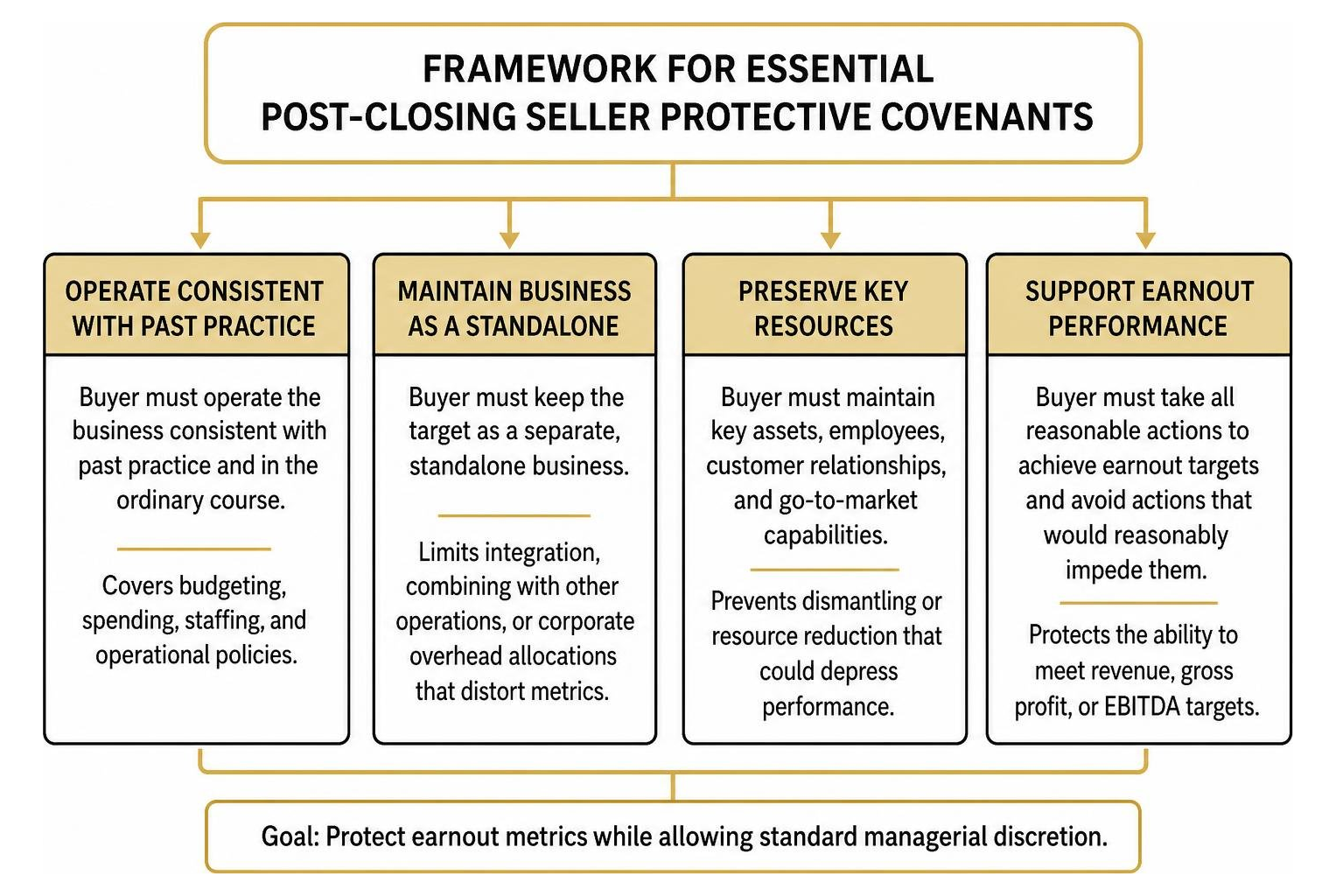
When drafting a purchase agreement, sellers should secure operational covenants that protect their target metrics while allowing the buyer standard managerial discretion.
Critical Protective Covenants in an Earnout Clause in Sale Contracts
Only about 25% of earnout transactions contain at least one formal post-closing covenant requiring the buyer to operate consistently with past practice or manage the target as a standalone business. Sellers should negotiate for explicit protections:
- Ordinary Course of Business: An agreement requiring the buyer to operate the business in good faith, consistent with historical practice, avoiding artificial deferrals of customer billings or sales pipelines.
- Standalone Ledger Maintenance: The acquired entity must maintain separate books and records under US GAAP, preventing the commingling of revenues or parent-company overhead expenses.
- Committed Working Capital and Headcount: Specific minimum budgetary and sales-force commitments prevent the buyer from defunding operations critical to hitting earnout milestones.
- Information and Audit Rights: The seller requires clear inspection rights, including 30-to-60-day windows to review closing calculation statements and underlying financial documentation, as modeled in standard public filings such as an SEC sample earnout agreement.
Acceleration, Buyout Rights, and Set-Off Mechanics
Agreements should anticipate broader liquidity events before the performance period concludes:
- Change of Control Acceleration: If the buyer sells the business or its primary assets during the earnout period, the unearned contingent consideration should immediately accelerate and become payable in full.
- Buyer Buyout Provisions: Buyers may seek an early buyout option, allowing them to pay a pre-agreed lump sum to extinguish future earnout liabilities and eliminate ongoing operational restrictions.
- Indemnification Offsets: Buyers often draft rights to set off indemnity claims against future earnout installments. Sellers should insist that set-offs apply only to finalized, non-appealable claims rather than unverified third-party notices.
- Carryback and Catch-Up Provisions: If an annual target is missed in Year 1 due to integration friction, excess performance in Year 2 should allow the seller to “catch up” on previously unearned payouts.
Legal Standards, Delaware Case Law, and Dispute Avoidance
Earnout disputes represent a frequent source of post-closing M&A litigation. Docket filings mentioning earnouts and M&A in state and federal courts have shown sharp increases during periods of broader economic reallocation.

Parties often look to Delaware Court of Chancery jurisprudence to interpret comprehensive earnout legal provisions and resolve disagreements over operational discretion.
Commercially Reasonable Efforts and Good Faith Obligations
The baseline implied covenant of good faith and fair dealing prevents a buyer from deliberately subverting an earnout target. However, Delaware courts do not interpret good faith as an obligation to prioritize the seller’s earnout over the buyer’s broader business interests. Consequently, parties negotiate contractual effort standards:
- Inward-Facing Standards (Fortis Advisors v. Dematic): Measures whether the buyer devoted resources consistent with its own historical practices across comparable internal divisions.
- Outward-Facing Standards (SRS v. Alexion): Evaluates whether the buyer’s operational actions matched the efforts of a prudent, similarly situated industry peer executing comparable programs.
- Safety and Commercial Justifications (Menn v. ConMed Corp.): Demonstrates that courts respect a buyer’s decision to alter or discontinue products if driven by genuine safety concerns or fundamental market shifts rather than an effort to evade earnout payments.
Resolving Disagreements Over an Earnout Clause in Sale Transactions
To minimize legal expenses and court backlogs, agreements should incorporate structured dispute resolution paths:
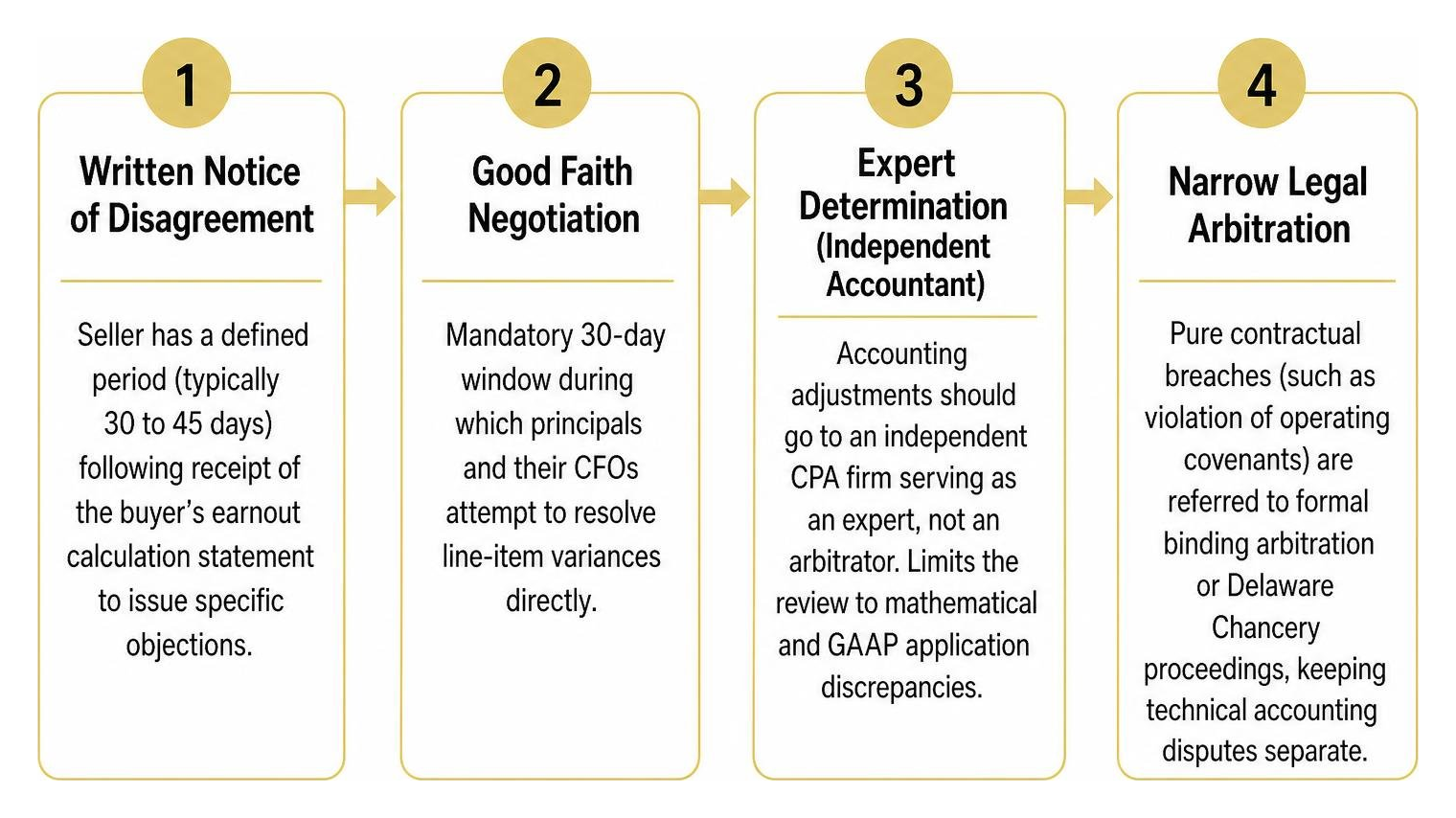
- Written Notice of Disagreement: The seller has a defined period (typically 30 to 45 days) following receipt of the buyer’s earnout calculation statement to issue specific objections.
- Good Faith Negotiation: A mandatory 30-day window during which principals and their CFOs attempt to resolve line-item variances directly.
- Expert Determination (Independent Accountant): Accounting adjustments should go to an independent CPA firm serving as an expert, not an arbitrator. This limits the review to mathematical and GAAP application discrepancies rather than legal interpretations.
- Narrow Legal Arbitration: Pure contractual breaches (such as violation of operating covenants) are referred to formal binding arbitration or Delaware Chancery proceedings, keeping technical accounting disputes separate.
Earnouts vs. Alternative Valuation Gap Solutions
An earnout is one of several deal structures used to align expectations between buyers and sellers. Evaluating how an earnout compares to other contingent instruments helps founders choose the right path after completing a comprehensive business valuation.
Seller Promissory Notes and Subordinated Debt
A seller note converts a portion of the purchase price into deferred debt. The buyer makes regular principal and interest payments based on an amortization schedule, independent of post-closing EBITDA fluctuations.
While this eliminates operational tracking disputes, the seller assumes standard credit default risk, and notes are typically subordinated to primary bank debt.
Rollover Equity and Contingent Value Rights
Rather than relying on operational metrics, rollover equity allows sellers to reinvest a portion of their closing proceeds (often 10% to 30%) into the acquiring entity. This approach:
- Aligns long-term incentives without requiring line-item GAAP metric audits.
- Enables founders to participate in a potential “second bite of the apple” upon a subsequent liquidity event or recapitalization.
- Carries the traditional risks associated with holding non-controlling, minority equity positions.
For public acquisitions, Contingent Value Rights (CVRs) function similarly to earnouts, offering tradeable or non-tradeable instruments tied to discrete regulatory or commercialization events.
Frequently Asked Questions About Earnout Clauses
How are earnout payments taxed by the IRS?
Earnouts are generally taxed under installment sale rules (IRC Section 453), where gain is recognized as contingent cash is received across tax years.
However, sellers must beware of the compensation trap: if earnout distributions are tied to continued post-closing employment rather than equity ownership, the IRS may reclassify those proceeds from capital gains to ordinary income, subjecting them to higher tax rates and payroll withholdings.
Additionally, if the purchase agreement lacks stated interest on deferred installments, the IRS will apply imputed interest rules, treating a portion of every payment as ordinary interest income.
What is the typical duration of an earnout period?
Outside the life sciences sector, the market median duration is 24 months, with most standard commercial contracts running between 12 and 36 months.
Transactions in biotechnology, pharmaceuticals, and specialized medical hardware regularly employ 3-to-5-year (or longer) performance terms to align with clinical trials, regulatory filings, and commercial scaling milestones.
How can a seller prevent a buyer from manipulating post-closing EBITDA?
Sellers can limit financial engineering by embedding clear accounting guidelines in the purchase agreement:
- Explicitly requiring consistent application of historical GAAP standards.
- Barring the allocation of parent corporate overhead, administrative charges, or executive salaries to the target’s operating statement.
- Excluding transaction costs, severance expenses, and integration outlays from Adjusted EBITDA calculations.
- Securing audit access to the general ledger, invoices, and journal entries throughout the earnout period.
Conclusion
Structuring an earnout can convert a potential impasse into an executed transaction. However, a contingent payment mechanism should never serve as a substitute for thorough upfront negotiation. Without precise metrics, explicit accounting parameters, and enforceable operational covenants, deferred consideration can create post-closing friction rather than realized value.
At Earned Exits, we combine transaction advisory experience, CFO-level financial modeling, and structured negotiation strategies to protect your interests across every stage of the sale process. If you are preparing for a transaction and evaluating contingent consideration options, explore our advisory solutions for selling your business to ensure your exit terms reflect the enterprise value you have built.
