


Demystifying the Business Broker Selling Process: Step-by-Step to Success
What the Business Broker Selling Process Actually Looks Like — And Why It Matters
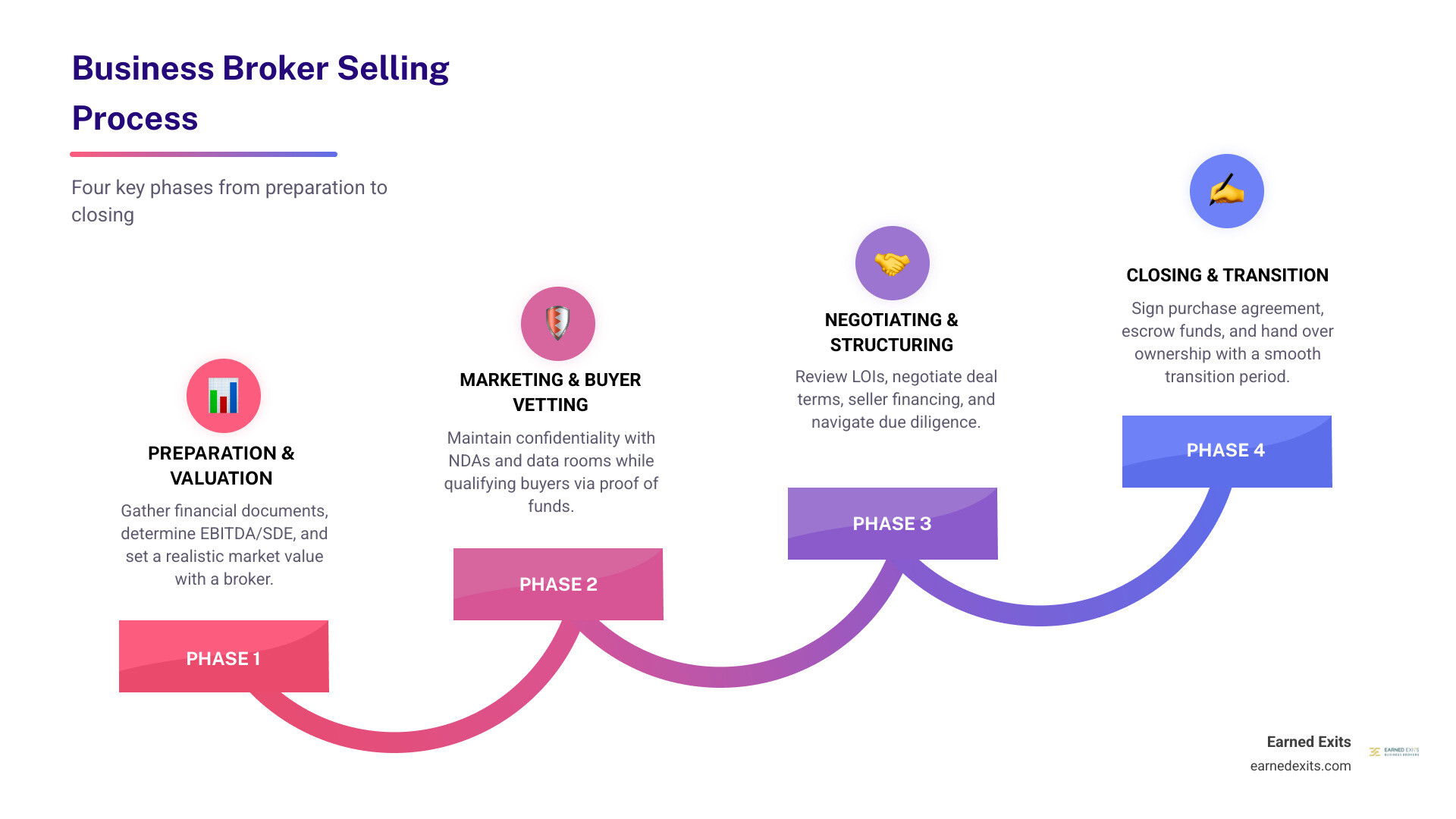
The business broker selling process typically unfolds in four key phases:
- Preparation and Valuation — gathering financials, establishing your business’s market value
- Marketing and Buyer Vetting — reaching qualified buyers while protecting confidentiality
- Negotiating and Structuring the Deal — reviewing offers, letters of intent, and deal terms
- Closing and Transition — finalizing legal documents and handing over ownership
Most business owners only sell a company once in their lifetime. That means the process is almost always unfamiliar — and the stakes are high. Around 80% of businesses listed for sale never actually close. Poor preparation and unrealistic pricing are the two biggest reasons why.
The good news? Sellers who work with a professional broker and come prepared with clean financials and a formal valuation are 50% more likely to sell within their first year on the market. And on average, broker-assisted sales close for 20–30% more than owner-led sales.
This guide walks you through every step of the process — clearly and without jargon — so you know exactly what to expect and how to set yourself up for a successful exit.
I’m Britt Clas, a Business Broker and Partner at Earned Exits, where I’ve guided entrepreneurs through every stage of the business broker selling process — from initial valuation through closing — across companies ranging from $1M to $40M in revenue. I’ll walk you through each phase so you can approach your exit with clarity and confidence.
Basic business broker selling process vocab:
- business brokerage firm
- business brokerage firm near me
Phase 1: Preparation and Valuation in the Business Broker Selling Process

Preparation is where a transaction is won or lost. If you sprint to the market without laying the groundwork, you risk joining the 80% of businesses that fail to find a buyer. Before we write a single line of copy for a listing, we must construct a rock-solid foundation. This matches the advice found in the Beginners Guide to Selling a Business and the SBA guide on selling your business.
For online business owners, we also leverage specialized frameworks, such as The Essential Checklist for Selling Your Online Business, to account for unique digital assets like domain authority, subscriber lists, and software integrations.
Gathering Key Financial Documents
Buyers do not purchase promises; they purchase historical performance and future cash flows. To prove your business’s value, we need to gather a comprehensive package of financial records. This package typically includes:
- Three years of federal tax returns
- Year-to-date (YTD) profit and loss (P&L) statements (compared with the prior year)
- Current balance sheets
- Detailed equipment lists and inventory values
- Major customer or supplier contracts
Organizing these documents can feel like a chore, but it is the single best way to build buyer trust. In our guide on How to Organize a Clean and Profitable Company Exit, we emphasize that clean, transparent books prevent deals from collapsing later during due diligence.
Determining Business Valuation
How do we actually figure out what your company is worth? Business valuation is both a science and an art. While some business owners rely on “gut feeling” or industry gossip, professional brokers use concrete financial methodologies.
Most small-to-medium businesses are valued based on a multiple of SDE (Seller’s Discretionary Earnings) or EBITDA (Earnings Before Interest, Taxes, Depreciation, and Amortization).
- SDE is typically used for owner-operated businesses. It takes your net income and “adds back” your salary, owner perks, personal health insurance, and one-time non-recurring expenses.
- EBITDA is generally reserved for larger, mid-market companies where management is institutionalized.
Once we calculate your SDE or EBITDA, we apply a valuation multiple based on your industry, geographic market, growth rate, and risk profile. To dive deeper into how these multiples are determined, check out The Ultimate Guide to Hiring a Professional Business Broker or learn more about our dedicated business valuation services.
Phase 2: Marketing the Business and Maintaining Confidentiality
If your competitors, employees, or customers find out your business is for sale, it can cause immediate panic. Competitors might steal your clients, employees might start looking for new jobs, and suppliers might tighten payment terms. That is why maintaining absolute confidentiality is a cornerstone of the business broker selling process.
Trying to market a company yourself while keeping it quiet is incredibly difficult. This is one of the primary reasons we advise against FSBO (For Sale By Owner) routes in Selling Your Business on Your Own: A Risk You Don’t Want to Take.
To market your business safely, we use a two-step approach:
- The Blind Profile (or Teaser): This is a one-page document that summarizes the business’s highlights, financial performance, and industry without revealing the company name, exact location, or branding.
- The Confidential Information Memorandum (CIM): This is a highly detailed book containing your full financials, operational details, and identity. We only share this after a buyer has signed a legally binding Non-Disclosure Agreement (NDA).
Vetting Buyers in the Business Broker Selling Process
Not all buyers who express interest are qualified to buy. In fact, many are “looky-loos” who lack the capital, or competitors fishing for proprietary information.
As brokers, we run interference for you. We vet every prospect by requiring:
- A signed, legally binding NDA.
- A professional resume or biography outlining their industry experience.
- Proof of funds or a financial statement showing they have the liquid capital required for the down payment.
By filtering out unqualified buyers early, we protect your time and ensure we only introduce strategic buyers or qualified financial buyers. For more tips on finding an intermediary who excels at this gatekeeping role, read The Thorough Guide to Picking a Trusted Business Sale Broker.
Phase 3: Structuring the Deal and Negotiating Offers
Once we find a qualified buyer, they will submit a Letter of Intent (LOI). This document outlines the proposed purchase price, the transaction structure, and the timeline for closing.
Negotiating a deal is about far more than just the final purchase price. The structure of the deal is often more important than the headline number. A $5M offer paid entirely in cash at closing is usually much better than a $6M offer that requires 80% seller financing over ten years with no collateral.
Typical deal structures involve:
- Cash at Close: The liquid funds paid to you on the closing day.
- Seller Financing: A promissory note where you act as the bank, allowing the buyer to pay you back with interest over time.
- Earnouts: Future payments tied to the business hitting specific performance metrics post-sale.
We help you navigate these terms so you do not take on unnecessary risk. We call this delicate process “the dance.” You can read our advice on how to handle these conversations in Mastering the Negotiate Business Sale Broker Dance and Sealing the Deal: A Guide to Evaluating Offers When Selling Your Business.
Navigating Due Diligence
Once the LOI is signed, the transaction enters due diligence. This is the phase where the buyer and their accounting and legal teams verify everything you have claimed about the business. They will inspect your tax returns, bank statements, customer contracts, and inventory.
Due diligence can be stressful; it often feels like an invasive audit. This is where having a dedicated broker with strong CFO and due diligence support makes all the difference. We keep the digital data room organized, answer buyer questions promptly, and keep the deal moving forward. To see how this fits into our broader methodology, review our 10 Step Selling Process.
Phase 4: Closing the Transaction and Transitioning Ownership
Once due diligence is complete, the lawyers step in to draft the definitive Asset Purchase Agreement (APA) or Stock Purchase Agreement. This is the final, legally binding contract that dictates the exact terms of the transfer.
At closing, the funds are moved into an escrow account, the final closing documents are signed, and the keys (both physical and digital) are handed over to the buyer.
But our job is not quite done yet. A successful transition period is essential to ensure the business continues to thrive under new ownership. We help you structure a transition plan—usually lasting 30 to 90 days—where you train the buyer and introduce them to key clients and suppliers. This ensures a clean break and protects your legacy, as detailed in Master the Sale: How a Business Broker Elevates Your Exit Strategy.
Overcoming Challenges in the Business Broker Selling Process
Selling a business is rarely a straight line. Challenges pop up in almost every transaction. Some of the most common hurdles include:
- Deal Fatigue: The process takes time, and both parties can get tired and frustrated.
- Emotional Hurdles: Letting go of a business you built from scratch is emotionally taxing.
- Landlord Consent: If you lease commercial space, getting the landlord to approve the lease transfer to the new buyer can be surprisingly difficult.
A professional broker acts as a buffer, keeping emotions in check and solving logistical issues before they derail the transaction.
Below is a comparison of how broker-led sales compare to owner-led (FSBO) sales:
| Metric | Broker-Led Sale | Owner-Led (FSBO) Sale |
|---|---|---|
| Success / Close Rate | ~50% (within 1st year if prepared) | ~20% overall close rate |
| Average Sales Price | 20% to 30% higher | Lower market value |
| Average Time to Close | 6 to 12 months | Often 12+ months (or never) |
| Confidentiality Protection | High (NDAs, Blind Profiles) | Low (Direct exposure) |
Frequently Asked Questions About Selling a Business
How long does the typical sales timeline last?
On average, selling a small-to-medium business through a broker takes 6 to 12 months. This timeline is heavily influenced by current market conditions, your industry, the health of your financial statements, and how realistic your initial asking price is.
Having a broker manage this timeline allows you to focus on running your business so performance does not dip during the transaction. For more on this, see Why Every Business Sale Broker Is Your New Best Friend.
Why do so many business listings fail to sell?
Roughly 80% of businesses listed for sale fail to close. The primary reasons include:
- Overvaluation: Listing the business at an unrealistic price that buyers and lenders cannot support.
- Poor Financial Records: Messy books that scare off buyers during due diligence.
- Lack of Buyer Vetting: Spending months negotiating with a buyer who does not have the funds to close.
To avoid these pitfalls and ensure your listing succeeds, read Don’t Get Ghosted When Choosing a Leading Business Brokerage Firm.
What fees do business brokers charge?
Most business brokers operate on a commission basis, often called a success fee. This commission is typically a percentage of the final purchase price (usually ranging from 8% to 12% for main street businesses, and lower percentages for larger mergers and acquisitions). Some brokers may also charge an upfront retainer or valuation fee to cover initial marketing and packaging costs.
To make sure you find a partner whose incentives align with yours, check out our guide on 10 Questions to Ask a Business Broker: Choosing the Right Partner for a Meaningful Exit.
Conclusion
The business broker selling process can feel overwhelming, but you do not have to navigate it alone. From organizing your initial financial documents to handing over the keys at closing, having professional guidance makes the journey smoother, safer, and far more profitable.
At Earned Exits, we specialize in providing a seamless, highly organized selling process. With our excellent communication, comprehensive CFO and due diligence support, and custom client tools built for maximum efficiency, we make sure you do not leave money on the table.
If you are ready to explore what your exit could look like, check out our Sell My Business resource or explore our full suite of business brokerage services. Let’s work together to secure the exit you have earned.
