


Dairy Queen Franchise Cost and Requirements for New Owners
How Much Does a Dairy Queen Franchise Cost? (2026 Overview)
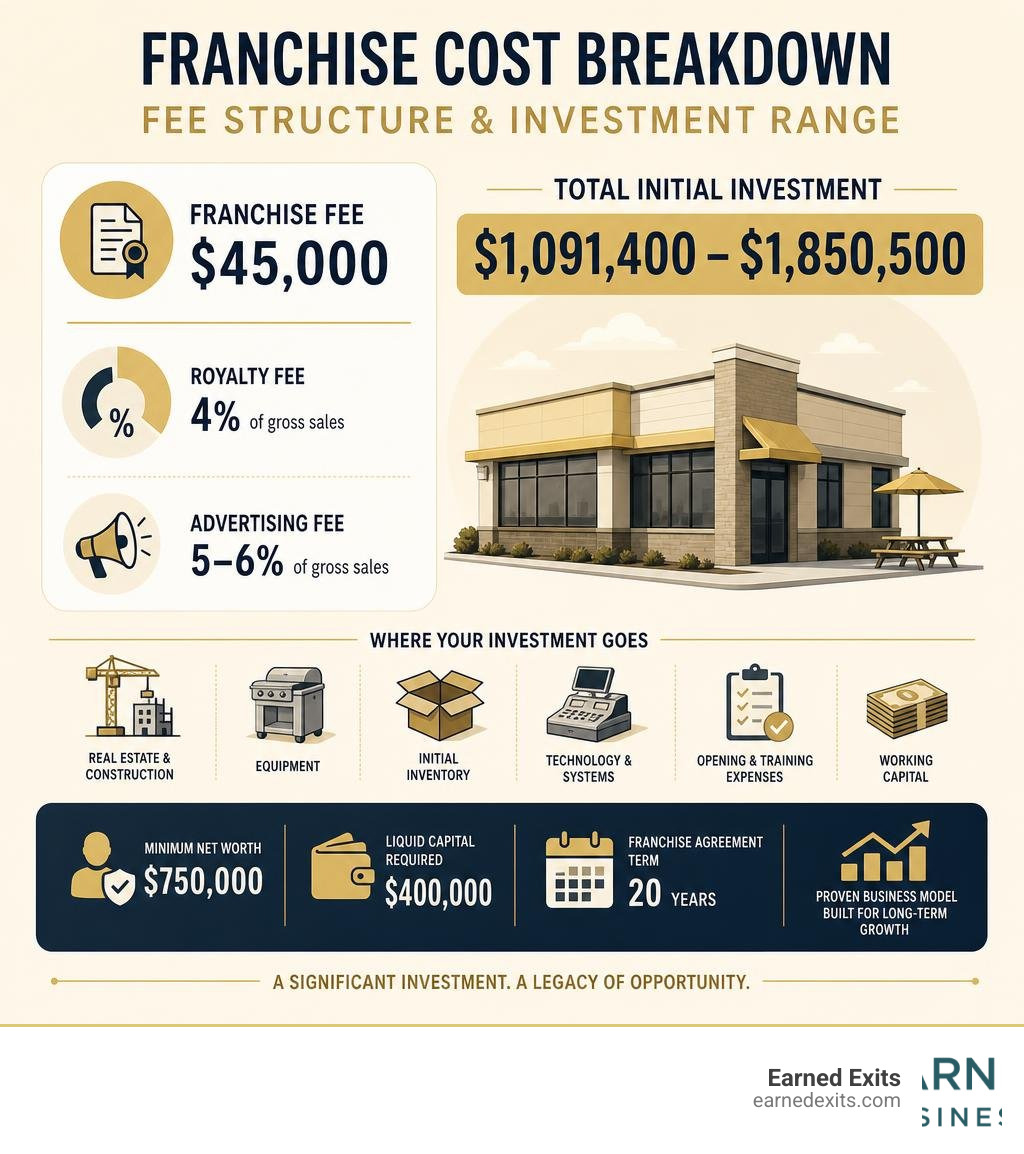
The dairy queen franchise cost falls between $1,091,400 and $1,850,500 in total initial investment, making it one of the more significant commitments in the quick-service restaurant space. Here’s a fast snapshot:
| Cost Item | Amount |
|---|---|
| Franchise Fee | $45,000 |
| Total Initial Investment | $1,091,400 – $1,850,500 |
| Minimum Net Worth Required | $750,000 |
| Liquid Capital Required | $400,000 |
| Royalty Fee | 4% of gross sales |
| Advertising Fee | 5–6% of gross sales |
| Franchise Agreement Term | 20 years |
Those numbers cover a lot of ground — from construction and equipment to initial inventory and working capital. The exact figure depends heavily on your store format, location, and local construction costs.
Dairy Queen has been around since 1938, long before food franchising was even a recognized business model. Today, with more than 7,800 locations across 20 countries and 95% brand name recognition in the U.S., it’s one of the most established franchise systems in the world. Since 1998, it has operated under Berkshire Hathaway — a level of financial backing that very few franchise brands can claim.
That combination of brand legacy, global scale, and corporate stability is a big part of why entrepreneurs keep looking at DQ as a potential investment. But brand recognition alone doesn’t pay the bills. Understanding what you’re actually getting into — financially and operationally — is what separates a well-planned investment from an expensive mistake.
I’m Britt Clas, a Business Broker and Partner at Earned Exits Business Brokers, and I work with entrepreneurs navigating major financial decisions — including evaluating the full dairy queen franchise cost before committing to ownership or planning an exit. In this guide, I’ll walk you through exactly what it costs, what you need to qualify, and what to watch out for.
Understanding the Total Dairy Queen Franchise Cost
When evaluating the dairy queen franchise cost, it is vital to look beyond the initial franchise fee. The $45,000 franchise fee is simply your ticket to entry. The true cost of getting a location up, running, and profitable is a multi-layered financial puzzle.
For a standard freestanding location, the bulk of your capital will go toward real estate development, site work, and construction. Building a restaurant from the ground up requires substantial outlays for civil engineering, utility hookups, zoning permits, and structural construction. If you are building a classic, freestanding Grill & Chill, building and site work alone can easily range from $700,000 to over $1,300,000.
Once the shell of the building is ready, you must outfit it. Dairy Queen’s proprietary kitchen setup—which includes specialized soft-serve machines, rapid-broilers for burgers, fryers, walk-in freezers, and point-of-sale (POS) systems—costs between $360,000 and $510,000.
To help visualize how these expenses differ by store format, let’s look at a realistic comparison of the two primary models: the full-service Grill & Chill and the smaller, treat-focused formats (such as mall-based Treat Centers or non-traditional kiosks).
Store Format Cost Comparison
| Expense Category | Grill & Chill Format | Treat-Only / Kiosk Format |
|---|---|---|
| Initial Franchise Fee | $45,000 | $25,000 – $35,000 |
| Real Estate & Buildout | $700,000 – $1,500,000+ | $80,000 – $300,000 |
| Equipment, Signage & POS | $360,000 – $510,000 | $100,000 – $250,000 |
| Initial Inventory | $15,000 – $25,000 | $5,000 – $10,000 |
| Working Capital (3 Mos) | $80,000 – $150,000 | $20,000 – $50,000 |
| Total Estimated Investment | $1,516,200 – $2,543,050 | $215,000 – $650,000 |
As shown above, the cost of opening a full-service Grill & Chill is significantly higher due to the physical footprint, drive-thru infrastructure, and more complex kitchen equipment. However, the revenue potential is also vastly different. You can explore a highly detailed, category-by-category breakdown of these startup expenses by visiting the Dairy Queen Franchise Cost – Startup Investment & Fees guide.
Financial Requirements and Qualifications for Franchisees
Because Dairy Queen is a premier, globally recognized brand, its corporate development team is highly selective. They do not just look for individuals who can write a check; they conduct rigorous financial and operational screenings to ensure that every new owner is positioned for long-term success.
Meeting the Liquid Capital and Dairy Queen Franchise Cost Requirements
To qualify for a single-unit Dairy Queen franchise, corporate headquarters requires a minimum net worth of $750,000 and at least $400,000 in liquid capital. Liquid capital refers to cash, market-ready securities, or other assets that can be converted to cash within 30 days.
It is worth noting that while the corporate minimum for liquid capital is $400,000, many SBA lenders and commercial banks require a larger cash cushion. In the current economic climate of 2026, lenders often look for six months of operating reserves in escrow. This can add an extra $40,000 to $80,000 in cash requirements above the published corporate floor.
Having this extra working capital is essential. The Franchise Disclosure Document (FDD) lists estimated working capital at $80,000 to $150,000, but real-world experience shows that the actual cash burn during the first year of business is often closer to $150,000 to $250,000 as you hire staff, establish local marketing, and smooth out supply chain logistics. For more details on these baseline financial requirements, refer to the overview on the Dairy Queen: Ice Cream & Fast Food Franchise profile.
Operational Experience and Multi-Unit Commitments
Financial strength is only half of the equation. Dairy Queen strongly prefers candidates with a proven background in restaurant management or fast-casual food service operations.
DQ is strictly not a passive or semi-absentee franchise model. Corporate expects the franchise owner to be hands-on, actively managing the day-to-day operations of the store—especially during the critical first year. If you do not plan to be the active operator, you must designate an approved operating partner who holds an equity stake in the business and has extensive restaurant management experience.
Additionally, to maintain your franchise agreement, corporate requires that each location have at least three certified DQ managers on staff at all times. This ensures that even when you are not physically in the building, the brand’s strict operational standards, food safety protocols, and customer service expectations are met.
If you are looking to build a larger footprint, DQ actively encourages multi-unit development agreements. However, stepping up to a multi-unit commitment naturally increases your financial requirements, often pushing the required net worth to $1.5 million or more.
Performance, Training, and Store Formats
Success in the franchise world depends on how well you execute a proven system. Dairy Queen has spent nearly nine decades refining its operational models, training programs, and store layouts to ensure that new owners can hit the ground running.
Evaluating the Dairy Queen Franchise Cost Against Expected Revenue
When you invest over a million dollars into a business, your primary question is: What is my return on investment?
According to historical FDD data, a standard freestanding Dairy Queen Grill & Chill location generates an Average Unit Volume (AUV) of $900,000 to $1.4 million, with top-performing units in high-traffic areas exceeding $1.5 million to $1.6 million annually.
At these revenue levels, a well-run location typically operates on an EBITDA margin of 8% to 12% (though highly efficient owner-operators can achieve up to 15% to 20% restaurant-level profit margins). This translates to an estimated Year-1 owner cash flow of $90,000 to $160,000 on a $1.4 million AUV, which can grow to $140,000 to $220,000 by Year 3 as operational efficiencies improve.
However, profitability is heavily influenced by two unique factors:
- Seasonal Demand: In northern states, Dairy Queen locations experience extreme seasonality. It is not uncommon for a store in Minnesota, Wisconsin, or Montana to generate 65% to 70% of its total annual sales between April and September. Managing cash flow during the slower winter months is a critical skill for DQ owners.
- Cake Merchandising: Ice cream cakes are one of the highest-margin items on the DQ menu. At top-performing units, cake sales represent 12% to 18% of total AUV. Operators who aggressively market and merchandise custom cakes can significantly boost their overall profitability.
To see what this looks like in practice, you can review real-world financial performance and cash flow metrics in our listing for Sundaes Best Dairy Queen 380k SDE Drive Thru Small Town Charm, which highlights how a well-positioned drive-thru location can maximize owner earnings. For a broader look at national revenue averages across different regional sub-franchises, check out the analysis on Dairy Queen Franchise 2026: $1.7M–$2.8M, $1.5M Revenue.
Training Programs and Ongoing Corporate Support
To help you achieve these financial benchmarks, Dairy Queen provides a comprehensive, world-class training program. Before your grand opening, you and your management team will undergo:
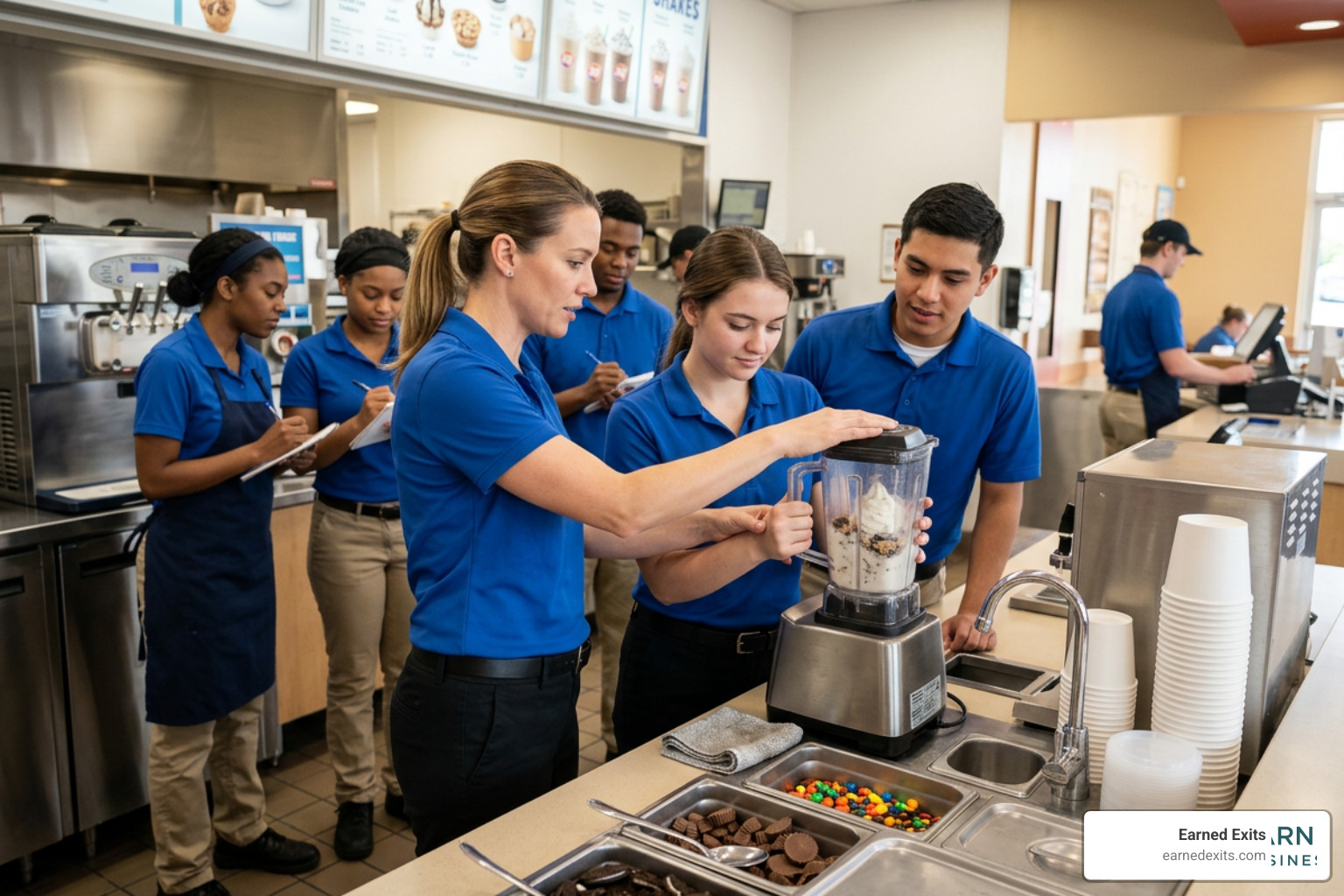
- 142 hours of on-the-job training inside an active, certified training store. Here, you will learn the mechanics of food prep, inventory management, labor scheduling, and customer service.
- 32 hours of classroom training, covering business analytics, local store marketing, financial management, and brand standards.
Once your doors are open, corporate support remains highly active. You will have access to a dedicated Field Consultant, nationwide supply chain networks that secure stable pricing on ingredients, and integrated marketing programs. DQ’s modern mobile app and loyalty program also help drive repeat visits and increase average ticket sizes through targeted digital promotions.
Frequently Asked Questions about DQ
Investing in a franchise is a major life decision. Here are direct answers to some of the most common questions prospective buyers ask during their due diligence process.
What is the ongoing royalty and marketing fee structure?
Dairy Queen operates on a percentage-of-sales fee structure. As a franchisee, you will pay an ongoing royalty fee of 4% of gross sales. In addition to the royalty, there is a marketing/advertising fee of 5% to 6% of gross sales.
This combined fee load of 9% to 10% is on the higher end for the quick-service restaurant industry. It means that for every $100,000 your store brings in, $9,000 to $10,000 goes directly to corporate before you pay for labor, food costs, rent, or utilities. This high fee structure is why we strongly advise against opening single-unit, non-drive-thru locations in expensive coastal markets where high labor and rent costs can easily squeeze your net margins. You can read a complete breakdown of how these fees impact long-term profitability in the evaluation Should I open or buy a Dairy Queen franchise in 2027?.
Are there development incentives for multi-unit operators?
Yes! To accelerate growth, American Dairy Queen has introduced highly attractive development incentives. Currently, qualified operators who sign development agreements can access a $150,000 cash incentive for opening a new freestanding Grill & Chill location.
Furthermore, if you commit to multi-unit growth, corporate offers a $200,000 cash incentive for each additional unit opened within an 18-month window. These incentives can significantly lower your upfront capital requirements and shorten your overall payback period, making multi-unit development the preferred route for well-capitalized investors.
Can I buy an existing Dairy Queen franchise instead of building new?
Absolutely, and in many cases, we highly recommend it. Buying an existing, operational Dairy Queen franchise offers several distinct advantages over building a new one from scratch:
- Immediate Cash Flow: You bypass the 9-to-15-month construction and permitting phase and start generating revenue on day one.
- Proven Performance: You don’t have to guess at the AUV; you have years of historical tax returns and profit-and-loss statements to analyze.
- Established Staff & Customer Base: The store already has trained managers, kitchen staff, and a loyal local customer base.
However, buying an existing store requires careful due diligence. You must carefully inspect the physical facility for deferred maintenance. Dairy Queen corporate typically mandates major facility remodels at the 10-year mark of a franchise agreement. If you buy an older store, you may inherit a corporate mandate to spend $200,000 to $400,000 on modernization shortly after taking ownership.
If you are an existing owner looking to transition out of the business, or a buyer looking to acquire an established location, we can help guide you through the valuation and transfer process. Learn more about how we facilitate these transitions by visiting our specialized Sell Your DQ page.
Conclusion
Investing in a Dairy Queen franchise is a journey into a legendary brand with incredibly strong consumer loyalty, recession-resistant appeal, and the robust backing of Berkshire Hathaway. However, with a total dairy queen franchise cost ranging from $1.1 million to over $2.5 million depending on the format, it is an investment that requires thorough financial planning, realistic cash flow modeling, and active, hands-on management.
Whether your goal is to build a new freestanding Grill & Chill, acquire an existing location with proven cash flow, or eventually exit the system and cash in on the equity you’ve built, having the right professional guidance makes all the difference.
At Earned Exits, we specialize in helping business owners navigate the complexities of buying, valuing, and selling businesses. Our experienced team provides comprehensive CFO and due diligence support, clear communication, and a seamless, organized process designed to maximize your value and protect your hard-earned wealth.
If you want to explore your options in the franchise market, or if you are ready to plan your eventual transition, we invite you to explore our services on our Sell My Business page. Let us help you make your next business exit your most profitable one.
