


California Business Valuation: The Ultimate Guide to Finding Your Company’s True Value
What Is Business Valuation in California — and What Should You Expect?
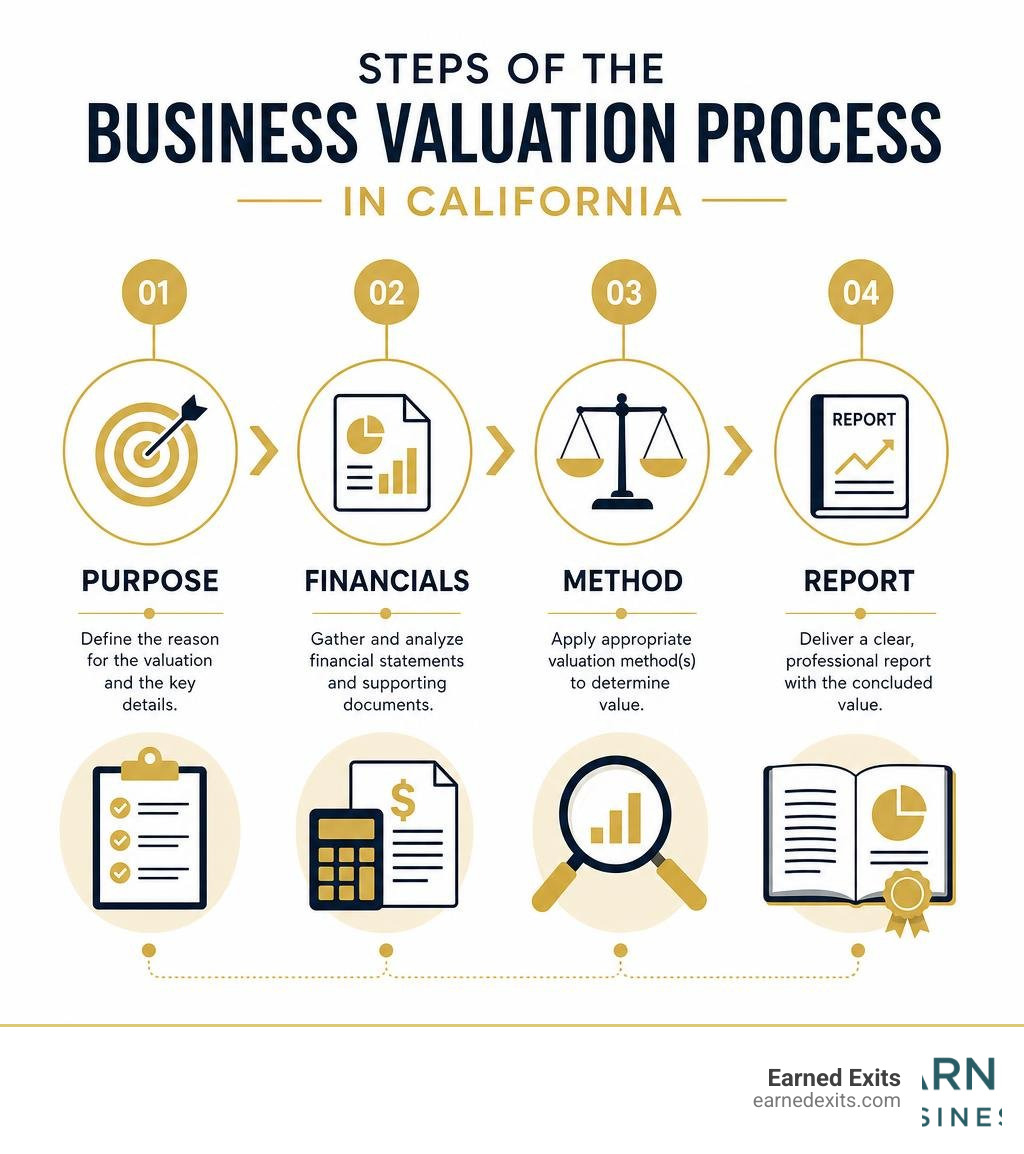
Business valuation in California is the formal process of determining what your company is worth — in dollars, on a specific date, for a specific purpose.
Here’s a quick overview of what that means in practice:
| Question | Quick Answer |
|---|---|
| What is it? | A professional analysis of your company’s fair market value |
| Who needs it? | Owners selling, planning estates, seeking financing, or handling legal matters |
| What approaches are used? | Income, market, and asset-based |
| How much does it cost? | Roughly $2,500–$10,000+ depending on scope and complexity |
| How long does it take? | Typically 5–20 business days after receiving all documents |
| Who performs it? | Credentialed professionals (ASA, NACVA, CPA/ABV) |
California’s economy is the fifth largest in the world, spanning tech, biotech, entertainment, agriculture, real estate, and professional services. That scale and diversity makes business valuation here more complex — and more consequential — than in most other states.
Whether you’re preparing to sell, planning your estate, or navigating a dispute with a co-owner, understanding what your business is truly worth is one of the most important financial steps you’ll take as an owner.
Most business owners only go through this process a handful of times in their careers. That’s exactly why it can feel so unfamiliar — and why getting it right matters so much.
I’m Britt Clas, a business broker and partner at Earned Exits, where I’ve guided entrepreneurs through the full exit process — including business valuation in California and across the country — as part of over $2 billion in completed transactions. In this guide, I’ll walk you through everything you need to know so you can approach your valuation with confidence.
Why Business Valuation in California is Essential for Owners
Operating a business in California comes with incredible opportunities, but also unique regulatory, legal, and financial landscapes. Because of this, relying on “back-of-the-napkin” math or generic online calculators to estimate your company’s worth can be a costly mistake.

A certified, defensible appraisal is often a legal or operational necessity. In our work at Earned Exits, we frequently see California business owners require a professional valuation for several critical reasons:
- Mergers and Acquisitions (M&A): If you plan to sell your business, you need to establish a realistic baseline value. An accurate appraisal helps you avoid pricing your business too low (leaving money on the table) or pricing it too high (scaring off qualified buyers). To understand the broader framework of this process, you can read The Definitive Guide to Business Valuation.
- Estate and Gift Tax Planning: When transferring ownership interests to family members or heirs, the IRS requires a formal valuation to assess gift and estate taxes. If a business owner passes away, the estate tax return is generally due within nine months, requiring a highly defensible valuation of the decedent’s business interests. For lifetime gifts, valuations must be completed to support tax filings due by April 15 of the following year.
- Shareholder and Partnership Disputes: If a co-owner wants to exit, or if partners reach an impasse, a neutral, third-party valuation is the only fair way to structure a buyout and prevent protracted litigation.
- Employee Stock Ownership Plans (ESOPs): Under federal law, an ESOP cannot pay more than “adequate consideration” for employer securities. This requires an independent valuation both at the inception of the plan and on an annual basis.
- SBA 7(a) Loans and Business Financing: If a buyer is utilizing an SBA 7(a) loan to purchase your business, the SBA mandates an independent business valuation for any loan over $250,000, or when the buyer and seller have a close relationship.
- Marital Dissolution and Community Property: California is a community property state. This means that assets acquired during a marriage are presumed to be owned equally by both spouses. In a divorce, a business or professional practice must be valued to ensure an equitable division of assets. Courts will often appoint a joint forensic accountant under California Evidence Code Section 730, or each spouse may hire their own expert under Section 733 to establish the community’s share of the business’s value.
Primary Approaches to Business Valuation California
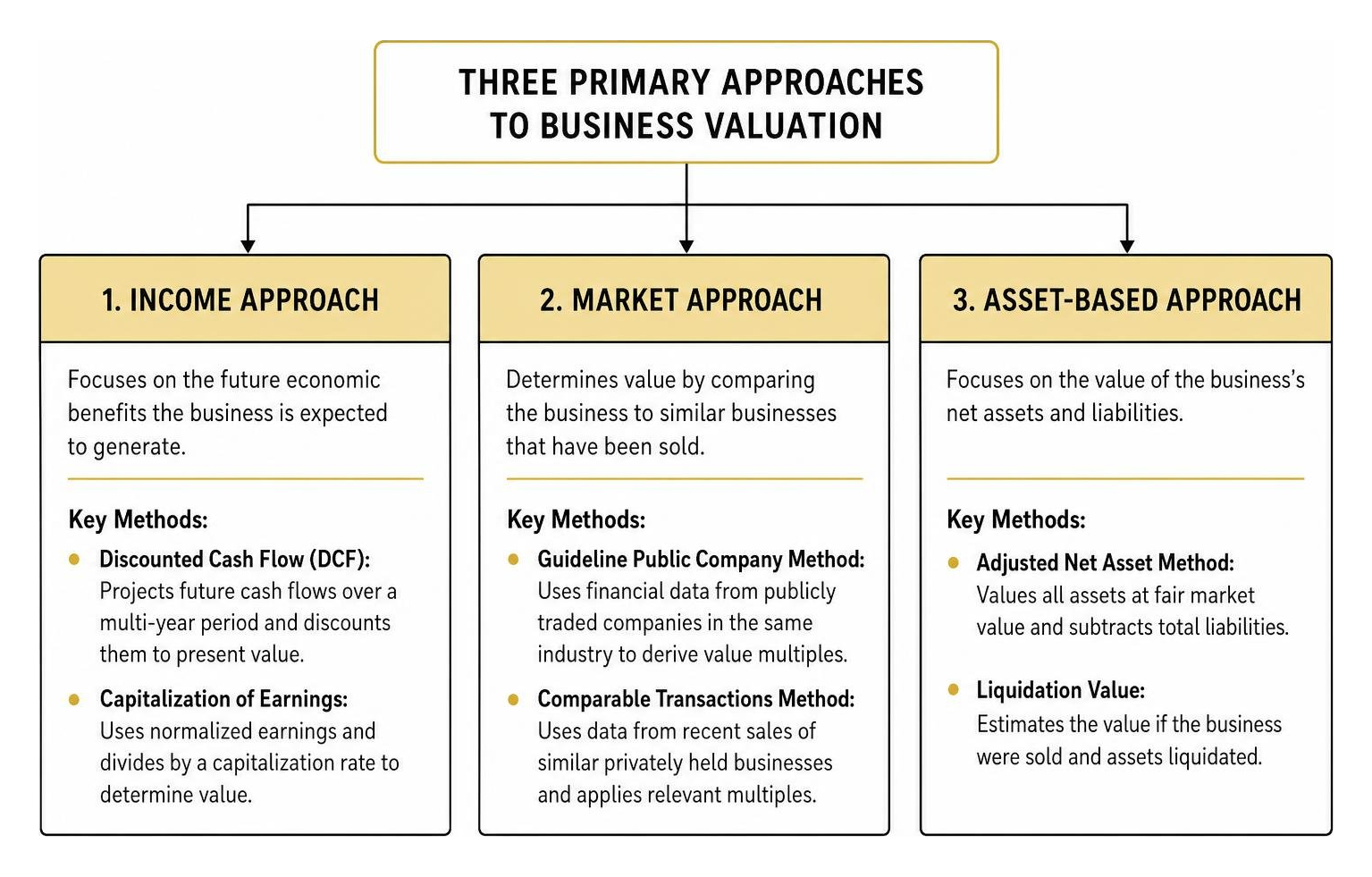
Professional appraisers do not rely on guesswork or simple industry rules of thumb. Instead, they look at your business through three primary valuation lenses, often combining and weighting them based on your specific industry and the purpose of the appraisal.
1. The Income Approach
The income approach focuses on the future economic benefits the business is expected to generate. It translates future cash flows into a single, present-day dollar value. The two most common methods under this approach are:
- Discounted Cash Flow (DCF): This method projects the company’s free cash flows over a multi-year period and discounts them back to the present day using a discount rate that reflects the risk of the business and the time value of money.
- Capitalization of Earnings: Best suited for stable, mature businesses with predictable earnings, this method takes a single period of normalized historical earnings and divides it by a capitalization rate to determine the business value.
To dive deeper into these calculations, explore The Ultimate Guide to Small Business Valuation Methods.
2. The Market Approach
The market approach determines value by comparing your business to similar companies that have recently sold or are publicly traded.
- Guideline Public Company Method: This method compares your business to publicly traded companies in the same industry, applying adjusted valuation multiples (like Price-to-Earnings or EV-to-EBITDA) to your financial metrics.
- M&A Transaction Method: This analyzes transaction data from private company sales within your industry to see what real-world buyers are actually paying for similar operations.
3. The Asset-Based Approach
The asset-based approach calculates value by subtracting the company’s total liabilities from the fair market value of its total assets. Rather than relying on historical book value, an appraiser will adjust assets (such as real estate, equipment, and inventory) to their current market value. This approach is highly relevant for asset-heavy businesses like manufacturing, real estate holding companies, or underperforming businesses where liquidation value is higher than operating cash flow value. For a comprehensive breakdown, see our A Complete Asset-Based Valuation Guide.
Comparing the Valuation Approaches
| Valuation Approach | Primary Focus | Best Suited For | Key Metric / Method |
|---|---|---|---|
| Income Approach | Future cash flows and risk profile | Service businesses, high-growth tech, stable cash-generating entities | Discounted Cash Flow (DCF), Capitalization of Earnings |
| Market Approach | Real-world transaction data and multiples | Industries with active M&A markets (retail, distribution, software) | Guideline Public Company, Private Transaction Multiples |
| Asset-Based Approach | Net value of tangible and intangible assets | Manufacturing, real estate, holding companies, liquidating firms | Adjusted Net Asset Method |
California-Specific Factors and Appraiser Standards
Valuing a business in California requires more than general financial knowledge; it demands a deep understanding of the state’s unique economic and regulatory environment.

Several local factors can significantly impact your company’s fair market value:
- Tax Environment: California has the highest state income tax rate in the country, topping out at 13.3%. This heavy tax burden, combined with aggressive Franchise Tax Board (FTB) audits, must be factored into cash flow projections and discount rates. For businesses converting from a C-Corporation to an S-Corporation, a timely valuation is required to establish the tax basis and avoid built-in gains taxes if assets are sold within five years.
- Regulatory and Environmental Compliance: Stringent environmental laws, labor regulations, and local zoning ordinances in California can increase operating costs, which directly affects net cash flows and reduces overall business value compared to similar businesses in less regulated states.
- Regional Economic Conditions: A tech firm in Silicon Valley operates under vastly different market multiples, talent acquisition costs, and growth trajectories than an agricultural business in the Central Valley. A qualified appraiser must understand these hyper-local dynamics.
Professional Appraiser Credentials
Because of these complexities, you should only trust your business appraisal to professionals holding recognized credentials. Look for experts certified by the leading valuation authorities:
- ASA (Accredited Senior Appraiser): Granted by the American Society of Appraisers, this requires rigorous training and a minimum of five years of full-time valuation experience.
- CVA (Certified Valuation Analyst): Granted by the National Association of Certified Valuators and Analysts (NACVA).
- ABV (Accredited in Business Valuation): A specialty credential for CPAs granted by the American Institute of Certified Public Accountants (AICPA).
For a detailed breakdown of what these credentials mean for your business, check out Everything You Need to Know About Accredited Business Valuation.
Furthermore, any valuation intended for tax, court, or lending purposes must comply with the Uniform Standards of Professional Appraisal Practice (USPAP) and IRS Revenue Ruling 59-60. These standards outline the ethical and performance guidelines that ensure an appraisal is unbiased, thorough, and legally defensible. CPAs performing these services must adhere to strict guidelines, which you can read about in Business Valuations: Applicable Standards for CPAs.
Types of Valuation Reports
Depending on your goals and budget, appraisers offer different types of reports:
- Comprehensive Report (40–100+ pages): A highly detailed, fully documented report that stands up to IRS audits, FTB scrutiny, and court trials.
- Summary Report (5–25 pages): A streamlined report that outlines the key findings and methodologies, ideal for internal planning or informal partnership buyouts.
- Calculation Report: A limited-scope analysis that provides a preliminary estimate of value based on agreed-upon procedures. It is cost-effective but not intended for court or tax filings.
Frequently Asked Questions About Business Valuation California
How much does a professional business valuation california cost and how long does it take?
For a comprehensive, IRS-defensible business appraisal in California, the cost typically ranges from $2,500 to $10,000+, depending on the size of the business, the complexity of its capital structure, and the industry.
Limited-scope calculations or preliminary assessments for internal planning can range from $500 to $1,000.
The typical timeline to receive a complete Professional Business Valuation Report is 5 to 20 business days after you have provided all the necessary financial documents and records.
How do courts and the IRS challenge a business valuation california?
The IRS and California courts frequently challenge valuations that rely on generic formulas, outdated market data, or unsupportable assumptions.
To make an appraisal defensible, the appraiser must justify their calculations, particularly regarding:
- Discount for Lack of Marketability (DLOM): This discount accounts for the difficulty of quickly converting a private business interest into cash. The IRS heavily scrutinizes these discounts; they must be backed by real-world transaction data, not arbitrary assumptions.
- Discount for Lack of Control (DLOC): Applied to minority ownership interests, this discount reflects the owner’s inability to direct company operations or force a sale.
Combined, these discounts can sometimes exceed 40% of the entity’s net asset value, making them a primary target for audits. If a valuation ends up in court, the appraiser must be prepared to provide expert witness testimony to defend their methodology under cross-examination.
What documents are required for a California business appraisal?
To perform an accurate and thorough valuation, an appraiser will typically ask you to gather the following documents:
- Federal and state tax returns (usually the last 3 to 5 years)
- Historical financial statements (balance sheets, income statements, and cash flow statements)
- Year-to-date financial statements and current-year projections
- Detailed depreciation schedules for tangible assets
- Organizational documents (articles of incorporation, bylaws, or partnership agreements)
- A management census detailing key employees, roles, and compensation
- Lists of major customers, suppliers, and competitors
Conclusion
Obtaining a professional business valuation in California is one of the most powerful strategic tools available to an owner. It goes far beyond simply putting a price tag on your hard work. A clear understanding of your company’s true value reveals operational strengths, uncovers hidden inefficiencies, and provides a concrete roadmap for maximizing your eventual exit value.
At Earned Exits, we specialize in helping business owners navigate the complexities of exit planning, business brokerage, and strategic planning. We provide the thorough support and clear communication you need to transition your business seamlessly when the time is right.
If you are ready to stop guessing what your business is worth and start planning your next chapter with confidence, contact us today to learn more about our professional Business Valuation Services.
