


Bluegrass and Business Brokers: Selling Your Kentucky Franchise
Why Finding the Right Sell Franchise Kentucky Broker Makes All the Difference
If you’re ready to sell franchise Kentucky broker searches have led you to, here’s what you need to know at a glance:
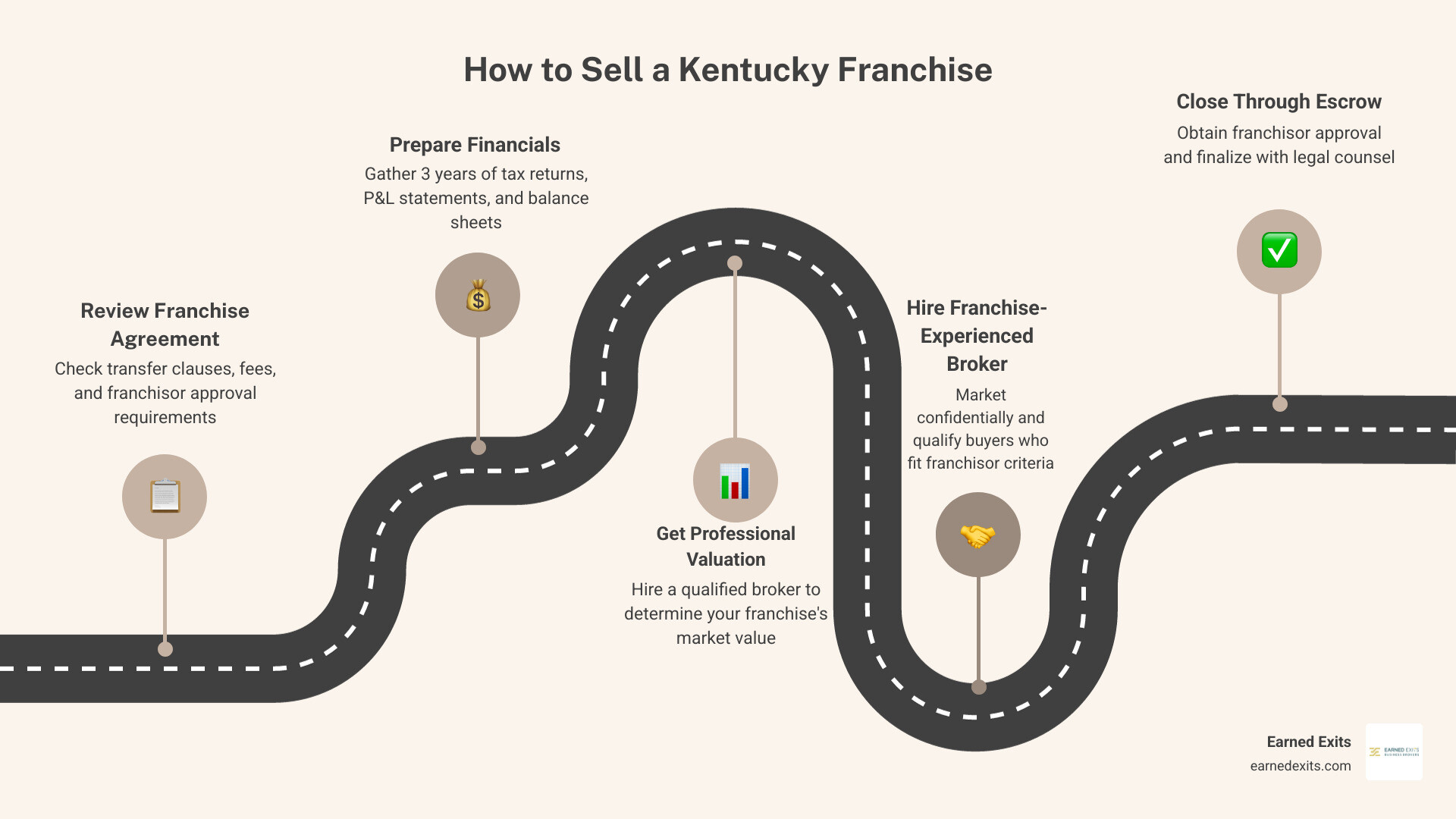
How to sell a franchise in Kentucky — quick answer:
- Review your franchise agreement for transfer clauses, fees, and franchisor approval requirements
- Prepare your financials — three years of tax returns, P&L statements, and balance sheets
- Get a professional valuation from a qualified business broker
- Hire a franchise-experienced broker to market confidentially and qualify buyers
- Obtain franchisor approval for your chosen buyer
- Close through escrow with legal counsel familiar with Kentucky business law
Kentucky’s franchise market spans more than 35 industries — from food and healthcare to mobile services and senior care. That diversity means real opportunity for sellers. But it also means the process is more layered than a standard business sale. Franchisor rules, transfer fees, buyer qualification requirements, and state regulations all add complexity that can catch first-time sellers off guard.
The good news? A skilled broker who knows the Kentucky market can walk you through every step.
I’m Britt Clas, a Business Broker and Partner at Earned Exits, where I specialize in helping entrepreneurs navigate the exit process — including the specific challenges that come with trying to sell a franchise with a Kentucky broker by your side. I’ve guided business owners through valuations, negotiations, and closings as part of a team with over $2 billion in completed transactions, so you’re in experienced hands from day one.
Basic sell franchise Kentucky broker glossary:
- franchise brokers
- franchise resale
- business valuation
Key Steps to Selling a Franchise in the Bluegrass State
Selling a franchise in Kentucky is a unique dance. Unlike selling an independent business where you only answer to the buyer and your own conscience, selling a franchise means dancing in a trio. You, the buyer, and the corporate franchisor must all agree on the rhythm.
The process begins by understanding your current Franchise Agreement. This contract is the law of your business land. It dictates whether you can sell, who you can sell to, how much you have to pay the corporate office to let you leave, and whether the franchisor has the right to buy the business back from you before anyone else can.
To help visualize how this differs from a traditional business exit, let’s look at the key operational differences:
| Feature | Independent Business Sale | Franchise Transfer / Sale |
|---|---|---|
| Primary Parties | Buyer and Seller | Buyer, Seller, and Corporate Franchisor |
| Transfer Fees | None | Typically 5% to 10% of the franchise fee (or a flat fee) |
| Approval Process | Buyer and Seller agree on terms | Franchisor must fully vet and approve the buyer |
| Training Requirements | Seller trains buyer (optional) | Franchisor mandates corporate training for the buyer |
| Right of First Refusal | Rare | Extremely common in franchise agreements |
Preparing Your Financials and Franchise Disclosure Documents
Buyers are not just buying your physical assets; they are buying your cash flow and the security of a proven system. To prove your business is worth their investment, you must pull together a comprehensive financial package. In 2026, buyers and lenders are more meticulous than ever.
You will need to gather:
- Three years of profit and loss (P&L) statements
- Balance sheets matching your tax returns
- Three years of federal and state tax returns
- Your current Franchise Disclosure Document (FDD) and any active local lease agreements
Your FDD is crucial because it outlines the rules of the franchise network. For a federal overview of what an FDD covers, the Federal Trade Commission provides a helpful Consumer’s Guide to Buying a Franchise. A professional broker will help you organize these papers into a clean, easy-to-read prospectus that highlights your “Seller’s Discretionary Earnings” (SDE) while clearly stating the ongoing royalty fees the new owner will inherit.
Securing Franchisor Approval and Managing Transfer Fees
One of the most common hurdles in a franchise sale is the Right of First Refusal (ROFR). This clause gives your franchisor the legal right to match any offer you receive and buy the business back themselves. We must submit our signed buyer agreement to the corporate office and wait for them to either pass on the option or exercise it.
Once the ROFR is waived, the buyer must go through the franchisor’s official approval process. This includes financial background checks, interviews, and mandatory corporate training. Additionally, you must determine who pays the transfer fee – a charge levied by the corporate office to cover administrative and training costs. This fee can range from a few thousand dollars to a significant percentage of the initial franchise fee, and who pays it is a major point of negotiation between you and the buyer.
How to Partner with a Sell Franchise Kentucky Broker to Maximize Value
Navigating these extra layers of corporate red tape is exactly why working with an experienced broker is highly recommended. When you partner with us for our business brokerage services, we act as your buffer, coordinator, and strategist.
A local broker understands the specific economic landscape of Kentucky, from the bustling commerce of Louisville and Lexington to the expanding markets of Bowling Green and Northern Kentucky. We know how to position your franchise’s local reputation alongside the national brand’s power to demand the highest possible market price.
Evaluating the Track Record of Your Sell Franchise Kentucky Broker
Not all business brokers are created equal, and very few specialize in the unique world of franchise transfers. When looking for the right professional to represent you, you need to check their credentials and experience.
Ask potential brokers:
- Have you successfully closed franchise sales in Kentucky before?
- Are you familiar with the transfer requirements of major national brands?
- Do you have an active network of qualified buyers looking specifically for franchise opportunities?
To make sure you don’t make a costly mistake when hiring representation, read through The Thorough Guide to Picking a Trusted Business Sale Broker.
How a Sell Franchise Kentucky Broker Markets Your Business
Marketing a franchise requires a delicate touch. If your employees, customers, or competitors find out you are selling, it can hurt your daily operations. A professional broker uses blind, confidential marketing strategies to attract buyers without revealing your exact location or identity.
Furthermore, we carefully screen every prospect. Kentucky’s franchise market has a wide variety of entry points. For instance, some buyers might look to local business directories and franchise portals to find new opportunities, but many prefer buying an established, revenue-generating location.
We filter these buyers based on minimum cash requirements. In Kentucky, franchise investments vary wildly:
- Low-cost/Vending franchises: Minimum cash required around $30,000 to $53,000 (e.g., Healthier 4U Vending)
- Mobile/Service franchises: Minimum cash required around $150,000 (e.g., Zoomin Groomin)
- High-investment/brick-and-mortar models: Minimum cash required upwards of $350,000 (e.g., Children’s Lighthouse)
By checking a buyer’s financial capabilities before sharing your sensitive business data, we protect your confidentiality and save you from wasting time on unqualified looky-loos.
Understanding Broker Commissions and the Sales Timeline in Kentucky
Before you list your business, you need to understand how brokers are paid and how long you will need to keep running your day-to-day operations.

Typical Commission Structures for Kentucky Brokers
Most business brokers in Kentucky operate on a success fee model. This means they only get paid when your business successfully closes.
The standard commission structure often follows the Double Lehman Scale or a flat percentage of the total transaction value (usually ranging between 8% and 12%, depending on the size of the deal). In some cases, co-brokering occurs when one broker represents the seller and another represents the buyer, with the commission split between them at no extra cost to you.
How Long Does the Franchise Sale Process Take?
On average, selling a franchise in Kentucky takes six to twelve months.
This timeline includes:
- Preparation (1-2 months): Valuation, gathering financial documents, and drafting marketing materials.
- Marketing & Buyer Screening (2-5 months): Finding and qualifying the right buyer.
- Negotiation & Due Diligence (1-2 months): Agreeing on terms and allowing the buyer to inspect your books.
- Franchisor Approval & Corporate Training (1-2 months): Waiting on the corporate office to approve the transfer and train the buyer.
- Closing & Escrow (2-4 weeks): Finalizing legal paperwork and transferring funds.
Legal Requirements and Common Pitfalls to Avoid
Selling a business in the Bluegrass State requires adhering to specific state laws and corporate mandates. If you want to avoid legal headaches, check out our guide on Finding the Best Local Business Brokers Near You Without Losing Your Mind.
Navigating Kentucky Franchise Regulations and Legalities
Kentucky requires several specific legal steps during a business transfer:
- State Tax Clearance: You must prove that your business does not owe any back taxes to the Kentucky Department of Revenue before transferring assets.
- Bulk Sales Laws: These laws protect creditors by requiring buyers to notify them of the impending sale of business assets.
- Non-Compete Agreements: Most franchise agreements contain strict geographic and industry-specific non-compete clauses that remain active even after you sell your location.
Costly Mistakes to Avoid When Selling Your Franchise
- Breaching Confidentiality: Telling your staff or customers too early can cause panic, leading to staff departures and dropping sales.
- Neglecting the Business: Many owners “check out” mentally once they decide to sell. If your revenue drops during the listing period, buyers will demand a lower price or walk away entirely.
- Ignoring Franchisor Rules: Trying to bypass the corporate transfer process can lead to the termination of your franchise agreement, leaving you with nothing to sell.
Frequently Asked Questions About Selling a Kentucky Franchise
What are the most in-demand franchise industries in Kentucky right now?
Kentucky’s franchise market is incredibly diverse, spanning over 35 industries. Currently, the most sought-after sectors include:
- Healthcare & Senior Care: Highly recession-resilient with a rapidly aging demographic.
- Mobile & Home-Based Services: Lower overhead options like mobile pet grooming (e.g., Zoomin Groomin) are highly attractive to lifestyle-focused buyers.
- Food & Beverage: Quick-service restaurants remain a staple of the Kentucky economy.
- Vending & Automated Retail: Low-cost entry models (e.g., Healthier 4U Vending) require minimal direct management and are highly popular for semi-absentee buyers.
How is an existing Kentucky franchise valued compared to a new one?
While a new franchise is sold based on future potential and corporate estimates, an existing franchise is valued based on historical financial performance and Seller’s Discretionary Earnings (SDE). An existing location is often highly attractive because it already has cash flow, trained staff, an established local customer base, and active local marketing channels. This immediate cash flow allows buyers to secure bank financing much easier than they could for a start-up location.
Can I sell my Kentucky franchise without franchisor approval?
Simply put: No. Your franchise agreement is a legally binding contract. Attempting to transfer ownership or sell assets without the explicit, written consent of the franchisor is a breach of contract. Doing so can result in the immediate termination of your franchise license, legal lawsuits, and the forfeiture of your business assets.
Conclusion
Selling your franchise in Kentucky doesn’t have to be an overwhelming process. By partnering with a dedicated broker who understands the local landscape and the corporate rules of franchise transfers, you can secure a clean exit and maximize your hard-earned value.
At Earned Exits, we pride ourselves on delivering a seamless, highly organized process. We support our clients with thorough CFO-level due diligence, excellent communication, and advanced tools designed to make your business transfer as efficient as possible.
Ready to take the next step? Visit our Sell My Business page today to schedule a confidential consultation and discover how we can help you achieve the perfect exit.
