


Beginner’s Guide to Selling a Business
What First-Time Sellers Need to Know Before They Sell a Business
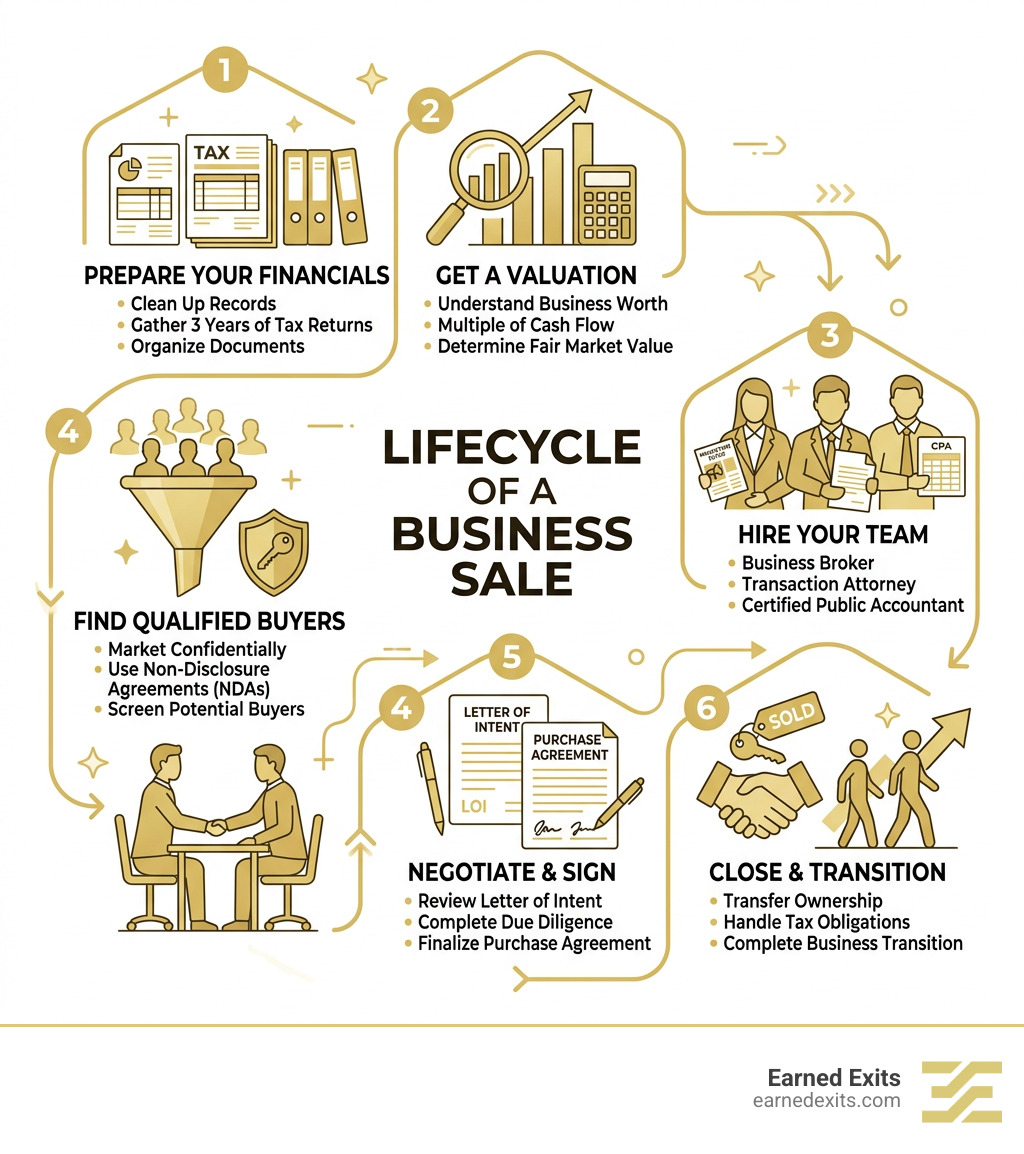
Ready to sell a business but not sure where to start? Here’s a quick overview of how the process works:
- Prepare your financials – Clean up records, gather 3 years of tax returns, and organize documents
- Get a valuation – Understand what your business is worth (typically 3-6x cash flow)
- Hire your team – Bring on a business broker, transaction attorney, and CPA
- Find qualified buyers – Market confidentially using NDAs and blind listings
- Negotiate and sign – Review the Letter of Intent, complete due diligence, finalize the purchase agreement
- Close the deal – Transfer ownership, handle tax obligations, complete the transition
Selling a business is one of the biggest financial decisions you’ll ever make. For most owners, it’s also completely unfamiliar territory.
You’ve spent years – maybe decades – building something valuable. But the process of exiting that business? It’s a different skill set entirely. There are valuations, legal documents, tax strategies, and negotiations to navigate. And one wrong move can cost you significantly.
The good news: with the right preparation and the right team, the process is manageable. Even for first-timers.
This guide walks you through everything – from deciding if the timing is right, to closing the deal and moving on to what’s next.
Why and When to Sell a Business

Deciding to sell a business is rarely a snap judgment. It is often the culmination of years of hard work and a shift in personal or professional priorities. We see owners move toward an exit for a variety of reasons. Retirement is the classic motivator—after decades at the helm, you’re ready to trade the boardroom for the beach. Others face burnout; the daily grind of operations can eventually wear down even the most passionate entrepreneur.
Strategic factors also play a role. You might notice the competitive landscape shifting or realize that to reach the next level, the company needs resources or capital that you aren’t prepared to provide. Sometimes, it’s simply about profit maximization—selling while the “getting is good” and your EBITDA is at an all-time high.
However, there are Many different factors may be involved in this choice. You must weigh the emotional attachment against your financial goals.
When You Should Consider NOT Selling
It’s just as important to know when to hold. If your industry is in a temporary slump, you might not get the valuation you deserve. If the business is currently experiencing a massive growth spurt, selling now could mean leaving significant money on the table. We also suggest reconsidering if you don’t have a “Plan B” for your life post-sale. The “seller’s remorse” is real if you haven’t visualized your next chapter. Furthermore, Deciding not to sell your business is often the right move if you have a clear path to succession within the family or if the business provides a level of financial stability that you can’t easily replicate elsewhere.
Pros and Cons of Selling
| Pros | Cons |
|---|---|
| Significant liquidity and financial freedom | Loss of identity and daily purpose |
| Elimination of personal liability and debt | Potential for “seller’s remorse” |
| Ability to pursue new ventures or retirement | Complex tax implications and high fees |
| Ensuring the business lives on under new leadership | Impact on loyal employees and company culture |
How to Value and Sell a Business
Before you hit the market, you need to know your “number.” Business valuation isn’t just about what’s in the bank; it’s about future earning potential. Most small to mid-sized businesses are valued using a multiple of their cash flow—specifically Seller’s Discretionary Earnings (SDE) or EBITDA. Typically, we see valuations ranging from three to six times the current cash flow, though this varies wildly by industry.
To get an accurate picture, you must understand “add-backs.” These are one-time or personal expenses (like your health insurance or that one-off legal fee) that are added back to the net income to show the true profit potential for a new owner. At Earned Exits, we provide Business Valuation Services to help you find that sweet spot. For a deeper dive into these mechanics, check out our guide on Unlocking Business Valuation: Exploring Methods and Market Multiples.
Determining the Right Market Timing
Timing the market is part science, part gut feeling. You want to sell when interest rates are favorable (making it easier for buyers to get loans) and when buyer interest in your specific sector is high. If your business has shown three years of consistent growth, you are in a position of strength. If you’re curious about where you stand today, we offer a Free Valuation to help you gauge the current climate.
Preparing Your Company for a Successful Exit
Preparation is the difference between a smooth closing and a deal that falls apart in the eleventh hour. Buyers hate surprises. Your goal is to make your business “due diligence proof.”
Financial Cleanup and Documentation
Start by cleaning up your books. You will need at least three years of tax returns and year-to-date financial statements. If you’ve been running personal expenses through the business (we won’t tell!), now is the time to stop and clearly document them. This is where Demystifying Add-Backs and Seller’s Discretionary Earnings becomes vital—you need to prove that the profit you claim is real and repeatable.
Operational Readiness
A business that relies entirely on the owner is hard to sell. To maximize value, you need to prove the company can run without you.
- Management Team: Do you have a “number two” who can handle operations?
- SOPs: Are your processes documented? Standard Operating Procedures make a transition seamless.
- IP Protection: Ensure your trademarks, patents, and domain names are legally secured and owned by the entity.
For more “war stories” and tips on preparation, see our Insights into Successful Business Exits.
Finding the Right Professional to Sell a Business
You wouldn’t perform surgery on yourself, so don’t try to sell a business without an expert team.
- Business Brokers/M&A Advisors: They are your quarterbacks. They find buyers, manage the process, and negotiate on your behalf. We offer comprehensive Business Brokerage Services to handle the heavy lifting.
- CPAs: Essential for tax planning and verifying financial data.
- Transaction Attorneys: They draft the contracts that protect you from future litigation.
When interviewing a partner, use these 10 Questions to Ask a Business Broker to ensure they are the right fit for your goals.
Maintaining Confidentiality During the Sale
The last thing you want is for your employees, customers, or competitors to find out you’re selling before the deal is done. This can lead to staff quitting or competitors poaching your clients. We use “blind listings”—advertisements that describe the business without naming it—to attract interest. Before any sensitive data is shared, buyers must sign a robust Non-Disclosure Agreement (NDA). Attempting Selling Your Business on Your Own: A Risk You Don’t Want to Take often leads to confidentiality leaks that can devalue your company overnight.
The Step-by-Step Process to Sell a Business
The path from “For Sale” to “Sold” follows a structured sequence. Understanding this 10 Steps Selling Process helps you stay patient during the months of work ahead.
- Valuation & Listing: Setting the price and going live.
- Buyer Screening: Vetting buyers for financial capability and experience.
- The LOI (Letter of Intent): A buyer makes a formal, non-binding offer.
- Due Diligence: The buyer “opens the hood” to verify everything you’ve told them.
- Purchase Agreement: The final, binding legal contract.
- Closing: The exchange of keys for cash.
Navigating Tax Implications and Legalities
Uncle Sam is going to want his cut. How you structure the deal—whether it’s an asset sale or an entity (stock) sale—has massive tax consequences. In an asset sale, the buyer picks and chooses which assets they want, which often results in higher taxes for the seller but less risk for the buyer.
The IRS requires a specific “allocation of consideration” using the residual method. This means you must allocate the purchase price across different asset classes (inventory, equipment, goodwill). Goodwill is usually taxed at capital gains rates, which is generally lower than ordinary income rates. For those facing more difficult circumstances, the IRS Bankruptcy Tax Guide provides critical info on debt cancellation. Also, keep in mind Internal Revenue Code section 332 regarding corporate liquidations if you’re structured as a subsidiary.
Before you sign anything, read our guide: Sealing the Deal: A Guide to Evaluating Offers.
Finalizing the Closing and Transition
The “Closing” involves signing a mountain of paperwork, including the Bill of Sale and potentially Promissory Notes if you are providing seller financing. Most deals include a training period (usually 30 to 90 days) where you stay on to teach the new owner the ropes. You will also likely sign a non-compete clause, preventing you from opening a similar business across the street.
This is about Selling Your Business: Crafting a Meaningful Exit Beyond Just the Price. You want to ensure your legacy is in good hands.
Frequently Asked Questions About Selling a Business
How long does it typically take to sell?
On average, it takes 6 to 12 months to sell a business. The first 1-2 months are spent on preparation and valuation, followed by 3-6 months of marketing and finding a buyer, and finally 2-3 months of due diligence and closing. Factors like your industry, the accuracy of your records, and the “cleanliness” of your financials can speed this up or slow it down. To see how a pro can accelerate this, read Master the Sale: How a Business Broker Elevates Your Exit Strategy.
What are the most common mistakes sellers make?
The biggest deal-killer is overpricing. If your asking price isn’t backed by data, savvy buyers will walk. Other common blunders include:
- Poor Record-Keeping: If you can’t prove your profit, it doesn’t exist to a buyer.
- Taking Your Foot Off the Gas: Many owners stop trying once they list the business. If performance declines during the sale, the buyer will renegotiate or pull out.
- Breaching Confidentiality: Telling the wrong person too early can cause chaos.
Guiding Your Success: Why Finding the Right Business Broker is Crucial explains how to avoid these pitfalls.
What are the typical costs involved in a sale?
Selling isn’t free. You should budget for approximately 15% of the sale price in total expenses. This typically includes:
- Broker Commissions: Generally 5% to 10% of the total sale price.
- Legal Fees: For drafting and reviewing contracts.
- CPA Fees: For tax planning and “audit-ready” financials.
- Closing Costs: Escrow fees and state-specific filings.
For more details on professional costs, see our Mergers and Acquisitions Advisory Services.
Conclusion
Selling your business is the final act of your entrepreneurial journey. It’s the moment you turn years of “sweat equity” into tangible wealth. But because the stakes are so high, you shouldn’t go it alone.
At Earned Exits, we specialize in making this complex process seamless and organized. From our thorough CFO and due diligence support to our suite of client tools designed for maximum efficiency, we ensure you don’t just sell—you exit with excellence. Whether you are in Alabama, California, Florida, or any of our many locations across the country, we are here to help you navigate the market with confidence.
Ready to take the first step? Visit us to Sell My Business and let’s start planning your meaningful exit today.
