


A Comprehensive Guide to Business Brokerage
Business Brokerage Makes a Complex Sale Manageable
Business Brokerage is the professional service of helping owners prepare, value, market, negotiate, and close the sale of a business. A business broker acts as an intermediary between seller and buyer, bringing structure to a process that can otherwise feel unfamiliar and high stakes.
For a first-time seller, the practical value is simple: a broker can help you organize financial records, set a supportable asking price, market the business without broadly revealing its identity, screen buyers, manage due diligence, and negotiate terms that work beyond the headline sale price.
Selling a business often takes 6 to 12 months through a professional broker. The work is not just finding a buyer. It is protecting confidentiality, keeping employees and customers from learning too early, resolving buyer questions, and getting every document and deadline ready for closing.
Britt Clas is a Business Broker and Partner at Earned Exits, where she helps entrepreneurs navigate Business Brokerage, from exit planning and valuation through marketing, negotiation, due diligence, and transition. She works with founders of businesses generating roughly $1 million to $40 million in revenue, with a focus on strong financial outcomes, buyer fit, and deal structures that protect a company’s legacy.
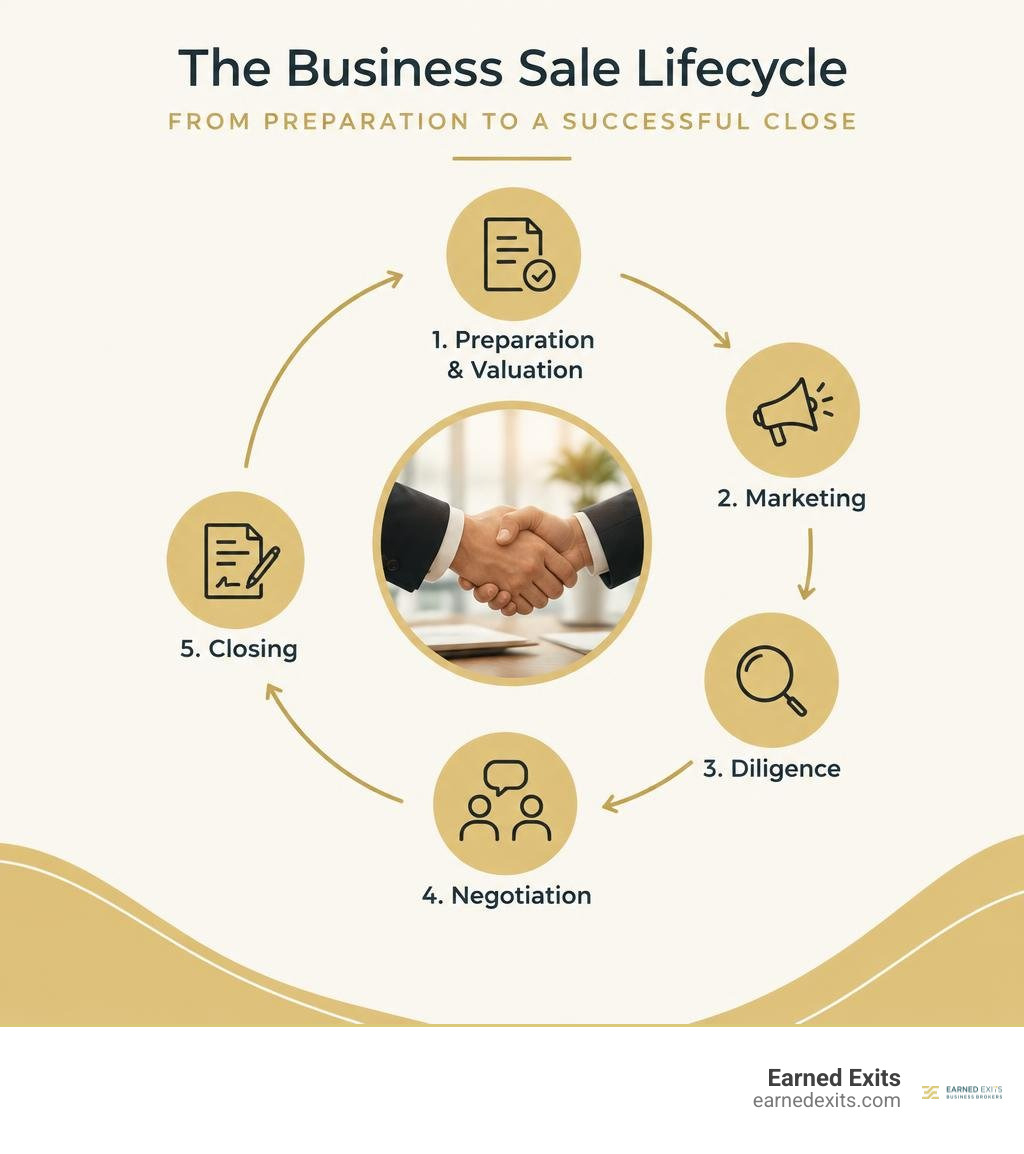
Business Brokerage terms made easy:
- business sale brokers near me
- local business brokers near me
- national industry network business brokers
What Is Business Brokerage and What Services Are Included?
At its core, a business brokerage acts as an essential bridge between those looking to transition out of ownership and qualified buyers seeking viable acquisitions. Selling an operating company is vastly different from selling real estate. It involves moving intangible assets, sensitive customer relationships, proprietary workflows, and active payrolls. Without an intermediary managing the flow of data, transactions can easily fall apart under the weight of misaligned expectations.
Professional representation offers deep operational relief. Exploring the perks of hiring a broker reveals that intermediaries don’t just find buyers; they recast financial statements, eliminate unqualified window-shoppers, coordinate legal documents, and preserve operational momentum so that your company’s performance does not dip while you focus on exiting.
Core Services Provided by a Business Brokerage Firm
A full-service brokerage manages every phase of the transaction lifecycle to ensure clean execution. These core responsibilities include:
- Financial Recasting and Normalization: Adjusting historical balance sheets and income statements to reflect true owner earnings by adding back discretionary, non-recurring, or personal expenses.
- Confidential Packaging: Drafting “blind” profiles (one-page teasers) and comprehensive Confidential Information Memorandums (CIMs) that describe the opportunity without revealing your company’s identity.
- Targeted Marketing and Buyer Screening: Filtering prospects by evaluating their net worth, liquidity, and operational experience before granting access to sensitive records.
- Deal Structuring: Crafting balanced purchase terms involving cash, seller notes, earn-outs, and equity rollovers across independent companies or growing franchise business models.
- Escrow and Legal Coordination: Guiding the transaction through definitive legal agreements, closing checklists, working capital adjustments, and escrow transfers alongside attorneys and CPAs.
Buyer and Seller Representation Dynamics
While many transactions involve exclusive seller representation—where the broker owes a fiduciary duty solely to the business owner—some engagements involve buyer-side representation or dual transactional facilitation.
When representing sellers, the intermediary focuses on maximizing valuation, securing favorable contract terms, and running a competitive bidding process. When assisting buyers, the broker helps clarify acquisition criteria, identifies off-market opportunities, analyzes underlying risks, and assists in securing acquisition financing, such as SBA 7(a) loans or private equity backing. In regions where dual representation is permitted, brokers act as neutral facilitators, ensuring fair disclosures, objective valuation baselines, and compliant asset transfers for both parties.
The Step-by-Step Business Brokerage Process from Listing to Closing

Navigating a sale requires a deliberate, milestone-driven framework. Understanding the business broker selling process helps owners anticipate timeline requirements and prevent deal fatigue from creeping in during extended reviews.
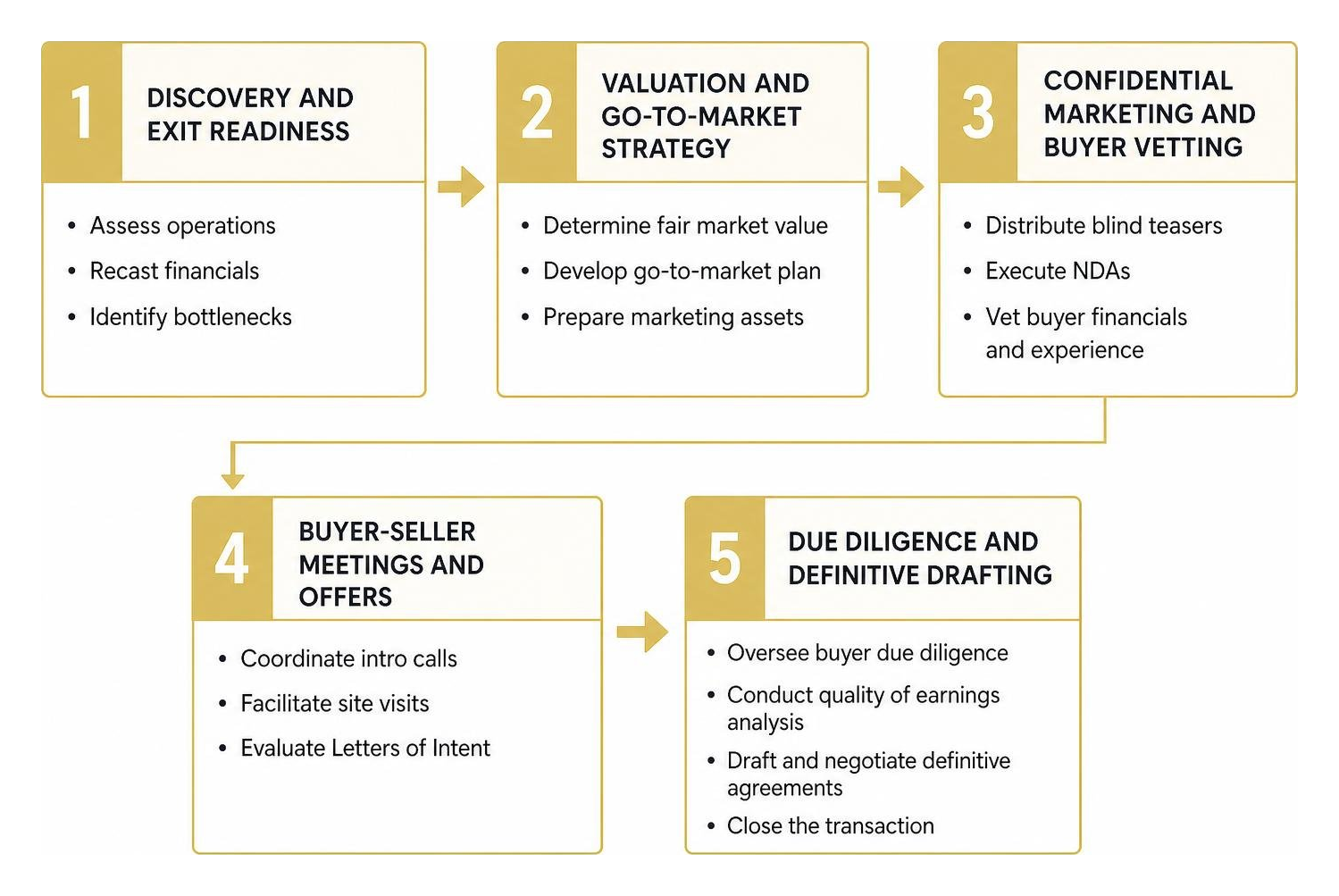
- Discovery and Exit Readiness: Assessing operations, recasting historical profit and loss statements, and identifying operational bottlenecks.
- Valuation and Go-to-Market Strategy: Establishing a defensible market price and preparing sanitized marketing assets.
- Confidential Marketing and Buyer Vetting: Circulating blind teasers to targeted industry buyers, securing Non-Disclosure Agreements (NDAs), and vetting financial capacity.
- Buyer-Seller Meetings and Offers: Coordinating preliminary introductory calls, site visits outside operating hours, and evaluating Letters of Intent (LOIs).
- Due Diligence and Definitive Drafting: Managing buyer audits, quality of earnings analyses, lease assignments, and Asset Purchase Agreement (APA) drafting.
- Closing and Handover: Executing legal transfers, funding escrow, finalizing prorations, and announcing the transition to staff and clients.
Valuation and Confidential Marketing Strategies
Determining the fair market value of a business is both an art and a science. For lower-middle-market and main street companies, valuation generally hinges on cash flow multiples. Small businesses valued under $1 million—which represent the vast majority of brokerage transactions—are typically priced using Seller’s Discretionary Earnings (SDE). Larger, management-led entities are valued using Earnings Before Interest, Taxes, Depreciation, and Amortization (EBITDA).
| Valuation Parameter | Seller’s Discretionary Earnings (SDE) | EBITDA Multiples |
|---|---|---|
| Target Business Size | Owner-operated (Revenue < $5M) | Management-led (Revenue $5M–$50M+) |
| Owner Compensation | Adds back one full-time owner’s salary | Normalizes owner salary to market rate replacement |
| Discretionary Perks | Includes personal auto, health, discretionary perks | Focuses purely on standardized enterprise profitability |
| Typical Valuation Range | 2.0x to 3.5x SDE | 4.0x to 8.0x+ EBITDA |
| Primary Buyer Pool | Individual owner-operators, corporate refugees | Private equity groups, family offices, strategic buyers |
Once the valuation is set, confidential marketing begins. We distribute blind summaries that outline high-level operational metrics, margins, and regional parameters without disclosing company names, specific addresses, or identifiable client lists. Only after a buyer signs an enforceable NDA and passes financial pre-qualification do we release the CIM.
Navigating Due Diligence and Closing the Transaction
Due diligence is the stage where the buyer verifies every operational, legal, and financial claim made about the company. The buyer’s accounting team will review tax filings, customer concentration figures, supplier contracts, employee handbooks, and standard operating procedures.
We streamline this rigorous phase by establishing organized Virtual Data Rooms (VDRs), coordinating Quality of Earnings (QoE) reviews, and negotiating deal terms to keep discussions productive. A strong intermediary prevents minor issues—such as unassigned software licenses or inventory discrepancies—from derailing weeks of progress.
Key Benefits and Costs of Professional Representation

Attempting to sell a company unassisted is comparable to performing your own surgery while running a marathon. Studies show that using a business broker can increase the final sale price of a business by an average of 15% to 25% compared to a for-sale-by-owner approach. Furthermore, professional brokers compress transaction velocity, achieving an exit within 6 to 12 months rather than the multi-year timelines common in private attempts.
For owners weighing different advisory styles, reviewing the 10 best business brokers compared helps highlight how experienced intermediaries bring market exposure that private sellers cannot replicate.
Maximizing Value and Managing Confidentiality Risks
Confidentiality breaches carry real financial consequences. If competitors, key staff, suppliers, or customers discover that an enterprise is on the market before terms are finalized, the resulting instability can erode company value quickly. In fact, premature disclosure can harm an active business’s market valuation by up to 20% due to client departures and employee turnover.
Brokers mitigate this risk by using staged disclosures:
- Tier 1 (Public): Blind industry profiles detailing general financial bands and regional attributes.
- Tier 2 (Post-NDA): Complete marketing memorandum with historical financials and brand scope.
- Tier 3 (Under LOI): Customer-level details, employee census, and intellectual property access.
Understanding Business Brokerage Commission and Fee Structures
Business brokerage compensation is structured around aligned incentives. In most arrangements, the intermediary earns a success fee calculated as a percentage of the total enterprise value upon a completed closing.
- Standard Success Fees: For main-street companies (under $1 million), success fees typically range between 10% and 12% of the transaction price, often subject to a minimum fee threshold.
- The Lehman Formula: For mid-market companies ($2 million to $20+ million), firms frequently use standard or Double Lehman scaling (e.g., 5% of the first million, 4% of the second, 3% of the third, etc.), reducing the percentage as the deal size expands.
- Retainers and Engagement Fees: Some brokerages charge upfront retainer fees to offset the costs of recasting, CIM creation, and targeted marketing campaigns.
To explore these cost dynamics in detail, see how brokerage fees are structured across different deal sizes.
How to Choose the Right Intermediary for Your Exit
Choosing the right transaction team is as critical as choosing a business partner. You are entrusting an intermediary with your most valuable asset, sensitive financial information, and personal transition goals.
Understanding what goes into hiring a professional business broker helps ensure you partner with an advisor who brings the right expertise to your specific industry. You can also explore curated overviews, such as the best business brokerage companies and comparisons of leading firms via the 5 best business brokers compared, to gauge how different teams position their offerings.
Key Evaluation Criteria for Advisory Firms
When interviewing potential brokerage partners, focus your assessment on these specific areas:
- Verifiable Transaction History: Demand past deal sheets demonstrating successful exits within your valuation range.
- Dedicated CFO and Due Diligence Support: At Earned Exits, we prioritize hands-on CFO support, clean virtual data rooms, and proactive document staging to eliminate surprises before buyers find them.
- Professional Credentials: Look for industry-standard designations such as Certified Business Intermediary (CBI) through the International Business Brokers Association or Mergers & Acquisitions Master Intermediary (M&AMI).
- Marketing Network: Ensure the intermediary uses diverse acquisition networks, proprietary databases, and co-brokerage platforms rather than merely posting a listing to a single classifieds board.
Working with a trusted business sale broker ensures that you avoid firms that make inflated valuation promises just to secure exclusive listing agreements.
Avoiding Common Pitfalls in M&A Transactions
Transactions frequently stumble when parties fail to anticipate standard friction points:
- Emotional Anchoring on Price: Fixating on an arbitrary exit number rather than grounding your valuation in verifiable financial trends.
- Messy Bookkeeping: Blending personal expenses with business operations without clean documentation, which can alarm institutional buyers.
- Premature Customer Outreach: Informing key accounts or employees of a planned exit before due diligence is satisfied and funds are secured.
- Operational Slump During the Sale: Diverting attention away from daily operations, resulting in declining revenues right before closing.
Frequently Asked Questions About Business Brokerage
How long does it typically take to sell a business through a broker?
Selling a business typically takes 6 to 12 months from the initial discovery meeting to final closing. Preparation and packaging take roughly 2 to 4 weeks, marketing and offer negotiation require 60 to 120 days, and due diligence, financing approval, and legal drafting generally consume the remaining 60 to 90 days.
What commission rate do business brokers charge?
Most business brokerages charge a success fee between 10% and 12% for transactions under $1 million. For mid-market companies ($2 million to $20+ million), firms generally employ tiered or scaled percentage models that decrease as the overall enterprise value increases.
How do brokers protect confidentiality during marketing?
Brokers safeguard identity by issuing blind profiles containing sanitized information, requiring signed, legally binding Non-Disclosure Agreements (NDAs), and vetting buyer identity and financial capacity before releasing any identifiable corporate materials or tax returns.
Conclusion
Exiting a business marks the culmination of years of financial investment, operational grit, and personal dedication. Executing a successful transition requires careful valuation, strict confidentiality, skilled negotiation, and disciplined due diligence management.
At Earned Exits, we simplify this journey with hands-on CFO support, transparent client communication tools, and a structured process designed to achieve top-tier market valuations. Whether you are beginning to plan your transition or are ready to go to market, partnering with an experienced intermediary lets you exit on your own terms. Learn how our team can help you prepare by exploring our business brokerage services.
