


A Complete Asset Based Valuation Guide
Why Every Business Owner Needs an Asset Based Valuation Guide
An asset based valuation guide walks you through how to determine what a business is worth by calculating the value of everything it owns, then subtracting what it owes.
Here’s the quick version of how it works:
- List all assets – both physical (equipment, property, inventory) and intangible (patents, trademarks, brand value)
- Adjust values to fair market value – not just what’s on the books
- List all liabilities – including debts, contingent liabilities, and off-balance sheet obligations
- Subtract liabilities from assets – the result is your Net Asset Value (NAV)
Formula: Total Assets (fair market value) – Total Liabilities (fair market value) = Business Value
Research suggests that 98% of business owners don’t actually know what their company is worth. If you’re preparing to sell, that’s a serious problem.
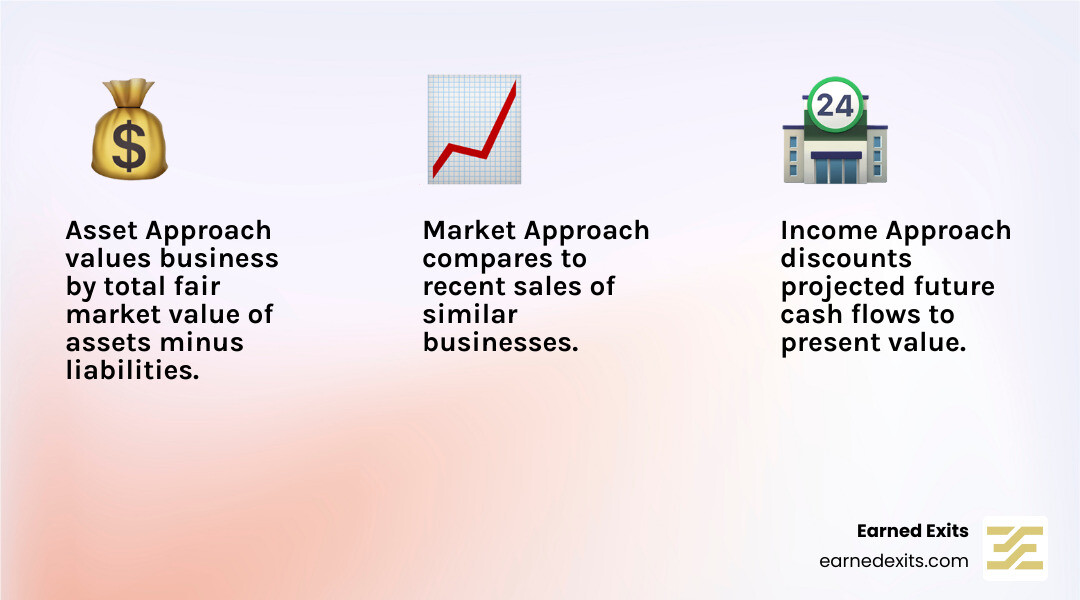
Asset-based valuation is one of three major approaches used by professional valuators – alongside the income approach and the market approach. It’s especially useful for businesses with significant physical assets, holding companies, or companies facing a sale or liquidation.
It sounds simple. But getting it right takes real skill.
This guide breaks down the methods, the steps, and the situations where this approach makes the most sense – so you can go into the selling process informed and confident.
What is Asset-Based Valuation?

At its core, asset-based valuation is a method of determining a business’s worth by focusing on its net asset value (NAV). Think of it as a “bottom-up” approach. Instead of looking at how much money the company might make in five years (the income approach) or what similar companies sold for recently (the market approach), we look at what the company actually has right now.
This method relies on the Principle of Substitution. This economic theory suggests that a prudent buyer wouldn’t pay more for a business than the cost to recreate an enterprise of equal utility. In other words, why pay $1 million for a landscaping company if you could buy the exact same trucks, mowers, and client contracts for $800,000?
In an asset based valuation guide, we categorize items into two buckets:
- Tangible assets: These are physical items you can touch, such as real estate, machinery, vehicles, and tangible assets like inventory or office supplies.
- Intangible resources: These are non-physical but highly valuable items like registered patents, trademarks, proprietary software, and brand recognition.
The Alphabet Inc. Case Study
To see this in the real world, look at a giant like Alphabet Inc. (GOOG). As of December 31, 2023, the company reported total assets of $402.4 billion. However, $29 billion of that was attributed to goodwill and other intangibles. After subtracting total liabilities of $119 billion, the company’s net tangible asset value sat at approximately $254.5 billion. While the market values Google much higher because of its future earning power, this asset-based figure provides a “floor value”—the absolute minimum the company is worth based on its holdings.
Primary Methods in an Asset Based Valuation Guide
Not all asset valuations are created equal. Depending on why you are valuing the business, we might use different techniques. Here are the primary methods you’ll encounter:
- Adjusted Net Asset Method: This is the “gold standard” for going-concern businesses. It involves taking the book value from the balance sheet and adjusting every item to its current fair market value.
- Asset Accumulation: A meticulous process of identifying every single asset and liability, including those not found on a standard balance sheet (like a pending lawsuit or a self-developed patent).
- Excess Earnings (The Treasury Method): This is a hybrid method. It values tangible assets but then adds a value for “goodwill” based on earnings that exceed a fair return on those tangible assets.
- Cost Approach: Often used for unique assets, this calculates the cost to replace an item with one of similar utility.
- Relief-from-Royalty: Specifically used for intangibles like trademarks, estimating how much you’d save by owning the asset rather than paying to license it.
Book Value vs. Fair Market Value
One of the most common mistakes we see is business owners relying on their tax returns or internal balance sheets. These use “Book Value,” which is often irrelevant for a sale.
| Feature | Book Value | Fair Market Value |
|---|---|---|
| Basis | Historical cost | Current market price |
| Depreciation | Standard accounting schedules | Actual physical condition |
| Intangibles | Often excluded or nominal | Included at market worth |
| Purpose | Tax and internal reporting | Buying/Selling a business |
The Adjusted Net Asset Method
The adjusted net asset method provides a more accurate reflection of a company’s value by adjusting the book values of assets and liabilities to their current fair market values.
For example, if you bought a warehouse 20 years ago for $200,000, your “book value” might be near zero after depreciation. However, the fair market value might be $2 million. We adjust that line item upward. Conversely, we re-evaluate liabilities. If you have a long-term loan with a high interest rate, that liability might actually be “worth” more in today’s market conditions.
Using the Excess Earnings Method in an Asset Based Valuation Guide
The Excess Earnings method is particularly popular for valuing professional practices (like law firms or medical offices) and successful privately held firms.
It works by:
- Calculating a fair rate of return on the company’s tangible assets.
- Comparing that to the actual total earnings.
- Any “excess” earnings are attributed to intangible value (goodwill).
- Capitalizing those excess earnings to find the total value of the goodwill.
This method bridges the gap between what a company owns and what it earns, making it a powerful tool in any asset based valuation guide.
Step-by-Step Process for Calculating Net Asset Value
Performing a thorough valuation is like being a financial detective. We follow a structured process to ensure nothing is missed. You can learn more about how this fits into broader strategies in our guide on Unlocking Business Valuation: Exploring Methods and Market Multiples.
Step 1: Identify All Business Assets We start with the audited balance sheet but go much deeper. We look for “off-balance sheet” items. Did the company develop a software tool internally that isn’t listed? Does it have a favorable long-term lease in a hot neighborhood?
Step 2: Assess the Value of Tangible Assets This often requires specialists. We might bring in an appraiser for heavy machinery or a real estate expert for land. We look at the “replacement cost new” and then subtract for physical, functional, and economic obsolescence.
Step 3: Evaluate the Value of Intangible Assets This is where it gets tricky. We look at patents, trademarks, and brand value. If a company has a 98% customer retention rate, that “customer list” has a quantifiable value, even if it doesn’t show up in your QuickBooks.
Step 4: Estimate All Liabilities We don’t just look at the current accounts payable. We investigate “contingent liabilities.” These are potential future costs, such as:
- Pending legal judgments.
- Environmental compliance costs.
- Product warranties.
- Unfunded pension obligations.
Step 5: Arrive at the Net Asset Value (NAV) Finally, we subtract the total adjusted liabilities from the total adjusted assets. This gives us the equity value of the business.
Identifying Intangibles in Your Asset Based Valuation Guide
Intangibles are often the most valuable part of a modern business, yet they are the hardest to value. Subjectivity is a major challenge here. To value a brand or a patent, we might look at the future cash flows that specific asset is expected to generate and discount them back to today’s dollars.
When to Apply the Asset-Based Approach
While we consider all three valuation pillars, the asset-based approach takes center stage in specific scenarios:
- Asset-Heavy Companies: Businesses like farms, construction firms, or manufacturing plants where the physical equipment and land represent the bulk of the value.
- Liquidation: If a business is closing its doors, we use a “forced liquidation” or “orderly liquidation” value. This assumes a quick sale, often resulting in values lower than fair market price.
- Holding Companies: If the business exists solely to own real estate or stocks, the value is simply the sum of those holdings.
- Distressed Sales: When a company is losing money, the income approach might show it’s worth nothing. The asset approach ensures the owner still gets value for the “bones” of the company.
- M&A Due Diligence: Buyers use this to ensure they aren’t overpaying for “blue sky” (goodwill) that isn’t backed by hard assets.
- Divorce and Bankruptcy: Courts often prefer the objectivity of asset-based methods for equitable distribution.
If you’re unsure if this is the right path for you, exploring our Valuation services can provide clarity.
Advantages and Limitations of the Asset Approach
Every asset based valuation guide must be honest about the pros and cons.
The Advantages:
- Objectivity: It’s much harder to argue with the value of a piece of equipment than it is to argue about projected sales in the year 2029.
- Transparency: It provides a clear, line-item breakdown of what is being bought.
- Statutory Requirements: Many tax authorities (like the IRS in gift tax scenarios) require an asset-based “floor” calculation.
The Limitations:
- Ignores Future Earnings: A highly profitable software company with no physical assets will look “worthless” under a strict tangible asset valuation.
- Depreciation Impact: Accounting depreciation rarely matches reality. A machine might be “fully depreciated” on paper but still have 10 years of productive life left.
- Service-Oriented Businesses: For consulting firms or agencies, the value is in the people and the processes, which this method can struggle to capture accurately.
Frequently Asked Questions about Asset-Based Valuation
What is the difference between book value and fair market value?
Book value is an accounting term. It’s what you paid for an asset minus the accumulated depreciation. Fair market value is a “real world” term. It is the price that a willing buyer and a willing seller would agree upon on the open market. In an asset based valuation guide, we almost always prioritize fair market value to get an accurate picture of a company’s worth.
Is asset-based valuation used in mergers and acquisitions?
Absolutely. While the final sale price is often a multiple of earnings (SDE or EBITDA), the asset valuation sets the “floor.” It also helps the buyer with “purchase price allocation,” which is important for their future tax strategy and depreciation schedules.
How does depreciation affect asset-based valuation?
On a standard balance sheet, depreciation reduces the value of assets every year. In a professional valuation, we often “add back” that depreciation or ignore the accounting book value entirely, instead looking at the “replacement cost” or the “orderly liquidation value” of the equipment in its current condition.
Conclusion
Determining the value of your business is one of the most important steps you will ever take as an owner. Whether you are looking at a “floor” value for a distressed situation or trying to account for every piece of heavy machinery in a successful construction firm, an asset based valuation guide is an essential tool.
However, as we’ve seen, the “devil is in the details.” Identifying off-balance sheet liabilities, accurately valuing intangibles, and adjusting for market conditions requires a level of expertise that goes beyond simple bookkeeping.
At Earned Exits, we specialize in helping business owners navigate this complex landscape. Our Business Valuation Services provide the CFO-level support and due diligence you need to ensure you don’t leave money on the table.
If you are thinking, “It’s time to Sell My Business,” don’t guess at your value. Let us help you find the true worth of everything you’ve built. Contact us today for a seamless, organized, and professional valuation process.
